Appearance
10.10 — Kierkegaard, Nietzsche and the Existentialists
A reaction, and the target is Hegel — whose enormous system claimed to show that history is the rational unfolding of Spirit towards freedom, and that everything, including your own life, has its place in it.
And the objection is simple: I am not a place in a system. I am a specific person who has to decide what to do on Tuesday and who is going to die.
Kierkegaard
Danish, 1813 to 1855, and the first person to make that objection systematically.
He wrote under a series of pseudonyms, each presenting a position he did not necessarily hold, so the reader would have to decide rather than be told.
The three stages
Three ways of living, and each collapses into the next.
The aesthetic. Life organised around interest — pleasure, novelty, avoiding boredom. **The person here is not necessarily hedonistic; they may be sophisticated and refined. What defines them is that they are a spectator of their own life, keeping options open, committing to nothing.
And it collapses into despair, because nothing accumulates. A life of interesting moments with no commitment has no shape.
The ethical. Commitment. Marriage, work, duty, the acceptance of obligations. You become a specific person by binding yourself.
And this is genuinely better, and Kierkegaard says so, and it also fails — because you will not meet the standard, and the ethical life gives you no way to deal with your own failure.
And the religious. A relationship with the absolute, entered by a leap that reason cannot justify.
The leap
And this is his most famous idea, and it is regularly softened into something harmless.
Faith is not believing things without evidence in a comfortable way. It is a commitment made in objective uncertainty, without a guarantee, that you cannot justify to anybody, and that you are responsible for.
His example is Abraham, told to sacrifice his son. From the ethical standpoint, Abraham is a man preparing to murder a child, and there is no argument that makes it acceptable. Kierkegaard does not resolve this. He calls it the teleological suspension of the ethical and says it is incomprehensible from outside, and that Abraham cannot explain himself to anybody — which is exactly what makes it faith rather than reasoning.
Whether you find this profound or alarming, the structural point survives: some commitments cannot be justified from outside them, and making one is a decision rather than a conclusion.
Anxiety
And his best psychological observation, which is genuinely original.
Anxiety is different from fear. Fear has an object — you fear the dog. Anxiety has none.
And what produces it is freedom. Standing at a cliff edge, you are afraid of falling and you are also anxious about the fact that you could jump. The dizziness is not the height; it is the possibility.
He calls it "the dizziness of freedom," and it is one of the most accurate descriptions of the state anybody has produced.
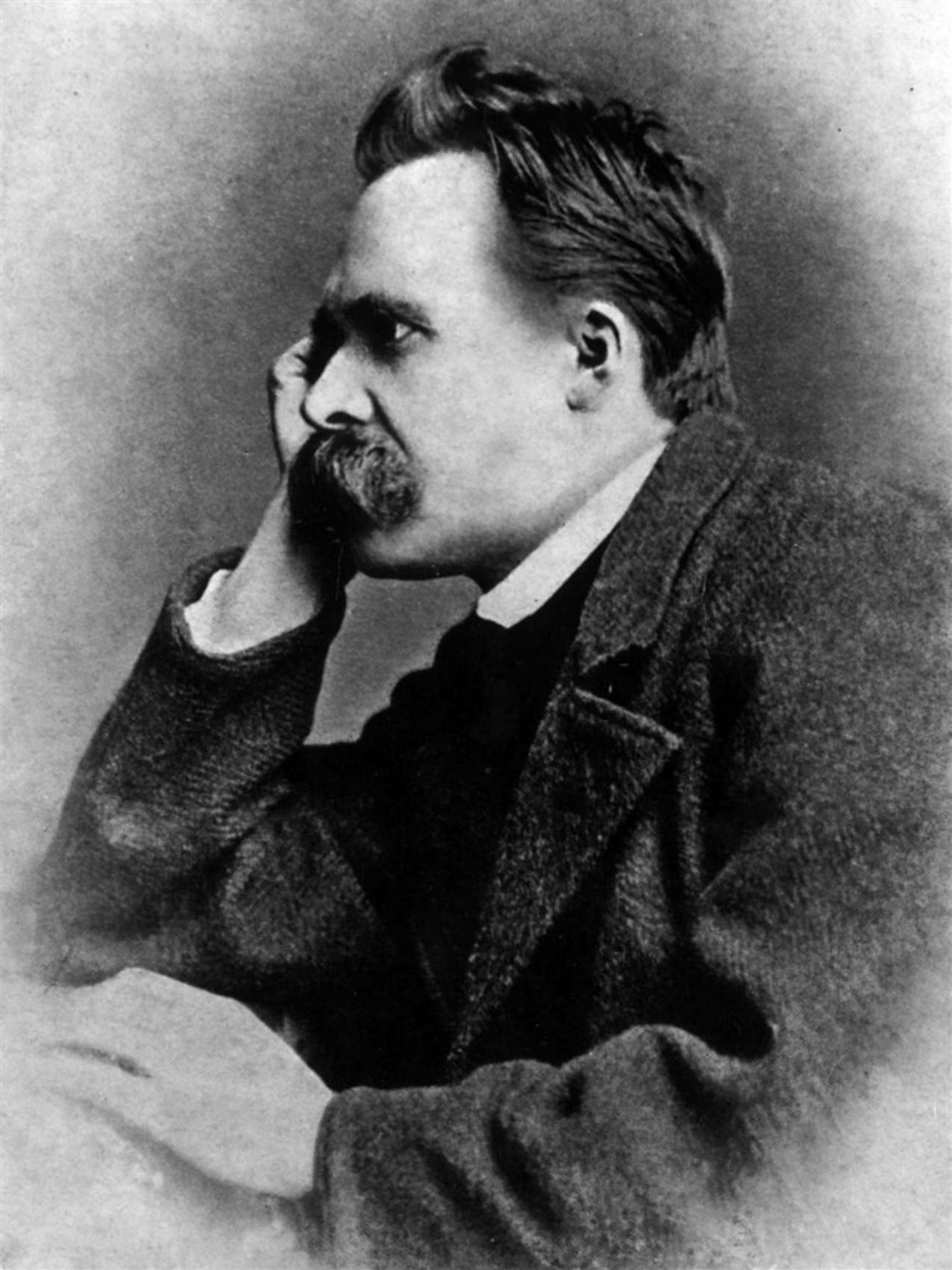
Nietzsche
1844 to 1900, German, a professor of classics at twenty-four, in poor health for most of his life, who collapsed into insanity at forty-four and never recovered.
He wrote in aphorisms and is quoted more and misread more than anybody in this Part.
God is dead
The line, and it is almost always taken backwards.
It is not a triumphant announcement of atheism. The passage in which it appears has a madman running into a marketplace with a lantern in daylight, crying out for God — and being laughed at by the people there, who do not believe.
And he tells them: we have killed him, and we do not understand what we have done. He asks who gave us the sponge to wipe away the horizon, whether we are not plunging continually, and whether it is not now colder.
Then he says: "I have come too early. This deed is still more distant from them than the most distant stars — and yet they have done it themselves."
The claim is diagnostic. The framework that grounded European morality no longer functions, most people have not noticed, and the consequences are coming. He predicted a century of enormous convulsions and he was right.
The problem, and his answer
If the ground of values is gone, either you invent new ones or you accept that there are none.
Nihilism is the second, and Nietzsche regards it as the danger rather than the conclusion.
His answer is the Übermensch — usually "overman" or "superman" — a person who creates values rather than receiving them. And it is deliberately underspecified; he does not give a description, and every attempt to make it concrete has been a distortion.
And the will to power. Not the desire to dominate other people, which is the standard misreading. A drive towards growth, mastery, the overcoming of resistance — including of oneself. The artist finishing a difficult work is exercising it.
Master and slave morality
His most inflammatory analysis, and it needs care.
He distinguishes two ways values arise.
Master morality: the strong define good as what they are — noble, powerful, capable — and bad as its lack.
Slave morality: those who are dominated cannot win, so they redefine. What the strong have becomes evil; what the weak have — humility, patience, meekness, restraint — becomes good.
And its engine is ressentiment, a resentment that cannot act and so becomes creative, producing a moral system in which the powerless are righteous.
Nietzsche's claim: European morality is slave morality that won, and it functions to make weakness admirable and strength shameful.
Three honest observations.
The analysis is genuinely penetrating as a description of a psychological mechanism. Everybody has met a person whose moral positions are precisely calibrated to condemn what they cannot have, and 8.9's envy is the same phenomenon.
It is not an argument that cruelty is good. Nietzsche despised brutality and antisemitism, broke with Wagner partly over it, and wrote against German nationalism explicitly.
And it was catastrophically misused. His sister, who was an antisemite and a Nazi sympathiser, controlled his papers after his collapse and edited them to serve that purpose. The association is largely her work, and the texts do not support it.
Eternal recurrence
And the test he proposes, which is the most useful thing he wrote.
Suppose a demon told you that you must live this life again and again, innumerable times, with nothing new in it — every pain, every joy, every thought, in the same sequence, eternally.
Would you throw yourself down and curse him, or would you say: you are a god, and never have I heard anything more divine?
It is not a metaphysical claim. It is a test. Amor fati — love of fate — is his term for passing it.
And it is a question you can actually ask about a specific week: would I take this again, unchanged, forever?
The existentialists
And the twentieth-century inheritors.
Sartre's formula: existence precedes essence.
A paper knife has an essence before it exists — somebody designed it for cutting. A human being does not. You exist first, and what you are is produced by what you do.
Therefore: you are condemned to be free. There is no human nature that determines you, no God who assigned you a purpose, and no excuse. You are entirely responsible for what you become.
And bad faith is his name for the evasion of this — pretending your role, your circumstances or your nature made you do it. His example is a waiter performing being-a-waiter with slightly too much precision, hiding from the fact that he chose it and could stop.
Simone de Beauvoir applied it and did the more durable work. "One is not born, but rather becomes, a woman" — the claim that a social category presented as a nature is a construction, which founded modern feminist theory (Volume VIII).
And Camus, who is the most useful of them.
The absurd is the collision between a human demand for meaning and a universe that does not supply one.
Three responses. Suicide, which he rejects. A leap to religious faith, which he calls philosophical suicide. And revolt — living fully in the confrontation, without appeal.
His image is Sisyphus, condemned to roll a boulder up a hill forever and watch it roll down. And his conclusion: the struggle itself is enough to fill a man's heart. One must imagine Sisyphus happy.
11.4 takes Sisyphus properly.
What to carry from this page
Anxiety is the dizziness of freedom. It has no object because its object is the possibility of your own choosing.
"God is dead" is a diagnosis and a warning, not a celebration, and the passage has a madman in it whom nobody understands.
Watch for values calibrated exactly to condemn what somebody cannot have. The mechanism is real, whatever you think of Nietzsche.
Would you take this week again, unchanged, forever? The best single question in this Part.
And existence precedes essence: nothing determines what you are except what you do. Which is either liberating or terrifying and is generally both.
Next: 10.11 — where the argument stands now, and the one that is still completely open.