Appearance
3.1 — The Biggest Book in the World
About 100,000 verses. Roughly ten times the Iliad and the Odyssey combined. Somewhere near 1.8 million words. It is the longest poem ever composed by human beings, and its length is not an accident of enthusiasm — it is the direct result of the thing it is trying to do.
What it is about
Stated in one sentence: a dispute over a kingdom between two branches of one family, which ends in a war that kills nearly everyone on both sides, including the winners' children.
Stated more accurately: it is a book about what dharma is, and it reaches the conclusion that nobody knows.
That second description sounds like a joke and it is the literal content. The word dharma — what a person should do, the right thing, duty, the order that holds a society together — appears constantly, and the epic's most repeated line about it is dharma is subtle. Every major character in the book follows a version of dharma faithfully and is destroyed by it. The most righteous man alive gambles away his family. A man who keeps a vow for sixty years ruins four generations by keeping it. A teacher's loyalty to a throne makes him fight his own students. The book is not confused. It is arguing that the rules do not resolve the hard cases, and it spends a hundred thousand verses proving it.
How it grew
Covered in 1.3 and worth restating because it explains the book's shape.
The text remembers three stages of itself. Jaya, "victory," at about 8,800 verses. Bharata, at about 24,000. Mahabharata, "the great Bharata," at about 100,000. A tenfold expansion over roughly eight centuries, from perhaps the fourth century BCE to the fourth century CE.
What got added is as informative as what was there first. The war narrative is old and tight. The vast ethical and political material — including Book 12, in which a dying Bhishma delivers many thousands of verses of instruction while lying on a bed of arrows — was inserted into gaps in the action. The Bhagavad Gita is very likely an insertion, and Part 5 is entirely about it. Whole sub-stories, fables and genealogies were attached.
The consequence for a reader: the book contradicts itself, and the contradictions are the most interesting parts. When one passage says a warrior must never strike a man who has laid down his weapon, and another passage shows Krishna arranging exactly that and defending it, you are not looking at a mistake. You are looking at two centuries arguing, and the epic kept both.
The frame, which nobody explains and which matters
The Mahabharata is told inside three nested frames, and knowing them changes how the whole thing reads.
A poet named Ugrashravas tells the story to sages in a forest. He heard it at a great snake sacrifice.
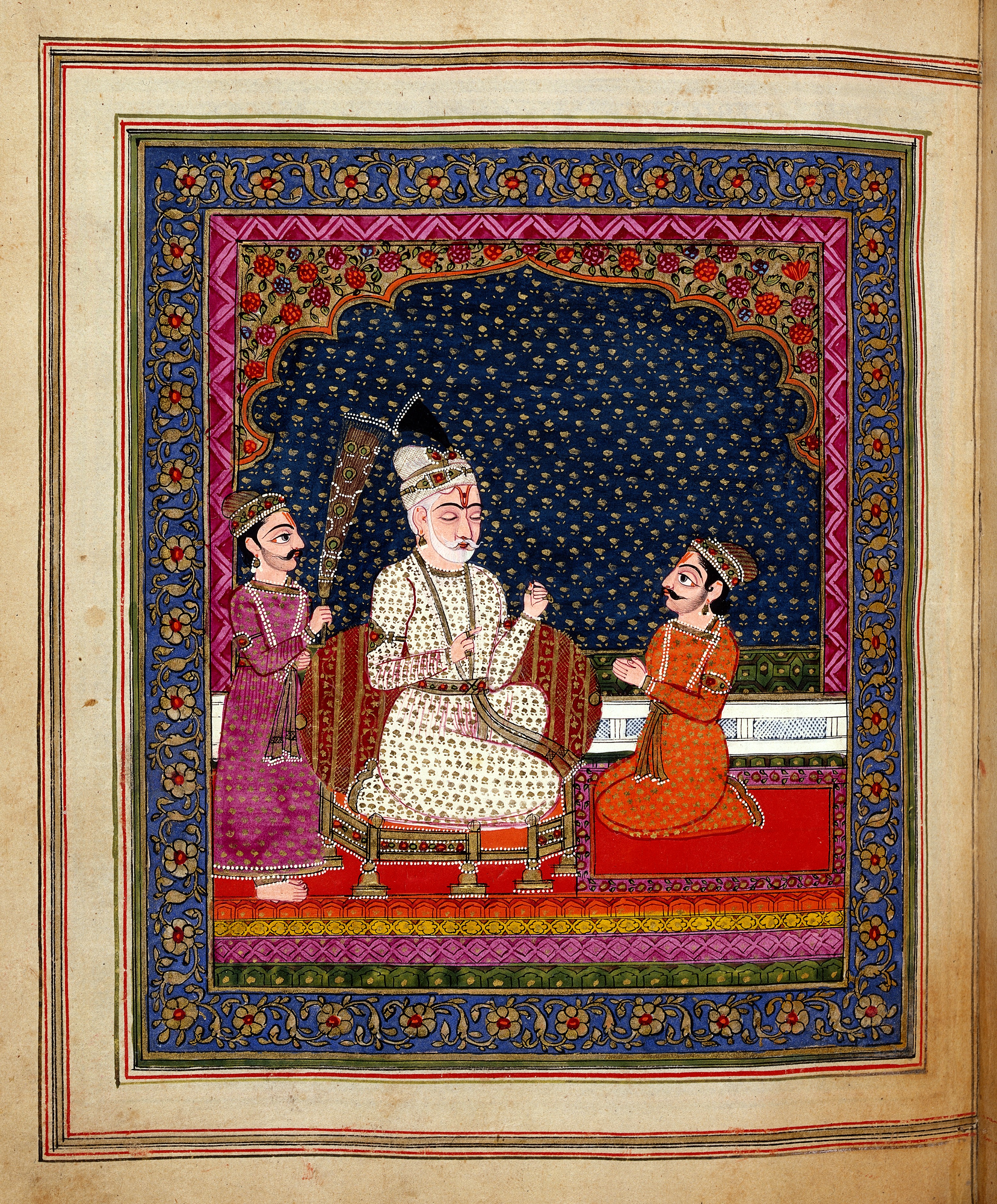
At that sacrifice, a sage named Vaishampayana told it to King Janamejaya — the great-grandson of Arjuna, one of the main characters. The story is being told to the family's own descendant, about how his ancestors destroyed themselves.
And Vaishampayana learned it from Vyasa, who composed it, and who is himself a character in the story — the biological grandfather of both sets of cousins (3.3).
So the author is in the book, and the audience is the family. That is not a literary flourish; it is a claim about what the book is for. It is presented as a warning delivered to the survivors of the thing it describes.
And there is one more frame, the darkest. Janamejaya is hearing this at a sacrifice he convened to exterminate all snakes, in revenge for his father's death by snakebite. He is committing a genocide while listening to a story about what revenge does to a family, and the story is being told to make him stop. It does. The epic's own frame tells you exactly what it thinks it is for.
Why it is worth twenty chapters
Three reasons, and they are the reasons this Part is the longest in the volume.
First, nobody in it is clean. Every single major character does something indefensible. The five brothers who are the heroes cheat, lie, kill dishonourably and gamble away their wife. A book in which the good side is good teaches you nothing you can use, because you are not on a good side; you are a person with mixed motives in a situation with no clean option, which is what everybody in this book is.
Second, it runs the consequences to the end. Most stories stop at the victory. The Mahabharata keeps going for several more books after the war is won, through the aftermath, the reign, the deaths, and the final walk into the mountains — and it shows that the victory produced almost nothing anybody wanted. Very few stories are willing to do that, and it is the entire reason the book is useful for making decisions.
And third, it names the mechanisms. Envy, humiliation, an unbounded promise, a father who cannot see what his son is, a group of good men who say nothing at the critical moment, a grievance nursed for forty years. The epic isolates each one, gives it a person, and runs it to its conclusion. Part 8 of this volume takes those mechanisms out and turns them into a working framework.
The cast, in the shape you need it
Do not try to hold the whole genealogy. Hold this.
The Kuru family rules from Hastinapura, a real settlement on the Ganga north of modern Delhi. Its throne descends through a line that will fail repeatedly to produce a clean heir, and every crisis in the book traces back to that.
Two sets of cousins. The Pandavas, five brothers, sons of Pandu: Yudhishthira, Bhima, Arjuna, Nakula and Sahadeva. The Kauravas, a hundred brothers, sons of Dhritarashtra, led by Duryodhana.
One wife between the five Pandavas: Draupadi, and 3.6 explains how that arrangement happened and what it does to the story.
The elders who fail. Bhishma, the grand-uncle, bound by a vow. Dhritarashtra, the blind king who cannot refuse his son. Drona, the teacher, bound by his salary. Vidura, the one wise man, whose birth means nobody has to listen to him.
And Karna, who is on the wrong side for a reason he does not know, and whose life is the moral centre of the book (3.5).
Krishna is the sixth major figure, and he gets his own Part.
The one thing to hold while reading
The epic supplies its own reading instruction, in the frame story, and it is this: the disaster is not caused by the war. By the time the war starts, everything has already gone wrong and nothing can be recovered.
It is caused by a long chain of ordinary decisions, made by decent people, over four generations, each one reasonable at the time, each one narrowing the options for everybody after.
So the question to carry through the next nineteen chapters is not who was right. It is: at which point could this still have been stopped, and what would it have cost the person who stopped it?
The answers are uncomfortable. In almost every case, someone could have prevented the entire catastrophe by accepting a moderate personal humiliation, and chose not to. That is the book.
Next: 3.2 — a king falls in love with a fisherman's daughter, and his son solves the problem by making the most extreme promise in Indian literature.