Appearance
10.5 — The Stoics
Founded in Athens around 300 BCE by Zeno of Citium, who taught in a painted colonnade — the stoa — which is where the name comes from.
And the three whose work survives in quantity are a slave, a playwright-politician, and an emperor.
Epictetus, born into slavery, lame, who taught after being freed and whose lectures were written down by a student.
Seneca, enormously wealthy, tutor and then adviser to Nero, who eventually ordered him to kill himself.
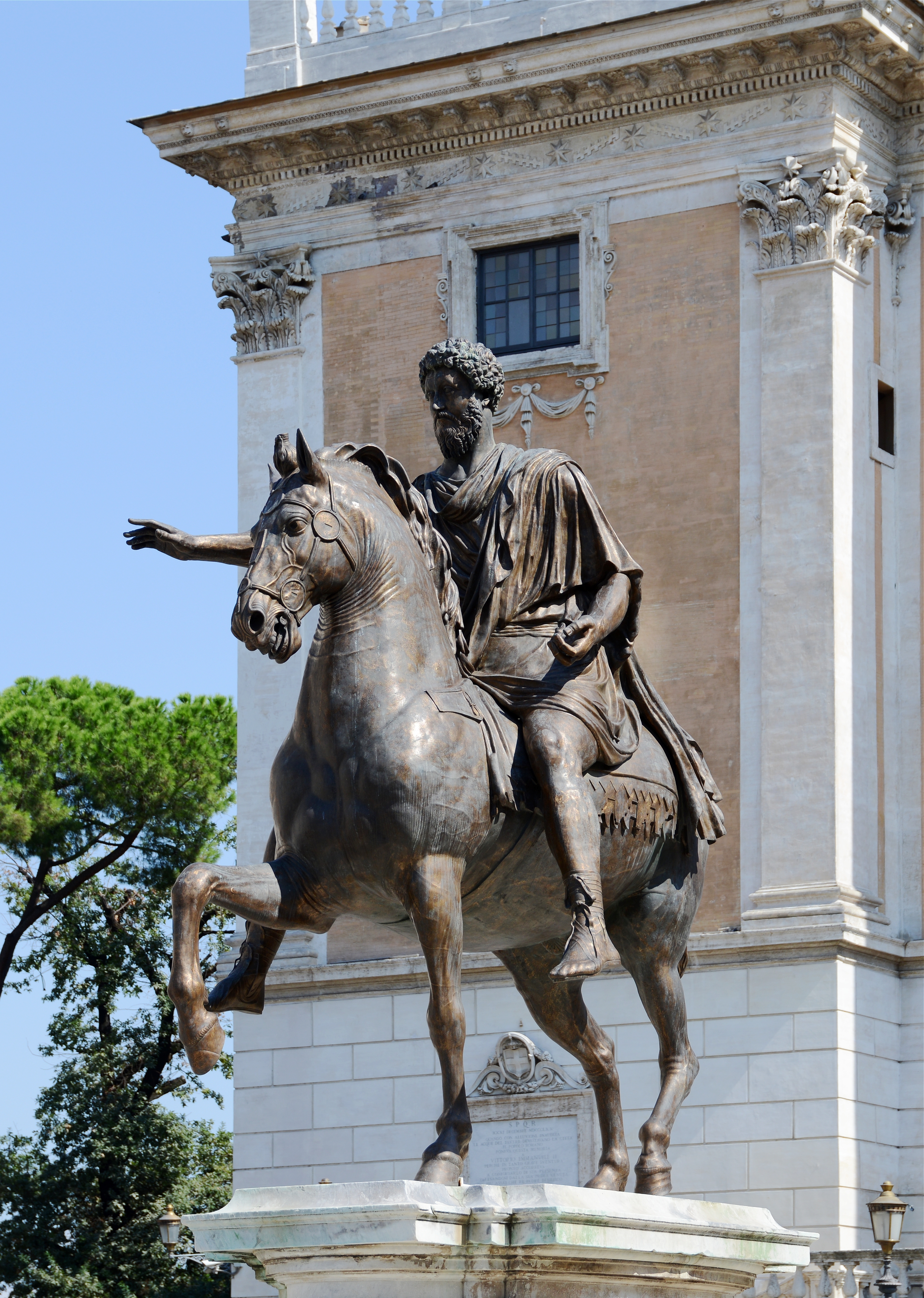
And Marcus Aurelius, emperor of Rome, whose Meditations is a private notebook never intended for publication.
A slave, a courtier and an emperor arriving at the same conclusions is the strongest single argument for the system.
The one idea
Everything in Stoicism follows from a single distinction, and Epictetus puts it in the first sentence of the Enchiridion.
Some things are up to us and some are not.
Up to us: our judgements, our intentions, our desires, our aversions — in short, our own responses.
Not up to us: our body, our reputation, our position, our property, other people, and everything that happens.
And the claim: all suffering that is not physical comes from treating things in the second category as though they were in the first.
Epictetus's own formulation, which is the most quoted line in the school: people are disturbed not by things, but by the views which they take of things.
And note that he was a lame former slave, so this is not a comfortable man's philosophy.
What it is not
Three corrections, because the word "stoic" in English has come to mean something different from and worse than the philosophy.
It is not emotional suppression. The Stoics distinguished sharply between the initial involuntary reaction — a jolt of fear, a flash of anger, tears at a death — which they said is natural and unavoidable, and the subsequent judgement that turns it into a settled passion. The first is not under your control and is not a failure.
It is not indifference to the world. All three of them were heavily engaged: Seneca ran an empire's finances, Marcus fought wars on the Danube for years, Epictetus taught for decades. The doctrine was explicitly that you engage fully and do not depend on the outcome — which is 5.3's karma yoga, arrived at independently, and the parallel is close enough to be startling.
And it is not passivity. You act with full commitment and you accept the result. The archer image is used in both traditions.
The techniques
And this is why Stoicism is the most immediately useful philosophy ever written: it consists largely of exercises.
The dichotomy, applied
In any situation, sort it. What here is my judgement and my action, and what is not?
And then act only on the first list. This is 5.3's practice and it is the same instruction.
Negative visualisation
Premeditatio malorum — the premeditation of evils.
Deliberately imagine losing what you have. Your position, your health, the people you love.
Two effects, and both are real.
It removes the shock. Seneca: the unexpected blow lands heaviest; what has been long anticipated falls more gently.
And it restores the value of what is present. The thing you have imagined losing becomes visible again, and Volume VI's gratitude research finds the same effect from the same mechanism.
Epictetus's harshest version: when you kiss your child goodnight, say to yourself that tomorrow they may die. This reads as monstrous and it is doing exactly what 3.10's greatest wonder describes — refusing the exception.
The view from above
Imagine looking down: your city, your country, the earth, the span of time.
Marcus does this constantly in the Meditations. He reminds himself that everybody he is annoyed with will be dead, that the emperors before him are gone and forgotten, and that fame is a noise made briefly by people who will also be gone.
Which sounds bleak and is used for a specific purpose: to right-size the thing currently consuming him.
The morning and evening review
Morning: rehearse the day and the difficulties in it. Marcus's most famous opening — say to yourself first thing in the morning: I shall meet with meddling, ungrateful, arrogant, deceitful and envious people. All this has come upon them through ignorance of good and evil.
And then the crucial second half, which is always cut: but I, who have seen the nature of the good, and of the bad, cannot be injured by any of them, nor can I be angry with my kinsman, for we are made for cooperation.
Evening: the audit. What did I do badly, what did I do well, what will I do differently — the same practice as 8.11 and from the same reasoning.
The last one
Memento mori. Remember that you will die.
Marcus: you could leave life right now; let that determine what you do and say and think.
And the Stoic use of it is not morbid. It is a prioritisation tool — a filter applied to the question of what is worth being upset about.
The metaphysics, and whether you need it
Classical Stoicism had a full physics and theology behind the ethics.
The universe is a single rational living whole, ordered by logos, and everything happens according to that order. Your own reason is a fragment of the universal reason. And virtue is living in accordance with nature, meaning in accordance with that rational order.
This is close to pantheism and it is why the Stoics could say that everything that happens is as it should be.
And the honest question: does the ethics survive without it?
Mostly yes. The dichotomy of control does not require the universe to be rational — it only requires that some things are outside your influence, which is obviously true. The techniques work on their own.
What is lost is the consolation. "This is part of a rational order" is a much stronger comfort than "this is outside my control." Modern Stoicism generally drops the metaphysics and keeps the exercises, and it should be honest that it is keeping the harder half without the softer one.
The problems
Two serious ones, and they should be stated.
The dichotomy can be used to accept what should be resisted. If your circumstances are outside your control, and virtue consists in your response, then an unjust system is something to be borne well rather than changed. Epictetus was a slave and his philosophy does not contain an argument against slavery.
The Stoic answer is that political action is within your control and is prescribed — Marcus and Seneca both governed, and Stoics were prominent in opposition to bad emperors, several of them fatally. The tension is real anyway, and 5.11 flagged the identical problem in the Gita.
And Seneca is a genuine embarrassment. He wrote about the unimportance of wealth while accumulating one of the largest fortunes in Rome. He advised Nero, and stayed while Nero killed his own mother. He wrote a justification of the murder.
This is either hypocrisy or the most instructive case in the school, and the honest reading is: he was a man of real insight in an impossible position who compromised repeatedly and knew it, and his letters are the writing of somebody arguing with himself. That is more useful than a clean example would be.
What to carry from this page
Sort every situation into what is your judgement and action, and what is not. Act on the first list only. Ten seconds, and it is the entire philosophy.
The initial jolt is not a failure. The judgement you add to it is where the work is.
Imagine losing what you have, deliberately, occasionally. It removes the shock and restores the value, and both effects are real.
And read the second half of Marcus's morning passage. The list of difficult people is quoted constantly; the conclusion — that we are made for cooperation and that he cannot be angry with them — is the point of it.
Next: 10.6 — the two schools that took the opposite route, one by pursuing pleasure carefully and one by refusing everything.