Appearance
2.3 — Sita, the Bow, and What a Marriage Meant
Vishwamitra takes the brothers to Mithila, the capital of Videha, a kingdom to the east. Its king is Janaka, and he is not a standard king.
Janaka is remembered across Indian literature as the philosopher-king: a ruler who held court on questions of the self, who hosted debates between the great thinkers of the age, and who is quoted in the Upanishads. The most famous debate in the Brihadaranyaka Upanishad happens at his court, and a woman named Gargi asks the hardest questions in it. That is the household Sita grew up in — a court where argument was the entertainment and where a woman asking a philosopher an unanswerable question in public was normal. Her later behaviour makes much more sense once you know this.
Sita
The oldest account of her origin is agricultural and strange. Janaka found her in a furrow while ploughing a field for a ritual. Her name means "furrow." She was not born to him; she was found in the earth and raised as a daughter.
This is either a foundling story told plainly, or a story about a girl of unknown parentage taken into a royal house, or a symbolic association with the earth. The epic keeps the association alive from beginning to end, and it pays it off in the last scene of the book, which is in 2.15.
What the text tells you about her before anything happens: she is educated, composed, and has a will of her own that shows up the moment it is tested. Every significant decision she makes in the epic, she makes against advice. She insists on the exile. She insists on the deer. She refuses Hanuman's offer of rescue. She ends the story on her own terms. Read her as passive and the book stops making sense.
The bow
Janaka has in his possession an enormous bow, said to have belonged to Shiva, kept on a wheeled cart because of its weight. He has made a public declaration: whoever can string it may marry his daughter. Kings have come and failed.
Rama lifts it, bends it to string it, and it breaks.
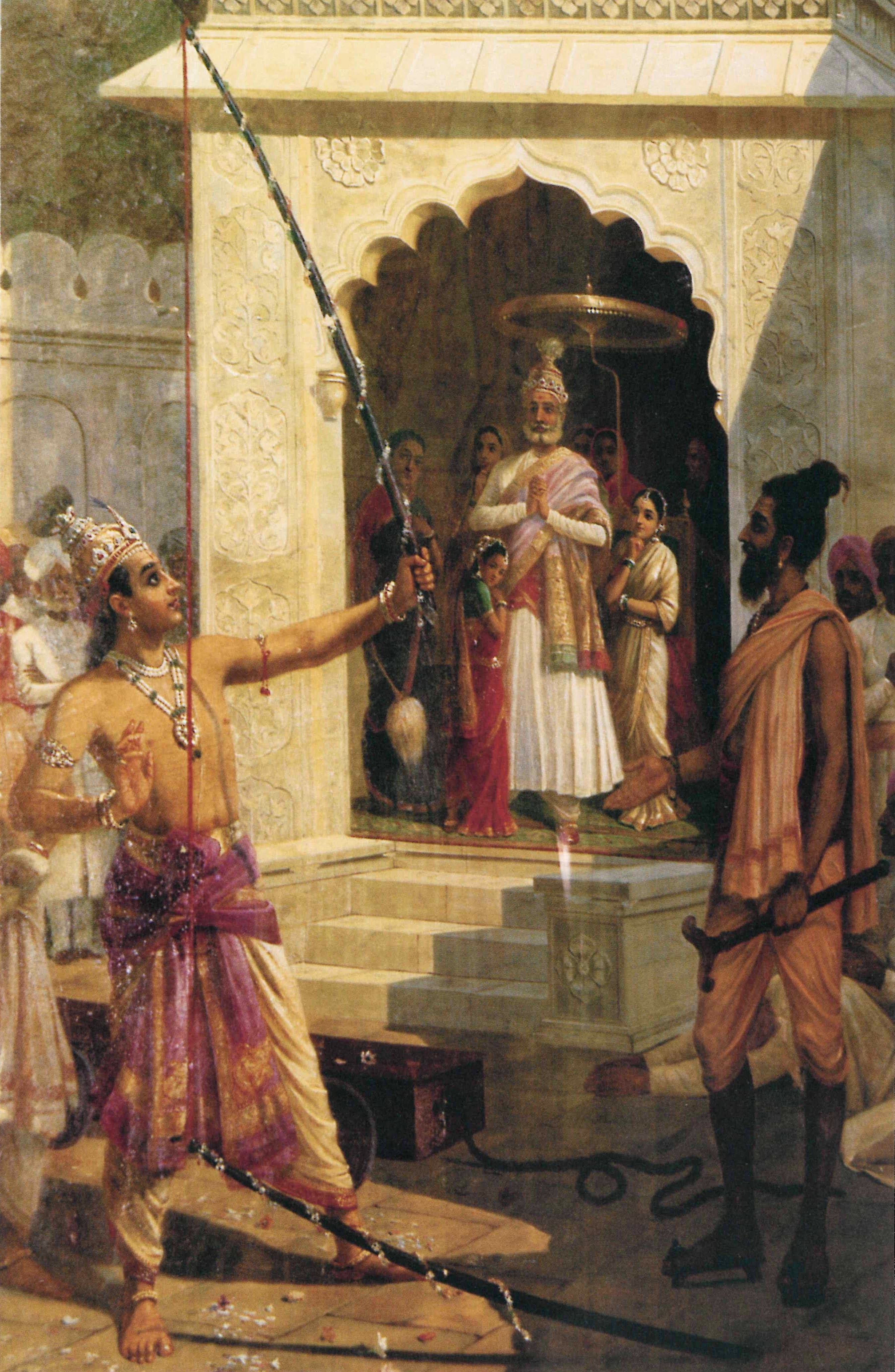
Grounded, this is a strength and skill test with a political function, and it is one of the oldest devices in human society. Reading the scene as the text presents it: the bow is heavy enough that most trained warriors cannot manage it; stringing a war bow requires technique as much as force, since you must bend a stave under great tension while holding it in a specific position; and the whole thing is conducted in front of an assembly.
The political function is the real content. Janaka is a ruler of a smaller kingdom who needs an alliance with a larger one, and who cannot simply choose without insulting everybody he does not choose. A public contest lets the strongest available party win in front of witnesses, so that the outcome cannot be disputed and no one has been slighted. The test is a procedure for making an unavoidable choice legitimate. This is what such contests are for in every society that has them.
What a marriage meant
The marriage is not two people choosing each other. That framing did not exist. It is a treaty between two states, sealed by a household.
The wedding is arranged between the two kings, with envoys and formal negotiation. All four brothers are married at once, into the same family — Rama to Sita, Lakshmana to Urmila, and Bharata and Shatrughna to Janaka's nieces. Four marriages in one ceremony is a political merger.
None of which means there was no love. The epic is quite clear that Rama and Sita loved each other, and it shows the relationship rather than asserting it. The point is that the affection grew inside an arrangement made for other reasons, which is how most marriages in most of human history have worked, and which is worth understanding without either romanticising it or sneering at it.
And there is a cost the epic quietly records. Urmila, married to Lakshmana, is left behind when he follows Rama into exile. Fourteen years. The main text says almost nothing about her, and later poets found the silence unbearable and wrote her a voice. She is the standing reminder that a story about four heroic men is also a story about the people who absorbed the cost of their heroism — and every household with a person in it who is admired for their sacrifices has an Urmila somewhere, usually unmentioned.
The teaching: choosing a person
The epic uses this section to make a claim about what actually binds two people, and it makes it by contrast rather than by statement.
The contest tests capability. The marriage tests something else entirely, and the epic separates them deliberately. Rama wins Sita by being the strongest man in the room. He keeps her — through fourteen years in a forest, through a year in captivity, through a war — by being someone whose word does not move. The strength gets him the wedding. The steadiness is what the marriage runs on.
And Sita's side of it gets the harder test first. Within days of the wedding, she is asked to give up a palace for a forest, and 2.5 shows what she does. The marriage is examined before it has had time to become comfortable.
The transferable point, stated plainly: the qualities that make somebody attractive at the start and the qualities that make a life with them work are almost entirely different qualities, and the first set is much easier to see. Strength, wit, status, beauty and confidence are visible in an hour. Whether a person keeps their word when keeping it costs them, whether they stay steady when things go badly, whether they treat people of no use to them well — those take much longer to see and they are the entire content of the next forty years. The bow is not the test. It just looks like the test.
Parashurama on the road home
One more scene, brief and important.
On the journey back to Ayodhya, the wedding party is intercepted by Parashurama, a fearsome Brahmin warrior who has spent his life destroying Kshatriya rulers in a long campaign of vengeance. He has heard that Shiva's bow was broken. He arrives furious, carrying a second bow, and challenges Rama to string it.

Rama does, without difficulty. And Parashurama, who has terrified an entire generation of kings, simply stops. He acknowledges that his time is finished, and he withdraws from the world.
Read symbolically — and the text invites this — the scene is a handover between two models of righteousness. Parashurama is righteousness as rage: correct in his grievance, endless in his retaliation, and unable to stop even after the original wrong is many times avenged. Rama is righteousness as restraint. The older model recognises the newer one and stands down, which is the rarest event in any human institution.
What it teaches, and this is worth sitting with: a person whose identity is built on a legitimate grievance almost never notices when the grievance has been settled. Parashurama's cause was real. His father was murdered. And twenty-one campaigns later he was still going, because the fighting had stopped being about the father a long time before. The hardest moment in any long fight is recognising that it is over and that you have become the thing you were fighting. He manages it. Most people do not, and 3.5 will show you Karna, who never does.
What to carry from this page
A public test is often a device for making a decision legitimate rather than for finding the best candidate. Recognise the mechanism and you will read hiring processes, competitions and family decisions much more accurately.
Separate what attracted you from what a life is made of. Make a list of both for someone you are close to. If the second list is short, that is information.
Look for the Urmila. In any story of admirable sacrifice, ask who paid the part of the cost that nobody mentions. Then say their name out loud, to them.
And ask, of any long-running fight you are in: has the original wrong already been settled, and am I still going?
Next: 2.4 — twelve years of ordinary happiness pass in three sentences, and then a single hunchbacked maidservant has a conversation that destroys a kingdom.