Appearance
7.6 — Parvati, and What the Second Courtship Teaches
She is born again as the daughter of the mountain — parvata is mountain, and Parvati means "of the mountain," daughter of Himavan, the Himalaya personified.
And Shiva is still sitting on Kailash, motionless, where 7.5 left him.
The problem
The gods need him. A demon named Taraka has a boon that only a son of Shiva can kill him, and Shiva has been in meditation for an age and shows no sign of stopping.
So they send Kama, the god of desire, to break his concentration — the same device 1.5 identified as the standard way of talking about an ascetic's own desire arriving at the worst possible moment.
Kama shoots his arrow.
Shiva opens his third eye and burns him to ash.
And this is why Kama is called Ananga, "the bodiless one" — desire without a form, which is a considerably more accurate description of desire than a man with a bow.
The attempt to manipulate him fails completely and violently.
What Parvati does instead
She goes to the mountain herself.
And her first approach is the conventional one: she comes with flowers and offerings, beautiful and dressed for it, and serves him while he sits.
He does not notice her.
So she does something else.
She leaves, and she takes up the practice herself.
She becomes an ascetic. The texts describe it in detail and it is severe: she stands in the sun in summer surrounded by fires, and in freezing water in winter. She gives up ornaments and comfort. She eats less and less, then only leaves, then — and this is where her other name comes from — nothing at all. Aparna means "she who does not even take a leaf."
Her family beg her to stop. She does not.
And she does this for years.
The test
Then a young brahmin comes to where she is practising and asks what she is doing.
She tells him.
And he begins to argue against Shiva. He lists everything wrong with him: he lives in a cremation ground, he owns nothing, he is covered in ash, his companions are ghouls, he has no family and no property, and there is no reason a woman of her house should want him. He goes on at length and the arguments are the same ones Daksha used (7.5).
And she becomes furious. She defends him, tells the brahmin to stop or leave, and turns away.
The brahmin is Shiva.
And he reveals himself and accepts her.
What the second courtship teaches
Four things, and they are the most practical things in Part 7.
Manipulation failed and the practice worked
The gods sent desire and it was burned to ash. Parvati went and did the work and it succeeded.
And the difference is not that one was a trick and the other was sincere. It is that Kama tried to change Shiva's state from outside, and Parvati changed her own.
She did not become more attractive to him. She became a person capable of being with him, which is a completely different project. He is an ascetic on a mountain; she went and became someone who could sit on a mountain.
The general form, and it is the useful one: you cannot make somebody want you. You can become somebody whose life is one they could actually share, and the second is under your control and the first is not.
She met him where he was
She did not ask him to come down.
She did not try to make him more domestic, more social, more presentable, or more like her father's world. She went up.
And it is worth noticing what the alternative would have been. Sati's story is a woman caught between a husband her family found unacceptable and a family her husband would not conform to, and it ended in a fire. Parvati's is a woman who stopped trying to reconcile the two worlds and went to one of them.
The test was about defence, not about devotion
The brahmin does not test whether she loves him. He tests whether she will defend him when a plausible, articulate person lists his real flaws.
And note that the flaws are real. Every criticism the disguised brahmin makes is true. He does live in a cremation ground. He does own nothing. The test is not whether she believes he is perfect; it is whether the accurate list of his faults changes anything.
That is the correct test and it is the one most relationships eventually run, usually without anybody arranging it. Somebody will list your partner's genuine faults to you, plausibly, and what you do in that conversation is the actual state of the relationship.
And she was angry
Her response is not a serene defence. She is furious and tells him to get out.
The tradition does not treat this as a failure of composure. The anger is the evidence.
The marriage
And what follows is the most unusual portrait of a marriage in Indian religious literature.
They argue. The Puranas are full of it. She criticises him for his appearance, his habits and his companions. He teases her about her colouring, and in one famous episode the teasing goes far enough that she leaves, performs austerities, and returns transformed — the origin of her form as Gauri, the fair one. The tradition preserves an argument about a remark that went too far.
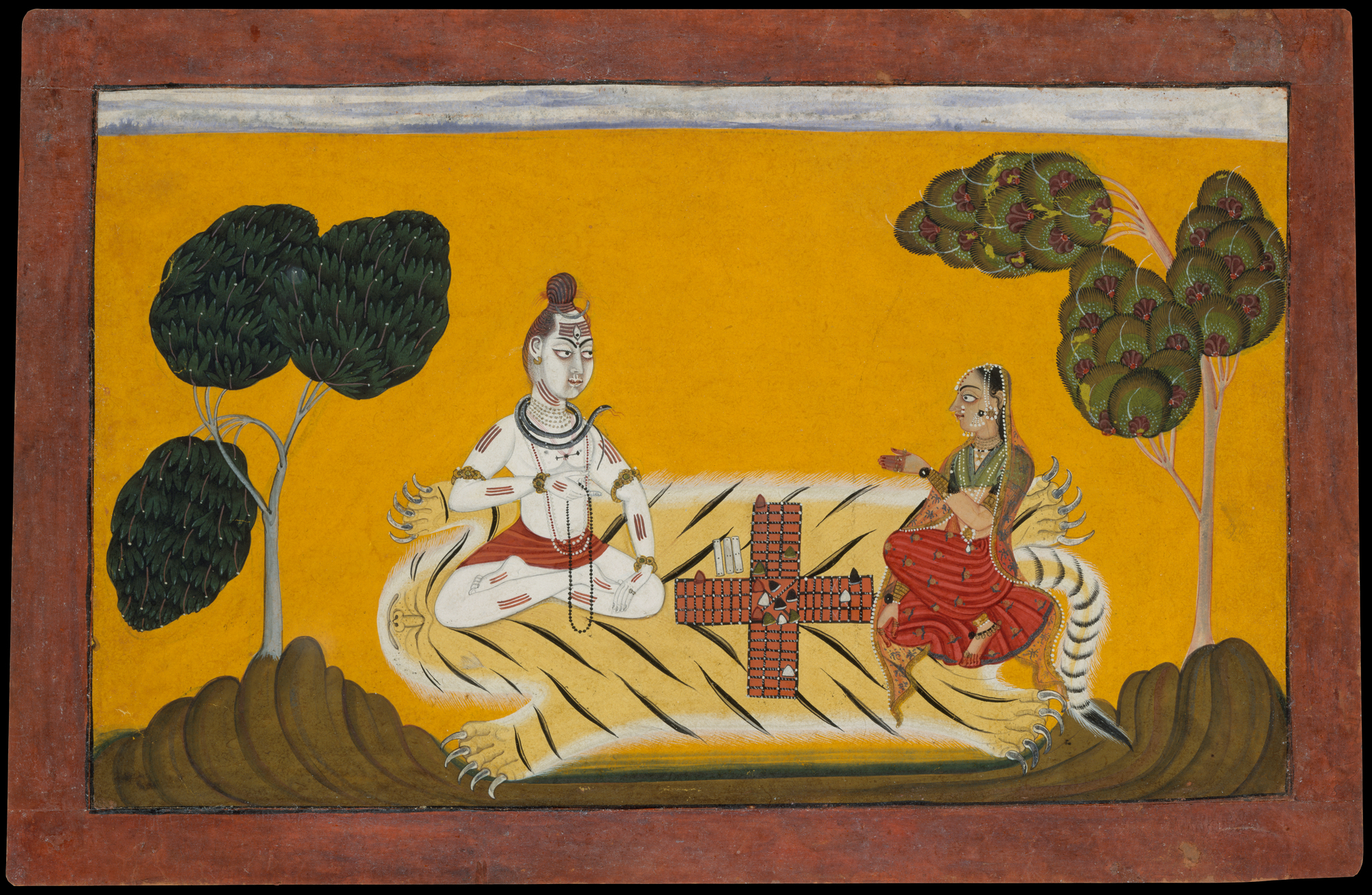
They play dice, and the texts say she cheats, and he loses.
She interrupts his teaching with questions. A very large body of tantric literature is framed as a dialogue in which Parvati asks and Shiva answers, which makes her the reason the teaching exists in transmissible form at all.
And in the Ardhanarishvara form (7.1), they are literally one body divided down the middle.
Why the arguments are the point
Most religious traditions present their divine couples as harmonious. This one presents a marriage with friction in it and treats the friction as normal.
And the model it produces is a good one.
Two people who are genuinely different and stay different. She does not become an ascetic permanently and he does not become a householder in her father's sense. The Ardhanarishvara form is not a merger where both halves became the same; it is one body with two visibly distinct sides.
Conflict that does not threaten the structure. They argue, one of them leaves, they reconcile. Nobody is destroyed by a quarrel.
And equality of standing. She is not an attribute of him. In the Shakta traditions she is the primary reality and he is the inert principle without her — a complete reversal, held by millions of people, inside the same tradition.
Volume VI's relationship chapters reach the same conclusions from research: what predicts survival is not the absence of conflict but how conflict is conducted, and whether both people remain themselves. The Puranas got there by telling stories about a couple who bicker.
What to carry from this page
You cannot make someone want you. You can become a person whose life theirs could actually join. The first is manipulation and it gets burned to ash; the second is Parvati's austerity.
Go up rather than asking them to come down, or accept that you are asking for a different person.
The test is not whether you think they are perfect. It is what you do when somebody accurate lists their faults.
And a marriage with arguments in it is not a failing marriage. The tradition's supreme couple play dice, and she cheats, and they quarrel about his appearance, and it lasts forever.
Next: 7.7 — the dance, the linga and the Nataraja bronze, and what the symbols actually encode, including the one that everybody gets wrong.