Appearance
2.14 — The War: Kumbhakarna, Vibhishana, and the Fall of a Great Man
The army crosses and camps outside Lanka. Rama sends one more embassy offering terms: return her, and there is no war. He offers this three times across the campaign, which is worth noting, because the popular image of the war is a righteous destruction and the text is at pains to show it was avoidable at several points.
Ravana refuses each time.
Ravana, taken seriously
Before the battle, the man, because reading him as a demon king wastes the most instructive character in the epic.
He is a scholar. The tradition credits him with works on medicine and music, and with a famous hymn to Shiva that is still sung, the Shiva Tandava Stotram. He is described as a master of the Vedas and of statecraft.
He is a great ruler. Lanka under him is wealthy, well governed, well defended, and — the text says this repeatedly — the envy of the world. His people are prosperous. His court functions. He has held power for a very long time against real opposition.
He is a devotee. His worship of Shiva is genuine and lifelong, and the tradition never denies it.
And he is spectacularly disciplined in one specific respect that most retellings drop. He holds Sita for over a year and he does not touch her. He threatens, he pressures, he sets deadlines, he has her guarded by women instructed to break her — and he does not force her, because he is bound by a curse or, in the plainer reading, by his own code, which holds that a woman must come willingly. The most powerful man in the story exercises real restraint in the one area where nobody could have stopped him.
So: an intelligent, capable, disciplined, learned, successful ruler. Not a monster. Which makes his destruction useful, because monsters teach nothing and this man is recognisable.

What the ten heads mean
The most common reading in the tradition, and the most useful one, is that the ten heads are not anatomy. They are ten kinds of knowledge — the four Vedas and the six branches of learning attached to them — carried by one man. Another reading makes them the six inner enemies of 8.5 plus the four aims of life.
Both readings say the same thing: he is a man of enormous capacity, and the capacity is the problem. He can argue his way past any objection, including his own. A person with ten heads has a counter-argument for everything, which sounds like a strength and is the specific mechanism by which he ignores every warning he receives.
The people who told him
Four people tell Ravana, clearly and early, that this will destroy him. This is the part of the Ramayana that should be read by anybody who has ever run anything.
Maricha (2.9) told him, from direct experience of Rama, that it would end Lanka. He was threatened into compliance and died in the act.
Vibhishana, his brother, argued in open council on both moral and practical grounds: the act was wrong, and the war was unwinnable. He was kicked out of the court, and he defected (2.13).
Mandodari, his queen, told him repeatedly and privately. She is one of the sharpest figures in the epic and she is largely ignored by the retellings. Her lament over his body at the end is a precise account of exactly how he destroyed himself, delivered by the person who had watched it happen and said so at the time.
And Kumbhakarna, his brother, whose scene is the one that matters most.
Kumbhakarna
The popular image is a comic giant who sleeps for six months. The actual scene is one of the most painful in Indian literature.
He is woken when the war is going badly. He is enormously strong and Ravana needs him.
And when he understands what has happened, he tells his brother the truth without softening it. He says the abduction was wrong. He says Ravana should have consulted his council before acting, not after. He says the correct course now is to return Sita and make peace. He says Lanka will fall. He tells him, in front of the court, that he has behaved like a fool and destroyed his own kingdom.
Ravana is furious. And Kumbhakarna says — this is the line — that he has said what needed to be said, and now he will go and fight, because Ravana is his brother and the enemy is at the gate.
He goes out and dies.
The hardest question in Part 2
Was he right?
The case that he was: he did the two things a good subordinate should do, in the correct order. He gave the honest advice at full strength, publicly, at real personal risk. And when overruled by legitimate authority in an existential crisis, he did not sulk, defect or sabotage. Loyalty that only holds when you agree is not loyalty. The alternative — everyone abandoning a bad leader at the moment of maximum danger — destroys a state faster than any bad decision.
The case that he was wrong, and it is strong: he knew the war was unjust. He said so. And then he added his considerable strength to an unjust cause, which made it last longer and killed more people on both sides. Vibhishana faced exactly the same choice, made the opposite decision, and Lanka got a competent king out of it. "I objected and then I helped anyway" is not a defence — it is exactly Maricha's position, and Maricha is not admired.
Where this book lands, stated as a judgement rather than a fact: Kumbhakarna's mistake was treating the question as one of loyalty when it was a question of harm. The line is not "do I agree" — it is "will people who did nothing wrong die because of my help." In an ordinary disagreement, back your side and argue afterwards. When your side is doing something you have already told them is a crime, help is participation, and no amount of personal loyalty converts it into something else.
Both brothers are honourable and only one of them is right. The epic gives Kumbhakarna the more moving death and Vibhishana the throne, and it lets you feel the pull of both. That is the whole reason the scene is worth reading.
The war itself
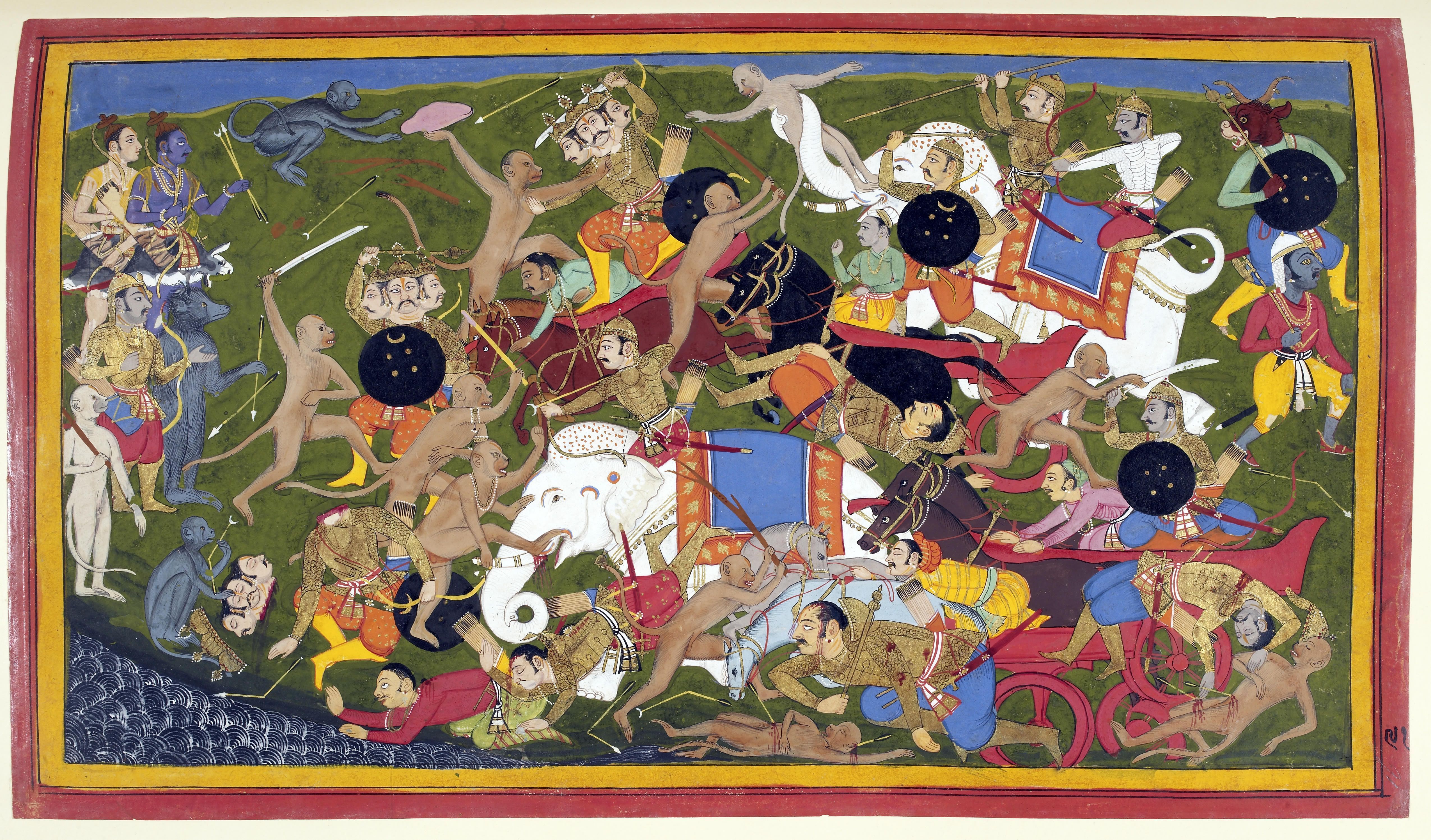
The fighting runs many days and the text is detailed about it. The parts worth keeping:
Indrajit, Ravana's son and the most dangerous individual on the field, fights from concealment using a technique the text describes as fighting while invisible — grounded, almost certainly fighting from cover at night, or from the air. He nearly ends the war twice. He is killed by Lakshmana in the one part of the campaign that is a genuine military operation rather than a duel.
Lakshmana falls, struck down and dying, and Hanuman is sent for a specific medicinal herb from a mountain in the Himalaya. Unable to identify the plant, he brings the entire mountain. The grounded reading is a very long journey for medicine and a physician who knew what to use — and the story kept the version where he brings the whole mountain because it is a perfect image of a certain kind of person: unable to do the precise thing, and refusing to let that stop him.
Vibhishana's intelligence decides everything. He identifies each commander as they come out, tells Rama how each fights, and supplies the weakness. The war is won by an insider who changed sides, which is a fact the triumphal retellings tend to underplay.
The end of Ravana
The final duel goes badly for Rama, because Ravana is genuinely the better-equipped fighter and the text does not pretend otherwise. Heads that are cut off grow back — grounded, an opponent who cannot be finished by ordinary wounds, or simply a way of saying that every attack failed.
Vibhishana supplies the answer: Ravana's life is not in his heads. It is in a vessel of nectar held in his navel. Rama strikes there, and Ravana dies.
Read plainly, this is a brother telling an enemy where his own family's weakness is, and it is the darkest thing anybody does in the epic, including Ravana. The text does not comment.
And what Rama does next is the chapter's last teaching. He orders that Ravana be given full funeral honours as a king. When Vibhishana hesitates — this man exiled him, kicked him, and destroyed everything — Rama says the line that closes the war: enmity ends at death. He tells Vibhishana that Ravana was his brother and is therefore also, in that moment, Rama's own kin, and that he will perform the rites himself if Vibhishana will not.
Mandodari's lament over the body is the epic's own summary of the whole affair, and it is devastating precisely because she is not a poet making a point. She is a wife saying I told you, itemising it: you had everything, you were warned by your brother, by your ministers, by me, and you preferred one woman who did not want you to all of it.
Why Ravana fell
The epic's answer is exact and it is not "he was evil."
He had one appetite he never accepted any limit on, and around that single unbounded appetite he built a machine of justification with ten heads. Every warning met an argument. Every adviser met a counter-argument. His intelligence was not a check on his desire; it was in service to it, which is what makes a very clever person more dangerous to themselves than a stupid one.
And the tell was visible for years before the crash: nobody could tell him anything. Maricha, Vibhishana, Mandodari, Kumbhakarna — four separate people, from four different positions, telling him the same thing, and every one of them was overruled, threatened or thrown out. By the time the war started, the only people left near him were people who agreed.
That is the whole mechanism, and it is the most transferable thing in Part 2. You cannot measure your own judgement from the inside. You can measure how often you are contradicted, and by whom, and what happened to them afterwards. If nobody has told you that you are wrong in the last six months, the problem is not that you have been right.
What to carry from this page
Count the people who have told you no this year, and what happened to them. That number is the only reliable instrument you have for the health of your own judgement.
When your side is doing something you have already called a crime, your help is participation. Loyalty is not a solvent for that. Object, and then decide — but do not pretend the objection settles it.
Give the dead enemy full honours. Not for them. A person who cannot stop fighting an opponent who is already beaten is announcing that the fight was never about the cause.
And be suspicious of your own fluency. If you can produce a counter-argument to every warning you receive, you have ten heads, and that is not the strength you think it is.
Next: 2.15 — Sita is recovered, and what Rama says to her in the moment of victory begins the part of the epic that nobody has ever managed to defend.