Appearance
2.13 — The Bridge: How the Causeway Was Built, and What Adam's Bridge Really Is
The army reaches the southern shore. Across the water is Lanka. There are no boats, and there is no time to build a fleet capable of carrying an army.
This is the chapter where the grounding method of 1.1 does its most visible work, so let us do it properly: first what the text says, then what is physically there, then what it means.
What Valmiki actually says
Not floating stones. The oldest text describes a construction project, in the language of a construction project.
A named engineer. Nala, described as the son of the divine architect Vishvakarma, and — this is the important part — given the command because it is his profession. The text says he has inherited the craft. He is not a warrior who improvises; he is a specialist put in charge of specialists.
A workforce and a division of labour. The text describes parties assigned to different tasks: some felling trees, some hauling, some carrying rocks, some working at the water's edge. Thousands of workers, organised.
Surveying. Ropes and measuring lines are used to keep the causeway straight — the text mentions this explicitly, and it is the single most convincing detail in the passage, because nobody inventing a miracle adds a line about surveying instruments.
Materials. Trees of named species, boulders, rocks, and earth. Big material first, fill on top.
And a daily progress record. The causeway advances by fourteen yojanas on the first day, twenty on the second, twenty-one on the third, twenty-two on the fourth, twenty-three on the fifth. That is a foreman's log. The numbers even have the right shape — a slow first day while the work is organised, then a steady rate as the crews find their rhythm.
The whole passage reads like a site report. The floating-stone version appears more than a thousand years later in devotional retellings, and 1.4 explains exactly why it appeared.
What is physically there
Between Rameswaram in India and Mannar in Sri Lanka lies a chain of shoals, sandbanks and small islands running about 48 kilometres across the Palk Strait. It is called Adam's Bridge or Rama Setu, and it is clearly visible from orbit.
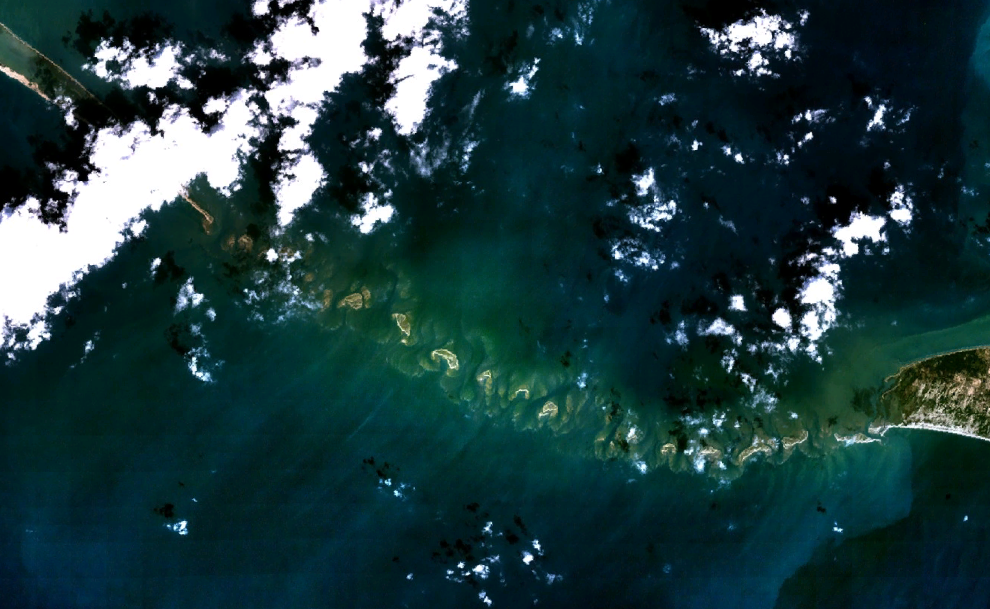
The facts about it, stated carefully.
The water is very shallow. Over most of the chain the depth runs from about one to ten metres, and there are sandbanks that dry out. This is the reason no shipping route passes through the Palk Strait — vessels going between India's east and west coasts sail all the way around Sri Lanka.
It was walkable in historical memory. Records indicate the chain was passable on foot until it was breached by storms, with a cyclone in the fifteenth century usually named as the event that deepened the channels. Temple records at Rameswaram preserve the tradition of a walkable connection.
It is a natural formation. The geological consensus is that it is a chain of sandbanks, shoals and coral formations built up by longshore drift and sea-level change over thousands of years, sitting on a shallow ridge between the two land masses. There is no accepted geological evidence that it was constructed, and claims to the contrary have not survived examination.
Its age is debated but old. Studies of the sediments and the coral give ages in the thousands of years, and the discussion of exactly how old is unsettled.
Putting the two together
Here is the reading this book takes, and it is stated as a reading rather than as a fact.
There is a real, shallow, partly-dry chain of shoals between India and Sri Lanka, walkable in places, with gaps where the water is deeper and the current runs. An army wanting to cross it does not need a bridge across 48 kilometres of sea. It needs a causeway across the gaps, and it needs the whole route made firm enough to carry thousands of people and their supplies without turning to mud under the traffic.
That is a completely achievable five-day engineering project for a large organised workforce, and it matches the text's description exactly: fell trees, drag boulders, fill the gaps, lay a surface, keep it straight with measuring lines, and record progress each day.
It also explains the miracle. A stone dropped into a metre of water on a sandbank does not disappear; it sits there, visible, with water washing over it. To an observer, and to the retelling of an observer, the stones stayed on the surface. Add a thousand years and the retelling has an explanation for why.
And the honest caveat, stated plainly: none of this is proof that Rama existed or that a campaign crossed the strait. What it establishes is that the story as told in the oldest text is physically coherent — the route is real, the depth is right, the technique is standard, and the timescale is plausible. That is all it establishes, and it is enough.
The teaching: how impossible things get done
The bridge is the epic's set piece about collective work, and there are four things in it worth extracting.
The first is the specialist. The army is full of extraordinary individuals — Hanuman can cross the water alone, and several others can too. None of that is any use. The problem is not crossing; it is moving a hundred thousand people and their supplies. So command goes to Nala, who is not a warrior and would lose a fight to anyone in the army, because he is the only one who knows how. The epic hands authority to competence rather than status, and it does it without any fuss at all.
The second is that the impossible thing is made of ordinary things. Trees. Rocks. Rope. Thousands of pairs of hands. There is no new technology in the bridge. What is new is the organisation — the division of the workforce, the sequencing, the measurement, the daily target. That is the actual content of most things that look impossible from outside, and it is worth internalising, because the instinct when facing something enormous is to look for a clever trick, and the answer is almost always an unglamorous system applied by a lot of people for a specific length of time.
The third is that the progress is measured daily. Fourteen, twenty, twenty-one, twenty-two, twenty-three. The army can see the number go up. A five-day project with a visible daily figure is a completely different psychological object from a five-day project with no measurement, and everybody who has run one knows it.
And the fourth is the one Rama gets right and nobody notices. He does not build it himself, supervise it, or interfere. He gives it to Nala and stays out of the way. The most competent leader in the epic makes exactly one decision here — who is in charge — and then does not touch it again.
Vibhishana arrives
Before the crossing, one more thing happens, and it is the single most consequential event of the war.
Vibhishana, Ravana's younger brother, defects. He has argued in open council that Sita should be returned, that the war is unjust, and that Lanka will be destroyed. Ravana has kicked him — the text says physically — out of the council. He crosses with four companions and asks for asylum.
The army is against accepting him, and their reasons are good: he is the enemy king's brother, he arrives at the decisive moment, and this is exactly what a planted agent looks like. Sugriva argues for killing him.
Hanuman argues for accepting him, on evidence: he watched Vibhishana argue against his own king in that court, at real risk, when nobody was watching for Rama's benefit. He has seen the man's behaviour when it cost him something.
Rama accepts him, and goes further — he declares him king of Lanka in advance, before a single battle.
Vibhishana then supplies the entire operational intelligence for the war. The layout of the city, the disposition of the forces, the identity and capability of each commander, and — decisively, in 2.14 — the one piece of knowledge that ends Ravana.
The teaching about defectors: the way to evaluate one is not their story and not their motive, which you cannot verify. It is whether they took a costly position before they needed you. Vibhishana argued for Sita's return in Ravana's own court, in front of the court, before he had anywhere to go. A person who paid for a principle when there was no audience and no benefit is telling you something real about themselves. Everything else is words.
What to carry from this page
Give command to competence and then leave it alone. Rama's contribution to the bridge is choosing Nala.
The impossible thing is usually an ordinary technique plus an organisation plus a deadline. Look for the boring system before you look for the trick.
Measure daily and let everyone see the number. Fourteen, twenty, twenty-one.
And judge people by the costly thing they did before they needed you — not by what they say now, when they need you.
Next: 2.14 — the war, and the two men on the losing side who told the king exactly what would happen and then died for him anyway.