Appearance
2.10 — Jatayu, Kabandha, Shabari: Dignity and the Overlooked
Three encounters on the road south. None of them advances the plot much. All three are about the same thing, and the epic keeps them because that thing is the point.
Jatayu
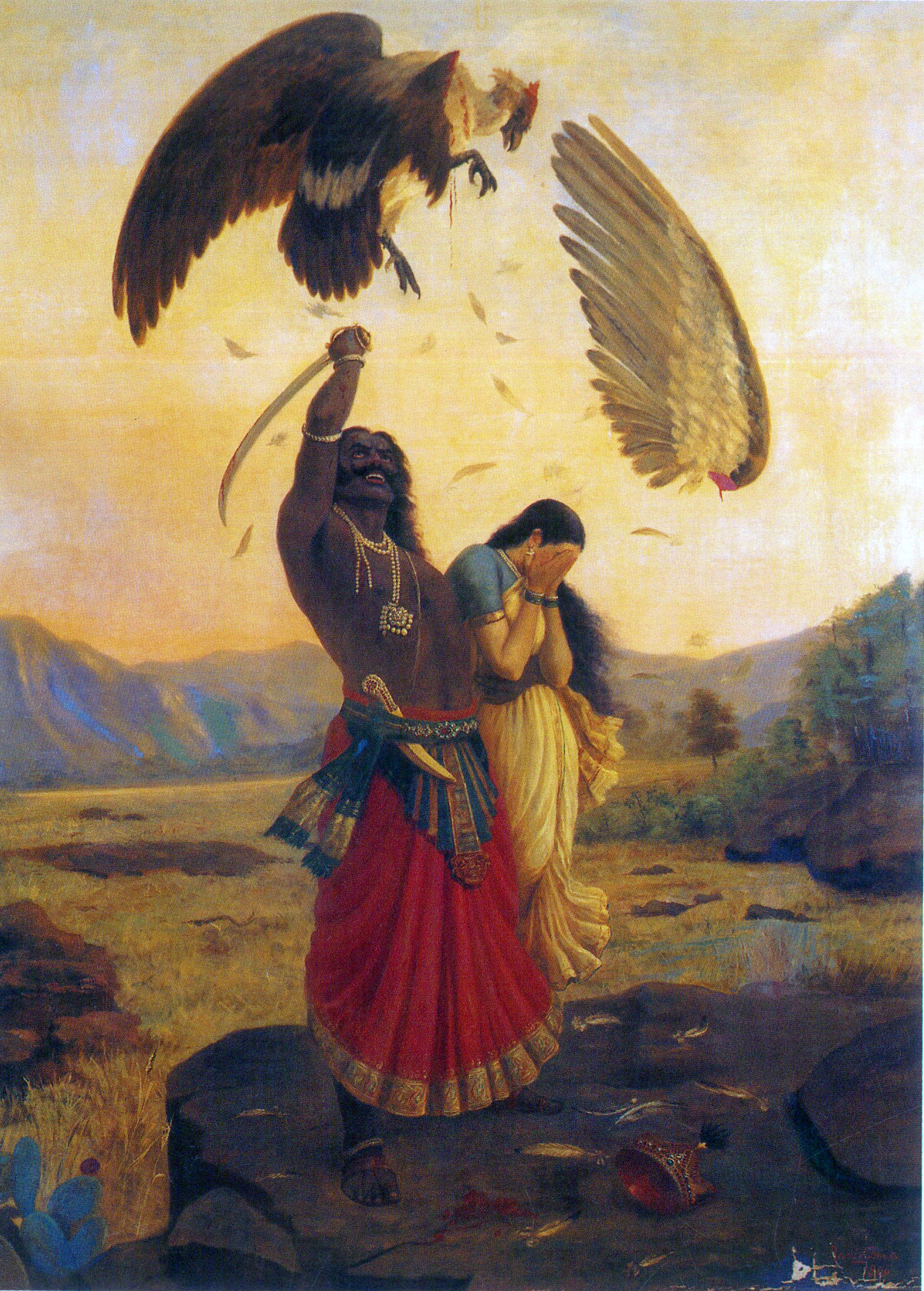
As Ravana carries Sita south, an old vulture sees them and intervenes.
Jatayu is elderly. The text is emphatic about it — he is past his strength, he was a friend of Dasharatha in a previous generation, he is described as ancient. He is a bird, or in the reading of 1.5, quite possibly a chief of a people whose emblem is a bird, living alone at the end of his life.
And he attacks Ravana. Ravana is the most powerful ruler in the region, with an army, and Jatayu is one old creature with no chance whatsoever.
He does real damage. The text says he breaks Ravana's bow, tears the chariot apart, and forces him down. Then Ravana cuts off his wings and he falls.
He stays alive long enough for Rama and Lakshmana, searching south, to find him. He tells them who took Sita and which direction they went. Then he dies, and Rama performs his funeral rites himself — the rites a son performs for a father.
What this is for
Jatayu is the epic's clearest statement about a specific question: what do you do when you cannot win?
He is old. He is alone. He knows what Ravana is. A completely reasonable calculation would have told him to stay in his tree, and he would have been right. Nothing was owed. He was under no obligation. Nobody would have known.
He goes anyway, and here is the part that matters: his intervention is what makes the rest of the story possible. He fails to save Sita. He does not fail at anything else. He fights long enough to be a witness, and the direction he supplies is the only reason the search goes south rather than in three useless directions for years.
The hopeless act was not useless. It was decisive, in a way he could not have known and did not need to know.
This is the general form and it is worth holding onto. You will regularly be in situations where you cannot fix something — a decision already made, a person already leaving, a harm already in progress. The calculation that says "I cannot stop this, so there is no point" is almost always wrong, and it is wrong for a reason you can state: you are computing the odds of the outcome you had in mind, not the odds of any useful outcome. Objecting on record. Being a witness. Slowing something down. Making someone do it in the open rather than quietly. Jatayu's whole contribution was that Ravana had to be seen doing it by somebody who lived long enough to say so.
And Rama's response is the second half of the teaching. He performs the funeral of a son for a bird. The highest honour available in that world, given by a prince to an old creature of no status who lost. The epic is making a point about what deserves respect, and it is not success.
Kabandha
Further south they meet Kabandha, described as a headless creature with a mouth in its stomach and two enormous arms, which seizes both brothers at once. They cut off its arms and it dies. As it dies it tells them its history — it was cursed into this shape — and asks to be cremated. They do it, and it tells them what they need: go to Sugriva at Kishkindha, make an alliance, and use his people to search.
The grounded reading is straightforward. A hostile figure of frightening appearance, in a region where the travellers know nobody, is defeated and then — in the moment of dying, or of being treated decently at the end — provides the single most valuable piece of intelligence in the story: there is a political faction to the south that needs allies as much as you do.
The teaching is narrow and practical: an enemy is very often the best-informed person about your situation. Kabandha is the only figure in the forest who knows the regional politics well enough to say where the leverage is. Rama gets that information because he grants a dying enemy's request. He does not have to. There is no advantage in it at the moment he does it.
A person you have defeated, treated decently, is one of the most useful sources you will ever have — and the reason is not that decency is rewarded by the universe. It is that they know exactly what you look like from the other side, and they will only tell you if you have given them a reason to.
Shabari
The third encounter is the one people remember, and it is the smallest.
Shabari is an old woman living alone at a hermitage. Her teacher and the other disciples died long ago; she has waited years, on his instruction, because he told her that Rama would come. She is of a forest tribe — the name itself refers to a tribal people — and in the caste terms of the period she is at the bottom of everything.
She receives them, and she offers them berries.
The famous version, which is a later addition and worth knowing as such: she tastes each berry first to check it is sweet, and offers him the ones she has already bitten. In the strict ritual terms of the culture, food touched by the mouth of a person like her is defiling in the highest degree. Rama eats them.
Then he does the thing that the episode is actually for: he talks to her. He asks about her practice. He treats her as a person whose spiritual life is worth a serious conversation. In some versions he asks her to teach him.
The teaching
The berries are the small point and the conversation is the large one.
Rama is, in that society, the highest possible status: prince, warrior caste, of the solar dynasty, at the top of every ladder. Shabari is at the bottom of all of them, old, female, tribal, alone, with nothing. The gap could not be wider, and it makes no difference to how he behaves.
The epic has been building this from the beginning. Back in 2.2, the first thing it tells you about Rama is that he speaks to everyone the same way. This is the payoff of that line, and its placement is deliberate: it comes at the lowest point of his life, when he has lost his wife and has no idea where she is. He is not being gracious from a position of strength. He is exhausted and desperate and he still treats an old woman's berries as a gift.
The general rule the three episodes give you together, and it is one of the most useful in this Part: the people who decide your outcomes are almost never the people your status calculation flags as important. An old bird nobody would have consulted supplies the direction. A defeated enemy supplies the strategy. A woman at the bottom of the social order supplies the last piece of the route. All three help because they were treated as people by someone who did not have to.
And the instruction that follows from it is not "be nice because it pays." That reverses it and ruins it. It is: your ranking of who matters is unreliable, so stop using it. Treat everyone as though they might be the one who knows the thing, because the record shows you cannot tell in advance, and because the alternative — Rama and Lakshmana at Panchavati in 2.8, deciding a woman did not count — is what started all of this.
The three together
Notice the pattern the epic has built across these encounters.
Jatayu: the one who cannot win and acts anyway, and turns out to be decisive.
Kabandha: the enemy who becomes the best source, because he was treated decently at the end.
Shabari: the person of no status who holds the last piece, and gives it to someone who spoke to her as an equal.
Placed exactly here, at the point in the story where Rama has nothing. He has lost the throne, the palace, his father, and now his wife. He has no army, no allies, no information, and no map. Everything he gets from here on, he gets from people his own society would have overlooked — and the whole southern campaign, the alliance, the bridge and the victory are built on that foundation.
That is not a coincidence in the text. It is the argument of the entire second half of the Ramayana.
What to carry from this page
When you cannot win, act anyway, and stop computing the odds of the outcome you had in mind. Object on record. Be the witness. Make them do it in the open. Jatayu did not save anybody and he decided everything.
Grant the dying enemy's request. Not for karma — because they know what you look like from the other side and nobody else can tell you.
And run this check on yourself once, honestly. Over the last month, who did you speak to differently because of their position? Not rudely — differently. Less attention, shorter answers, no follow-up question. That list is the list of people you have decided do not count, and it is a shorter step from there to Panchavati than anybody thinks.
Next: 2.11 — Rama arrives at Kishkindha and gains an army, at the cost of the most criticised act of his life.