Appearance
3.13 — Bhishma's Fall, and the Technicality That Ended a Giant
Ten days, and the Pandavas cannot break him.
On the ninth night they go to his tent — the enemy commander's tent, during a war — and ask him how to kill him. He tells them. He says he will not fight anyone he considers a woman, and he names Shikhandi, who was born a woman and became a man, and says that if Shikhandi stands before him he will lay down his weapons.
Then he says the thing that reframes the whole exchange: he is tired, he wants it to end, and this is his own release.
He is not defeated. He is arranging his own death, and he needs someone else to carry it out because his vow will not let him stop fighting for the throne while he is able.
Shikhandi
From 3.2: Amba was abducted by Bhishma, released, refused by her intended because she had been taken, and refused marriage by Bhishma himself because of his vow. She spent her life seeking his death and was reborn — or, in the plain reading, her cause was taken up — as Shikhandi, child of Drupada, born female and living as a man.
The Mahabharata contains a person who changes gender and treats it as a fact about the world rather than a scandal, which is worth stating plainly. Shikhandi is a warrior, is accepted by the army, commands troops, and dies fighting. The only person in the epic who has a problem with it is Bhishma, and his problem kills him.
The wrong from 3.2 returns and settles itself, sixty years later, through the exact category the wrong was made of. Bhishma abducted three women because of what he thought women were for, refused one of them because of a vow, and dies because he cannot bring himself to shoot at someone he classifies as a woman. The epic is not being subtle and it does not need to be.
The tenth day
Shikhandi stands in the chariot. Arjuna is behind him.
Bhishma sees Shikhandi and lowers his bow.
Arjuna shoots from behind him.
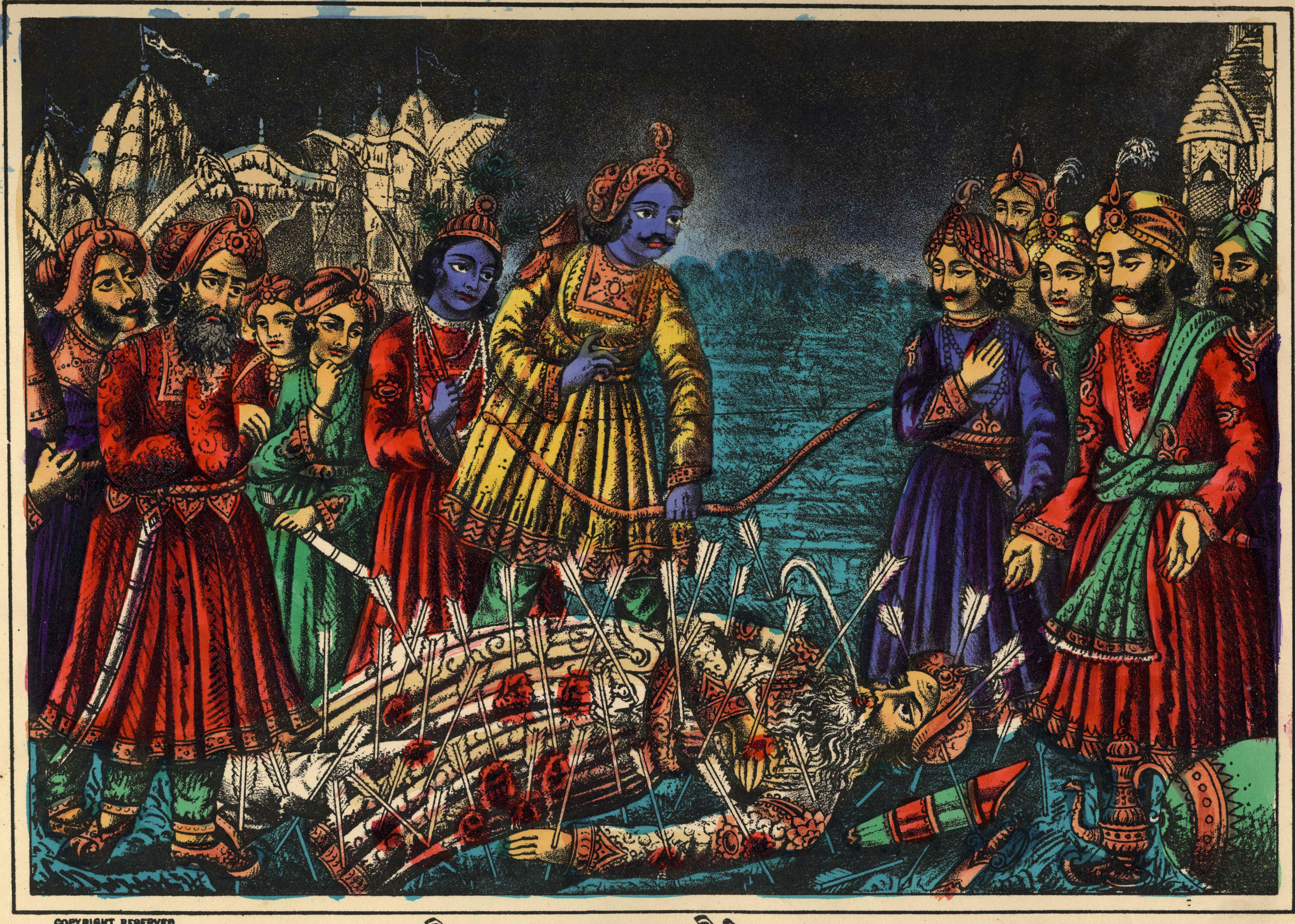
The text says Bhishma is pierced so thoroughly that when he falls, his body does not touch the ground. He lies on the shafts of the arrows. He asks for a pillow and, when soft cushions are offered, refuses them; Arjuna shoots three arrows into the earth to support his head. He asks for water, and Arjuna drives an arrow into the ground beside him and a spring comes up.
And he does not die. His father's boon means he dies when he chooses, and he chooses to wait — for the winter solstice, months away — so he lies on that bed through the remaining eight days of the war and long afterwards.
What he says while lying there
Both armies stop fighting and come to him. Duryodhana comes. The Pandavas come. Karna comes, and Bhishma — who has spent the entire war refusing to let Karna fight, on the grounds that he is a half-warrior — tells him the truth: that he knew Karna was Kunti's son all along, that he had held him back to prevent him fighting his own brothers, and asks him to make peace.
Karna refuses, and Bhishma releases him. From the eleventh day, Karna fights.
And Bhishma, asked by Yudhishthira for instruction, delivers the enormous body of teaching that fills Book 12 — thousands of verses on kingship, law, duty, and what a person owes. From 1.3, this is a later insertion into a gap in the action. It is also the most complete statement of political and moral thought in the epic.
Which produces the strangest fact about the book: the man who could not answer one question in the assembly hall — does a man who has lost himself own his wife? — delivers the longest lecture on dharma in world literature while dying of the consequences.
What his life adds up to
The epic gives him a reckoning, and it is worth assembling.
He asks himself why he is on the arrows. And the answer he gives — in the text, in his own mouth — is not the vow, not the war, and not the abduction of Amba.
It is that he sat in that hall. He says that he ate the food of the Kauravas, that he was bound by it, and that his failure to prevent what was done to Draupadi is the thing he cannot get past. Of everything in a hundred and twenty years, the moment he names is the one where he said nothing.
Read the whole life through that.
Age eighteen or so: he makes a vow to solve his father's problem. Praised universally.
For sixty years afterwards he is the most capable and most respected man in the kingdom, and he never once uses that standing to change an outcome. Not the succession. Not the house of lac. Not the dice game. Not the disrobing. Not the war.
And the reason is always the same: he is bound to the throne, and the throne is occupied by whoever is sitting there.
Bhishma is the epic's answer to the question of what happens to a good man who commits absolutely to an institution rather than to a purpose. He becomes an instrument. Anyone who holds the office holds him, and a person like that is worse than useless in a crisis, because his enormous reputation lends legitimacy to whatever he is being used for. His presence in Duryodhana's army was worth more to Duryodhana than his fighting.
The three failures, named
Because "he was bound by his vow" is the excuse, and it should be broken into its parts.
He made a commitment with no purpose clause. I serve the throne of Hastinapura. For what? To protect the kingdom? Then a king destroying the kingdom releases him. He never wrote the purpose down, and so it dropped out, and only the loyalty remained.
He refused the release when it was offered. Satyavati, the sole beneficiary, released him and he refused (3.3). After that point the vow was not a promise to anyone. It was a promise to his own reputation, and 3.2 named the trap: a vow that made him famous became a vow he could not revisit.
And he used "the question is subtle" as a refuge. In the hall, asked something with an obvious answer, he produced a display of scholarly uncertainty. He knew. Everybody knew. The uncertainty was manufactured to make silence look like rigour, and this book has already flagged this as one of the most recognisable moves in modern institutional life.
The defence, given fairly
It should be made, because he is not a villain and the epic clearly loves him.
He kept a promise for a hundred years at total personal cost. No marriage, no children, no throne, no life of his own. That is not nothing and very few people could do it.
He was genuinely constrained. In that society a vow of that kind was near-absolute, and breaking it would have destroyed his standing and, arguably, the legitimacy of the whole royal house.
And he did what he could inside the constraint. He told Yudhishthira how to defeat him. He held Karna back for ten days specifically to prevent brother killing brother. He refused to kill any Pandava. He fought the war he was bound to fight in the way that did the least damage.
Where this book lands: the defence is real, and it describes a man doing excellent work inside a cage he built himself as a teenager and refused to leave when the door was opened. The tragedy is not that he was trapped. It is that he was released twice — by Satyavati, and by every moment in sixty years when he could have acted — and he preferred the cage, because the cage was who he was.
What to carry from this page
Write the purpose clause. Any commitment — a job, a role, a promise, a loyalty — needs a sentence saying what it is for. Without it, the loyalty outlives the reason and starts serving whoever holds the position.
Take the release when it is offered. If the person you promised says you are free, you are free. Refusing means the promise has become a monument to yourself.
Listen for "it's complicated" from someone powerful in a moment that is not complicated. It is the single most reliable indicator of a person choosing silence and dressing it as rigour.
And ask what you will name on the bed of arrows. Bhishma had a hundred and twenty years, a legendary vow, and the greatest reputation in the land, and the thing he could not get past was an afternoon when he did not speak. It will not be your achievements. It will be a room.
Next: 3.14 — the Pandavas cannot beat Drona either, so they use a different weapon: the reputation of the one man in the world who has never told a lie.