Appearance
3.12 — The Two Armies, the Rules of War, and Day One
Kurukshetra is a real plain north of modern Delhi, flat and open, and it was chosen because both sides wanted a decisive battle rather than a long war of sieges. They agreed the location.
The two armies form up. The Kauravas are commanded by Bhishma, who agrees to lead on one condition: he will not kill any of the Pandavas, and he will not fight Shikhandi. The Pandavas are commanded by Dhrishtadyumna, Draupadi's brother, born from a ritual for the specific purpose of killing Drona (3.4).
The commander of one army is a man who will not kill the enemy, and the commander of the other exists to kill his own teacher. The epic sets this up in one line and moves on.
The two sides, and who is where
Fighting for Duryodhana: Bhishma, the grand-uncle of both sides. Drona, the teacher of both sides. Kripa, the other teacher. Ashvatthama, Drona's son. Karna, who is the Pandavas' eldest brother and does not tell them. Shalya, who is Nakula and Sahadeva's own maternal uncle. Kritavarma, of Krishna's clan.
Fighting for the Pandavas: the five brothers. Krishna, unarmed, driving a chariot. Drupada and Dhrishtadyumna. Shikhandi. Satyaki, of Krishna's clan. Abhimanyu, Arjuna's son, sixteen years old. Ghatotkacha, Bhima's son by Hidimbi (1.5).
Nearly everyone on the field is related to nearly everyone else, and this is not decoration. The war is a family killing itself, and the epic keeps the relationships visible on every page so that no death is anonymous.
Yudhishthira crosses the field
Before the fighting starts, Yudhishthira takes off his armour and walks across the open ground towards the enemy, alone.
His brothers assume he is surrendering.
He goes to Bhishma, and to Drona, and to Kripa, and to Shalya, and touches their feet, and asks each one for permission to fight them, and for their blessing.
Each gives it. Bhishma says he is bound to the throne by wealth and cannot leave it, and tells Yudhishthira: ask me for anything but that. Yudhishthira asks how he can be defeated, and Bhishma tells him. Drona does the same. Both men give the enemy the method of their own deaths, because they were asked correctly, in front of everyone.
This scene is the strangest and most human thing in the war, and it is worth sitting with. These men are about to kill each other and they are observing the forms of a family. The epic is not being ironic. It is showing you that both things are true at once: the relationships are real, the affection is real, and they are going to do it anyway.
The teaching, and it is uncomfortable: courtesy and slaughter are entirely compatible, and the presence of one is no evidence about the other. People who like each other, who genuinely wish each other well, destroy each other constantly — in families, in businesses, in courts. Warmth is not a brake. Structure is a brake. When you find yourself reassured by how civil everyone is being, check what the structure is doing, because the civility is not load-bearing.
And a second one, narrower and immediately usable: he asked, and they told him. Yudhishthira walks into the enemy camp and asks his opponents how to defeat them, and because he asked with the correct respect, in public, they answer honestly. People will tell you an astonishing amount if you ask them directly, respectfully, and in a setting where refusing looks worse than answering.
Arjuna puts down his bow
The armies face each other. Conches sound. And Arjuna asks Krishna to drive the chariot into the space between the two lines so that he can see who he is fighting.
He looks at both armies and sees his grand-uncle, his teacher, his cousins, his friends, the fathers of people he grew up with. And he cannot do it.
His collapse is described physically and precisely: his limbs give way, his mouth dries, his body shakes, his skin burns, his bow slips from his hand, and he says he cannot stand. He sits down in the chariot.
His argument is not cowardice and the epic is careful about this. He says: what is the point. If we win, we will have killed our own family for a kingdom, and the kingdom will be worth nothing because everyone we would have shared it with will be dead. He says the families will be destroyed, the women left without protection, the social order broken, and that he would rather be killed unarmed than do this.
Then he says: I do not know what is right. Tell me. And he asks Krishna to instruct him.
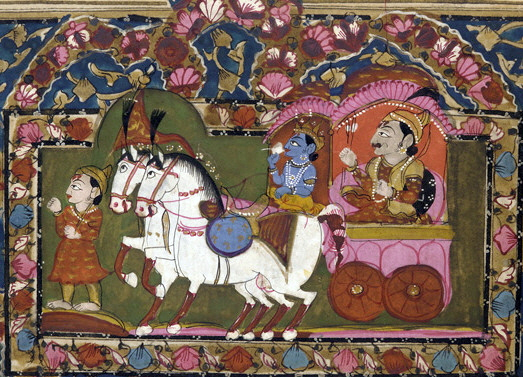
What follows is the Bhagavad Gita, and Part 5 of this volume is devoted to it. What matters here is the shape of the moment, and three things about it.
Arjuna's objection is correct. Everything he predicts happens. The families are destroyed. The kingdom is worthless. The epic's own ending (3.18) confirms every line of his speech. He is not wrong; he is right, and he is going to do it anyway.
The collapse is not weakness, it is accurate perception. He is the only person on that field who is looking clearly at what is about to happen. Everyone else has a reason, a vow, a salary or a grievance insulating them from the plain sight of it.
And he asks. From a position of total collapse, in front of two armies, the greatest warrior of the age says I do not know what to do, teach me. That sentence is the reason he gets the Gita and nobody else does.
Day one
The fighting begins and it goes badly for the Pandavas.
Bhishma is unstoppable. He is old, he does not want to be there, and he is still the best commander on the field.
Uttara, the young prince of Virata who had sheltered them, is killed on the first day, and his brother the day after. The epic kills the young allies first, and it does this deliberately throughout: the people who joined out of loyalty die before the people who had a stake.
Yudhishthira despairs by evening. Ten days of this follow, and the Pandavas lose ground every day.
The war's shape
Worth having in advance so the next four chapters read cleanly.
Days 1–10: Bhishma commands. The Pandavas lose steadily. It ends with the Shikhandi manoeuvre (3.13).
Days 11–15: Drona commands. The heaviest fighting, Abhimanyu's death (3.15), and Drona's death by a lie (3.14).
Days 16–17: Karna commands. He is killed on the seventeenth (3.5).
Day 18: Shalya commands and dies. Duryodhana's thigh is broken (3.16).
Night of day 18: the massacre in the sleeping camp (3.17).
Eighteen days. Two survivors on one side of the war's leadership, three on the other. The Pandavas win and lose every child they have.
What to carry from this page
Courtesy is not a brake. When everyone is being very civil about something destructive, notice that nothing has changed except the tone.
Ask directly and respectfully, in the open, and people will tell you things they have no reason to tell you. Yudhishthira got two death-methods out of two enemies with one walk across a field.
The person who stops and says I cannot do this and I do not know what is right is not the weak one in the room. They are the one who is actually looking. Everyone else is protected by a reason.
And when you are the one who has collapsed, the sentence that gets you help is the one Arjuna used: not "what should I do about this specific thing," but "I do not know what is right — teach me."
Next: 3.13 — the Pandavas cannot beat Bhishma, so they use the one thing he told them, and it involves putting a person in front of his chariot whom his code will not let him strike.