Appearance
4.4 — Govardhan: What Actually Happened When He Lifted the Mountain
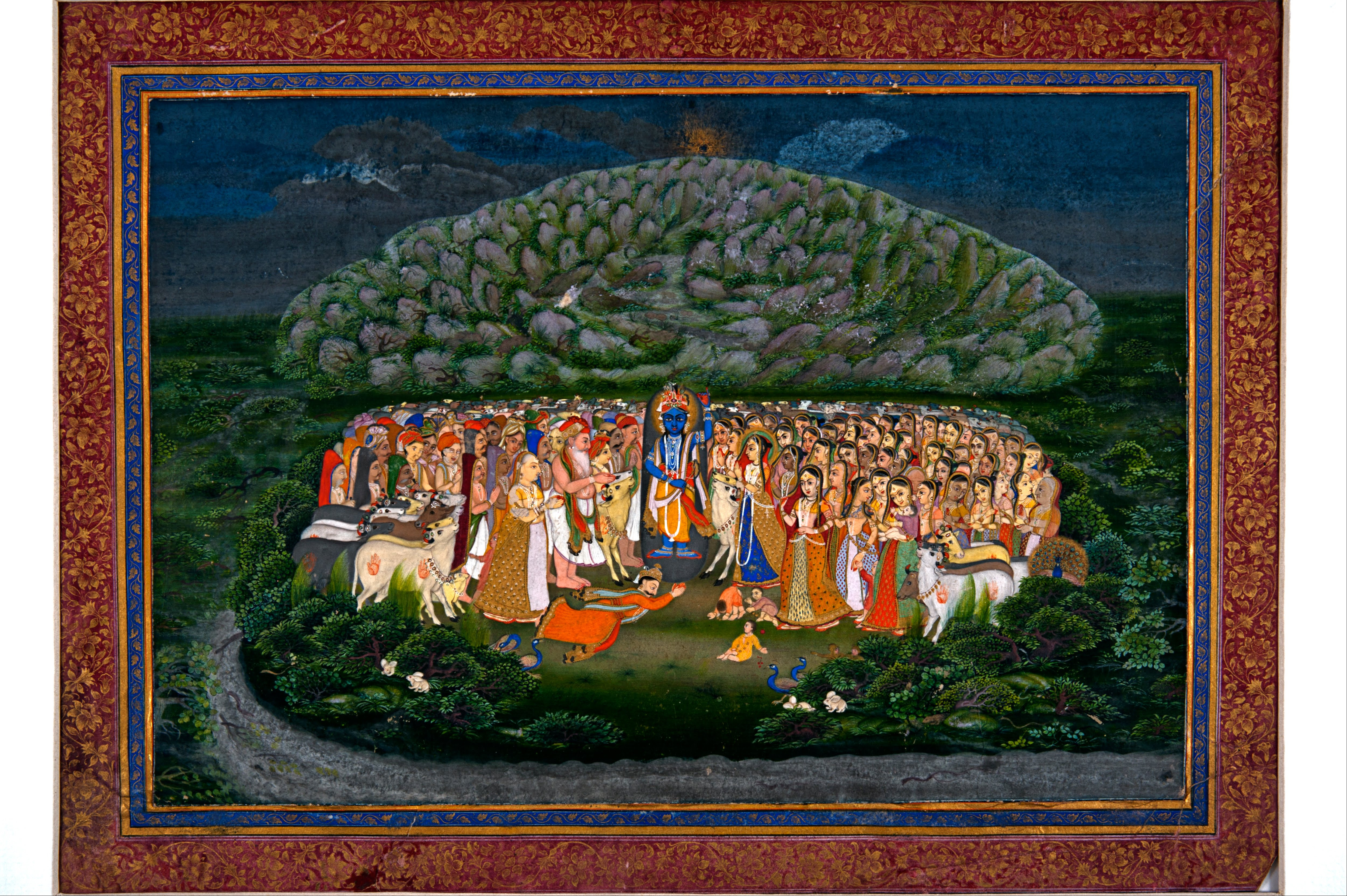
The famous version: the people of Braj stop their annual sacrifice to Indra on Krishna's advice. Indra, furious, sends a storm to destroy them. Krishna lifts the hill of Govardhan on the little finger of his left hand and holds it up for seven days while the whole community shelters underneath with their cattle. Indra gives up.
Now the grounding method from 1.1, applied properly.
What is physically there
Govardhan Hill is real. It stands about 25 kilometres from Mathura in the Braj region, and it is not a mountain. It is a long, low sandstone ridge, roughly 8 kilometres in length, and only around 25 to 30 metres high — lower than a modest apartment building.
It is also visibly eroding, and has been shrinking within recorded observation, which the local tradition itself accounts for with a story about a curse.
A low sandstone ridge, eight kilometres long, in a cattle-herding region, with overhangs and shelter along its length.
What the oldest layer says
The story does not appear in the Mahabharata proper. It comes from the Harivamsa and the Puranas (4.1), which are later.
And what those texts spend their time on is not the lifting. They spend it on the argument beforehand — a long, detailed, entirely political debate about whether the annual offering to Indra should continue. The theological confrontation is the substance; the hill is the ending.
The reading
A week of catastrophic monsoon rain over a herding community with no permanent buildings. Braj floods. Cattle are the community's entire wealth and they cannot be left in the open.
A young man who knows the country tells everyone to take the herds to the ridge and shelter under the overhangs, and organises it — which for several thousand animals and several hundred people over seven days is a genuine feat of coordination.
They survive with their cattle. The neighbouring settlements, who did what they always did and waited for the storm to end, do not.
And the memory becomes: he held the hill over us.
The phrase is even accurate in the only sense that matters. The hill sheltered them because he put them under it. What is remembered as an impossible physical act is the compressed form of a completely possible organisational one, and this is exactly the pattern 2.13 found with the causeway.
One detail the tradition preserves that supports this reading: the texts say the cowherds also held up their staffs, as if helping to support the hill. Read plainly, that is a memory of everybody working, tidied into a devotional image of a community assisting the divine.
The part that is actually the story
The confrontation with Indra is not about weather. It is about a payment, and the texts are surprisingly explicit.
Every year the community prepares an enormous offering for Indra, the storm god and the head of the divine establishment (1.5). The offering is substantial — food, wealth, goods — collected from a herding community that does not have much.
Krishna asks a question: why?
His argument is recorded at length and it is worth having in his own logic. Your wealth comes from the cattle. The cattle live on the grass. The grass grows on the hill. The hill is what actually sustains you. Indra sends rain whether you offer or not, because that is what he does. You are paying a distant authority for something you already have, and neglecting the thing that is actually keeping you alive.
So he tells them to offer to the hill, to the cows, and to the forest instead.
That is a tax revolt. A community stops sending its annual tribute to the central religious authority and redirects its resources to local, visible, verifiable sources of its own prosperity.
Indra's storm is the response of an establishment to a withheld payment. And the confrontation is settled the only way such things are ever settled: the community survives without paying, and the demand stops.
What the story is arguing
Three claims, and all three are radical for the period.
Worship what actually sustains you, not what has the highest rank. The hill, the grass, the cattle, the forest — the specific, local, checkable things. Not the distant power with the impressive title.
A ceremony continued only because it has always been done is a transfer of wealth to whoever collects it. The Braj community had never asked what the offering was for. Krishna's entire argument is one question — why — asked about an expense nobody had examined in living memory.
And an establishment threatened by a withdrawal of payment will respond with force and call it justice. Indra's storm is punitive. The story is completely clear-eyed about this.
Why this matters more than the miracle
Because it is the same move Krishna makes his whole life, and it is the most transferable thing about him.
He asks what a practice is actually for. Then he stops doing the part that serves nobody, and takes the consequences.
The same move appears at every scale of his life. He refuses the throne of Mathura, because the office is not what produces the outcome (4.2). He runs from Jarasandha and accepts an insulting nickname, because holding the city was not what mattered (4.8). He drives Arjuna's chariot rather than fighting, because the driver's seat is where the decisions are made (3.12).
In each case: identify the actual mechanism, ignore the form, absorb the loss of face.
And the third part is the hard one. Everybody can see that a pointless ritual is pointless. Almost nobody can take the disapproval that comes from stopping it. Braj was risking a god's anger, its neighbours' opinion, and the entire weight of "this is how it has always been done." What Krishna supplies is not the insight. It is the willingness to be the one who stops.
The everyday version
Because this is not about ancient offerings.
Every organisation, family and life runs a Govardhan sacrifice. The report nobody reads and everybody prepares. The meeting that exists because it existed. The ceremony performed for an authority that stopped noticing years ago. The expensive obligation kept up because stopping would look bad.
The test is exactly Krishna's: what is actually producing the thing I care about, and is this payment connected to it in any way?
And the second test is harder and more important: if the answer is no, am I willing to be the person who stops, and to be visibly wrong for a week while everyone waits to see what happens?
Because that is the entire content of the story. The community had to shelter under a hill for seven days with no idea whether they had made a catastrophic mistake. Somebody had to be under there saying it would hold.
What to carry from this page
Ask what the payment is for. Once, out loud, about something everybody takes for granted. The question is free and almost nobody asks it.
Honour what actually sustains you. Not the impressive distant thing — the specific local one. The people who do the work, the habit that keeps you well, the relationship that holds the whole arrangement up. They are the hill.
Expect the storm. Withdrawing a customary payment is read as an attack by whoever was receiving it, and the response will be dressed as principle.
And be the one under the hill. Insight is common and cheap. Somebody has to stand in the rain for a week saying it will hold, and that person is the whole difference between a good idea and a change.
Next: 4.5 — the serpent in the river, the poisoner at the door, and how to read the coded stories of the childhood without either swallowing them or throwing them away.