Appearance
7.1 — Who Shiva Is: From Rudra to Mahadeva
He is the strangest figure in Indian religion and the most loved, and the two facts are related.
He is an ascetic covered in ash who sits alone on a mountain, and a husband and father with a famously difficult marriage. He destroys the universe and he is the easiest god to please. He is the lord of yogis and he is associated with intoxication, wild dancing, and cremation grounds.
None of these contradictions is an accident, and this Part is about what they are for.
The oldest layer: Rudra
In the Rig Veda, the oldest text in the tradition, there is a god called Rudra, and he is not a major figure — a handful of hymns, against hundreds for Indra and Agni.
What he is: a storm god of the wild places. He lives outside the settlement, in the mountains and forests. He is dangerous. He carries a bow. He brings disease and he heals it, and the hymns to him are notably nervous — they ask him to spare the worshipper, the worshipper's children, cattle and horses. They repeatedly ask him to go away and be kind.
The name is usually derived from a root meaning to howl or to roar.
And he is called shiva — which is an adjective meaning "auspicious," "kindly," "benign." This is the origin of the name, and it is a euphemism. You call the dangerous one "the kindly one" because you would rather he were. The same instinct named the Black Sea "hospitable" and the Furies "the kindly ones."
So the figure begins as: an outsider god, unpredictable, associated with wilderness, disease and healing, addressed carefully.
What accumulated
Over the following centuries, several distinct things fused into one figure, and 1.4's mechanism explains the process.
The Vedic Rudra, providing the fierce, outsider, mountain-dwelling character.
Pre-Vedic and non-Vedic worship of a lord of animals and of fertility. The famous seal from the Indus civilisation showing a seated horned figure surrounded by animals has often been identified as a proto-Shiva — and it is worth being honest that this identification is contested and not established. The Indus script is undeciphered. What is more solid is that the linga form of worship (7.7) has non-Vedic roots and was absorbed rather than invented, and that the earliest datable linga, the Gudimallam linga in Andhra Pradesh, is from around the second century BCE.
Ascetic and yogic traditions, which predate the epics and which found in this outsider figure their natural patron.
And local and tribal deities across the subcontinent, absorbed under the name over centuries — which is why Shiva has so many regional forms and why so many of them are associated with a specific hill, river or grove.
By the epic period he is a major god. By the Puranic period he is, for a very large body of worshippers, the supreme reality.
The two poles
And the fusion left him with a permanent double character, which is his defining feature.
The ascetic. Naked or in a tiger skin, smeared with ash from cremation grounds, matted hair, seated motionless on Kailash in the snow, eyes closed, in meditation for ages. Owns nothing. Wants nothing. Outside every social arrangement.
The householder. Married to Parvati, with a famously argumentative and affectionate relationship (7.6), two sons, and a domestic life the Puranas describe in detail — including their quarrels.
Most traditions keep these two apart. The renunciate leaves the family; the family man does not renounce. Shiva is both simultaneously, and the tradition never resolves it.
And that is the point. He is the argument that the two are not actually opposed — that a person can be entirely unattached and entirely present in a relationship, and that renunciation is about the grip rather than about the arrangement (6.5). Which is the same claim the Gita makes about action (5.3), stated as a character instead of a doctrine.
The names, and what each carries
He has a thousand and eight in one list, and a few are worth knowing because they are the character.
Mahadeva — the great god.
Shankara — the one who does good, the benefit-maker.
Nataraja — the lord of the dance (7.7).
Bholenath — the innocent one, the simple one, the guileless lord. 7.3 is entirely about this name, and it is the most important one in practice.
Nilakantha — the blue-throated. 7.4 is the story.
Pashupati — the lord of animals, the herdsman of souls.
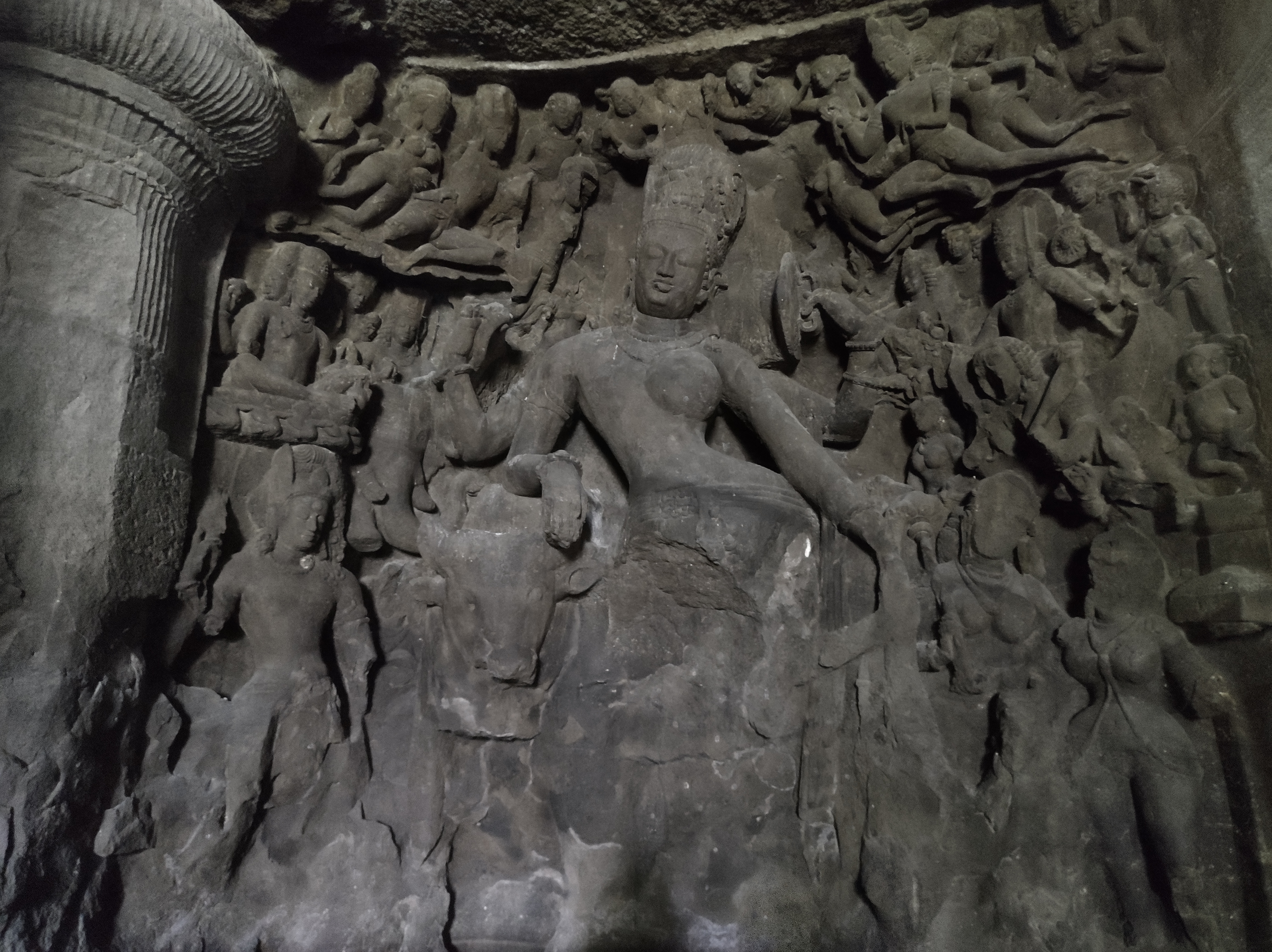
Ardhanarishvara — the lord who is half woman. A form in which the right half of the body is Shiva and the left is Parvati, divided down the middle, and the meaning is direct: the masculine and feminine principles are not two beings but one. Sculptures of this form exist from the first century CE onwards and it is one of the oldest explicit statements of that idea anywhere.
Mahakala — great time, and also great death. Compare kala in 5.9 — the same word, the same meaning, and the same claim: what destroys everything is time, and it is being personified rather than blamed.
The destroyer, correctly understood
The standard shorthand: Brahma creates, Vishnu preserves, Shiva destroys.
And "destroyer" is a bad translation of what is meant.
The word is samhara, which is closer to "withdrawal," "gathering back in," or "dissolution." It is not violence; it is the ending of a cycle.
And in the tradition's own logic, destruction is a prerequisite rather than a catastrophe. Nothing new can occupy a space that is full. A cell that does not die produces cancer. A forest that never burns accumulates fuel until it burns catastrophically. A person who cannot let anything end cannot begin anything.
Shiva is the principle that things must be allowed to end, and the reason he is associated with cremation grounds is not morbidity — it is that the cremation ground is where the fact is undeniable.
Which makes him, in practice, the god of the thing people find hardest: letting go of something that is already over.
Why he is the most loved
Assemble the character and the reason is obvious.
He is outside the system. No throne, no court, no hierarchy, no property. He lives on a mountain covered in ash. A god who has opted out entirely is available to people the system has no place for, and that has always been his constituency: ascetics, outsiders, the poor, the wild, and anybody who does not fit.
He is easy to please (7.3). No expensive ritual, no priestly mediation, no qualification. Water and a leaf.
He is not dignified. He dances, he is associated with intoxicants, he is depicted in states no other major god is depicted in. You cannot embarrass him.
And he has a family life with real friction in it. The Puranas show him and Parvati arguing, competing, sulking and reconciling. A god whose marriage has arguments in it is a different kind of religious object from one who does not.
What to carry from this page
The contradictions are the content. Ascetic and householder, destroyer and benign, terrifying and easy to please. He is the argument that these are not opposites, and every one of the eight chapters after this develops one of the pairs.
"Destroyer" means "the one who allows things to end." That is the hardest capacity a person can have, and it is why the tradition gave it a god.
And notice where he lives. Outside the settlement, on the mountain, in the cremation ground. The god of everybody who does not fit is the most popular god in India, and that fact says something about how many people that is.
Next: 7.2 — the Adiyogi: the claim that the whole of yoga began with one man teaching seven students on a mountainside, and what yoga originally meant before it meant exercise.