Appearance
1.1 — The Things in Your Hands
Look at what is within arm's reach of you. A keyboard. A pen. Possibly spectacles, a watch, a shirt with buttons and a collar, shoes with laces. Every one of those objects has a shape that somebody argued about, and in most cases the argument is more interesting than the object.
The keyboard
Why is the keyboard QWERTY and not ABCDE?

Christopher Latham Sholes, a Milwaukee newspaper editor, built his first typewriter in 1867 with the keys in alphabetical order across two rows. It jammed constantly. The reason is mechanical: each key swung a metal arm called a typebar up to strike the paper at a single point, and if two neighbouring typebars were thrown in quick succession, the second caught the first on its way back down. The typist then had to stop and untangle them by hand.
Sholes spent six years rearranging keys to reduce that. The layout that came out in 1873, when Remington bought the design, is close to the one you are looking at. But the popular version of the story — "QWERTY was designed to slow typists down" — is wrong, and it matters that it is wrong. Sholes was not trying to slow the typist. He was trying to separate the pairs of letters that most often follow one another in English so their typebars would swing from far-apart positions and never collide. Faster typing was the goal; separating the common pairs was the method.
The evidence for what actually drove the arrangement is messier than either story. The researchers Koichi and Motoko Yasuoka traced the layout through Sholes's prototypes and argued that the strongest single influence was telegraph operators, who were the first heavy users and who transcribed Morse code as it arrived. Certain letter confusions in American Morse — Z and the sequence SE are nearly identical in that code — meant an operator wanted those letters close enough to correct quickly. That is one reason Z sits where it does, next to nothing that makes sense for English.
So the real answer is: a mechanical jam problem, plus a market of telegraph operators, plus commercial accident. And it stayed because of Remington. Remington sold the machines and also ran the typing schools that trained the typists, so every trained typist in America knew QWERTY, and every office therefore bought a machine that used it. By the time the mechanical reason had disappeared entirely — electric typewriters in the 1930s, then computers — the cost of retraining the world exceeded any gain.
Is Dvorak actually faster?
August Dvorak patented an alternative layout in 1936 that puts all five vowels and the five most common consonants on the home row, so most words are typed without the fingers leaving their rest position. On paper it should win comfortably.
In measured trials it wins by very little, and possibly by nothing. The famous US Navy study that showed large gains was run by Dvorak himself, which is not an independent test. Later work — including a General Services Administration study in 1956 — found improvements in the range of nothing to a few per cent, easily swamped by how much a given person practises. A trained QWERTY typist who switches loses months and gains almost nothing.
This is a genuinely useful lesson well beyond keyboards. A standard that is merely adequate and universally known usually beats a better standard that nobody knows. Economists call it path dependence — the state you are in was decided by history rather than by merit, and getting out costs more than staying.
Why is there a bump on the F and J keys?
So your fingers can find the home row without looking. The two index fingers land on F and J, and the other six fingers follow into place from there. It is called a homing bar or homing dot, and it exists because touch typing needs exactly one moment of physical reference at the start and none afterwards. Some layouts put the bump on D and K instead; numeric keypads put it on the 5.
Why is the space bar so large?
Because the space is the single most-typed character in written English — roughly one in every six keystrokes, more common than E — and because it is the only key both thumbs can reach. Making it wide means neither thumb has to move. The design predates typewriters in principle: Sholes's early machines used a space key, and widening it into a bar was one of the changes that made continuous typing possible.
What you write with
Why did the ballpoint pen take so long to work?

The idea is old — a patent for a rolling-ball pen was filed by John Loud in 1888 — but the problem is fluid, not mechanical. Fountain-pen ink is thin. In a ball pen a thin ink floods past the ball and blots; a thick ink dries in the socket and stops. The gap between ball and socket has to be right to a few thousandths of a millimetre, and the ink has to be a paste that flows only under the shear of a rolling ball.
László Bíró, a Hungarian journalist, solved it in the late 1930s with help from his brother György, a chemist, by borrowing the fast-drying viscous ink used in newspaper printing. They patented it in 1938, moved to Argentina, and the pen sold first to the British Royal Air Force — because a fountain pen leaks at altitude when cabin pressure drops and a ballpoint does not. In much of the world the object is still called a biro.
Why is a pencil called "lead" when it contains no lead?
Because of a mistake nobody bothered to correct. In 1564 a large deposit of extremely pure graphite was found at Borrowdale in Cumberland, England. It marked paper beautifully, and at the time it was believed to be a form of lead, so it was called plumbago, "lead ore". By the time Carl Scheele showed in 1779 that it is carbon, the word was two centuries into the language and stayed.
The pencil you use is graphite mixed with clay and fired. More clay makes a harder, lighter line; more graphite makes a softer, darker one. That is the whole of the H-to-B scale: H is hard, B is black, HB is the middle, and the numbers say how far along you have gone. The alternative American scale of #1, #2, #3 maps roughly onto B, HB and H.
Why is a standard pencil hexagonal?
Three reasons, all practical. A hexagon does not roll off a desk. It is cut from a square blank with less waste than a circle. And it gives three natural grip positions rather than an arbitrary one. Round pencils survive mainly for carpenters — a carpenter's pencil is flat and oval so it cannot roll off a sloping roof, and so the flat sides can be sharpened to a chisel edge that draws a wide line on rough timber.
What you wear
Why do shirts have collars?
The honest answer has two halves, and the first half is dirt.
Before frequent laundering, the part of a garment that failed first was the part touching the neck — sweat, hair oil and grime concentrate there. So the neck opening was finished with a separate band that could be washed, replaced, or turned when it wore. By the nineteenth century this had become a literal detachable collar, a stiff starched ring buttoned onto a collarless shirt with studs. A man owned one or two shirts and a dozen collars, because the collar was what got dirty. The town of Troy, New York built an industry on making them.
The second half is signalling. A stiff white collar cannot be worn by anyone doing physical work, because an hour of it destroys the shape. That is precisely why it became the uniform of people who did not do physical work — and it is the literal origin of the phrase white-collar, coined against blue-collar, the dyed hard-wearing shirts worn in workshops where dirt should not show.
Collars were sewn back onto shirts as laundry became cheap in the twentieth century, and the shape survives with neither function intact: it does not need replacing, and almost nobody reads status from it now. What remains is a frame around the face, a structure that holds a tie, and about four hundred years of habit.
Why do men's and women's shirts button on opposite sides?
Men's buttons sit on the wearer's right, women's on the wearer's left, near-universally across Western clothing, and there is no agreed reason — only several plausible ones.
The most commonly repeated is that wealthy women were dressed by servants, who faced them, so buttons were placed for the dresser's right hand rather than the wearer's. It fits the timeline of elaborate women's clothing but has no direct documentary support. A second story concerns swords: a right-handed man drawing across his body wants the overlap facing away from the blade. A third simply says that once tailoring split into men's and women's trades, each standardised on a convention and the difference stuck because a visible difference is useful for sorting stock.
When several stories fit and none is proved, the honest position is that we do not know. What is certain is that the convention is old, arbitrary, and now self-sustaining.
How does a zipper actually hold?
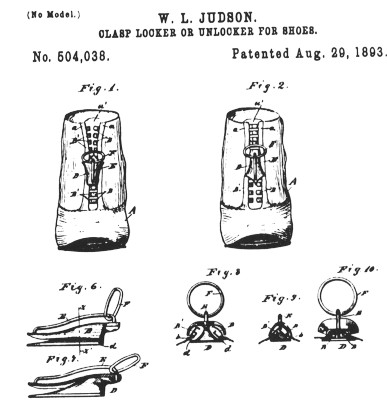
Every tooth on a zip has a bump on one face and a matching hollow on the other. The slider is a Y-shaped channel: pulled one way it forces the two rows together so each bump drops into the hollow of the tooth diagonally opposite, and pulled the other way it drives a wedge between them and pops them apart. Nothing is fastened along the length of the zip. Each tooth is held only by its two neighbours, which is why a zip fails completely the moment one tooth is bent or missing.
Whitcomb Judson patented a hook-and-eye version in 1893 that did not work reliably. The modern interlocking-tooth design is Gideon Sundback's, patented in 1917 while he was working for a company in Pennsylvania. The name came later: B. F. Goodrich put them on rubber overshoes in 1923 and called the boots Zipper for the noise they made. The onomatopoeia outlived the boot.
Why does Velcro work?
Because a hook is very hard to pull straight out of a loop and very easy to peel out sideways. One face carries thousands of small stiff hooks, the other a mat of soft loops; press them together and a large fraction of the hooks catch. Pull the two faces apart flat and every hook resists at once, which is why the join is strong. Peel from a corner and the hooks release a few at a time, which is why it opens easily and makes that noise.
The Swiss engineer George de Mestral invented it in 1941 after walking his dog and looking under a microscope at the burdock burrs stuck to its coat. The name is a contraction of the French velours (velvet) and crochet (hook).
Why do shoelaces come undone on their own?
This was measured properly, at Berkeley in 2017, and the answer is a two-stage failure. Walking subjects the knot to two separate forces. The foot striking the ground gives the knot a downward acceleration of several times gravity, which loosens the core of the knot slightly on each step. The leg then swinging forward whips the free ends outward, which tugs at the loosened knot. Neither force alone is enough. Together they behave like a person deliberately slackening the knot and then pulling the end. Once the knot slips past a threshold it fails within a step or two, which is why laces seem to stay tied for a mile and then come undone all at once.
The fix is knowing that the common shoelace bow has a strong and a weak version. If you finish with the two loops sitting across the shoe rather than along it, you have tied a granny knot, which is unstable under exactly this kind of shaking. Reversing the direction of either the starting knot or the bow gives a reef knot form that holds far longer.
The small metal things
Who invented the safety pin, and what did he get for it?
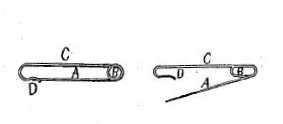
Walter Hunt, a New York mechanic, in 1849, in a single afternoon — the accounts say about three hours — because he owed a friend fifteen dollars. He twisted a length of wire into a coil that acts as a spring and a shield that covers the point, patented it, and sold the patent outright for four hundred dollars. He paid his debt and kept the rest.
The patent went on to be worth a fortune to somebody else. Hunt did this repeatedly: he also built an early sewing machine and declined to patent it, in part because he believed it would put seamstresses out of work, which left that industry to Elias Howe and later Isaac Singer. He is one of the clearest cases in the history of invention of the gap between inventing something and owning it.
Why is the paper clip that exact shape?
The double-oval shape you picture is the Gem clip, and it was never patented — it appeared in Britain in the 1890s from a wire-forming company and was simply the shape that worked. Its virtue is that a single length of springy wire, bent only in one plane, produces two opposing arms that grip by elasticity and can be pushed apart by the thickness of the paper without taking a permanent set.
Norway has a national attachment to the paper clip because Johan Vaaler, a Norwegian, patented a clip in 1899 — but his design was a worse one, a single loop without the inner return, and it was never manufactured. The story that Norwegians wore paper clips as a resistance symbol under German occupation is true; the belief that the clip was a Norwegian invention was part of what made it a symbol, and that belief grew up during the war itself.
Why does a stapler have a little rotating plate underneath?
It is called the anvil, and turning it changes the shape the staple legs are bent into. In one position the grooves curve the legs inward and under the paper — a permanent staple that lies flat and holds hard. In the other they bend the legs outward and straight — a pinning staple, deliberately weak, made to be pulled apart with your fingers when you need to separate the sheets again. Most people never discover the second setting exists.
Seeing and telling the time
Why do spectacle lenses sit in front of the eye rather than on it?
Because a lens bends light by a fixed amount and the eye needs the correction applied before the light reaches the cornea. The distance matters: move a strong lens closer to or further from the eye and its effective power changes, which is why a prescription for glasses and a prescription for contact lenses are different numbers for the same eye, and why the difference grows with the strength of the correction.
Spectacles appeared in northern Italy around 1286, made by an unknown craftsman in or near Pisa — a Dominican friar in Florence recorded in a sermon of 1306 that the maker was still alive and would not share the method. They were convex lenses for long-sightedness, which is the easier problem. Concave lenses for short sight took another century and a half.
Why is a watch dial shown at ten past ten in advertisements?

Because the hands form a symmetrical V that frames the manufacturer's name in the upper half of the dial, does not cover a date window at three or six, and reads as an upturned mouth. It is entirely aesthetic, and it is so consistent across brands that finding a photographed watch not set to roughly 10:10 is difficult. Digital watch advertisements have their own version — the display is very often set to 10:08 or 12:00 for the same balance reason.
In simple terms, setting the time to 10:10 makes the watch look happy. The hands point up like a smile, they don't block the brand name at the top, and they keep the bottom half clear. It just looks friendly and balanced to our eyes.
Why is a clock face divided into twelve, and not ten?

Because of the number 60 and the number 12, both inherited from Mesopotamia over four thousand years ago, and both chosen for the same reason: they divide cleanly. Twelve divides by 2, 3, 4 and 6. Sixty divides by 2, 3, 4, 5, 6, 10, 12, 15, 20 and 30. Ten divides only by 2 and 5. In a world doing arithmetic without decimals, a base you can halve and third and quarter without fractions is enormously more useful than one you cannot.
To put it simply, people chose 12 because it is very easy to cut into pieces. If you want a half, a third, or a quarter of an hour, you get a whole number of minutes (30, 20, or 15). If the clock had 10 hours, a quarter of an hour would be a messy fraction. We kept 12 just because the math is so much easier.
The day was split into twelve by the Egyptians, who used a set of star groups that rose in sequence through the night, and made the daylight hours match. The hour of fixed length, and the minute and second beneath it, came from Islamic and then European astronomers who needed the base-sixty arithmetic Babylon had left behind. The calendar side of the same story is in 2.7.
What comes next
The objects here are the ones you carry. The next page moves one room outward, into the house — where the microwave, the fridge, the mirror and the drain in your sink each hide a piece of physics worth knowing, and where one very common object exists purely because of a rule about airflow that almost nobody has been told.