Appearance
4.4 — The Sky, the Solar System and Beyond
The sky is the one laboratory everybody has access to, and most of what it does can be worked out from the geometry of three objects.
The moon
Why does the moon have phases?

Because you are seeing a lit sphere from changing angles, and the Earth's shadow has nothing to do with it.
Half the moon is always in sunlight, exactly as half the Earth is always in daylight. What changes over a month is where the moon is in its orbit relative to the line between you and the sun.
When the moon is roughly between the Earth and the sun, its lit face points away from you and you see the unlit side: new moon. When the Earth is between the sun and the moon, the lit face points at you: full moon. In between you see a lit fraction from an angle, which appears as a crescent or a half disc.
The clean test that eliminates the shadow explanation: a half moon is visible in the afternoon sky with the sun still up. The Earth's shadow points directly away from the sun, and cannot be on the moon while the sun is shining on both.
Why do we always see the same face of the moon?
Because the moon rotates exactly once per orbit — a state called tidal locking — and it did not start that way.
The Earth raises a tidal bulge in the moon's rock, just as the moon raises one in Earth's oceans. When the moon spun faster than it orbited, that bulge was constantly being dragged out of alignment, and the friction of that dragging acted as a brake. Over hundreds of millions of years it slowed the moon's spin until the bulge stopped moving — which happens exactly when one rotation equals one orbit.
The same process is running on the Earth right now. Tidal friction is slowing our rotation by roughly 1.8 milliseconds per century, and the moon is receding about 3.8 centimetres per year to conserve angular momentum. We know the recession precisely because Apollo astronauts left mirrors on the surface and a laser pulse can be bounced off them.
The far side is not the "dark side" — it gets exactly as much sunlight, on the same monthly cycle. It was first photographed by the Soviet Luna 3 in 1959, and it looks strikingly different: far more cratered, with almost none of the dark volcanic plains that make up the near side's features.
Why do solar eclipses not happen every month?
Because the moon's orbit is tilted about 5 degrees from the plane of the Earth's orbit around the sun.
If the two planes matched, there would be a solar eclipse at every new moon and a lunar eclipse at every full moon. The tilt means that at most new moons the moon passes above or below the sun, and its shadow misses the Earth entirely. Eclipses happen only when a new or full moon coincides with the moon crossing the orbital plane — the two crossing points are called nodes, and the alignment comes round in seasons roughly every six months.
The coincidence that makes total solar eclipses possible is genuinely remarkable. The sun is about 400 times wider than the moon and about 400 times further away, so the two appear almost exactly the same size in the sky. That is why totality reveals the corona rather than simply darkening the sky.
It is also temporary. The moon is receding, and in perhaps 600 million years it will be too far away to cover the sun completely, so total solar eclipses will stop occurring. We happen to be alive during the window when they work.
Why does the moon look enormous near the horizon?
It does not. It is an illusion, and it is one of the oldest unsolved problems in perception.
The moon's angular size is essentially identical at the horizon and overhead — you can verify it with a camera, or by holding a coin at arm's length. It is very slightly smaller at the horizon, because you are further from it by roughly the Earth's radius.
The explanations offered involve how the brain judges distance. One says the sky is perceived as a flattened dome rather than a hemisphere, so an object at the horizon is judged further away, and an object judged further away at the same angular size must be bigger. Another says the comparison with trees and buildings on the horizon does the work.
Neither fully survives testing — the illusion persists over an empty sea, and it changes if you bend over and look at the horizon moon between your legs. It is a good reminder that "the brain constructs what you see" is not a slogan.
The solar system
Why is Pluto not a planet any more?
Because the definition of planet had never been written down, and when the International Astronomical Union finally wrote one in 2006, Pluto did not meet it.
The forcing problem was discovery, not opinion. Astronomers had begun finding a great many objects beyond Neptune, and in 2005 Mike Brown's team found Eris, which appeared to be larger than Pluto and is certainly more massive. The choice was to admit a growing and unbounded list of planets, or to draw a line.
The definition adopted has three parts: a planet orbits the sun, is massive enough for its own gravity to pull it into a round shape, and has cleared the neighbourhood around its orbit of other comparable bodies.
Pluto fails the third. It sits inside the Kuiper Belt among a great many similar objects, and its mass is a small fraction of the total material in its orbital zone — whereas Earth's is millions of times the rest of its zone combined. Pluto became a dwarf planet, a category that also holds Eris, Ceres, Makemake and Haumea.
The criticism of the definition is legitimate: "cleared the neighbourhood" is vague, the definition only applies to our solar system, and the vote at the 2006 assembly involved a small fraction of the membership. But the underlying point is not really arguable — Pluto is a member of a large population, not a singular object, and calling it a planet meant either an arbitrary cut-off or several dozen planets.
New Horizons flew past in 2015 and found a startlingly active world with nitrogen glaciers, mountains of water ice and a thin atmosphere. It became a much more interesting object at exactly the moment it lost the title.
Why is Mars red and Venus hot?
Mars is red because its surface is covered in iron oxide — the same rust as in 4.2. Iron-rich dust reacted with the water and oxygen that existed in its past, and now blows around a dry planet in global storms.
Venus is hot for a reason that gets misattributed. It is closer to the sun, but that is not the main cause: its atmosphere is about 96 per cent carbon dioxide, at a surface pressure ninety times Earth's. Sunlight gets in, the surface radiates infrared, and the thick CO₂ absorbs it and radiates it back down. The surface sits at around 465 °C, hot enough to melt lead, and it is hotter than Mercury, which is nearly twice as close to the sun.
That comparison is the clearest evidence that an atmosphere's composition matters more than distance, which is why Venus appears in every serious discussion of the greenhouse effect.
Why does everything orbit in roughly the same plane and the same direction?
Because the solar system formed from a single spinning cloud.
A large cloud of gas and dust began collapsing under gravity. Any slight initial rotation speeds up as it contracts, for the same reason a spinning skater speeds up on pulling their arms in. Rotation resists collapse sideways but not along the axis, so the cloud flattened into a disc, with the sun forming at the dense centre and planets accreting from the disc.
Everything therefore inherited the same rotational direction and roughly the same plane. The exceptions carry information: Venus rotates backwards and Uranus is tipped on its side, and both are usually explained by enormous collisions during the chaotic early period.
Are the planets in the sky actually visible, and how do you tell them from stars?
Five are easily visible without any instrument — Mercury, Venus, Mars, Jupiter and Saturn — and they have been known to every culture in history. They are the reason the week has seven days, in 2.7.
The reliable test is twinkling. A star is so far away that it is effectively a point of light, and a point of light is easily wobbled by turbulence in the atmosphere — so stars twinkle. A planet is close enough to be a tiny disc rather than a point, and the wobbles across its surface average out. A steady bright light is a planet; a flickering one is a star.
Venus is the brightest object in the sky after the sun and moon, always near the horizon around sunrise or sunset — the morning and evening star. Jupiter is next brightest and can be anywhere. Mars is obviously orange.
Distance, and the very far
What does a light year measure?
Distance, not time. It is how far light travels in one year: about 9.46 trillion kilometres.
The reason astronomers use it is that the numbers otherwise become unusable. The nearest star system, Alpha Centauri, is 4.25 light years away — about 40 trillion kilometres. The centre of our galaxy is about 26,000 light years. The Andromeda galaxy is 2.5 million.
The consequence is that looking out is looking back. The sun you see is eight minutes and twenty seconds old. Andromeda as you see it is 2.5 million years old, from before Homo sapiens existed. Telescopes looking at very distant galaxies are seeing light that left when the universe was a few hundred million years old.
Professional work more often uses the parsec, about 3.26 light years, because it comes directly out of the measurement method: it is the distance at which a star appears to shift by one arcsecond over the course of Earth's orbit.
Why is the night sky dark?
This sounds trivial and is one of the sharpest questions in the history of cosmology. It is called Olbers' paradox.
If the universe were infinite, eternal and roughly uniformly filled with stars, then every line of sight would eventually land on a star, and the whole sky would blaze at the surface brightness of a star. Distant stars are fainter, but there are proportionally more of them at greater distance, and the two effects cancel exactly.
Dust does not save the explanation — dust heated by starlight for eternity would glow just as brightly.
The resolution is that the universe has a finite age. Light from beyond about 13.8 billion light years has not had time to arrive, so there is a horizon and only a finite number of stars are visible. Stars also have finite lifetimes, so they have not been shining forever. And the expansion of the universe stretches distant light to longer wavelengths, moving it out of the visible range.
The dark sky is direct evidence that the universe had a beginning. Edgar Allan Poe, of all people, wrote something close to the correct answer in an 1848 essay.
What does a photograph of a black hole show?
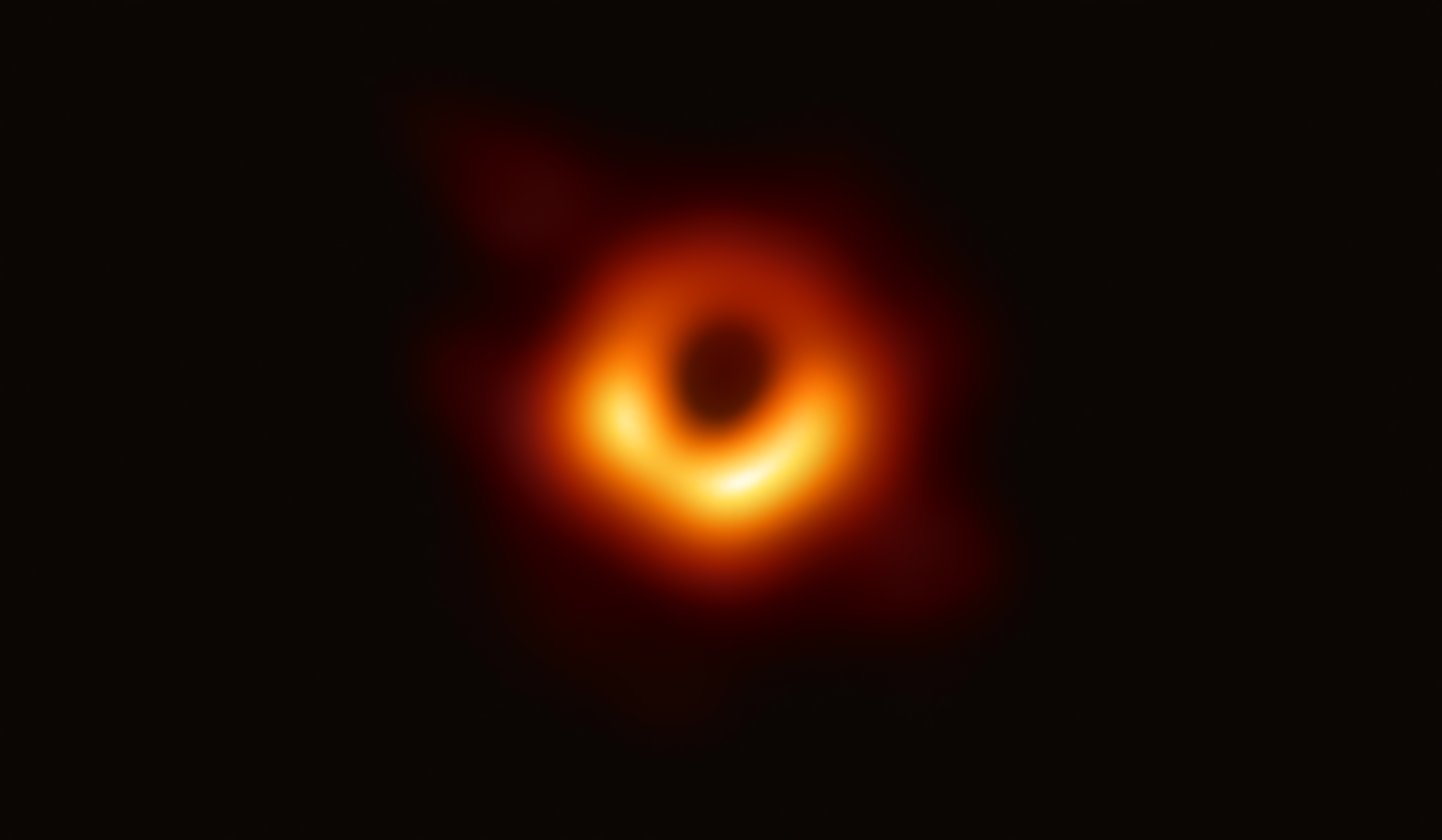
Not the hole — that emits nothing by definition. It shows the shadow the hole casts on the hot gas around it.
The bright ring is superheated material in an accretion disc, glowing at millions of degrees. The dark centre is the region from which no light can reach us, and it is noticeably larger than the event horizon itself because the black hole bends light from behind it around the sides and into our view.
The 2019 image of M87* was made by the Event Horizon Telescope, which is not one telescope but eight radio observatories from Hawaii to the South Pole observing simultaneously and combining their data. The technique makes the array behave as a single dish the size of the Earth, which is the only way to achieve the resolution needed — equivalent to reading a newspaper in Paris from New York. The data was so large it was flown on hard drives rather than transmitted; the South Pole disks had to wait months for the Antarctic winter to end.
Sagittarius A*, the black hole at the centre of our own galaxy, was imaged in 2022. It is much closer and much smaller, and harder to photograph because the gas orbits it in minutes rather than days, so the image changes while you are taking it.
The particle that barely interacts
What is a neutrino?
An almost weightless particle with no electric charge that passes through matter as though it were not there.
Roughly a hundred trillion neutrinos from the sun pass through your body every second, and over your whole life perhaps one will interact with an atom in you. A neutrino would pass through a light year of solid lead with a decent chance of not being stopped.
They were proposed in 1930 by Wolfgang Pauli to fix a bookkeeping problem: in beta decay, the energy of the emerging electron varied instead of being fixed, which appeared to violate conservation of energy. Pauli suggested an undetected particle carrying the balance, and apologised in writing for postulating something that could not be detected. It was detected in 1956.
They come from the sun's core, from supernovae, from cosmic rays hitting the atmosphere, from nuclear reactors, and from the Earth's own radioactivity.
How does a detector catch something that does not interact?

By making the target enormous and waiting.
Super-Kamiokande in Japan is a cylindrical tank 40 metres across and 40 metres tall, holding 50,000 tonnes of ultrapure water, sitting a kilometre underground inside a mine. The rock overhead is a filter: it stops essentially every other kind of particle from the sky, and lets neutrinos through untouched.
Very occasionally a neutrino hits an electron or a nucleus in the water and produces a fast charged particle. That particle travels faster than light does in water — which is allowed, since light is slowed to about 75 per cent of its vacuum speed in water, and nothing forbids exceeding that.
A charged particle exceeding the local speed of light produces a shock wave of light, exactly as a supersonic aircraft produces a cone of sound. It is called Cherenkov radiation, it is blue, and it spreads as a cone that lands on the tank walls as a ring.
Over 11,000 photomultiplier tubes line the walls, each able to detect a single photon. From the shape, brightness and timing of the ring, the detector reconstructs the direction and energy of the original neutrino. A sharp ring means a muon; a fuzzy one means an electron.
The water must be extraordinarily pure — you could see roughly 70 metres through it — because any particle or dye would absorb the faint light.
The results have been substantial. In 1987 Kamiokande detected neutrinos from a supernova in the Large Magellanic Cloud, hours before the light arrived, which confirmed the theory of how a star collapses. And in 1998 Super-Kamiokande showed that neutrinos change type as they travel — oscillation — which is only possible if they have mass. The Standard Model had assumed they did not, so this is one of the few confirmed cracks in it, and it won Takaaki Kajita and Arthur McDonald the 2015 Nobel Prize.
In 2001 an accident destroyed most of the tubes: one imploded at the bottom of the filled tank, and the pressure wave triggered a chain reaction that destroyed about 7,000 of them in seconds. They were rebuilt with protective shells.
What comes next
The next page brings it back to the ground — earthquakes, monsoons, why hurricanes spin one way in each hemisphere, and why the seasons have nothing to do with distance from the sun.