Appearance
4.1 — Physics in Plain Sight
Everything on this page is visible from where you are sitting, and every answer is a real mechanism rather than a name for the effect.
Light and colour
Why is the sky blue?

Because air molecules scatter short wavelengths far more strongly than long ones, and the effect is fiercer than most people expect.
Sunlight arriving at the top of the atmosphere contains all visible colours. When a light wave passes a molecule of nitrogen or oxygen, it jiggles the molecule's electrons, and the jiggling molecule re-radiates light in all directions. That is scattering.
The crucial fact is how strongly it depends on colour. The amount scattered goes as the fourth power of the frequency — so violet, at roughly twice the frequency of red, is scattered about sixteen times as much. Blue light therefore bounces around the sky and reaches your eye from every direction, while red light mostly carries straight through.
Two follow-up questions kill the wrong explanations.
Why not violet, which scatters even more? Two reasons. The sun emits less violet than blue to begin with, and human eyes have three types of colour receptor whose combined response peaks well away from the violet end. The sky is genuinely emitting a mixture that we perceive as blue.
Does it reflect the sea? No. The sky is blue over the Sahara and over Delhi, and the sea is blue partly because it reflects the sky and partly because water itself absorbs red light over a few metres of depth.
Why is a sunset red, then?
Same mechanism, longer path.
At noon, sunlight passes through the atmosphere almost vertically — the shortest possible route. At sunset it comes in at a shallow angle and travels through many times more air. Over that long path, so much of the blue has been scattered away sideways that almost none is left travelling towards you, and what survives to reach your eye is the red and orange.
So the blue sky and the red sunset are the same fact seen from two positions. Dust, smoke and pollution add to it by scattering more, which is why sunsets after a volcanic eruption or a forest fire can be spectacular, and why the most vivid ones are often not a sign of clean air.
Why does a rainbow have that shape and always appear opposite the sun?
Because of what happens inside one raindrop, and the answer is a fixed angle.
Light entering a spherical drop refracts on the way in, reflects off the far inside surface, and refracts again on the way out. The geometry of the sphere means the emerging light is concentrated at about 42 degrees from the direction it came in — light leaving at other angles is spread thin, and light near 42 degrees piles up.
Since red and violet refract by slightly different amounts, they emerge at slightly different angles, about 42 and 40 degrees, and the colours separate.
So every drop that sits at 42 degrees from the line running from the sun through your head sends red light to you. The set of points at a fixed angle from a line is a cone, and the visible part of that cone is an arc. That is why a rainbow is a circle centred on the shadow of your own head, why it is always opposite the sun, and why you can never reach the end of one — it moves as you do, because it is defined by your position and not by any place.
A secondary rainbow comes from light that reflected twice inside the drop, appears at about 51 degrees, and has its colours reversed. The band between the two is noticeably darker and is called Alexander's band.
Why does a mirage look like water on the road?
Because hot air is less dense than cool air, and light bends towards denser air.
On a sunny day the tarmac heats the layer of air immediately above it. That thin hot layer bends light coming down at a shallow angle back upwards, so light from the sky arrives at your eye as though it came from the road surface. You are seeing the sky, reflected off a layer of air. It shimmers because the hot layer is turbulent.
The same physics runs the other way in cold conditions, over ice or cold sea, where light bends downward around the curve of the Earth and objects appear that should be below the horizon — including the effect that made sailors report seeing ships in the sky.
Water and matter
Why does ice float?
Because water is one of the very few substances whose solid form is less dense than its liquid, and the reason is the shape of the molecule.
A water molecule is bent, with the oxygen slightly negative and the hydrogens slightly positive. Those opposite charges attract between neighbouring molecules — a hydrogen bond. In liquid water the molecules jostle, bonds constantly break and reform, and they pack fairly close.
When water freezes, each molecule locks into four hydrogen bonds arranged towards the corners of a tetrahedron, and that arrangement is an open cage with empty space in the middle. The ordered structure is roughly nine per cent less dense than the disordered liquid. So ice floats, and water expands as it freezes — which is why pipes burst and why a bottle left in a freezer cracks.
It is difficult to overstate how much depends on this. If ice sank, lakes and seas in cold regions would freeze from the bottom up, the ice would be insulated from summer sun by the water above it, and they would freeze solid permanently. Aquatic life through an ice age would be largely impossible. Instead a floating lid of ice insulates the liquid beneath, which is where things survive.
Why is the sea salty, and why is it not getting saltier?
Rain is slightly acidic, because carbon dioxide dissolves in it. Falling on rock, it dissolves a small amount of mineral, and rivers carry the dissolved ions to the sea. Water then evaporates from the sea and the salt does not, so ions accumulate.
That has been running for billions of years, which raises the obvious question of why the sea is not saturated. The answer is that ions leave as well: some are taken up by organisms building shells and skeletons, some precipitate onto the seafloor, some are removed at hydrothermal vents where seawater circulates through hot crust, and vast quantities have been locked away as salt beds when shallow seas dried out. Input and removal have been roughly in balance for a very long time.
Sodium and chloride dominate because they are the ions that stay dissolved. Calcium is delivered in enormous quantities and is constantly removed by shell-building.
Where does the energy inside an ordinary sheet of paper come from?
This is a genuinely deep question and it has a real answer, in layers.
Nothing is still. The atoms in the paper vibrate constantly, faster the warmer it is — that vibration is temperature. Inside each atom, electrons occupy states around a nucleus with characteristic energies. Inside each proton and neutron, quarks are bound by an interaction so strong that most of the mass of the paper is not the mass of its particles at all but the energy of the binding between them. Roughly 99 per cent of the mass of ordinary matter is binding energy and quark motion, and only about 1 per cent is the intrinsic mass of the quarks themselves. This is E = mc^2 read backwards: the mass is the energy.
Where did it come from? The chain runs back cleanly. The chemical energy in the paper's cellulose came from a tree, which built it from carbon dioxide and water using sunlight. The sunlight came from hydrogen fusing into helium in the sun's core, which releases binding energy. The hydrogen came from the first few minutes after the Big Bang, when the universe was hot and dense enough to make protons out of quarks. The quarks, and the field that binds them, came from the Big Bang itself, and what happened before that is not currently answerable.
So the honest end of the chain is: the total energy of the universe was set at its beginning, and everything since has been that energy changing form. Nothing has been created since. The reason the paper is not dead is that it is made of things that have never stopped moving, because there is no mechanism by which they could.
Motion, force and sound
What is resonance, and how does it destroy things?
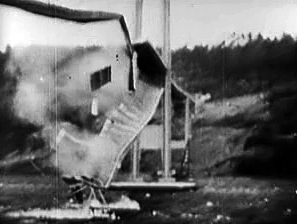
Every object that can flex has one or more frequencies at which it prefers to vibrate — its natural frequencies, set by its stiffness and its mass. Pluck it, hit it, or let the wind past it, and it rings at those.
Resonance is what happens when you push at exactly that frequency. Each push arrives in step with the motion already there, so it adds rather than fights, and the amplitude grows on every cycle. A child on a swing is the everyday case: small pushes at the right moment produce a large swing, and the same pushes at the wrong moment produce nothing.
Growth is limited only by how fast the system loses energy to friction and air. In a lightly damped structure that loss is small, so a modest driving force can build to a destructive amplitude.
Tacoma Narrows in 1940 is the standard example, and the usual explanation of it is wrong. It was not simple resonance with the wind's own frequency. It was aeroelastic flutter: the deck's twisting motion changed how air flowed over it, and the changed airflow pushed the deck further in the same direction. The structure was extracting energy from a steady wind and feeding it into its own motion, which is more dangerous than resonance because there is no external frequency to avoid.
Soldiers break step crossing bridges because a marching rhythm is a periodic driving force. The Millennium Bridge in London had to close two days after opening in 2000 for a related reason: a slight sideways sway made people adjust their footing in unison, which drove the sway harder.
Why do you not feel the Earth spinning?
Because you are not being accelerated in any way your body can detect.
At the equator the surface moves at about 1,670 kilometres per hour, and the whole planet orbits the sun at around 107,000 km/h. But speed is not something a body can sense. Sitting in a train at a constant 200 km/h feels exactly like sitting still; you only feel the starts, stops and corners. What your inner ear detects is change in motion.
The Earth does turn you in a circle, so there is an acceleration — but it is tiny. The circular motion at the equator produces an outward effect of about 0.03 metres per second squared, roughly a three-hundredth of gravity. It is real, and it is measurable: you weigh about half a per cent less at the equator than at the poles, partly from this and partly because the Earth bulges there.
The rotation is detectable if you look for it. A Foucault pendulum swings in a fixed plane while the floor turns beneath it. Hurricanes rotate in opposite directions in the two hemispheres. And long-range artillery has to correct for it.
Why does a spinning top not fall over?
Because gravity, acting on a spinning object, does not tip it — it steers it.
A stationary top falls because gravity pulls its centre of mass down and there is nothing to resist the tipping. A spinning top has angular momentum, a quantity pointing along its axis, and the rule for a spinning object is that a force does not produce motion in the direction it pushes but at right angles to it.
So gravity trying to tip the top sideways instead makes the axis swing slowly around in a horizontal circle. That slow circling is precession, and it is why a spinning top's axis traces a cone rather than falling.
The same effect keeps a moving bicycle upright and steerable, holds a rifle bullet point-first, and makes the Earth's own axis trace a circle over about 26,000 years — which is why the pole star has not always been Polaris and will not be in a few thousand years.
Why does thunder come after lightning, and how do you use the gap?
Because light arrives essentially instantly and sound does not. Light covers a kilometre in about three microseconds; sound takes about three seconds to cover the same kilometre, at roughly 343 metres per second in ordinary air.
So count the seconds between flash and thunder and divide by three for the distance in kilometres, or by five for miles. A gap under about three seconds means the strike is within a kilometre and you should already be indoors.
The thunder itself is the air along the channel being heated to around 30,000 °C — five times the surface of the sun — in a few microseconds. It expands explosively, and the shock wave is the bang. A nearby strike gives a single crack because you hear the whole channel at once; a distant one rumbles because the channel is kilometres long and the sound from its far end arrives noticeably later than from its near end.
Why does sound carry further at night, and across water?
Because of a layer of air that bends it back down.
During the day the ground is warmer than the air above, so sound moving upward passes into progressively cooler air. Sound travels more slowly in cold air, and a wave crossing into slower material bends — in this case, upward, away from the ground. So daytime sound leaks into the sky.
At night the ground cools faster than the air, producing a layer where the air above is warmer than the air at the surface — a temperature inversion. Now sound moving upward bends back down, and it can bounce between the inversion and the ground for kilometres. The same thing happens over cold water on a warm day, which is why a conversation carries across a lake.
The very large and very fast
Why can nothing go faster than light?
Because the speed of light is not really a speed limit on objects; it is a property of spacetime itself, and things that have mass simply cannot reach it.
The clean way to see the problem is momentum. Pushing an object gives it momentum, and in Newton's mechanics that means more speed without limit. In relativity, as an object's speed approaches that of light, the same push produces less and less extra speed and more and more extra momentum and energy. Getting a massive object to exactly light speed requires infinite energy. The limit is unreachable rather than forbidden.
Light itself travels at that speed because it is massless, and everything massless does — gravitational waves too.
The deeper reading: the constant c is better understood as the rate at which cause can propagate. It is the speed at which any influence crosses space. Light happens to travel at it. If a faster signal existed, then in some frames of reference the effect would arrive before the cause, and the ordering of events would depend on who is watching.
Why do tides happen twice a day, and why on both sides of the Earth?
The moon pulls on the Earth, and the pull is stronger on the near side than the far side because gravity weakens with distance.
Take the Earth's centre as the reference. The water on the near side is pulled towards the moon more than the centre is, so it bulges towards the moon. The water on the far side is pulled less than the centre is, so the centre is pulled away from it — leaving a bulge pointing away from the moon.
Two bulges, on opposite sides. The Earth rotates through both of them each day, so most coasts get two high tides and two lows. The interval is about 12 hours 25 minutes rather than 12, because the moon has moved along its orbit in the meantime.
The sun does the same thing with about 45 per cent of the effect. When sun and moon line up, at new and full moon, the effects add and you get large spring tides — nothing to do with the season. When they are at right angles, at the quarter moons, they partly cancel, giving weak neap tides.
Real coastal tides are much messier than this, because water has to slosh around continents and through channels, and local geometry can amplify a tide enormously — the Bay of Fundy in Canada sees a range of over 15 metres.
What comes next
The next page stays close to home and moves from physics to chemistry: why an apple browns, why chilli is hot, why rust destroys iron and gold survives thousands of years underground.