Appearance
7.3 — Indian Cinema
The largest film industry in the world by volume, made in more than twenty languages, and organised around a relationship between film and audience that has no close equivalent anywhere else.
The beginning
What was the first Indian film?
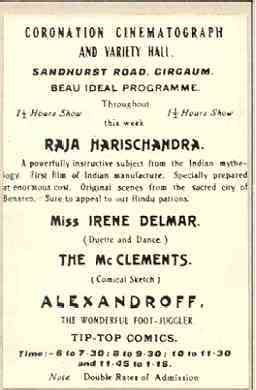
Raja Harishchandra, released in 1913, made by Dhundiraj Govind Phalke — known as Dadasaheb Phalke.
He had seen The Life of Christ in a Bombay cinema in 1910 and, by his own account, spent the screening imagining Indian gods on the screen instead. He mortgaged his life insurance, travelled to London to learn the technology and buy a camera, and came back to make a mythological.
He could not persuade any woman to appear in it. Acting was regarded as disreputable, and he advertised without success — including, reportedly, in the red-light district, where he was also refused. The role of the queen Taramati was played by a young man named Anna Salunke, who worked in a restaurant.
The film was a substantial success, and Phalke made around ninety more. India's highest award in cinema is named after him.
Why did Indian cinema fragment into so many languages?
Because sound arrived, and India had no single spoken language for it to arrive in.
Silent films circulated across the whole subcontinent with title cards translated as needed. The first Indian sound film, Alam Ara, came in 1931 — and from that moment a film had to choose a language, and therefore an audience.
Distinct industries formed almost immediately around the major languages: Hindi in Bombay, Bengali in Calcutta, Tamil in Madras, Telugu, Marathi, Malayalam, Kannada, and later Punjabi, Bhojpuri, Assamese and others.
The nicknames — Bollywood for Hindi cinema, Tollywood for Telugu and originally for Bengali cinema in Tollygunge, Kollywood for Tamil, Mollywood for Malayalam — are journalistic and disliked by many people working in those industries, since they frame everything as a derivative of Hollywood.
The scale is worth stating precisely. Hindi cinema is the most widely exported but is not a majority of Indian production; in several recent years, Telugu and Tamil films have out-earned Hindi ones at the Indian box office.
Why the songs
Why do Indian films have songs in them?
Because Indian performance traditions had never separated them, and the film industry inherited a form rather than inventing one.
Sanskrit drama, folk theatre forms across the country, and the nineteenth-century Parsi theatre from which the early Bombay industry drew most of its personnel all combined dialogue, music and dance as a matter of course. There was no tradition of spoken drama without music to depart from.
Alam Ara had seven songs. Some early films had dozens — one 1932 film reportedly had over seventy.
The songs also do specific narrative work, which is why they persisted long after the tradition's origin was forgotten. They compress time. They allow emotion to be stated at an intensity dialogue could not carry. And under censorship rules that forbade depicting physical intimacy, the song sequence was where a relationship could be expressed at all — which is the real explanation for the much-mocked convention of a couple suddenly appearing in Switzerland.
What is a playback singer?
Someone who records the songs that the actors then mime to on screen, and in Indian cinema they are stars in their own right — often more famous and longer-lasting than the actors.
The system began in the 1930s when recording and filming simultaneously proved impractical, and it became permanent because it separates two very different skills. An actor need not be able to sing, and a singer need not be able to act.
The careers this produced are extraordinary. Lata Mangeshkar recorded across seven decades and in dozens of languages, and her voice defines the sound of Hindi cinema for two generations. Mohammed Rafi, Kishore Kumar, Asha Bhosle, S. P. Balasubrahmanyam and K. J. Yesudas are comparable figures.
The film song is also India's popular music industry. Unlike most countries, where film music is a subsidiary of a larger pop industry, in India the film song has historically been the mainstream — which is why the music director of a film is a headline credit and why a soundtrack is released before the film as marketing.
The traditions
What did Satyajit Ray do?
Made Pather Panchali in 1955 with no experience, no money and a mostly amateur crew, and put Indian cinema onto the international map permanently.
Ray was a commercial artist in Calcutta. He had illustrated an edition of Bibhutibhushan Bandyopadhyay's novel about a poor Brahmin family in rural Bengal, saw Bicycle Thieves in London and decided that was the way to make it.
Production ran for nearly three years because he kept running out of money, shooting at weekends when he could pay the crew, pawning his wife's jewellery, and eventually being funded by the West Bengal government under a road-development budget line because nobody could classify it otherwise. Several actors visibly aged during the shoot, which he wrote into the film.
It won at Cannes and became the first of the Apu Trilogy. Ray went on to make around three dozen films, wrote the scripts, designed the posters, and from Teen Kanya onwards composed the music himself. He also wrote children's detective fiction and science fiction in Bengali that remains widely read.
He received an honorary Academy Award in 1992, filmed in his hospital bed weeks before his death.
What was Parallel Cinema?
A movement from the late 1950s, running alongside the commercial industry, making realist films on small budgets — often with state funding through the Film Finance Corporation, later NFDC.
Ritwik Ghatak, Mrinal Sen, Shyam Benegal, Adoor Gopalakrishnan, Girish Kasaravalli, Mani Kaul and others. Their films dealt with caste, land, Partition, and the failures of the post-independence state, in a register the commercial industry did not touch.
It also produced the actors the commercial industry later absorbed — Naseeruddin Shah, Om Puri, Shabana Azmi, Smita Patil — which is the most visible legacy, since the acting standard in mainstream Hindi cinema changed once those performers crossed over.
The movement declined in the 1990s as state funding contracted and the video market changed distribution.
What is a "masala" film?
A commercial film that deliberately combines several genres — action, romance, comedy, melodrama, songs — into one three-hour package, named after a mixture of spices.
It is a design principle rather than a failure of focus. A single film had to satisfy an entire family and a socially mixed audience buying tickets at several price points in the same hall, so it was built to contain something for each.
The form was consolidated in the 1970s, particularly around Amitabh Bachchan's "angry young man" persona in films written by Salim-Javed. Sholay (1975) is the canonical example, and it ran continuously in one Bombay cinema for over five years.
The films of that decade are politically legible: the angry young man was a figure of a period of unemployment, inflation, industrial unrest and the Emergency, and he is angry at institutions rather than at individuals.
The industry now
How does an Indian film make money?
Differently from a Hollywood film, and the difference has grown.
Theatrical revenue is split with exhibitors and varies heavily by state, since entertainment taxation was a state subject before GST and cinema pricing is politically sensitive — Tamil Nadu has capped ticket prices for long periods.
Satellite rights — the price a television channel pays for the right to broadcast — became a large revenue source in the 2000s, and for a period a film could be effectively profitable before release on the strength of them. Streaming rights have replaced that, and during the pandemic several films skipped cinemas entirely.
Music rights are sold separately and are substantial. Distribution is territorial, and a film is sold to distributors region by region, so a film can be profitable in one circuit and a loss in another.
Overseas markets matter enormously for Hindi and increasingly for Telugu and Tamil cinema, driven by the diaspora in the Gulf, North America, the UK and South East Asia.
Why are South Indian films suddenly everywhere?
Because dubbing and streaming removed the distribution barrier, and because the films were built for scale first.
Baahubali (2015 and 2017), made in Telugu and Tamil and dubbed into Hindi and other languages, was the demonstration: a film from outside the Hindi industry outgrossing Hindi films in the Hindi market. KGF, Pushpa and RRR followed the same route.
Two things made it possible. Multiplex chains and satellite channels created a national distribution network that did not exist before, and dubbing quality and speed improved to the point where a dubbed version could release simultaneously rather than months later.
RRR then did something no Indian film had: it built a following in the United States through word of mouth and won the Academy Award for Best Original Song in 2023.
What are the biggest Indian films and stars, by the numbers?
Box office comparisons are unusually unreliable in India, because reporting is not audited, producers announce their own figures, and rupee inflation over decades makes historical comparison meaningless without adjustment. Treat any list with caution.
What is solid: Baahubali 2, Dangal, RRR, Pathaan, Jawan and KGF 2 are among the highest-grossing. Dangal's total is dominated by China, where it earned more than in India — a market that opened dramatically to Indian films in the late 2010s and has since become harder to access.
On longevity, the record belongs to Dilwale Dulhania Le Jayenge, which ran continuously at the Maratha Mandir cinema in Mumbai from 1995 for over 25 years — the longest continuous theatrical run of any film anywhere.
The three Khans — Shah Rukh, Salman and Aamir, all born in 1965 — dominated Hindi cinema for roughly three decades, which is an unusually long run by any industry's standards. Rajinikanth in Tamil cinema has a relationship with his audience that has no equivalent: first-day screenings involve milk poured over cinema hoardings, and his statements on politics are treated as national news.
What comes next
The next page covers what happens when the camera is not pointed at actors — animation, documentary, and the medium that took over the living room.