Appearance
3.1 — The Mathematicians
Mathematics is the one field where a person working alone with paper can produce something that outlives every empire that existed while they wrote it. These are the lives that come up, with what they actually did and what it cost them.
The ancient world
Who was Archimedes, and what did he actually find?
A Greek from Syracuse in Sicily, roughly 287 to 212 BCE, and by most reckonings the greatest mathematician before Newton.
His own favourite result was that a sphere fits inside a cylinder of the same height and width with exactly two thirds of its volume and two thirds of its surface area. He asked for a sphere and cylinder to be carved on his tomb, and Cicero found that tomb overgrown a century and a half later using the carving to identify it.
He also calculated π to lie between 3.1408 and 3.1429 by squeezing a circle between polygons of 96 sides inside and outside it, worked out the law of the lever and of buoyancy, and in a lost work called The Method explained that he found results by imagining shapes balanced on a lever and then proved them rigorously afterwards — which is a strikingly modern admission that discovery and proof are different activities.
The bath story is probably not true in the form everyone knows, but the underlying problem — determining whether a crown was pure gold without damaging it — is exactly the kind of thing buoyancy solves. He was killed by a Roman soldier during the sack of Syracuse, reportedly while working on a diagram, after his machines had held off the siege for two years.
What happened to Hypatia?
Hypatia of Alexandria, born around 350–370 CE, taught mathematics, astronomy and Neoplatonic philosophy, edited and extended commentaries on Diophantus and Apollonius, and was widely respected across religious lines in a city that was tearing itself apart.
In 415 she was dragged from her carriage by a mob and murdered. The political context was a vicious struggle between the Roman prefect Orestes and the bishop Cyril; Hypatia was Orestes' ally and a convenient target.
She is often presented as the last scholar of the ancient world, killed by religious fanaticism, and that framing is too neat. Alexandrian scholarship continued after her, several of her own students were Christian, and the murder was as much factional politics as theology. What is not exaggerated is that a woman held a public chair of philosophy in the fourth century, and that no obvious successor did for a very long time.
The founders
Why is Euler on every page of mathematics?
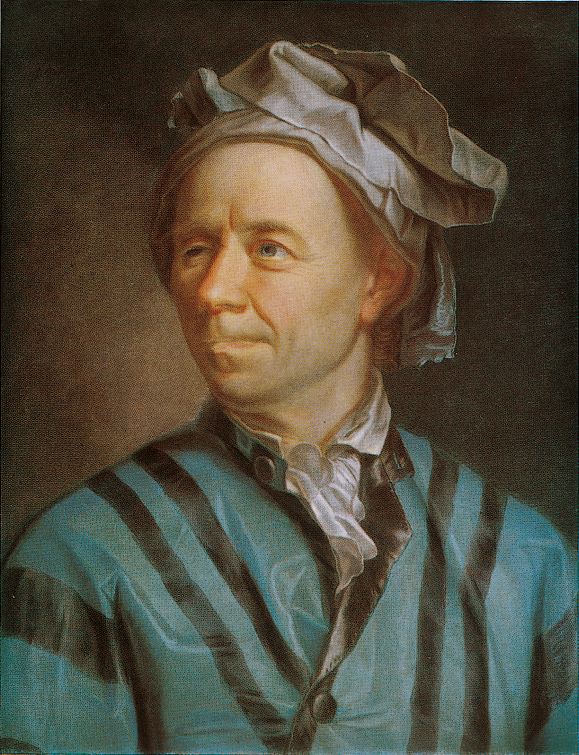
Because he invented most of the notation and roughly a third of the vocabulary.
Leonhard Euler (1707–1783), Swiss, working in St Petersburg and Berlin, published around 850 works. The collected edition has been in production since 1911 and is not finished. He wrote so much that for decades after his death the St Petersburg academy was still publishing his backlog.
The notation you use is largely his: f(x) for a function, e for the base of natural logarithms, i for the square root of minus one, \Sigma for a sum, and the modern use of \pi. He founded graph theory by solving the puzzle of the seven bridges of Königsberg — proving that no walk crosses each bridge exactly once, by throwing away the map and keeping only which land masses connect to which, which is the birth of the entire idea of a network.
And he found the identity that shows up in every list of beautiful equations:
e^{i\pi} + 1 = 0
Read aloud: e raised to the power i times pi, plus one, equals zero. It connects five constants that arrived in mathematics from completely unrelated directions — the base of growth, the imaginary unit, the ratio of a circle, the unit, and nothing — in one line.
He went blind. He lost his right eye in his twenties and the left to a cataract in his sixties, and produced roughly half his total output after that, dictating to assistants and doing the calculations in his head. He could recite the whole of Virgil's Aeneid from memory, and reportedly used his exceptional memory as a workspace.
What made Gauss "the prince of mathematicians"?

Range, and a refusal to publish anything he considered unfinished.
Carl Friedrich Gauss (1777–1855) was the son of a bricklayer and was spotted young. The schoolroom story — asked to sum the numbers from 1 to 100, he paired 1 with 100, 2 with 99 and so on to get 50 pairs of 101 — is well attested in outline and is a genuine insight rather than a trick.
At 21 he proved that a regular 17-sided polygon can be constructed with compass and straightedge, which Greek geometry had left open for two thousand years, and the result convinced him to choose mathematics over languages. He gave the first accepted proof that every polynomial equation has a solution among the complex numbers. He founded modern number theory in one book at 24. He worked out how to find a lost asteroid, Ceres, from three observations, inventing the method of least squares on the way — which is the ancestor of essentially all statistical fitting.
His motto was "few, but ripe". He worked out non-Euclidean geometry decades before Bolyai and Lobachevsky published it and kept it to himself, fearing the controversy. His diary, discovered in 1898, revealed a list of results he had found and never announced.
He also did enormous amounts of tedious practical work: a full geodetic survey of Hanover, measured personally in the field, and pioneering work on magnetism and the telegraph with Wilhelm Weber.
Who was Évariste Galois, and why does everyone tell his story?
Because he answered a question that had been open for three hundred years, and died at 20 in a duel.
Galois (1811–1832), French, failed the entrance examination to the École Polytechnique twice, had his papers repeatedly lost or dismissed by the academy — Cauchy mislaid one, Fourier died holding another — and spent time in prison for republican politics.
The question was: which equations can be solved by a formula? Everyone knows the quadratic formula. There are messier equivalents for cubics and quartics. For fifth-degree equations nobody could find one, and Abel had shown shortly before that none exists. Galois answered the deeper question of why, and which particular equations are solvable, by inventing a completely new object: he attached to each equation a group, describing the symmetries among its solutions, and showed that whether the equation can be solved by a formula is a property of that group's structure.
Group theory now runs through crystallography, particle physics, chemistry and cryptography. He wrote the essentials down the night before the duel, in a letter to a friend with notes in the margin saying he had no time. He was shot in the abdomen, left where he fell, and died the next day. His work was published fourteen years later.
The nineteenth and twentieth centuries
What did Ada Lovelace actually do?
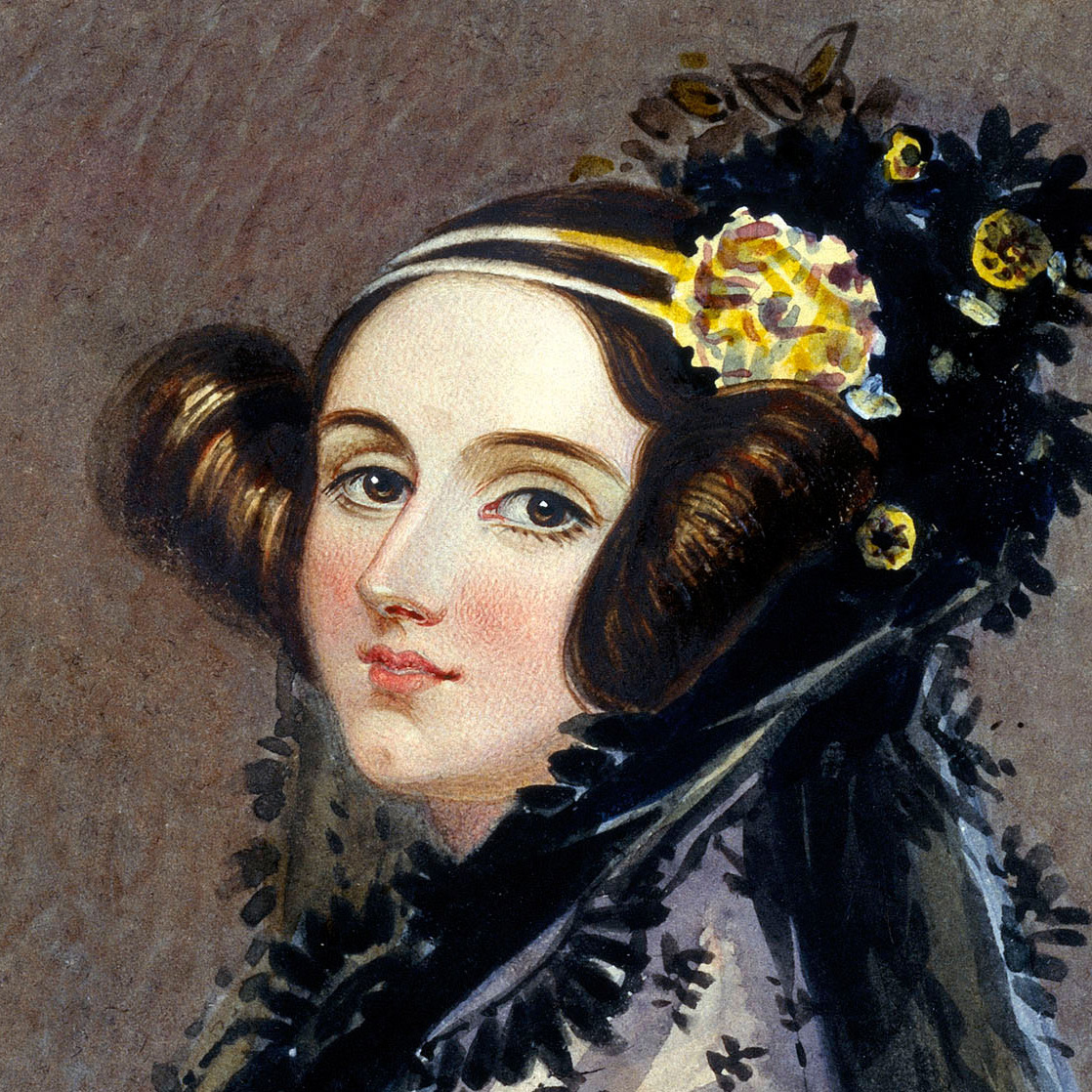
She translated an Italian engineer's article about Charles Babbage's proposed Analytical Engine and appended notes of her own that were three times the length of the original.
Two things in those notes matter. Note G contains a step-by-step procedure for the machine to compute a sequence of numbers, complete with a loop — widely regarded as the first published algorithm written for a machine to execute. Whether it counts as the first computer program depends on definitions, and Babbage had written similar sequences earlier without publishing them.
The second thing is the more original and less disputed. She was the first person on record to see that such a machine need not be about numbers at all. She wrote that if the relations between pitched sounds could be expressed in the machine's terms, it could compose music of any complexity. Babbage saw a calculator; Lovelace saw a general symbol processor, which is what a computer actually is.
She was Byron's daughter, never met him, was pushed towards mathematics by a mother determined to suppress any poetic tendency, and died of cancer at 36.
Why is Emmy Noether the most important mathematician most people cannot name?
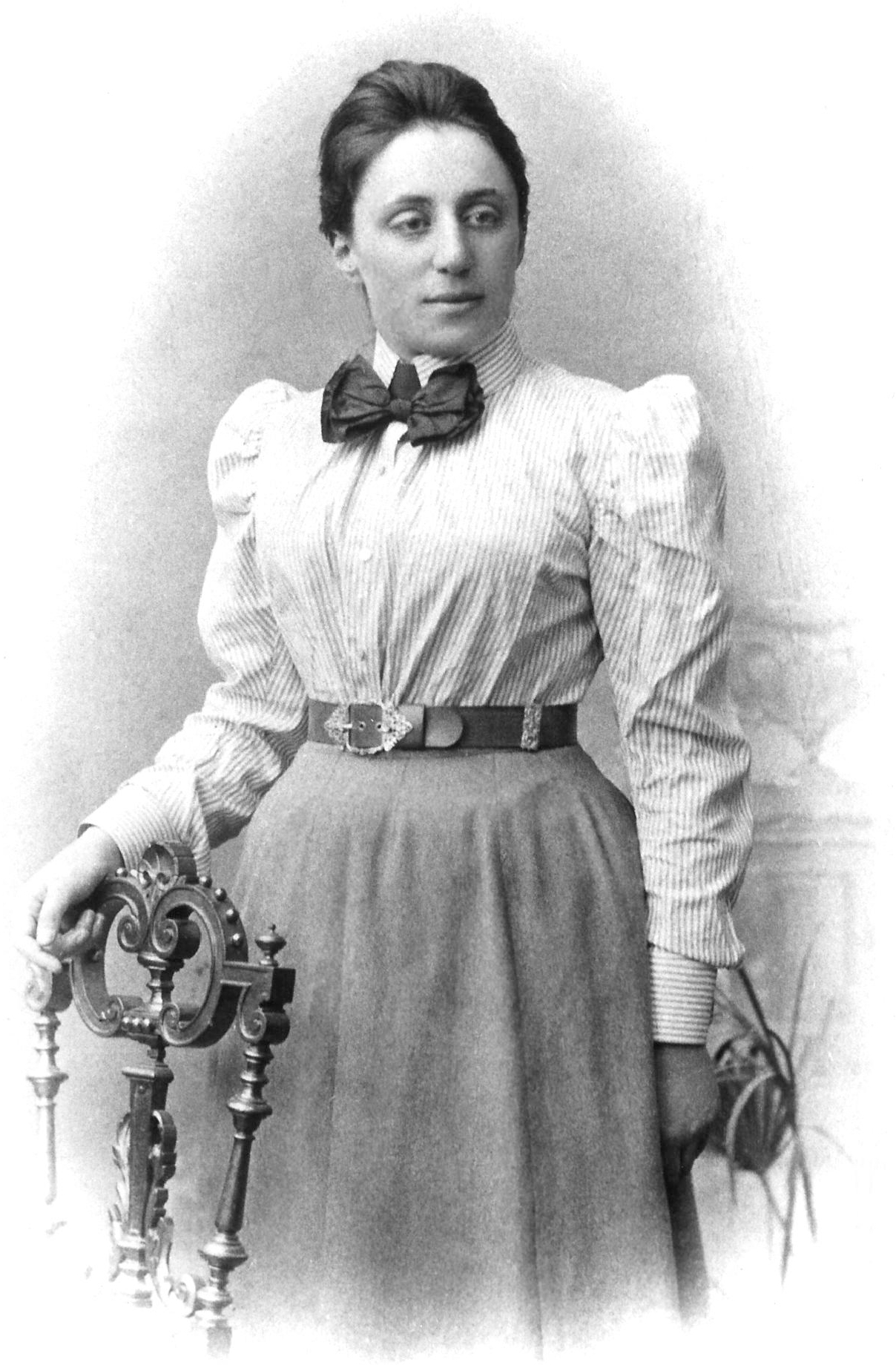
Because her most famous result is a physics theorem, and her most influential work is a way of thinking that is now so standard it is invisible.
Noether's theorem (1918) says that every continuous symmetry of a physical system corresponds to a conserved quantity. In plain terms: if the laws of physics work the same today as tomorrow, energy is conserved. If they work the same here as a metre to the left, momentum is conserved. If they work the same whichever direction you face, angular momentum is conserved.
That is not a poetic analogy. It is a theorem with a proof, and it turned conservation laws from mysterious facts about the universe into consequences of its symmetries. Every modern physical theory is built by choosing symmetries and reading off what must be conserved.
Her deeper legacy is abstract algebra. She reorganised the subject around structures and the maps between them rather than around calculations with particular objects, and that style — now simply how algebra is done — spread through topology, geometry and eventually computer science.
She worked at Göttingen for years without pay or title, because the university would not appoint a woman; Hilbert lectured under his own name with her doing the teaching and reportedly told the faculty senate that a university is not a bathhouse. She was dismissed in 1933 for being Jewish, moved to Bryn Mawr in America, and died two years later at 53 after surgery.
Who was Ramanujan, and how did he find what he found?
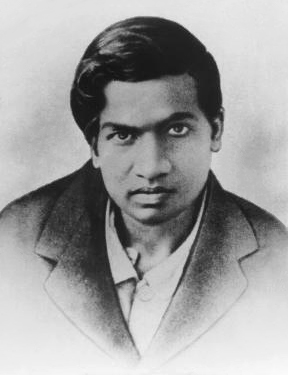
Srinivasa Ramanujan (1887–1920) grew up in Kumbakonam in Tamil Nadu, taught himself from a second-hand book of formulas, failed college twice because he would study nothing but mathematics, and worked as a clerk at the Madras Port Trust while filling notebooks with results nobody had seen.
In 1913 he wrote to G. H. Hardy at Cambridge, enclosing about 120 theorems. Hardy's account of reading it is famous: several results he knew, several he could prove with effort, and several that "defeated me completely; I had never seen anything in the least like them before" — and his conclusion was that they had to be true, because no one would have the imagination to invent them.
Hardy brought him to Cambridge in 1914. Their collaboration produced, among much else, an exact-looking formula for the number of ways an integer can be written as a sum of smaller integers, which is a problem whose answer grows explosively and had resisted everyone.
The strange thing about Ramanujan is the absence of proof. He wrote down results as complete statements, often with no derivation, and said that a family goddess, Namagiri, revealed them to him in dreams. What is verifiable is that the results are overwhelmingly correct — a small number are wrong, which itself argues against them coming from anywhere infallible — and that mathematicians have spent a century proving them properly.
The mock theta functions, which he described in his last letter to Hardy months before his death, were not properly understood until the 2000s, when they turned out to connect to modular forms used in the physics of black holes.
He was vegetarian, cooked for himself in wartime Britain where vegetables were scarce, fell seriously ill — probably hepatic amoebiasis, diagnosed decades later from his records — and returned to India, where he died at 32.
And the taxi story is real. Hardy visited him in hospital and remarked that his cab number, 1729, seemed dull. Ramanujan replied immediately that it is the smallest number expressible as the sum of two cubes in two different ways: 1^3 + 12^3 and 9^3 + 10^3.
What is Turing's actual contribution, apart from the war?
Alan Turing (1912–1954) answered a question in mathematical logic and invented computer science by accident.

In 1936 he was attacking Hilbert's Entscheidungsproblem — is there a mechanical procedure that can decide whether any given mathematical statement is provable? To answer it he had to define what "mechanical procedure" means, and he did so by imagining the simplest possible machine: an endless paper tape divided into squares, a head that can read and write one symbol at a time and move one square either way, and a table of rules.
That imaginary device is now called a Turing machine, and it defines what a computer can do. He then showed there is a specific question no such machine can answer — whether an arbitrary program will ever stop — and therefore no mechanical procedure decides all mathematics. The answer to Hilbert was no, and the by-product was the theoretical foundation of the field.
He also described a universal machine: one that reads a description of any other machine from its tape and behaves like it. That is the idea of software, four years before any electronic computer existed.
After the war he worked on early computer design, wrote the 1950 paper that proposed the imitation game now called the Turing test, and did original work in biology, showing mathematically how two chemicals diffusing and reacting can spontaneously produce spots and stripes — a mechanism confirmed in real animals decades later.
He was prosecuted in 1952 under the law against homosexual acts, chose chemical treatment over prison, lost his security clearance, and died in 1954 of cyanide poisoning at 41. He received a formal British apology in 2009 and a pardon in 2013.
The ones who changed the questions
Who was Cantor, and why did counting infinity break him?
Georg Cantor (1845–1918) asked whether all infinities are the same size, and proved they are not.
His method is simple enough to follow. Two sets are the same size if you can pair their members off exactly. On that definition, the whole numbers and the even numbers are the same size, which already offends intuition — pair 1 with 2, 2 with 4, 3 with 6, and nothing is left over on either side. The same works for fractions.
Then he showed the real numbers cannot be paired off with the whole numbers. Suppose you had a complete list of all the numbers between 0 and 1. Build a new number by taking the first digit of the first, the second digit of the second, and so on, and changing each one. The result differs from every number on your list in at least one place, so it was not on the list, so the list was not complete. The infinity of the continuum is strictly larger than the infinity of counting, and there is an endless tower of larger infinities above it.
Leopold Kronecker, a senior figure who believed mathematics should deal only in whole numbers, blocked his career and called him a corrupter of youth. Cantor suffered from severe depression through his later life and died in a sanatorium. His set theory is now the foundation on which the rest of mathematics is formally built.
What is the Bourbaki group?
Nicolas Bourbaki has an entry in the bibliography of twentieth-century mathematics, a substantial body of published work, and does not exist.
In the 1930s a group of young French mathematicians — André Weil, Henri Cartan, Jean Dieudonné and others — decided the French textbooks were a shambles and set out to rewrite mathematics from the foundations in a single rigorous style. They published collectively under an invented name, met in secret, applied for membership of the American Mathematical Society under the pseudonym, and kept a straight face for decades.
The joke had a serious purpose. Writing anonymously meant no individual could claim a chapter and no individual style could dominate, and the result was several thousand pages that reshaped how a generation was taught. The style — extremely abstract, no pictures, everything from axioms — was also criticised for stripping intuition out of the subject, and the argument about whether that was worth it is still live.
What comes next
The next page moves to physics — the people who worked out what everything is made of and how it moves, several of whom were also the mathematicians on this page.