Appearance
1.4 — Getting Around: Rails, Roads, Air and Sea
Transport is the branch of engineering where a small design decision is repeated a billion times, so every detail has been argued about by somebody. The width between two rails was set by a road-building habit. The shape of an aircraft window was settled by three crashes. The button on the wall of a train carriage exists because of a specific kind of accident.
The train
What are the parts of a railway coach, from the wheels up?

Start at the rail. A wheelset is two wheels rigidly fixed to one axle — they cannot turn at different speeds, which matters in a moment. Two or three wheelsets are held in a small frame called a bogie (in North America, a truck), with springs between the axleboxes and the frame, and a second set of springs between the frame and the coach body. Two bogies carry one coach, and the coach sits on a pivot at the centre of each, free to swivel. That is what lets a twenty-four-metre rigid box go round a curve — the body stays straight and the bogies steer under it.
Above that is the underframe, the structural floor beam that carries the whole load, and at each end of it the coupler that joins one coach to the next, plus the buffers or the crash element that absorbs a shunt. Running along the underframe is the brake pipe, a continuous air line down the whole train.
The body itself is a stressed shell: side walls and roof welded into a tube so the whole coach acts as a beam rather than the floor doing all the work. Inside are the vestibules at each end (the flexible gangway between coaches), the doors, the toilets at the coach ends over the wheels where floor vibration is worst and sleeping is unlikely, and the berth or seat bays between them.
Why does a train's brake fail safe?
Because the air line does the opposite of what you would guess. The brake pipe running the length of the train is kept pressurised, and pressure is what holds the brakes off. Each coach has its own reservoir and a valve; when pipe pressure drops, the valve lets that local reservoir push the brake blocks onto the wheels.
So if a coupling breaks and the train splits, the pipe is torn open, pressure falls to zero on both halves, and both halves brake themselves automatically. The same thing happens if a hose bursts, a valve fails, or a passenger pulls the emergency chain, which simply vents the pipe. George Westinghouse patented this in 1872 and it is the reason railways stopped being lethal at scale.
This is a design principle worth carrying well outside railways: arrange your system so the failure of any component produces the safe state rather than the dangerous one. A lift brake that is held open by an electromagnet and clamps when power is lost is the same idea.
How does the emergency talk-back unit in a coach work?
It is a passenger-to-crew intercom, fitted near the doorways of EMU, metro and newer mainline coaches, and it is deliberately different from the emergency chain beside it.
Press the button and it does two things. It lights an indicator in the driving cab and on the outside of that coach, so the crew know which coach and which unit. And it opens a two-way voice link over a wire running the length of the train to the loco pilot or guard, so you can say what is actually happening. The unit is a rugged speaker-microphone with a single button, because it has to work for a frightened person in the dark.
The reason it exists alongside the chain is that stopping a train is often the wrong response. A medical emergency, a fire, an assault or a person trapped in a door are all situations where the crew needs to know what is wrong before deciding whether to stop, where to stop, and what to call for. A train halted in a tunnel or on a bridge is far more dangerous than the same train continuing two minutes to a platform. The chain removes the decision; the talk-back returns it to the person with the information to make it.
Why is the standard rail gauge 1,435 millimetres — four feet eight and a half inches?
Because George Stephenson used it, and everybody after him had to match whatever was already laid.
Stephenson had been building colliery wagonways in north-east England, where the tracks were roughly at that spacing already, and he carried it to the Stockton and Darlington in 1825 and the Liverpool and Manchester in 1830. The half inch was added to give the flanges a little more room. When Britain's railways later had to interconnect, a Royal Commission chose the gauge that most of the existing mileage already used, and British engineers then exported it across the world.
The much-repeated story that this traces back to the wheel ruts of Roman chariots is a good story with no evidence behind it. What is true is duller: cart-building was a local craft with a locally settled axle width, wagonways copied carts, and Stephenson copied wagonways.
India has its own answer to the same question. The country was built mostly on broad gauge at 1,676 mm, chosen by Lord Dalhousie in 1851 partly for stability in high winds on open plains, and much of the twentieth century was then spent on Project Unigauge, converting thousands of kilometres of metre and narrow gauge to match, because a break of gauge means every passenger and every tonne of freight has to change train at the join.
Why do the wheels not fall off on a curve, if both are fixed to one axle?
Because the wheels are not cylinders. Each wheel is a shallow cone, thicker near the flange on the inside and thinner towards the outside.
On a straight track the wheelset rides centred. Push it slightly to one side and the wheel on that side now contacts the rail on a larger diameter while the other contacts on a smaller one. Rigidly joined, they must turn at the same rate, so the larger-diameter wheel travels further per revolution and the whole wheelset steers itself back towards the centre. The wheelset is a self-correcting mechanism, not a passive one.
On a curve the same geometry does the necessary work: the wheelset shifts outward, the outer wheel runs on the bigger diameter and covers the longer outside arc while the inner runs on the smaller. The flanges are a last resort, not the steering. A train whose flanges are grinding is a train where something has gone wrong.
The road
Why is there an SOS button in commercial cars and taxis now?
Because it was made compulsory by the Indian government, and the requirement is more interesting than the button.
After the 2012 Delhi gang rape and murder, money from what became the Nirbhaya Fund was directed at making public transport traceable. The technical result was AIS-140, an automotive standard requiring all newly registered public service vehicles — taxis, app cabs, buses, school vehicles — to carry a Vehicle Location Tracking device with a satellite positioning receiver, a mobile data connection, an internal battery so it keeps reporting if power is cut, and one or more panic buttons within reach of passengers.
Pressing it does not call the police in the way a phone does. It sends an alert with the vehicle's identity and live position over the mobile network to a state-level Emergency Response Support System control room, which then has both the location and a channel back to the driver's operator. The buttons are red, physically distinctive, and usually more than one so that a passenger anywhere in the vehicle can reach one.
Whether it works is a separate question from whether it is fitted, and enforcement has been uneven across states — but the button you are seeing is a legal mandate, not a manufacturer's idea.
Why is a traffic light red, amber and green in that order?
The colours came from the railways, which had them first, and red for danger was already established before there were signals at all — red is scattered least by fog and haze, so it carries furthest in bad weather, and it was the conventional danger colour by the 1840s.
Green is the awkward one. Early railway signals used white for clear and green for caution, and that combination killed people: a red lens falling out of a signal lamp left a plain white light, which a driver read as "proceed". Britain reassigned green to clear and dropped white entirely, and road signals inherited the finished scheme.
The vertical order is not arbitrary either. Red is at the top so that a colour-blind driver, who may not distinguish red from green reliably, can read the signal by position alone. For the same reason horizontal signals put red on the left in right-hand-drive countries and on the outermost end generally.
Why do speed bumps work when a fine does not?
Because they change the payoff at the moment of the decision rather than afterwards. A fine is a small probability of a large cost at some future date, discounted by every driver who thinks they will not be caught. A bump is a certainty of an immediate unpleasant one, applied to everybody, with no enforcement cost and no discretion.
The engineering detail is that the profile is tuned to a target speed. A rounded hump of a given height and length is barely noticeable at 25 km/h and violent at 50, because what you feel is vertical acceleration, which rises with the square of the speed. The bump is a speed filter built out of geometry.
What do the numbers on a car tyre mean?
A marking like 205/55 R16 91V reads as five separate facts. 205 is the tread width in millimetres. 55 is the aspect ratio — the sidewall height as a percentage of the width, so this sidewall is 112.75 mm; a lower number means a shorter, stiffer sidewall, sharper steering and a harder ride. R means radial construction, where the internal cords run across the tyre rather than diagonally. 16 is the wheel diameter in inches, an imperial number sitting in the middle of a metric one for purely historical reasons. 91 is a load index, here 615 kg per tyre. V is the speed rating, here 240 km/h.
There is usually a four-digit code elsewhere on the sidewall, like 2419, meaning the tyre was made in week 24 of 2019. Rubber ages whether or not it is used, and a tyre more than about six years old is worth inspecting regardless of tread depth.
The air
Why are aircraft windows rounded?
Because square ones killed people, and the investigation that established why is one of the most important in engineering history.
The de Havilland Comet, the first jet airliner, entered service in 1952 with roughly rectangular windows. In 1954 two Comets broke up in flight within three months. The investigation, led by the Royal Aircraft Establishment, put a whole airframe in a water tank and pressurised and depressurised it thousands of times.
The cabin is a pressure vessel: every flight inflates it and every landing deflates it. At a sharp corner, stress does not distribute — it concentrates, and at the corner of a square cut-out in a pressurised skin the local stress can be several times the average in the surrounding metal. Repeat that cycle a few thousand times and a crack starts at the corner and runs. The Comet's failures actually began at a cut-out for an antenna, but the principle and the fix were the same: a rounded corner gives the stress a curve to flow around, spreading it out. Every pressurised aircraft since has oval windows, and the lesson generalised into the whole discipline of fatigue analysis.
Why does the black box survive when the aircraft does not, and why is it orange?
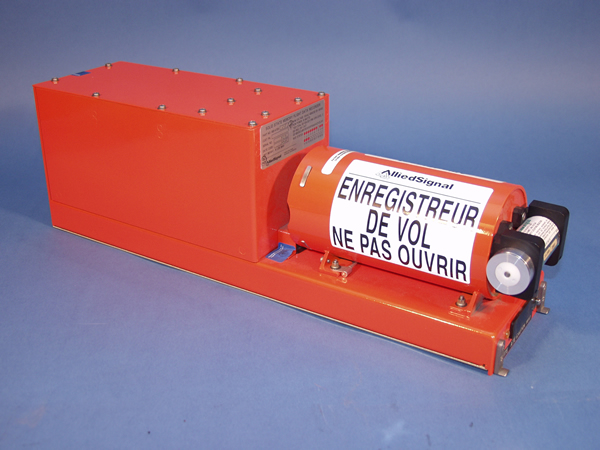
It is orange precisely so it can be found — the name "black box" is journalistic and predates the modern device. The requirement is that it survive an impact of 3,400 g, a fire of 1,100 °C for an hour, and immersion under 6,000 metres of seawater for a month.
It manages that because almost none of it is recorder. The memory chips sit inside a small stainless or titanium armoured cylinder, wrapped in a high-temperature insulating material — and the trick with fire is that the insulation contains a substance that absorbs heat by changing phase, holding the interior near its melting point while it does so, in the same way that a pan of boiling water cannot exceed 100 °C while there is still water in it. An underwater locator beacon on the outside pings for thirty days.
Two recorders are carried: the flight data recorder, logging hundreds of parameters many times per second, and the cockpit voice recorder. The inventor of the combined idea was David Warren, an Australian chemist, in the 1950s — whose own father had died in an air crash — and who was told for years that airlines and pilots did not want it.
Why do you have to open the window shade for take-off and landing?
Because those are the phases where nearly all accidents happen, and the shade up serves four purposes at once. The cabin crew can see outside — engine fire, a wing damaged, debris on the runway, water rather than ground. Rescuers outside can see in. Passengers' eyes are adjusted to the outside light level, so if the cabin loses lighting nobody is blind for the thirty seconds that matter. And in an evacuation, you can see which side of the aircraft the fire is on before you choose a door.
The same reasoning explains the other take-off rituals: dimmed cabin lights at night for the same eye-adaptation reason, seat backs upright so the person behind you has a clear path out, and tray tables stowed so nothing traps you at the hip.
Why is airline food bland?
It mostly is not — your sense of taste is. At cruise altitude the cabin is pressurised to the equivalent of roughly 1,800 to 2,400 metres and the air is extremely dry, around 10 to 20 per cent humidity. Dry nasal passages dull the sense of smell, which supplies most of what you experience as flavour, and low pressure reduces sensitivity further. Studies have measured drops of around 30 per cent in perception of sweet and salty.
Umami and sour hold up better, which is why tomato juice — rarely ordered on the ground — is one of the most requested drinks in the air, and why airline caterers season aggressively and lean on tomato, cheese and broth flavours.
The sea
What is the Plimsoll line painted on a ship's hull?

It is a legal maximum loading mark, and it exists because ship owners were deliberately overloading vessels and insuring them.
Overloading reduces freeboard, the height of deck above water, which is what stops waves boarding and what gives the hull the reserve buoyancy to right itself. An overloaded ship rides low, ships water, and sinks — and in the nineteenth century a heavily insured old ship that sank with its crew could be a profitable outcome for its owner. These were called coffin ships.
Samuel Plimsoll, a British member of parliament, campaigned on this through the 1870s to the point of being censured for calling shipowners villains in the House. The Merchant Shipping Act of 1876 forced a load line onto every ship, and the position of the mark eventually came under state control rather than the owner's.
The several lines are not decoration. Water density changes with temperature and salinity, so the same ship floats deeper in warm or fresh water than in cold seawater. The comb of marks — TF, F, T, S, W, WNA — gives the correct limit for tropical fresh water down to winter North Atlantic.
Why did the shipping container change the world more than the ship?
Because it removed the part of shipping that was actually expensive, which was never the ocean crossing.
Before containers, cargo was break bulk: sacks, crates and barrels loaded piece by piece by gangs of dockers. A ship could spend more time in port than at sea, handling cost more than the voyage, theft was routine, and every transfer between ship, train and lorry meant unpacking and repacking.
Malcom McLean, an American trucking operator with no shipping background, sailed a converted tanker carrying 58 loaded truck bodies from Newark to Houston in 1956. The insight was that the unit of shipping should be a sealed box that never opens between factory and destination, and that ships, cranes, trains and lorries should all be built around that box. Once the dimensions were standardised internationally in the 1960s, the cost of moving goods across an ocean fell by something like ninety-five per cent — which is the actual mechanism behind globalised manufacturing, more than any trade agreement.
What comes next
The next page stays with things you use constantly and cannot see into at all — the file that holds a song, the chip that pays for your coffee by being waved near a machine, and the reason your phone can charge without touching anything.