Appearance
2.5 — 1900 to 1945
Forty-five years in which physics was rebuilt twice, aviation went from a twelve-second hop to bombing cities from the stratosphere, two wars killed something in the region of eighty million people, and the century ended its first half with an object that could destroy a city.
The physics that broke
1900 — Planck, reluctantly, invents the quantum
Max Planck was trying to solve a narrow, unglamorous problem: predicting the colours of light given off by a hot object. Every classical calculation gave an answer that ran to infinity at short wavelengths, which is obviously wrong, since a warm oven does not emit lethal ultraviolet.
He found the correct formula by assuming energy is exchanged in discrete lumps proportional to frequency, with a constant now written h. He described it as an act of desperation and spent years trying to eliminate the assumption. He did not believe it meant anything physical. Einstein did, in 1905, when he used the same lumpiness to explain the photoelectric effect — and it was that paper, not relativity, that won him the Nobel Prize.
1903 — twelve seconds at Kitty Hawk
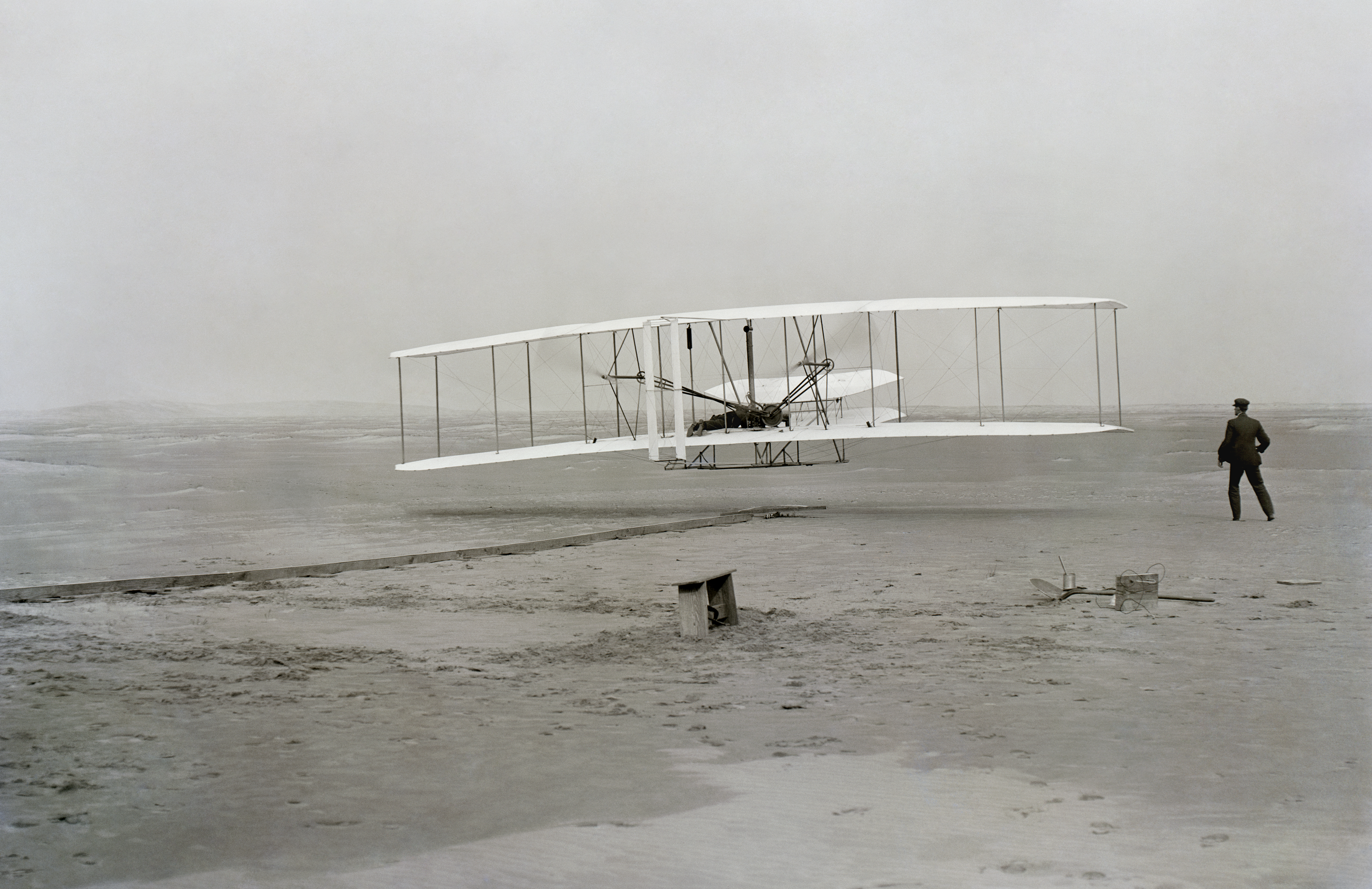
On 17 December, Orville Wright flew 37 metres in 12 seconds. The fourth flight that day, with Wilbur flying, covered 260 metres in 59 seconds.
They were bicycle makers, and that is the reason they succeeded where better-funded rivals failed. Everybody else was chasing power and lift. The Wrights understood from bicycles that an unstable machine can be controlled by a skilled rider, so they concentrated on control in three axes — a rudder for yaw, an elevator for pitch, and their key invention, wing warping, which twisted the wingtips in opposite directions to roll the aircraft. Modern ailerons do the same job.
They also built their own wind tunnel after finding the published lift tables wrong, tested around two hundred wing shapes, and learned to fly in gliders for three seasons before adding an engine. Their brother-in-law's designs, their own propeller theory — nobody had realised a propeller is a rotating wing — and their machine shop did the rest.
Almost nobody believed it for five years. American newspapers largely ignored the story, and the Wrights, obsessive about their patent, flew in private. Public demonstrations in France in 1908 ended the doubt overnight.
1905 — Einstein's four papers
A 26-year-old examiner in the Swiss patent office published four papers in one year, any one of which would have made a career.
March: light behaves as discrete quanta, explaining the photoelectric effect. May: the jittering of pollen grains in water — Brownian motion — is caused by collisions with individual molecules, giving the strongest evidence to that point that atoms are real, which was still disputed. June: special relativity, resolving a contradiction between Newton's mechanics and Maxwell's electromagnetism by accepting that the speed of light is the same for every observer and letting time and length give way instead. September: a three-page afterthought deriving E = mc^2.
He was doing this in the evenings, having failed to obtain an academic post.
1915 — general relativity
Special relativity had left gravity out, and it could not simply be added, because Newtonian gravity acts instantaneously across distance and nothing may travel faster than light.
Einstein's answer took eight years and required mathematics he had to be taught. Gravity is not a force. It is the shape of spacetime, curved by mass and energy, and objects moving freely follow the straightest available path through that curved geometry. A planet orbits the sun for the same reason a marble circles a funnel.
It made a testable prediction: light passing a massive body should bend. In 1919, expeditions led by Arthur Eddington photographed stars near the sun during a total eclipse and found the shift. The Times of London ran the headline "Revolution in Science", and Einstein became the first celebrity scientist. The timing mattered too — a British team confirming a German theory the year after the war ended was reported as a story about reconciliation.
The first war
1914–1918 — the war that nobody planned
Sparked by the assassination of Archduke Franz Ferdinand in Sarajevo on 28 June 1914, but the spark is the least interesting part. A web of alliances meant that a local Balkan crisis pulled in every major power within five weeks, and the mobilisation timetables — trains scheduled years in advance — meant that beginning to mobilise was almost impossible to stop.
The war produced a stalemate nobody had anticipated because defensive technology had outrun offensive tactics. Machine guns, barbed wire, and artillery firing from beyond the horizon made an infantry advance across open ground close to suicide, while the internal combustion engine was not yet good enough to restore movement. The result was a line of trenches from the Channel to Switzerland that moved by a few kilometres in four years, at a cost of millions.
Around 1.3 million Indian soldiers served, mostly for the promise of political progress afterwards, and around 74,000 died. The promise was not kept, which fed directly into what followed.
The peace terms at Versailles in 1919 imposed reparations and territorial losses on Germany that Keynes — present as a British delegate — publicly predicted would wreck the European economy and produce another war. He resigned and wrote a book saying so.
1918–1920 — the influenza pandemic
It killed somewhere between 25 and 50 million people, more than the war it followed, and possibly far more; India alone lost something in the region of 12 to 18 million.
It is called Spanish flu for a reason that says everything about wartime information. It did not start in Spain. Spain was neutral and its press was uncensored, so Spanish newspapers reported the epidemic freely while the belligerent countries suppressed news of it to protect morale. The public in France, Britain and Germany read about a Spanish disease.
Its strangest feature was that it killed young healthy adults disproportionately, which most influenza does not — probably because a strong immune system overreacted. The virus was recovered and sequenced in the 1990s and 2000s from bodies preserved in Alaskan permafrost.
Between the wars
1929 — the Wall Street crash
Share prices had risen through the 1920s, heavily on borrowed money — a buyer could put down ten per cent and borrow the rest, which magnifies gains and losses alike. In late October the market fell about 25 per cent in two days and kept falling for nearly three years, ending down about 89 per cent from its peak.
The crash did not cause the Depression by itself. What turned a market collapse into a decade of mass unemployment was the chain that followed: banks failed and took people's savings with them, since deposits were not insured; the money supply contracted sharply; countries raised tariffs against each other and world trade fell by two thirds; and governments, believing balanced budgets were the responsible response, cut spending into a collapse.
Nearly every institution now taken for granted — deposit insurance, securities regulation, central banks that expand money in a crisis, unemployment insurance — is a response to this, and Volume VIII covers the economics properly.
1930 — the Salt March
Gandhi walked 385 kilometres from Sabarmati to Dandi over 24 days and picked up a lump of natural salt from the beach, breaking a law that made it illegal for Indians to produce or sell salt and required them to buy it from a government monopoly that taxed it.
Choosing salt was tactically brilliant. It is not an elite grievance; everyone needs it, it costs nothing to make from the sea, and the injustice can be explained in one sentence and broken by one gesture. Journalists could photograph it. The scale of the response — tens of thousands arrested, including Gandhi — made the situation ungovernable by consent, which was the entire strategy.
The Indian independence movement is one of the most studied templates for non-violent resistance, and was explicitly used as a model by the American civil rights movement.
The second war
1939–1945 — the deadliest event in human history
It killed something in the region of 70 to 85 million people, most of them civilians, and it was several wars joined: a European war from September 1939, a war in China that had been running since 1937, and a Pacific war from December 1941.
Three things distinguish it from the war before. Air power made civilians targets by design rather than by accident, from Guernica and Chongqing to the firebombing of Hamburg, Dresden and Tokyo. The Holocaust: the industrialised murder of six million Jews, along with Roma, disabled people, Soviet prisoners, homosexuals and political prisoners, planned bureaucratically and carried out with railway timetables and factory logic. And the war was won substantially in laboratories — radar, code-breaking, the proximity fuse, penicillin at scale, and finally the bomb.
The Bengal famine of 1943 killed around three million people in British India, during the war, in a province with food available elsewhere in the country. Its causes are still argued: a cyclone, the loss of Burmese rice imports, wartime procurement policies that pushed prices out of reach, a denial policy that removed boats from coastal areas, and a refusal at the highest levels of the British government to divert shipping for relief.
1943–1945 — Bletchley Park and the machines that read the mail
German military communications were encrypted with the Enigma machine, whose settings changed daily and whose keyspace was astronomically large. Polish mathematicians — Marian Rejewski, Jerzy Różycki and Henryk Zygalski — broke early Enigma in the 1930s and handed their work to Britain and France weeks before the invasion of Poland.
At Bletchley Park, Alan Turing and others built on it. The insight that made it practical was not brute force but exploiting the machine's own design flaw — Enigma could never encrypt a letter as itself — combined with cribs, guessed fragments of plaintext such as the daily weather report. The electromechanical bombe machines tested settings and discarded contradictions at speed.
For the more complex Lorenz cipher used by the German high command, the engineer Tommy Flowers built Colossus, using 1,500 valves at a time when everyone told him valves were too unreliable in quantity. It ran in December 1943 and is the first electronic programmable digital computer. It was dismantled and classified after the war, so credit for the first computer went elsewhere for thirty years, and Flowers was never properly compensated.
Turing was prosecuted in 1952 for homosexuality, chemically castrated under the sentence, stripped of his security clearance, and died in 1954 of cyanide poisoning at 41.
1945 — Hiroshima and Nagasaki
On 6 August a uranium bomb was dropped on Hiroshima and on 9 August a plutonium bomb on Nagasaki, killing somewhere between 130,000 and 225,000 people, most of them immediately and the rest from burns, injury and radiation over the following months. Japan surrendered on 15 August.
The scientific chain is short and worth seeing whole: Becquerel's cloudy afternoon in 1896, Rutherford's nucleus in 1911, Chadwick's neutron in 1932, Meitner and Frisch's explanation of fission in 1938, and a weapon in 1945 — forty-nine years from an accident with a photographic plate.
Lise Meitner worked out the physics of fission with her nephew Otto Frisch after fleeing Nazi Germany, and was excluded from the Nobel Prize that went to her collaborator Otto Hahn. She refused to work on the bomb.
The moral argument about whether the bombings were necessary to end the war without an invasion has never been settled and is not settled here. What is not in dispute is the change of category: for the first time, a single decision by a small number of people could destroy a city, and within a decade, several.
What comes next
The second half of the century runs next — independence for a quarter of the world's population, a rivalry that never became a direct war, footprints on the moon, and a piece of software written to help physicists share papers that turned into everything.