Appearance
6.1 — Cricket
A sport in which a match can last five days and end with nobody winning, in which the ground has no fixed size, and in which the ball is deliberately allowed to bounce off the floor before it reaches you. Explained from nothing.
The basic shape
What is actually happening in a cricket match?
Two teams of eleven. One team bats, trying to score runs; the other fields, trying to stop them and to get the batters out. When ten of the eleven batters are out — you need two at the crease, so the innings ends when one is left alone — the teams swap.
In the middle of the ground is a strip of hard flat earth 22 yards long, the pitch. At each end is a set of three wooden stumps with two small bails balanced on top: the wicket.
A bowler runs up and delivers the ball at the batter standing in front of the far wicket. The batter tries to hit it and run to the other end, exchanging places with their partner. Each completed exchange is one run. Hit it to the boundary rope along the ground and that is four runs without running; over the rope on the full is six.
After six deliveries — an over — the bowling switches to the other end, with a different bowler, and the fielders all move round. That alternation is why the game looks like it keeps turning around.
How do you get out?
Ten ways exist and three account for the vast majority.
Bowled: the ball hits the wicket and dislodges a bail. Caught: a fielder catches the ball off the bat before it touches the ground. Leg before wicket (LBW): the ball hits the batter's body when it would otherwise have gone on to hit the wicket — the rule exists precisely so that a batter cannot simply stand in front of the stumps with their legs.
Then: run out, when a fielder breaks the wicket while the batters are between ends. Stumped, when the wicketkeeper breaks it while the batter has stepped out of their ground and missed the ball. Hit wicket, when the batter knocks their own stumps over.
And four rare ones: handled the ball, obstructing the field, hitting the ball twice, and timed out — failing to be ready within the allowed period after the previous wicket, which has happened in an international match exactly once, to Angelo Mathews in 2023.
Why is LBW so complicated?
Because it asks the umpire to judge what would have happened, which is the only rule in mainstream sport that does.
Four things have to be true. The ball must not have pitched outside the line of leg stump — otherwise a bowler could aim wide down the legside and trap anybody. It must strike the batter in line with the stumps, unless they made no genuine attempt to play a shot, in which case it can be outside off stump. It must not have hit the bat first. And it must, in the umpire's judgement, have gone on to hit the wicket.
Ball-tracking technology now predicts the path, and the Decision Review System adds a layer that is genuinely subtle: an on-field decision stands unless the tracking shows a clear margin, because the prediction itself has error bars. That is why a review can show the ball clipping the stumps and the batter is given not out if the umpire said not out — the system is explicitly deferring to the human where the machine is not confident. It is called "umpire's call", and most arguments about DRS are really arguments about whether people accept that principle.
The formats
Why are there three completely different versions?
Because the game was originally as long as it needed to be, and everything since has been an attempt to fit it into a life.
Test cricket is the original form: five days, two innings each, and if the time runs out with the match unfinished it is a draw. It is the only major sport where a team can play for five days specifically to not lose. The name comes from the idea that it is a test of a team over a long period rather than a single performance.
One Day Internationals appeared almost by accident. In 1971 a rained-off Test in Melbourne left a spare day, and the authorities put on a 40-over-per-side game to give the crowd something. It drew 46,000 people. The format was formalised at 50 overs a side, and the World Cup began in 1975.
Twenty20 was created by the England and Wales Cricket Board in 2003 as a deliberate commercial exercise to bring back an audience that would not sit through a day. Twenty overs a side, about three hours. The Indian Premier League from 2008 turned it into the most financially significant form of the game.
The formats have changed each other. Scoring rates in Test cricket rose sharply after T20, because batters trained in it brought its shot-making back. The game is faster than it was in every format.
What is a "declaration" and why would you stop batting?
In a Test, the batting captain may end their innings voluntarily at any point. You do it when more runs are worth less than more time, because you cannot win without bowling the other side out twice and that takes hours.
It is one of the most interesting decisions in sport: a captain trading a certain resource, runs, for an uncertain one, time, against a fixed clock, with a draw as the punishment for getting it wrong in either direction. Declare too early and the opposition chases the target down. Declare too late and you run out of overs with wickets in hand.
The ball, and why it does strange things
Why does the ball swing in the air?
Because a cricket ball is not symmetric, and it is made not to be.
The ball has a raised stitched seam around its middle. A bowler holds it with the seam angled and keeps one side of the leather polished and the other rough. Air flows differently over the two sides: over the smooth side it stays smooth for longer and separates earlier; over the rough side it becomes turbulent, clings to the surface longer, and separates later. Unequal separation means unequal pressure, and the ball is pushed sideways in flight.
Conventional swing moves towards the rough side. Reverse swing, which appears with an old ball at high pace, moves the other way, because at high enough speed the airflow over the polished side goes turbulent too and the balance inverts. It was developed in Pakistan in the 1970s and 80s by Sarfraz Nawaz and then Imran Khan, Wasim Akram and Waqar Younis, and was widely disbelieved and accused of cheating before it was understood.
Which is why polishing the ball is legal and altering it is not. Sweat and saliva on one side, and rubbing it on your trousers, is maintaining the asymmetry; scratching the other side with a bottle cap or sandpaper is manufacturing it, and that is what the 2018 Australian ball-tampering scandal was about. Saliva was banned during the pandemic and the ban was made permanent, which is a genuine change to the physics of the game.
What is spin bowling actually doing?
Making the ball rotate so that it changes direction when it hits the ground.
A ball spinning about a vertical axis grips the pitch on landing, and the friction converts spin into sideways deflection. An off spinner turns the ball into a right-handed batter, a leg spinner turns it away, and the leg spinner is harder both to play and to bowl because the wrist action is unnatural.
Spin also affects flight before the bounce. A ball with sufficient over-spin dips more sharply than the batter expects, because the spin generates a downward force — the same Magnus effect that curves a football. Getting a batter out with drift and dip rather than turn is considered the higher art.
The condition of the surface matters enormously. A dry, crumbling pitch on days four and five of a Test grips much more, which is why the toss and the choice to bat first can decide a match, and why the Indian subcontinent produces spinners and rewards them.
History and numbers
Where did cricket come from?
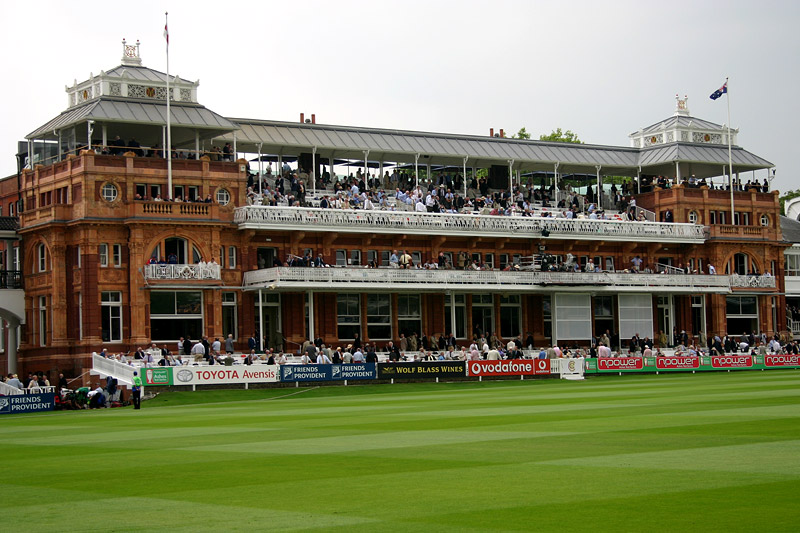
From children's games in south-east England, recorded by the sixteenth century and probably older. It became an adult sport in the seventeenth, largely because it attracted gambling, and the first written laws in 1744 exist mainly to settle bets.
The MCC — Marylebone Cricket Club — has owned and written the Laws since 1788, and still does, which makes cricket unusual: a global sport whose rulebook belongs to a private members' club in London. They are called Laws rather than rules, which tells you something about the institution.
The Ashes began with a mock obituary. After Australia beat England in England for the first time in 1882, a newspaper printed a notice announcing the death of English cricket and that "the body will be cremated and the ashes taken to Australia". A small urn was later presented to the England captain and the series has carried the name since.
Why is the field not a fixed size?
Because the Laws never specified one, and by the time anyone might have, grounds had been built.
The pitch in the middle is exact — 22 yards, which is one chain, an old surveying unit. The boundary is whatever the ground allows, subject only to modern minimum and maximum distances. So the same shot is six runs at one ground and caught at another, and grounds have genuine characters: short square boundaries here, a long straight one there.
It is one of very few major sports where the playing area varies. Baseball is another, for the same historical reason.
What are the numbers worth knowing?
Don Bradman's Test batting average of 99.94 is the most extreme statistic in any sport. The next best averages in history are in the high 50s and low 60s. He needed four runs in his final innings to finish at 100 and was out for a duck, second ball.
To see how far outside the distribution that is: being as far above the field in most sports would mean averaging something like fifty per cent more than the best player who ever lived. It is routinely used as the standard example of an outlier.
Sachin Tendulkar holds the most international runs and the most centuries — 100 across formats — and played for 24 years. Muttiah Muralitharan holds the most Test wickets with 800. Jim Laker took 19 wickets in a single Test match in 1956, out of a possible 20, which nobody has approached.
The highest individual Test score is Brian Lara's 400 not out. The highest in any first-class match is Lara's 501 not out. The highest ODI score is Rohit Sharma's 264.
Why does India dominate cricket economically?
Because it has by far the largest audience, and broadcast rights follow audiences.
Roughly 70 to 80 per cent of global cricket revenue is generated in India, and the BCCI is by a wide margin the wealthiest cricket board in the world. That gives it decisive influence over international scheduling, the structure of tournaments and the distribution of ICC revenue — a situation that other boards find frustrating and cannot change, since a tour of India is worth more to them than any other fixture.
The Indian Premier League is the second most valuable sports league in the world by per-match value, after the American NFL. Its innovation was to combine a city-franchise structure, a player auction that mixes international and domestic players in the same squad, and a window in which the world's best players are available.
The bits people ask about
Why do they change the ball colour?
Red for Test cricket, white for limited-overs, pink for day-night Tests.
Red was the original and works in daylight against a background of grass and sightscreens. It is unusable under floodlights on television, because it goes dark and blurs, so white was adopted for the coloured-clothing formats — and white balls get dirty and are visible for fewer overs, which is why limited-overs games use two new balls from opposite ends.
Pink was developed for day-night Tests as a compromise: visible under lights, durable enough for eighty overs, and it holds its colour. The complaint about it is real — the seam is stitched in black or green to be visible, the ball behaves differently under lights in the evening session, and batters say it is hardest to pick up at twilight.
What is a duck, a maiden and a googly?
A duck is a batter dismissed without scoring, from "duck's egg" for the zero shape on the scoreboard. A golden duck is out first ball, a diamond duck out without facing one.
A maiden is an over in which no runs are scored off the bat. A wicket maiden is one with a dismissal in it too.
A googly is a leg spinner's delivery bowled with the same arm action but the back of the hand, so it turns the opposite way to what the batter reads. It was invented by Bernard Bosanquet around 1900 and is called a bosie in Australia after him. The whole art of wrist spin is disguise, which is why the leg spinner's variations all have names — googly, flipper, slider, top-spinner.
Why is a cricket score written like that?
"India 287/4" means 287 runs for the loss of 4 wickets. Australians write it the other way round — "4/287" — which causes confusion in every international broadcast.
A bowler's figures are written wickets-for-runs, so "5/32" means five wickets while conceding 32 runs. A "five-for" is the benchmark of a great bowling performance, and the name of the honours board at Lord's is where players most want it recorded.
What comes next
The next page is the sport played by more people than any other, and the one whose rules fit on a page and whose politics do not.