Appearance
1.7 — The Small Print: Codes, Numbers and Dates
Every manufactured object carries numbers that were put there for a machine and are readable by you if you know the scheme. Several of them contain a built-in check that catches a mistyped digit before it becomes a wrong order, a wrong patient, or a wrong bank transfer.
Dates on food and medicine
How is an expiry date actually calculated?
Not by guessing, and not by law. It is measured, by deliberately storing the product and testing it until it fails.
The method is called shelf-life testing. Batches from a real production run are stored under defined conditions — a stated temperature and humidity — and samples are pulled at intervals and tested against whatever the failure criterion is for that product. For food that means microbial counts, moisture, rancidity in the fats, vitamin content, texture and a trained sensory panel. For a medicine it means measuring how much of the active ingredient is still there and how much has turned into breakdown products, by chromatography.
The rule for medicines is usually stated as the point at which the product would fall below 90 per cent of its labelled strength, or at which any degradation product would exceed its safe limit, whichever comes first. Then a safety margin is taken off. A drug that tested fine at 36 months is very often labelled at 24.
Real-time testing takes as long as the shelf life, which is a problem for launching a product. So manufacturers run accelerated stability testing alongside it: store samples at 40 °C and 75 per cent humidity, where chemical degradation runs far faster, and extrapolate. The underlying relationship is the Arrhenius equation from chemical kinetics, which says reaction rate rises roughly exponentially with temperature — as a rough rule, a 10 °C rise doubles the rate. Six months at 40 °C then stands in for about two years at 25 °C, and the accelerated result gives a provisional date while the real-time study catches up.
What is the difference between "use by" and "best before"?
One is about safety and the other is about quality, and confusing them wastes an enormous amount of food.
"Use by" is the safety date, used on things that grow dangerous bacteria without necessarily looking or smelling wrong — fresh meat, fish, ready meals, unpasteurised dairy. After that date the product should not be eaten, and in many countries it is illegal to sell it. Freezing before the date stops the clock.
"Best before" — and its Indian equivalent, "best before n months from manufacture" — is a quality date. It marks when the manufacturer stops guaranteeing the texture, colour or flavour. Biscuits, rice, tinned goods, pasta and spices are usually perfectly safe long past it and simply less good. Dried and tinned foods can be years past it.
The manufacturing-date form used widely in India exists because the shelf-life study produces a duration, and printing the duration plus the manufacture date lets the same packaging run be used regardless of when it is filled.
Why do medicines say to store below 25 °C when Indian summers are 45?
Because the stability data was generated at a defined condition, and the label states the condition the data supports rather than a condition anybody expects a cupboard to hold.
Regulators divide the world into climatic zones for this purpose, and India falls into the hottest and most humid category, Zone IVb, for which stability studies are run at 30 °C and 75 per cent humidity rather than 25 °C and 60. That is why an Indian-market medicine often carries a different storage statement and sometimes a shorter shelf life than the identical product sold in Europe.
What actually matters is cumulative exposure, not a single hot afternoon. Heat and humidity accelerate degradation gradually. The practical consequences: keep medicines out of the bathroom, which is the most humid room in the house, and out of a car's glovebox, which regularly exceeds 60 °C. Insulin, some antibiotics in suspension and vaccines are genuinely fragile and need refrigeration.
Numbers that check themselves
What do the digits in a barcode mean?
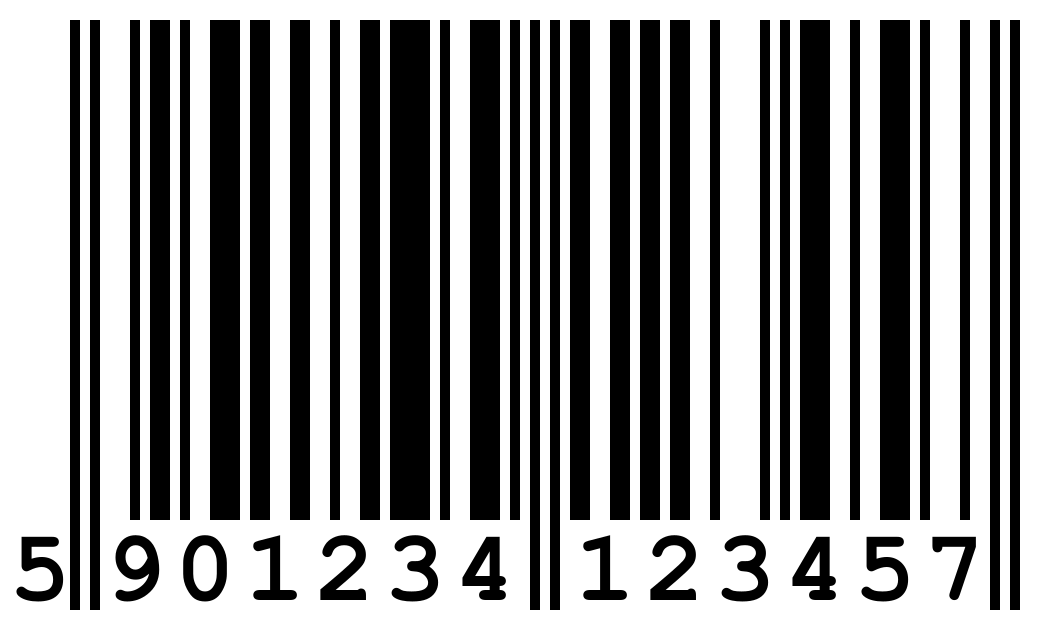
The common retail barcode is EAN-13, thirteen digits in three meaningful groups plus a check.
The first two or three digits are a GS1 prefix identifying the numbering organisation that issued the block — 890 is India, 50 is the United Kingdom, 30 to 37 is France, 00 to 13 is the United States and Canada. This is not where the product was made. It is where the company that registered the number joined the system, which is why an Indian-manufactured product sold by a British company carries 50.
The next block identifies the company, and the block after that identifies the specific product — the same tomato ketchup in two sizes has two different numbers, because the number identifies a stock item, not a brand.
The last digit is a check digit, and it exists to catch scanning and typing errors. Multiply the digits alternately by 1 and 3 from the left, add them up, and the check digit is whatever makes the total a multiple of ten. That single rule catches every single-digit error and most cases of two adjacent digits being swapped, which are the two mistakes humans and scanners actually make.
The bars themselves are not the digits directly. Each digit becomes a pattern of seven modules, and the left half uses a different encoding from the right half — deliberately, so that a scanner reading the symbol backwards can tell immediately, and flip it. That is why you can scan a packet upside down.
Do credit card numbers have a check digit too?
Yes, and it is the most widely deployed piece of arithmetic in the world.
The last digit of a card number is computed by the Luhn algorithm, patented by Hans Peter Luhn at IBM in 1960. Working from the rightmost digit leftwards, double every second digit; if a doubled value exceeds nine, subtract nine from it. Sum everything. A valid number is one whose total is a multiple of ten.
It is not security — anybody can compute it, and generating a number that passes is trivial. It is an error check, and it means a mistyped digit or a transposed pair is rejected in the browser instantly instead of travelling to a bank and coming back as a declined payment.
The rest of the number is structured too. The first digit is the Major Industry Identifier — 4 for Visa, 5 for Mastercard, 3 for travel and entertainment cards like Amex and Diners, 6 for Discover and RuPay ranges. The first six to eight digits together are the BIN, identifying the issuing bank, which is how a shop knows which network to route the transaction to before anything is authorised.
What is an IMEI, and can it be changed?
The IMEI is a fifteen-digit number identifying a physical mobile handset, as opposed to the SIM, which identifies the subscription. Dial *#06# on any phone and it appears.
The first eight digits are the Type Allocation Code, identifying the model — so the IMEI says what the phone is, not just which one. The next six are the serial number within that model, and the fifteenth is a Luhn check digit, the same algorithm as the bank card.
It matters because it is what a stolen phone is blocked on. Reporting a theft puts the IMEI on a shared blacklist — in India, the government's Central Equipment Identity Register — after which networks refuse the handset regardless of which SIM is inserted. Changing an IMEI is technically possible and illegal in most countries, including India under the Indian Telegraph Act, precisely because it defeats that mechanism.
What is in a book's ISBN?
Thirteen digits, and like the barcode it is a set of nested blocks. It begins with 978 or 979, which is a GS1 prefix reserved for the publishing industry so that an ISBN can also be a valid barcode. Then a registration group for country or language area — 0 and 1 for English, 81 and 93 for India, 2 for French, 3 for German. Then the publisher, then the title, then a check digit.
The block for the publisher is variable in length, and this is the elegant part: a large publisher gets a short publisher code and therefore many title numbers, and a small publisher gets a long code and few. The blocks are sized to fit the actual scale of the business.
Note what an ISBN identifies, because people get this wrong constantly. It identifies an edition and format. The hardback, the paperback, the ebook and the second edition of the same book all have different ISBNs — because a bookshop ordering stock needs to receive exactly the object it ordered.
What can you read off a car's chassis number?
The seventeen-character VIN has been internationally standardised since 1981, and every character has a defined role.
The first three are the World Manufacturer Identifier — country, then manufacturer, then vehicle type or division. Characters four to eight describe the vehicle itself: model, body style, engine, restraint system. Character nine is a check digit, computed by a weighted sum in which letters are converted to numbers. Character ten is the model year, using a rotating letter-and-digit code, and eleven is the assembly plant. The last six are the sequential serial number off that line.
The letters I, O and Q never appear anywhere in a VIN, because they are too easily confused with 1 and 0 — the same reasoning that keeps them out of aircraft registrations and many licence plate schemes.
Sizes and standards
Why is A4 that particular shape?
Because it is the only shape that stays itself when you fold it in half.
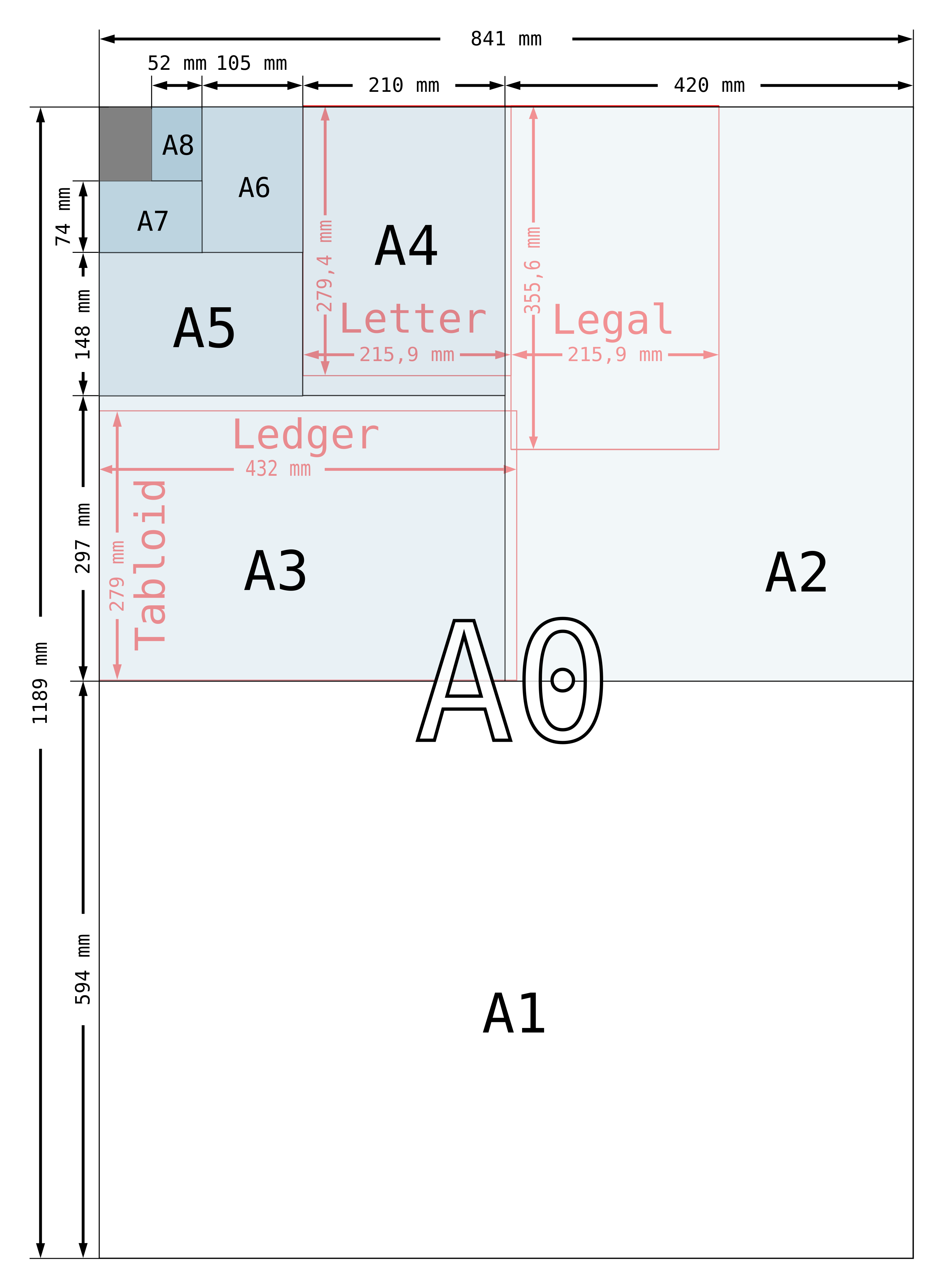
Take a rectangle whose long side divided by its short side is the square root of two, about 1.414. Fold it across the long side. The new rectangle has the original short side as its long side, and half the original long side as its short side — and the ratio comes out the same. No other proportion has this property.
That single choice makes the whole system work. A4 folded is A5; two A4 sheets side by side make A3. Enlarging A4 to A3 on a photocopier is exactly 141 per cent and nothing is cropped. A booklet imposes without waste.
The series is anchored by defining A0 as the sheet of that shape with an area of exactly one square metre, which is why A0 is 841 × 1189 mm rather than a round number, and why the weight of paper in grams per square metre translates directly: an A4 sheet is one-sixteenth of A0, so sixteen sheets of 80 gsm paper weigh 80 grams.
The proportion was proposed by the German physicist Georg Lichtenberg in 1786, adopted as a German standard in 1922, and is now used by every country in the world except the United States, Canada and a few others, where Letter and Legal survive from pre-standard printing practice with no mathematical relationship to each other at all.
Why are batteries called AA and AAA?
They are the surviving names from an American standard set in 1924 that ran A, B, C, D, and upward, sized by physical dimension rather than by chemistry. The single-A and double-A sizes were added as things got smaller, and the triple-A after that. The names are a size chart, not a strength scale — an AAA and an AA both supply 1.5 volts, and the AA simply holds about three times the energy because it is bigger.
The 9-volt rectangular battery is the odd one, and if you break one open you find out why: it is six small cells stacked in series inside a metal box. That is where the nine comes from.
What do the numbers inside the recycling triangle mean?
They identify the plastic, and they were introduced in 1988 by the plastics industry itself. The triangle is not a promise that the item is recycled or even recyclable in your area. It is a material code, and that ambiguity was criticised from the start as making plastic look more recoverable than it is.
1 — PET, drink bottles, widely recycled. 2 — HDPE, milk jugs and detergent bottles, widely recycled. 3 — PVC, pipes and some packaging, rarely recycled and contains chlorine. 4 — LDPE, carrier bags and film, difficult in kerbside systems. 5 — PP, food tubs and bottle caps, increasingly accepted. 6 — PS, polystyrene, very rarely recycled. 7 — everything else, including polycarbonate and mixed multilayer materials, essentially never recycled.
The practical reading is that 1 and 2 are worth sorting, 5 depends on where you live, and the rest are optimistic.
Why is there no single electrical plug in the world?
Because electrification happened country by country, before there was any body capable of setting a global standard, and by the time one existed every country had millions of sockets in walls.
The deeper split is voltage. Early systems in North America settled around 110-120 volts, and Europe later moved to 220-240. The European choice is genuinely better for distribution — doubling the voltage halves the current for the same power, and losses in a wire go as the square of the current, so you can use thinner and cheaper cable — but by the time that argument was won, America had a vast installed base it could not economically change. It is the path-dependence problem from 1.1 again, at national scale.
The plug shapes then diverged for local reasons: the British three-pin type G carries a fuse in the plug itself, a wartime measure to save copper by allowing one ring of cable to serve a whole room; the Indian type D descends from an older British standard; the Europlug is designed to be thin and unearthed for low-power devices. There is an international standard plug, the IEC Type N, and almost nobody uses it — Brazil and South Africa adopted it, and that is close to the entire list.
Why are shoe sizes different in every country, and what is a "barleycorn"?
Because British shoe sizing was standardised on a unit of length equal to one-third of an inch — a barleycorn, literally the length of a grain of barley, which was a legal unit in England from the fourteenth century. Each full shoe size is one barleycorn, 8.47 mm, longer than the last, and half sizes split that.
The zero point is arbitrary and differs: UK sizing counts from a different starting length than US sizing, which is why the same shoe is roughly one and a half sizes larger in American men's numbering and about two and a half in American women's. European sizing uses a completely different unit, the Paris point, which is two-thirds of a centimetre, so European sizes step in smaller increments and have no half sizes.
The only system that describes reality is the one nobody markets: the Mondopoint scale, which simply states the foot length in millimetres, and is used for ski boots and military footwear because they are fitted for function rather than sold by habit.
What comes next
That is the end of the objects. The next Part changes the axis entirely, from things to time — the dates worth carrying in your head, starting with the ones before anybody was counting years at all.