Appearance
13.12 — Films, Television and Music
Firsts, awards and origin stories, in India and elsewhere. Almost every entry here has a detail attached that quizzes actually ask for.
How cinema began
Who held the first public film screening, and when? The Lumière brothers, 28 December 1895, in a Paris café basement. They later said cinema was an invention without a future.
Who made the first fiction films with tricks? Georges Méliès, a stage magician, who discovered substitution splicing when his camera jammed. A Trip to the Moon, 1902, is the rocket in the eye.
What was the first feature-length talkie? The Jazz Singer, 1927. Within three years silent film was commercially dead worldwide.
Why is film shot at 24 frames per second? It was the lowest rate that carried acceptable optical sound on the film edge, and film stock was the biggest cost. Silent films ran at 16–18, which is why they look comically fast today.
What was the first feature-length animated film? Disney's Snow White and the Seven Dwarfs, 1937 — called "Disney's Folly" during production and then the highest-grossing film released to that point.
What was the first entirely computer-animated feature? Toy Story, 1995. Toys were chosen because plastic was within reach of what the rendering could convincingly do.
What was Technicolor's three-strip process? A camera splitting light onto three black-and-white negatives through colour filters, recombined by dye transfer. The Wizard of Oz, 1939, uses the switch to colour as a plot device.
Indian cinema
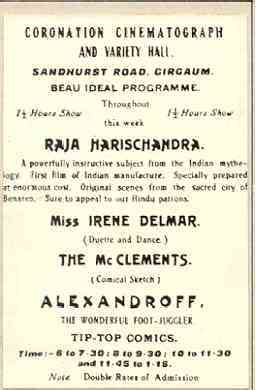
What was the first Indian feature film, and who made it? Raja Harishchandra, 1913, by Dhundiraj Govind Phalke — Dadasaheb Phalke, after whom India's highest cinema award is named.
What was the first Indian sound film? Alam Ara, 1931, with seven songs. Sound is what split Indian cinema into separate language industries.
Why do Indian films have songs? Because Sanskrit drama, folk theatre and Parsi theatre never separated music from performance — there was no tradition of spoken drama without it to depart from.
What is a playback singer? Somebody who records the songs the actors mime to. Lata Mangeshkar, Mohammed Rafi, Kishore Kumar, Asha Bhosle and S. P. Balasubrahmanyam are stars in their own right.
Which Indian film industry makes the most films? India as a whole makes more feature films than any country — typically 1,500 to 2,000 a year across more than twenty languages, and Hindi cinema is not the majority.
Who was Satyajit Ray, and what did he win? The director of Pather Panchali (1955) and the Apu Trilogy. He wrote, scored and designed the posters for his films, and received an honorary Academy Award in 1992, filmed in his hospital bed.
Which Indian film was the first submitted to the Oscars, and which have been nominated? Mother India (1957) was the first Indian nomination for Best Foreign Language Film, followed by Salaam Bombay! (1988) and Lagaan (2001). None has won.
Which Indians have won competitive Academy Awards? Bhanu Athaiya for costume design on Gandhi (1983); A. R. Rahman for score and song, Resul Pookutty for sound and Gulzar for lyrics on Slumdog Millionaire (2009); and RRR's "Naatu Naatu" for Best Original Song in 2023. The Elephant Whisperers won Best Documentary Short the same year.
Which film ran the longest in cinemas? Dilwale Dulhania Le Jayenge, continuously at Maratha Mandir in Mumbai from 1995 for over 25 years — the longest theatrical run of any film anywhere.
Which film ran for over five years at one Mumbai cinema in the 1970s? Sholay, 1975, the defining masala film, written by Salim-Javed.
Which Indian film broke out nationally from outside the Hindi industry? Baahubali (2015, 2017), made in Telugu and Tamil and dubbed, which showed a non-Hindi film could top the Hindi market.
Who is Dadasaheb Phalke Award-winning and also a playback singer? Lata Mangeshkar received both the Phalke Award and the Bharat Ratna.
What is India's film censor body called? The Central Board of Film Certification, which certifies rather than censors in name — U, UA, A and S are the categories.
Which Indian city is home to the world's largest film studio complex? Hyderabad, with Ramoji Film City, recognised by Guinness as the largest.
Awards
When were the Academy Awards first held, and how long was the ceremony? 1929, and the first ceremony lasted about fifteen minutes with the winners announced in advance.
Why is it called an Oscar? The origin is disputed; the most repeated story credits an Academy librarian who said the statuette looked like her uncle Oscar.
How is Best Picture counted differently? By preferential ballot — voters rank the nominees and the lowest is eliminated repeatedly. Every other category is a simple plurality, which is why Best Picture rewards broad acceptability over passion.
Who has won the most Oscars? Walt Disney, with 22 competitive awards. Katharine Hepburn holds the acting record with four Best Actress wins.
Which films have won eleven Oscars? Ben-Hur (1959), Titanic (1997) and The Lord of the Rings: The Return of the King (2003) — the last winning every category it was nominated in.
Which was the first non-English-language film to win Best Picture? Parasite, South Korea, 2020.
What are the major film festivals and their prizes? Cannes with the Palme d'Or, Venice with the Golden Lion — the oldest festival, from 1932 — Berlin with the Golden Bear, and Sundance for independent film.
What is an EGOT? Winning an Emmy, Grammy, Oscar and Tony — television, music, film and theatre. Fewer than twenty people have done it competitively.
What are the Grammys, Emmys, Tonys and Golden Globes for? Music, television, Broadway theatre and film-and-television by the foreign press association.
Which Indian awards should you know? The National Film Awards, decided by government-appointed juries across all Indian languages; the Filmfare Awards, the oldest private awards from 1954; and the Dadasaheb Phalke Award for lifetime contribution.
Music: the basics
Why do two notes an octave apart sound the same? Because one is exactly double the frequency, and they share nearly all their harmonics.
How many notes in an octave on a piano, and why twelve? Twelve semitones — the smallest number of equal steps that gets acceptably close to the simple whole-number ratios.
What is equal temperament? Dividing the octave into twelve exactly equal steps, so every interval is slightly out of tune and every key sounds the same. It is what makes changing key possible.
How many keys does a standard piano have? 88 — 52 white and 36 black.
What is A tuned to, and is that universal? 440 Hz by international agreement from 1939. Many European orchestras use 442 or 443, and Baroque ensembles often use 415.
What are the four families of orchestral instruments? Strings, woodwind, brass and percussion. The Indian classification from the Natya Shastra uses string, wind, membrane and solid.
Which instrument has the largest range in an orchestra? The piano, spanning more than seven octaves, which is why it is used to teach theory.
What makes instruments sound different playing the same note? Timbre — the relative strength of harmonics — plus the attack. Remove the first tenth of a second of a piano note and most people cannot identify the instrument.
What is the most-used chord progression in pop music? I–V–vi–IV. In C major that is C, G, A minor, F, and it appears in an enormous number of songs across decades.
Why is a pop song about three minutes long? Because that was the capacity of a 10-inch 78 rpm record. The album's length comes from the 12-inch LP's roughly 22 minutes a side.
Indian music
What is a raga, and is it a scale? No — it specifies which notes are used and also how each is approached, which are emphasised, which phrases are obligatory and which movements are forbidden. Two ragas can use identical notes and be completely different.
What is a tala? The rhythmic cycle. Teentaal is 16 beats in four groups of four; Jhaptaal is 10; Rupak is 7. The first beat, the sam, is what everything resolves to.
What are the seven notes called? Sa, Re, Ga, Ma, Pa, Dha, Ni — shorthand for Shadja, Rishabha, Gandhara, Madhyama, Panchama, Dhaivata, Nishada.
What is the difference between Hindustani and Carnatic music? Hindustani, in the north, emphasises slow improvisational development beginning with an unmetered alap. Carnatic, in the south, is composition-centred, faster and rhythmically more intricate.
Who are the Carnatic trinity? Tyagaraja, Muthuswami Dikshitar and Syama Sastri, all of the late eighteenth and early nineteenth centuries.
Which instrument was borrowed into Carnatic music from Europe? The violin, adopted in the eighteenth century, retuned and played seated with the scroll resting on the foot.
Which Indian instruments should you match to their players? Sitar — Ravi Shankar, Vilayat Khan; sarod — Ali Akbar Khan, Amjad Ali Khan; santoor — Shivkumar Sharma; bansuri — Hariprasad Chaurasia; shehnai — Bismillah Khan; tabla — Zakir Hussain, Alla Rakha; veena — S. Balachander; mandolin — U. Srinivas; nadaswaram — Sheik Chinna Moulana.
Which Indian musicians have received the Bharat Ratna? M. S. Subbulakshmi, Ravi Shankar, Bismillah Khan, Lata Mangeshkar and Bhupen Hazarika, among others.
Who was M. S. Subbulakshmi? The Carnatic vocalist who was the first musician to receive the Bharat Ratna and the first Indian to perform at the UN General Assembly, in 1966.
What are the classical dance forms of India? Bharatanatyam from Tamil Nadu, Kathak from the north, Kathakali and Mohiniyattam from Kerala, Kuchipudi from Andhra, Odissi from Odisha, Manipuri from Manipur, and Sattriya from Assam.
Which dance form uses elaborate green face paint and takes hours to apply? Kathakali.
Western music, quick-fire
Which composers are the "three Bs"? Bach, Beethoven and Brahms.
What did Beethoven compose while deaf? Much of his late work, including the Ninth Symphony with the Ode to Joy. He reportedly had to be turned around at its premiere to see the applause.
Who wrote the most operas that are still performed? Verdi, Puccini, Mozart and Wagner dominate the repertoire. Wagner's Ring cycle runs about fifteen hours over four evenings.
Which Mozart work was unfinished at his death? The Requiem, completed by his student Süssmayr.
Which band has sold the most records? The Beatles, by most counts, followed by Elvis Presley and Michael Jackson.
What is the best-selling album of all time? Michael Jackson's Thriller, released 1982.
Which is the most-covered song? "Yesterday" by the Beatles, with thousands of recorded versions.
What is the best-selling single of all time? "White Christmas" by Bing Crosby, from 1942, on most estimates.
Which is the most-performed song in English? "Happy Birthday to You", which was under a claimed copyright until a US court invalidated it in 2016.
Who has won the most Grammys? Beyoncé holds the record for most wins; Georg Solti held it for decades before her.
What is the difference between an opera, an operetta and a musical? All sung with orchestra; operetta is lighter with spoken dialogue; a musical has more spoken dialogue and popular idiom.
Television and the rest
What was the first television broadcast in India, and when did colour arrive? Doordarshan began experimental broadcasts in 1959; colour arrived in 1982, for the Asian Games in Delhi.
Which Indian television serials broke viewership records? Ramayan and Mahabharat in the late 1980s, which reportedly emptied streets during broadcast.
Why is American television 30 frames and European 25? Because each locked to its mains electricity frequency — 60 Hz and 50 Hz.
Why does a 24 fps film run fast on old European television? Because it was simply played at 25, shortening the running time by about four per cent and raising every voice by nearly a semitone.
What changed television into prestige drama? Subscription funding. A channel people actively pay for rewards distinctiveness, where an advertising-funded network must avoid alienating anybody.
What comes next
The next page is literature, art and language — the books, the painters and the words that quizzes lean on.