Appearance
8.1 — Painting and Its Movements
Art history looks impenetrable from outside and becomes tractable the moment you ask one question of each period: what problem were these painters trying to solve, and what had just changed?
Before perspective
What is the oldest art, and why did people make it?
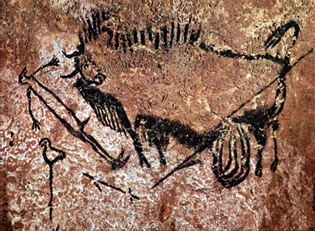
The oldest known figurative painting is a warty pig on a cave wall in Sulawesi, Indonesia, dated to at least 45,500 years ago. Hand stencils and animal figures in Spain have been dated older still, and at least one Spanish site predates the arrival of modern humans, which would make it Neanderthal work.
The famous European caves — Lascaux and Chauvet in France, Altamira in Spain — are between 17,000 and 36,000 years old. India has its own at Bhimbetka in Madhya Pradesh, with some paintings around 10,000 years old and a rock shelter sequence running much further back.
Why is genuinely unknown, and the honest answer is a list of hypotheses. The paintings are frequently in the deepest and least accessible parts of caves, not in the living areas, which argues against decoration. They overwhelmingly depict animals and rarely people. Some show spears and wounds, suggesting hunting magic. Some are in acoustically resonant chambers, suggesting ritual. Some may be records — a proposed reading of the dot markings alongside animals is that they encode a seasonal calendar of mating and birthing.
What is certain is that it was skilled, deliberate, and repeated over thousands of years. The Chauvet paintings show animals in motion, overlapping legs to suggest movement, and use the rock's contours as anatomy.
Why does medieval European painting look flat?
Because it was not trying to depict space, and treating that as a failure gets the whole period wrong.
Medieval religious painting was made to communicate a hierarchy and a set of facts to a largely illiterate audience. Figures are sized by importance, not by distance — Christ is largest, saints next, donors small. Gold backgrounds represent not a place but eternity, which has no location. Multiple moments of a story appear in one image because the picture is a summary, not a snapshot.
The technique was highly developed within those aims. What changed in the fifteenth century was not skill but the question being asked.
The Renaissance
What did linear perspective actually do?
Gave painters a mathematical method for producing the image a single eye would receive from a single point, and it was invented rather than discovered gradually.
Filippo Brunelleschi demonstrated it in Florence around 1420 with an experiment that is worth describing because it is so direct. He painted the Florence Baptistery on a panel, drilled a small hole through the painting at the vanishing point, and had a viewer look through the hole from the back while holding a mirror in front. Removing the mirror revealed the actual building; replacing it showed the painting. The two matched.
Leon Battista Alberti wrote the method down in 1435, and after that any competent painter could construct a convincing three-dimensional space: parallel lines converge on a vanishing point, and objects shrink at a calculable rate with distance.
The consequence is bigger than technique. A perspective painting has a single correct viewing position, which means it constructs a viewer — an individual, standing in one place, seeing the world from their own position. That is a substantially different proposition from a medieval image made for everyone at once, and art historians read it as part of the same shift in thinking that produced the individual in philosophy and politics.
Why is the Mona Lisa famous?
Partly because it is very good, and substantially because it was stolen.
The genuine qualities: Leonardo's sfumato, a technique of building form through dozens of translucent glazes with no visible outline, so that edges dissolve — the corners of the mouth and eyes in particular are deliberately indistinct. That indistinctness is why the expression seems to change: your peripheral vision, which handles low-detail information, reads the mouth differently from your central vision, so the smile appears and disappears as your gaze moves.
The landscape behind is also unusual, with the horizon at different heights on the two sides, which subtly destabilises the figure.
But it was one admired painting among many until 1911, when it was stolen from the Louvre by an Italian employee, Vincenzo Peruggia, who walked out with it under his coat. It was missing for two years. Newspapers around the world ran the empty wall. Crowds queued to see the space where it had been, which is an event in the history of celebrity as much as of art. Peruggia was caught trying to sell it in Florence, claiming a patriotic motive.
By the time it came back it was the most recognisable painting in the world, and everything since — the vandalism attempts, the reproductions, the Duchamp moustache — has compounded it.
Who were the major Renaissance figures and what distinguishes them?
Leonardo da Vinci (1452–1519) finished very few paintings and left an enormous body of notebooks — anatomy from dissections he performed himself, hydraulics, flight, and machines. His anatomical drawings were centuries ahead and had no influence, because they were unpublished until long after the questions had been settled by others.
Michelangelo (1475–1564) regarded himself as a sculptor and resented being made to paint the Sistine Chapel ceiling, which took four years lying on scaffolding — not on his back, as the legend has it, but standing with his head tilted back, which he complained about in a poem. His David is 5.17 metres tall and was carved from a block another sculptor had abandoned as ruined.
Raphael (1483–1520) is the one whose reputation has fluctuated most. His compositional clarity was regarded for centuries as the summit of painting and then dismissed as too easy, and is now taken seriously again.
Caravaggio (1571–1610), slightly later, changed lighting permanently — extreme contrast between light and dark, called chiaroscuro, with figures emerging from blackness — and used ordinary people including prostitutes as models for saints, which was scandalous. He also killed a man and spent his last years on the run.
The nineteenth century break
What did photography do to painting?
Removed its main job, and forced it to find another.
For four centuries a painter's most reliably paid work was recording appearance: portraits, landscapes, records of events. Photography from 1839 did that faster, cheaper and more accurately. The portrait miniature trade collapsed within about a decade.
Painting responded by asking what it could do that a photograph could not, and the answers produced most of modern art: colour that is not literal, brushwork that is visible, subjective experience, movement, and eventually abandoning representation altogether.
Photography also changed what painters saw. Muybridge's horse sequences in 7.1 proved every previous painting of a galloping horse wrong, and Degas and others began using photographic devices — cut-off figures at the frame edge, unbalanced compositions, high viewpoints — that had previously looked like mistakes.
What is Impressionism, and why was it hated?
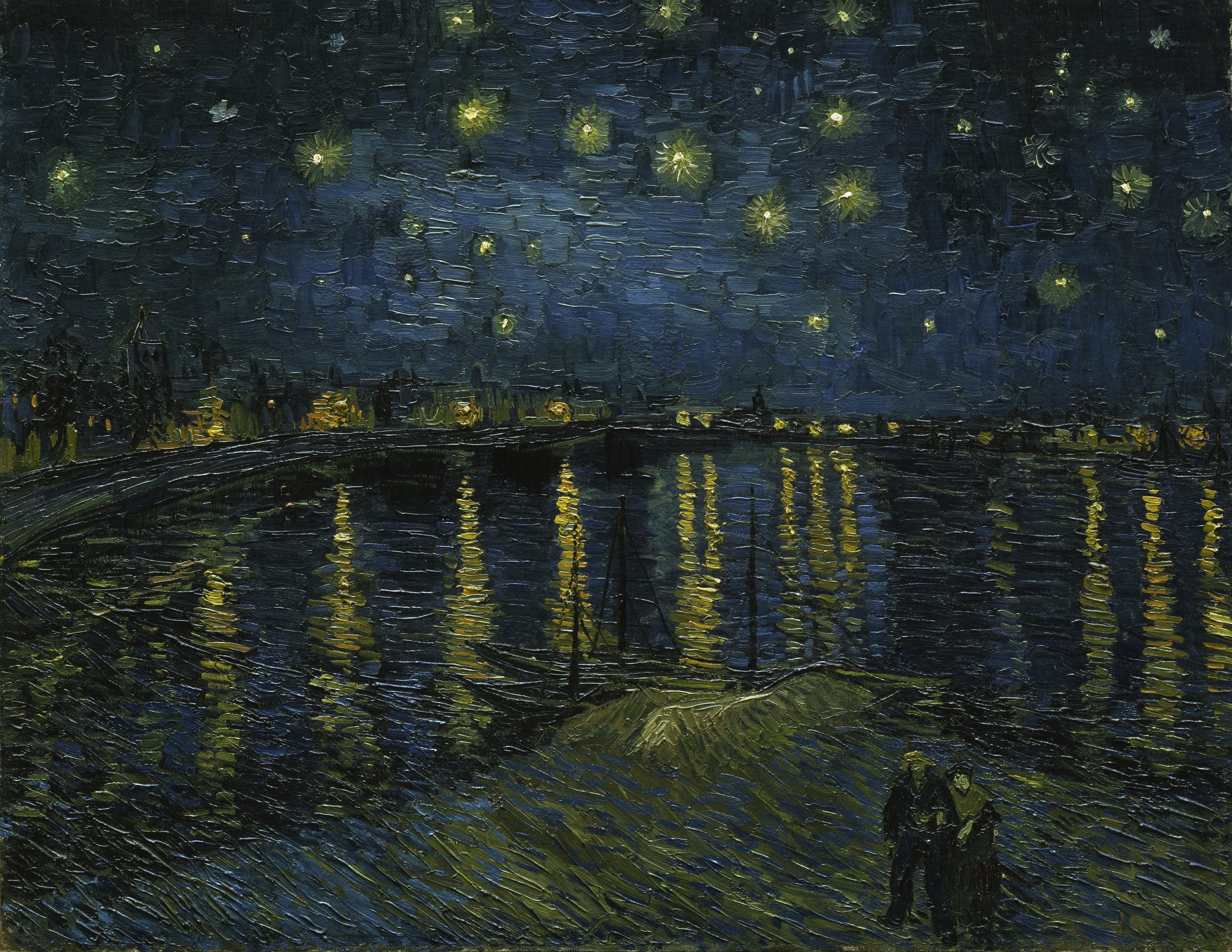
A group of painters in 1860s and 70s France attempting to capture the impression of a moment — particularly the behaviour of light — rather than a finished, smoothed, studio-corrected image.
Their innovations were partly technical and partly enabled by a mundane invention. Paint in metal tubes, patented in 1841, meant a painter could work outdoors for the first time with a full palette; before that, paint was ground and mixed in the studio and did not travel. Working outdoors changes what you paint, because the light moves and you must work fast.
The techniques followed: visible broken brushstrokes, colour placed side by side rather than blended, shadows painted in colour rather than in black, and the same subject painted repeatedly at different hours.
The hostility was severe. They were refused by the official Salon, and the name Impressionism comes from a hostile review of Monet's Impression, Sunrise in 1874. Critics complained the work looked unfinished, which was accurate and was the point.
Van Gogh belongs to the generation after and is the standard example of posthumous fame: he sold very few paintings in his lifetime, was supported financially by his brother Theo, and died at 37. His letters to Theo — several hundred of them, articulate and analytical — are one of the best records of how a painter thinks that exists.
What happened after that, in order?
The sequence is more legible than it looks, because each movement is a response to the previous one.
Post-Impressionism (Cézanne, Gauguin, Van Gogh): keeping the colour freedom, restoring structure. Cézanne in particular tried to build solid form out of patches of colour, and is usually described as the bridge to everything after.
Fauvism (Matisse, from 1905): colour completely detached from description. Green faces, red trees.
Cubism (Picasso and Braque, from 1907): abandoning the single viewpoint that perspective established. An object is shown from several angles at once, flattened onto the canvas. It is the direct rejection of Brunelleschi, five centuries later.
Futurism, Dada, Surrealism (1910s–20s): speed and machines; then, after the First World War, deliberate anti-art nonsense as a response to a civilisation that had produced the trenches; then the unconscious and dream logic, with Dalí and Magritte.
Abstract Expressionism (New York, 1940s–50s): Pollock, Rothko, de Kooning. Large scale, no subject, the act of painting itself as the content.
Pop Art (1950s–60s): Warhol, Lichtenstein. A response to abstraction's seriousness, using advertising, packaging and comics.
Conceptual art (1960s onward): the idea is the work, and the object is optional.
Read as a sequence, each is a reaction to what came immediately before, which is why the movements accelerate — each generation has more to react against.
Indian painting
What traditions should you know?
Ajanta, from roughly the second century BCE to the sixth century CE — Buddhist murals in rock-cut caves in Maharashtra, and the earliest large body of Indian painting to survive. They use modelling and foreshortening, and their influence spread across Asia along the Buddhist routes.
Mughal miniature painting from the sixteenth century: a synthesis of Persian technique with Indian subject matter and observation, made in imperial workshops. Akbar's studio employed both Hindu and Muslim artists, and the work is characterised by extremely fine brushwork, flattened space, and — unusually for the period — accurate natural history.
Rajput and Pahari painting, developing in the Rajasthani and Himalayan courts, more devotional and lyrical, with the Kangra school known for its treatment of the Krishna legends.
Company painting, made by Indian artists for British patrons from the eighteenth century, documenting occupations, castes, birds and monuments — a hybrid form driven by the customer.
The Bengal School in the early twentieth century, around Abanindranath Tagore, consciously rejecting Western academic style as a nationalist position. Then the Progressive Artists' Group in 1947 — Husain, Souza, Raza, Gaitonde and others — rejecting the Bengal School's revivalism in turn and engaging with modernism directly.
Folk traditions — Madhubani in Bihar, Warli in Maharashtra, Pattachitra in Odisha and Bengal, Kalamkari in Andhra, Gond in central India — are living practices with their own conventions rather than survivals, and several have moved from wall and floor to paper and canvas within living memory.
The market
Why is a painting worth millions?
Because of scarcity, provenance and the structure of the market, and only partly because of the object.
Supply is fixed absolutely. A dead artist made a specific number of works, and museums have permanently removed most of the best from circulation, so the tradeable supply of major work by any canonical artist shrinks over time and never grows.
Provenance is a large part of the price. A documented chain of ownership back to the artist is what separates a valuable painting from an identical one that might be a forgery, and gaps in a chain — particularly across 1933 to 1945 in Europe — can make a work unsaleable.
And the market is thin and opaque. Very few buyers exist at the top, auction results are the only public prices, and a work that fails to sell at auction is "burned" and harder to sell later, which gives sellers a strong incentive to guarantee sales in advance through private arrangements.
Art is also an asset class, with the properties that implies: portable, storable in free ports outside customs jurisdiction, and useful for moving value across borders. That is not the whole of the market by any means, and it is a real component of the top of it.
The record for a work sold at auction is Leonardo's Salvator Mundi, at $450 million in 2017 — a painting whose attribution to Leonardo is genuinely disputed among specialists and whose current location has not been confirmed publicly.
What comes next
The next page moves from the flat surface to the object and the building it stands in — sculpture, museums, and the long argument about who owns what.