Appearance
8.2 — Sculpture, Museums and Stolen Things
Sculpture is the art form with the most physical constraints, museums are a recent invention with a specific origin, and a substantial fraction of what is in them is disputed.
Sculpture
Why were Greek statues white, and why is that wrong?
They were not white. They were painted, brightly, and the paint has gone.
This is one of the largest corrections in the history of art, and it is comparatively recent. Traces of pigment survive in crevices on a great many classical statues and buildings, and ultraviolet imaging, X-ray fluorescence and residue analysis have reconstructed the schemes in detail. Reds, blues, golds, patterned textiles, painted eyes, and sometimes metal attachments for weapons and jewellery.
The white marble ideal came from the Renaissance and then hardened in the eighteenth century, when Johann Winckelmann, whose writing established classical art history, praised the noble simplicity and quiet grandeur of white marble — describing objects whose original surfaces had weathered away.
The correction has been resisted. Reconstructions with the original colours are frequently described as garish, and there is a live argument among historians that the attachment to whiteness is not innocent and has been entangled with nineteenth and twentieth-century ideas about race and the classical world.
How was a marble statue actually made?
Not by chipping away until something appeared, which is Michelangelo's romantic account of his own method and not how most sculpture was produced.
The standard workshop process used a pointing machine: a full-size model was made in clay or plaster, and a mechanical frame with adjustable arms transferred measured points from the model to the block, so assistants could remove the bulk of the stone accurately before the master worked the surface.
Roman sculpture was largely a copying industry. Most of the famous Greek bronzes are known only through Roman marble copies, made in quantity for villa decoration — which is why so many classical marbles have a tree stump or a strut beside a leg. Bronze is strong enough to support an outstretched limb; marble is not, so a copy in marble needs added support the original never had.
The bronzes themselves are mostly gone because bronze is valuable and was melted down. The few that survive were generally recovered from shipwrecks.
What is the Ellora Kailasa temple, and why is it barely believable?
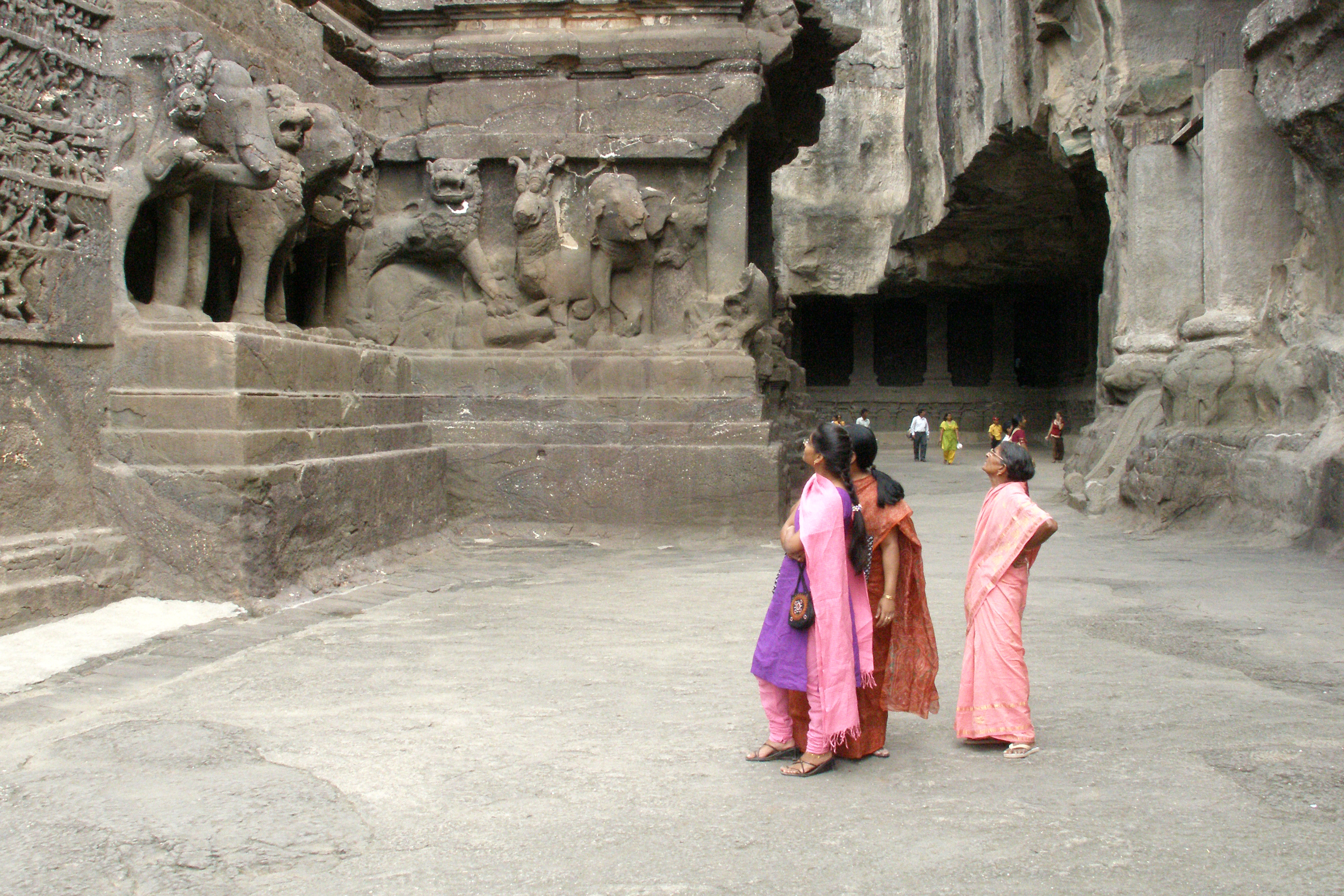
A temple in Maharashtra, cut from a single piece of rock in the eighth century under the Rashtrakuta king Krishna I.
It was not built up from blocks. It was carved down from the top, starting at the hillside surface and removing everything that was not the temple — an estimated 200,000 tonnes of rock — leaving a free-standing multi-storey structure, complete with towers, bridges, courtyards, life-sized elephants and detailed relief panels, sitting in a courtyard whose walls are the original hill.
The reason this is extraordinary is that there is no possibility of correction. A conventional building can be adjusted; a mistake is replaced. Here, every cut is permanent, the whole design must be held in advance, and the work proceeds top-down through material that cannot be added back.
Ellora has 34 caves in total — Buddhist, Hindu and Jain — excavated over about five centuries, frequently adjacent to each other. The nearby Ajanta caves are older and are primarily Buddhist, and were abandoned and forgotten until a British hunting party stumbled into them in 1819.
What are the sculptures everyone should recognise?
The Venus de Milo (about 130-100 BCE), armless because the arms were lost, and much argued over as to what she was doing.
The Winged Victory of Samothrace (about 190 BCE), headless, and generally regarded as the finest depiction of movement in classical sculpture — the drapery is carved to show wind pressing against a body.
Michelangelo's David (1504) and Pietà (1499), the latter carved when he was 24 and the only work he ever signed, reportedly after overhearing someone credit it to another sculptor.
Rodin's The Thinker (1904), originally a small figure of Dante on a larger work and enlarged later. Rodin's practice raises a real question about authorship: his bronzes were cast from his models by foundries, and casts continued to be made legally after his death, so there are many authentic Thinkers.
The Terracotta Army at Xi'an — around 8,000 life-sized soldiers buried with China's first emperor, found in 1974 by farmers digging a well. Each figure's face is individual, and they were painted, though most of the pigment flaked within minutes of exposure to air after excavation.
The Nataraja, the bronze Shiva as lord of dance, from the Chola period in south India from the ninth century onwards, cast by the lost-wax method — and one of the very few artworks with a copy at CERN, presented by India in 2004.
Museums
Where did the idea of a museum come from?
From private collections opened to the public, and the transition is recent enough to date.
Wealthy Europeans from the sixteenth century assembled cabinets of curiosities — rooms of shells, fossils, coins, antiquities, oddities and forgeries, arranged to display the owner's learning rather than by any system.
The British Museum, founded in 1753, is generally the first national public museum. It came from the collection of Hans Sloane, a physician who left about 71,000 objects to the nation on condition that Parliament pay his heirs. It opened in 1759 free of charge, though admission initially required a written application and a waiting period.
The Louvre became a public museum in 1793, during the Revolution, when the royal collection was declared national property — which is the more consequential model, since it establishes that art belongs to a public rather than to an owner.
Museums are therefore an Enlightenment institution, built on the idea that knowledge should be classified, displayed and accessible, and that argument was made against the assumption that these things were private property.
Why is so much of it disputed?
Because a very large proportion of the world's museum holdings were acquired during colonial rule, under conditions that ranged from purchase to confiscation to looting during military action.
The Parthenon Marbles are the standing case. Lord Elgin removed roughly half the surviving sculpture from the Parthenon between 1801 and 1812, with a permit from the Ottoman authorities then governing Greece whose original text does not survive and whose scope is disputed. He sold them to the British government. Greece has requested their return since independence and has built a museum at the Acropolis with a space left for them.
The Benin Bronzes are the clearer case. Several thousand brass and ivory works were taken from Benin City, in present-day Nigeria, during a British punitive expedition in 1897 that burned the city. They were sold to cover the cost of the expedition and are now in museums across Europe and North America. Several institutions have begun returning them since 2021, and Germany transferred ownership of over a thousand.
The Koh-i-Noor diamond was surrendered under the Treaty of Lahore in 1849 by Duleep Singh, who was ten years old. India, Pakistan, Iran and Afghanistan have all claimed it.
The arguments against return are usually: that a universal museum lets objects be seen in a global context; that the objects were legally acquired under the law of the time; and that safety and conservation favour where they are. The arguments for are that the law of the time was written by the party taking the objects, that the objects are of central significance to living cultures, and that the safety argument has generally not survived contact with the facts about modern conservation elsewhere.
The position has moved substantially in the last decade, and the direction is towards return, transfer of ownership with long-term loans, and shared arrangements.
What is a fake, and how are they caught?
The techniques are physical, documentary and stylistic, and no single one is decisive.
Physical: pigment analysis catches anachronisms — titanium white was not available before about 1920, so its presence in a supposed seventeenth-century painting settles the question. Radiocarbon dating works on canvas and wood. X-ray and infrared imaging reveal underdrawing, which a forger must fake as well.
Documentary: the provenance chain. A large number of forgeries have been caught not by examining the object but by checking the paperwork, since a plausible chain of ownership is harder to fabricate than a plausible painting.
Stylistic: connoisseurship, which is a trained eye — and it is the least reliable, because the whole point of a good forgery is to satisfy it.
Han van Meegeren is the standard case and it runs in an unusual direction. He forged Vermeers in the 1930s and 40s, sold one to Hermann Göring, and was arrested after the war for collaboration — selling a national treasure to the enemy. His defence was that it was not a national treasure because he had painted it himself, and he had to paint another one in custody to prove it. He was convicted of forgery instead and became briefly a folk hero.
Public art
Why do statues get pulled down?
Because a statue is not a record of the past. It is a statement by the people who erected it about who should be honoured, and that statement is renewed every day it stands.
The dates of erection are usually the most informative fact. A large share of Confederate monuments in the American South were erected not immediately after that war but decades later, in two waves that coincide with the imposition of segregation laws and with the civil rights movement — which is evidence about their function.
The same argument runs elsewhere: Rhodes at Oxford and Cape Town, Colston in Bristol, and a great many colonial-era statues across Asia and Africa that were quietly removed at independence.
The counter-argument — that removal is erasing history — is worth taking seriously and does not hold up well, since a museum with an explanatory label preserves far more history than a plinth in a square. The genuinely difficult version of the question is where to stop, and it does not have a clean answer.
India's own case is instructive: many colonial statues were not destroyed but moved, most notably to Coronation Park in Delhi, where the statue of George V that stood under the canopy at India Gate now stands in a field with several others.
What is the largest statue in the world?
The Statue of Unity in Gujarat, of Sardar Vallabhbhai Patel, at 182 metres — completed in 2018 and roughly twice the height of the Statue of Liberty measured from feet to crown.
The Spring Temple Buddha in China is taller if its pedestal and building are counted, at 128 metres for the figure itself.
For comparison: the Statue of Liberty's figure is 46 metres, and 93 with base and pedestal. It was a gift from France, its copper skin is about 2.4 millimetres thick — roughly two coins — and it is green because of the patina described in 4.2. Its internal frame was engineered by Gustave Eiffel, three years before the tower.
Height is a poor measure of anything, and the recent competition in colossal statuary is a political phenomenon rather than an artistic one — which is also true of the ancient Colossus of Rhodes, and of every ruler who has ever built one.
What comes next
The next page is about the structures the sculptures stand in — how architectural styles differ, what problem each was solving, and why a building can be recognised at a glance.