Appearance
1.7 — Real Numbers, and the Sizes of Infinity
The Pythagoreans, in the fifth century BCE, believed something like a religious doctrine: that all is number, and by number they meant whole numbers and their ratios. Every length, they held, could be expressed as a ratio of two whole numbers. Then one of them looked at the simplest possible square, with sides of length one, and asked how long the diagonal was.
By Pythagoras' own theorem — Chapter 3.2 proves it — the diagonal d satisfies d^2 = 1^2 + 1^2 = 2. So d = \sqrt{2}. And \sqrt{2} is not a ratio of whole numbers. The proof is short, complete, and was devastating.
The legend says Hippasus was drowned at sea for revealing it. The legend is almost certainly false, but it survives because it captures something true: this discovery destroyed a worldview.
1. The proof that \sqrt{2} is irrational
This is one of the finest arguments in mathematics and it needs nothing you have not already met.
Suppose \sqrt{2} is a ratio of whole numbers. Then we can write
\sqrt{2} = \frac{a}{b}
with a and b whole numbers and — this is the crucial move — the fraction already reduced to lowest terms, so a and b share no common factor. Chapter 1.3 says every fraction has such a form.
Square both sides:
2 = \frac{a^2}{b^2} \quad\Longrightarrow\quad a^2 = 2b^2
So a^2 is even. Now, an odd number squared is odd (odd times odd is odd), so if a^2 is even then a must be even. Write a = 2k for some whole number k. Substitute:
(2k)^2 = 2b^2 \quad\Longrightarrow\quad 4k^2 = 2b^2 \quad\Longrightarrow\quad b^2 = 2k^2
So b^2 is even, and by the same reasoning b is even.
But we have now shown that a and b are both even, so they share the common factor 2 — and we started by insisting they shared none. The assumption has contradicted itself, so it was false. No such fraction exists.
This style is proof by contradiction: assume the opposite of what you want, derive an impossibility, conclude the opposite is false. Chapter 8.3 examines it as a technique.
An irrational number is a real number that is not a ratio of integers. In decimal terms, from Chapter 1.3: rationals either terminate or repeat, so irrationals are exactly the decimals that go on forever without ever settling into a repeating block.
2. The real line, and what "complete" means
Put the rationals on the number line. Between any two of them there is another — take the average — so between any two rationals there are infinitely many. Mathematicians call this dense. It feels like the line must be full.
It is not. There is a hole exactly where \sqrt{2} should be, at about 1.41421356\ldots, and a hole at \pi, and a hole at e, and — as Section 5 will show — vastly more holes than there are rationals.
The real numbers \mathbb{R} are the rationals with every hole filled in. The property this buys is called completeness, and here is the honest statement of it: any set of reals that is bounded above has a least upper bound that is also a real number.
That sounds technical. What it means practically: if you have an increasing sequence of numbers that is heading somewhere, there is an actual number it is heading to. Take 1, 1.4, 1.41, 1.414, 1.4142, \ldots Among the rationals alone, that sequence heads towards nothing — the destination is not in the system. Among the reals it arrives at \sqrt{2}.
Completeness is the property that makes calculus possible. Every theorem in Part 5 that says "there exists a point where..." — a maximum somewhere on a closed interval, a crossing point for a continuous function that changes sign, a value where the average slope is achieved — is completeness being cashed in. Calculus over the rationals alone would be full of functions that cross zero without ever equalling it.
3. The named irrationals
\sqrt{2} \approx 1.41421356. The diagonal of a unit square. Also, pleasingly, the reason A4 paper is 210 \times 297\ \text{mm}: the A-series is defined so that halving a sheet gives the same shape, which requires the side ratio to be exactly \sqrt{2}.
\pi \approx 3.14159265. The ratio of any circle's circumference to its diameter — the same for every circle, which is itself a striking fact and is proved in Chapter 3.3. Irrational, shown by Lambert in 1761, and more than that: transcendental, meaning it is not the solution of any polynomial equation with whole-number coefficients. Lindemann proved that in 1882, and it settled a problem that had been open for 2,000 years — squaring the circle with ruler and compass is impossible, because compass-and-straightedge constructions can only produce certain algebraic numbers.
e \approx 2.71828182. Chapter 1.4 built it from continuous compounding. Also transcendental (Hermite, 1873).
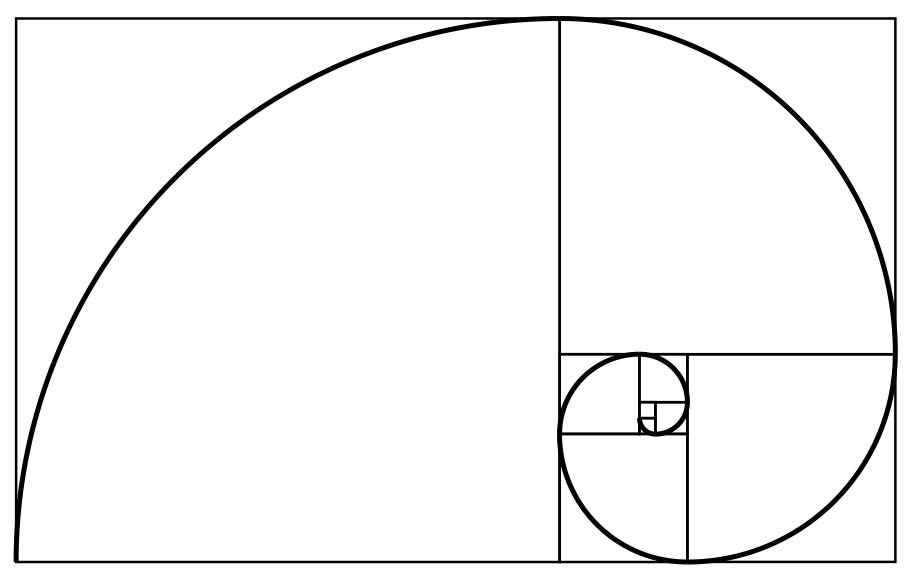
\varphi = \frac{1+\sqrt 5}{2} \approx 1.61803, the golden ratio: the number for which cutting a 1 \times \varphi rectangle into a square and a smaller rectangle leaves a rectangle of the same shape. It is the limit of ratios of consecutive Fibonacci numbers, and Chapter 8.5 derives that. Be sceptical of the claims that it governs the Parthenon and the human face — most are retrofitted, and the mathematics is far more interesting than the mysticism.
Algebraic versus transcendental. An algebraic number solves some polynomial equation with integer coefficients: \sqrt{2} solves x^2 - 2 = 0, and \varphi solves x^2 - x - 1 = 0. A transcendental number solves none. Almost every real number is transcendental — Section 5 explains the sense in which that is true — yet proving any particular number transcendental is extremely hard. Whether \pi + e is transcendental is still unknown.
4. Cantor: are there more reals than fractions?
Both sets are infinite. Asking which is "bigger" sounds like a category error, and until Georg Cantor in the 1870s everyone treated infinity as a single undifferentiated thing.
Cantor's move was to go back to Chapter 1.1's shepherd. He never counted his sheep; he matched them against pebbles. So: two sets have the same size when their members can be paired off one-to-one, with nothing left over on either side. Apply that to infinite sets and see what happens.
The strange results come first
There are as many even numbers as whole numbers. Pair n with 2n: 1↔2, 2↔4, 3↔6, and so on. Every whole number has exactly one partner, every even number is used exactly once. Perfect matching. Yet the evens are a strict subset with "half" the members.
This is not a paradox; it is the definition of infinite. A set is infinite precisely when it can be matched with a proper part of itself. No finite set can do that.
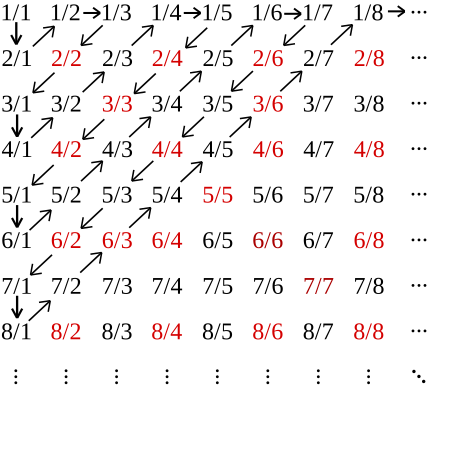
There are as many fractions as whole numbers. This is much more surprising, since between any two whole numbers sit infinitely many fractions. But list the positive fractions in a grid — row a, column b holding \frac{a}{b} — and walk it along diagonals: \frac11, \frac12, \frac21, \frac13, \frac22, \frac31, \ldots, skipping any you have already seen in lowest terms. Every fraction appears somewhere in that walk at a definite position, so the fractions can be numbered 1, 2, 3, \ldots and matched with the whole numbers.
A set that can be matched with the whole numbers this way is called countable. So the integers are countable, and — startlingly — so are the rationals. The algebraic numbers are countable too, by a similar argument.
The diagonal argument
Now the reals. Cantor's proof (1891) is as short as Euclid's and just as famous.
Suppose the reals between 0 and 1 are countable. Then they can be listed, first, second, third, forever, with every one appearing somewhere. Write the list out as decimals:
\begin{aligned} r_1 &= 0.\mathbf{4}15926\ldots\\ r_2 &= 0.7\mathbf{1}8281\ldots\\ r_3 &= 0.61\mathbf{8}033\ldots\\ r_4 &= 0.414\mathbf{2}13\ldots\\ &\;\;\vdots \end{aligned}
Now build a new number x digit by digit, using the bolded diagonal. Make x's first digit differ from r_1's first digit, its second differ from r_2's second, its third from r_3's third, and so on forever. (A concrete rule: if the diagonal digit is 5, write 4; otherwise write 5. This also avoids the 0.\overline{9} = 1 trouble from Chapter 1.3.)
The number x is a perfectly good real between 0 and 1. But it cannot be r_1, because they differ in the first digit. It cannot be r_2, because they differ in the second. It cannot be r_n for any n, because they differ in the $n$th digit by construction.
So x is missing from a list that was supposed to contain every real. The assumption fails. The reals cannot be listed. They are uncountable — an infinity strictly larger than the infinity of the counting numbers.
What this actually implies
The rationals are countable, the reals are not, so almost all real numbers are irrational — in the strongest sense available. The rationals, dense as they are, are a vanishingly thin scattering in the real line. Same for the algebraic numbers: almost every real number is transcendental, even though naming one is hard.
Cantor went further. The set of all subsets of a set is always strictly larger than the set itself, so there is no largest infinity — there is an endless tower of them. The sizes get names: \aleph_0 (aleph-null) for the countable infinity, and larger alephs above.
The continuum hypothesis asks whether there is any infinity strictly between the size of the whole numbers and the size of the reals. Cantor believed not, and could not prove it, and it damaged him — he suffered repeated breakdowns and died in a sanatorium. The answer arrived in two halves: Gödel showed in 1940 that it cannot be disproved from the standard axioms, and Cohen showed in 1963 that it cannot be proved from them either. The question is undecidable — both answers are consistent, and you may add either as a new axiom. Chapter 11.5 tells that story properly.
5. Where this shows up in your life
Your A4 paper is \sqrt 2 tall for every wide, which is why photocopying two pages onto one loses nothing but scale.
Every screen and every measurement. A computer cannot store \sqrt 2 or \pi; it stores a rounded approximation. Volume I, 1.4 and Chapter 10.1 of this volume cover what that costs and when it bites — from a game's physics jittering to a rocket's guidance drifting.
Every circle, wheel, gear and orbit carries \pi, and every growth or decay process carries e.
Every proof that something is impossible. Squaring the circle, trisecting an angle with compass and straightedge, solving a general fifth-degree equation with a formula in radicals — all impossibility results in the same family as the irrationality of \sqrt 2. Volume I, 1.7 covers the computing version, the halting problem, which is Cantor's diagonal argument in a different costume: Turing built his proof on exactly this technique.
Random numbers. If you could pick a real number between 0 and 1 truly at random, the probability of landing on a rational is zero. Not "unlikely" — zero. Chapter 7.4 explains how an event can have probability zero without being impossible.
Part 1 is finished. We have numbers: counting, negative, fractional, prime-structured, wrapping, irrational, and infinite in more than one size. What we cannot yet do is reason about a number we have not been told. That is what algebra is for.
More places these turn up
The compound-interest formula is on every mortgage statement and every credit-card agreement you will ever sign, and knowing that the exponent is nt rather than t is the difference between understanding the number and accepting it. The log laws are why sound is measured in decibels and earthquakes in magnitudes: both quantities span so many orders of magnitude that only an exponent is readable, and the reason a magnitude 7 quake releases about 32 times the energy of a magnitude 6 is the power law in action. The harmonic mean is what fuel-economy figures and average-speed cameras are quietly doing. The digit-sum rule for 3 and 9 is the fastest sanity check in mental arithmetic. And Euler's theorem is running right now, inside the padlock in your browser's address bar, in the way described in 1.6.
Next: 1.P — Worked Problems puts every formula on this page to work on real questions, one line at a time.