Appearance
3.3 — Circles, π, and the Measurement of Curved Things
Take any circle in the universe — a coin, a plate, the Moon, a hydrogen atom's orbit — and divide its circumference by its diameter. You always get the same number. Not approximately: exactly, every time.
That is not obvious, and it is worth staring at for a moment. Why should a small circle and a huge one share a ratio at all? The answer is Chapter 3.2's similarity: all circles are similar to one another. Every circle is a scaled copy of every other, and scaling multiplies all lengths by the same factor, so any ratio of two lengths in the figure is untouched. The ratio is a property of circle-ness, not of any particular circle.
That shared number is \pi.
\pi = \frac{C}{d} = \frac{\text{circumference}}{\text{diameter}} \approx 3.14159265358979\ldots
1. The formulas, and where they come from
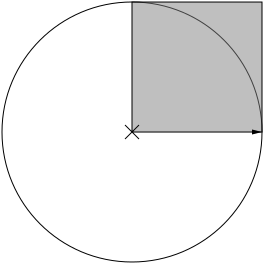
A circle is the set of all points at a fixed distance r — the radius — from a centre. The diameter is d = 2r.
C = 2\pi r, \qquad A = \pi r^2
The first is the definition of \pi, rearranged. The second needs an argument, and Archimedes' is beautiful.
Why the area is \pi r^2. Cut the circle into many thin wedges, like slices of pizza, and lay them out alternately pointing up and down. They interlock into a shape that is almost a rectangle. The more slices you use, the closer to a rectangle it gets.
That rectangle's height is r, the length of each wedge. Its width is half the circumference, \pi r, because half the wedges point up and half down, so each side of the rectangle takes half the original perimeter. Area of a rectangle is width times height:
A = \pi r \times r = \pi r^2
Notice what just happened. We computed the area of a curved shape by approximating it with straight-sided shapes and letting the approximation get better without bound. That is calculus, two thousand years before calculus. Archimedes was doing integration and lacked only the notation and the general method.

2. How π was actually computed
Archimedes, around 250 BCE, gave the first rigorous method, and it is a masterpiece of getting a grip on something you cannot reach directly.
Draw a regular polygon inside the circle and another outside it. The circle's perimeter is squeezed between the two, so \pi is squeezed between two numbers you can compute from straight lines. Then double the number of sides, and double again — each doubling tightens the squeeze, and there is a formula for going from an n-gon to a 2n-gon.
He worked up to 96 sides on both sides and obtained:
\frac{223}{71} \lt \pi \lt \frac{22}{7}, \qquad\text{that is,}\qquad 3.1408 \lt \pi \lt 3.1429
Two decimal places, guaranteed correct, by hand, in Greek numerals, without algebra. The famous approximation \frac{22}{7} is Archimedes' upper bound, and it is accurate to about 0.04\%.
A better one worth knowing: \frac{355}{113}, found in China by Zu Chongzhi in the fifth century, is correct to six decimal places. It is easy to remember as the digits 113355 split in the middle and read backwards.
Later methods used infinite series instead of polygons. The Kerala school in India, particularly Madhava around 1400, found
\frac{\pi}{4} = 1 - \frac{1}{3} + \frac{1}{5} - \frac{1}{7} + \cdots
two centuries before Leibniz rediscovered it in Europe. It is elegant and hopeless in practice — you need about 500 terms for two decimal places — but Madhava had accelerated versions that gave eleven digits.
Today we know \pi to over one hundred trillion digits, computed with algorithms that roughly double the digit count each iteration. This is entirely a benchmark exercise. NASA uses 15 digits for interplanetary navigation, and 40 digits would give the circumference of the observable universe to the width of a hydrogen atom.
Why \pi is irrational, proved by Lambert in 1761, and transcendental, proved by Lindemann in 1882 — both discussed in Chapter 1.7. The transcendence is what killed the ancient problem of squaring the circle.
The Indiana Pi Bill
In 1897 the Indiana General Assembly considered House Bill 246, based on an amateur's claimed squaring of the circle, which implied a value of \pi around 3.2. It passed the House unanimously. It was stopped in the Senate only because a mathematics professor happened to be visiting the capitol on other business, saw what was happening, and coached the senators.
The lesson is not that legislators are foolish. It is that \pi is not a convention that anyone can set — it is forced by geometry, and no vote can move it.
3. Radians: the measure that makes calculus work
Degrees are arbitrary. There are 360 of them in a full turn because the Babylonians used base 60 and because 360 divides conveniently by lots of numbers. Nothing in geometry produces the number 360.
The natural measure asks: how far along the circle did you travel, measured in radii?
\theta \;(\text{in radians}) = \frac{\text{arc length}}{\text{radius}}
A full circle has arc length 2\pi r, so a full turn is 2\pi radians. Half a turn is \pi, a quarter turn is \frac{\pi}{2}.
180° = \pi \text{ rad}, \qquad 1 \text{ rad} = \frac{180}{\pi} \approx 57.3°
Two formulas become trivial in radians, which is the immediate payoff:
\text{arc length} = r\theta, \qquad \text{sector area} = \tfrac{1}{2}r^2\theta
In degrees these carry ugly factors of \frac{\pi}{180}.
The real reason radians matter arrives in Chapter 5.3: the derivative of \sin x is \cos x only if x is in radians. In degrees you get an extra factor of \frac{\pi}{180} trailing through every calculation forever. Radians are the unit in which the calculus of angles comes out clean, which is a strong signal that they are the natural unit and degrees are a historical accident.
A note that catches everyone at least once: programming languages' Math.sin takes radians, not degrees. Math.sin(30) is not 0.5; it is the sine of 30 radians, which is about -0.988.
4. The circle theorems
A handful of facts about angles in circles, each proved from the fact that all radii are equal.
The inscribed angle theorem. An angle at the centre is exactly twice the angle at the circumference standing on the same arc.
The proof sketch: draw the radius from the centre to the point on the circumference. It splits the figure into isosceles triangles, because two of their sides are radii and therefore equal. Isosceles means two equal base angles, and the exterior angle of a triangle equals the sum of the two opposite interior angles. Put those together and the doubling drops out.
Thales' theorem, the special case everyone remembers: an angle in a semicircle is a right angle. If the angle at the centre is 180° (a straight line, the diameter), the angle at the circumference is 90°. So any triangle drawn with the diameter as one side and the third vertex anywhere on the circle has a right angle at that vertex. Thales is said to have sacrificed an ox in celebration.
Angles in the same segment are equal. Two points on the circumference, both looking at the same chord from the same side, see it at the same angle. This is why a footballer's shooting angle is constant along an arc, and why the goalkeeper's positioning problem is a circle problem.
A tangent is perpendicular to the radius at the point of contact. A tangent is a line touching the circle at exactly one point. This is the fact that makes the geometry of gears, belts and pulleys work.
Cyclic quadrilaterals. If all four corners of a quadrilateral lie on one circle, its opposite angles sum to 180°.
5. Solids: surface area and volume
The formulas, and then the two that deserve explanation.
| Solid | Volume | Surface area |
|---|---|---|
| Cuboid | lwh | 2(lw + lh + wh) |
| Cylinder | \pi r^2 h | 2\pi r^2 + 2\pi r h |
| Cone | \frac{1}{3}\pi r^2 h | \pi r^2 + \pi r l |
| Sphere | \frac{4}{3}\pi r^3 | 4\pi r^2 |
| Pyramid | \frac{1}{3} \times \text{base area} \times h | depends on base |
Why the cone and pyramid have a third. Three identical pyramids of the right shape stack exactly into a cube — you can build this from card and see it. In general it takes calculus (Chapter 5.5): slice the cone horizontally, each slice is a disc whose radius shrinks linearly with height, and integrating \pi r^2 down the height produces the third.
The sphere, and Archimedes' favourite result. Take a sphere and the smallest cylinder that contains it — same radius, height equal to the diameter. Then:
\frac{\text{sphere volume}}{\text{cylinder volume}} = \frac{\frac{4}{3}\pi r^3}{\pi r^2 \cdot 2r} = \frac{2}{3}
The sphere is exactly two thirds of its cylinder, in volume and in curved surface area. Archimedes proved this without calculus and regarded it as his finest work; he asked for a sphere-in-cylinder to be carved on his tombstone. Cicero found the grave, overgrown, 137 years later and recognised it by that carving.

The isoperimetric fact. Among all shapes with a given perimeter, the circle encloses the most area; among all solids with a given surface area, the sphere encloses the most volume. This is why soap bubbles are spherical — surface tension minimises area for the enclosed air — why planets are round, why cells are round, and why a hot drink in a round mug stays hot longer than in a square one.
6. Conic sections: one cone, four curves
Take a double cone — two cones tip to tip — and slice it with a flat plane. The curve you get depends entirely on the angle of the slice.
- Slice horizontally: a circle.
- Tilt slightly: an ellipse.
- Tilt until the plane is parallel to the cone's side: a parabola.
- Tilt further, so the plane cuts both halves: a hyperbola.

Each also has a definition purely in the plane, using distances:
- Circle: points at a fixed distance from one point.
- Ellipse: points where the sum of distances to two fixed points (the foci) is constant. Pin a loop of string between two nails, pull it taut with a pencil, and trace — that is an ellipse, and gardeners use it to lay out flowerbeds.
- Parabola: points equidistant from one point and one line.
- Hyperbola: points where the difference of distances to two foci is constant.
Why they matter enormously. Apollonius studied them as pure geometry with no application whatsoever. Then:
- Kepler (1609): planets orbit in ellipses with the Sun at one focus. Newton later derived this from the inverse-square law of gravity.
- Galileo (1638): projectiles trace parabolas (Chapter 2.3).
- An object passing a star too fast to be captured leaves on a hyperbola — the path of an interstellar comet.
- The reflection property: a parabola focuses parallel rays to a point (satellite dishes, telescope mirrors, car headlights run in reverse); an ellipse reflects everything from one focus to the other (whispering galleries, and lithotripsy machines that shatter kidney stones by focusing shock waves without surgery).
Eighteen hundred years between the pure mathematics and the applications. It is the standard example of why mathematics done for its own sake keeps turning out to be the thing you need later.
Every formula above, built from scratch
None of the results in this chapter are worth memorising, because each one can be rebuilt in under a minute from something simpler. What follows is that rebuilding, one result at a time, so the formula and the reason for it sit on the same page as the explanation that needed them.
Area and perimeter
Triangle
A = \tfrac12 \times \text{base} \times \text{height}
Where it comes from. Take any triangle and make a copy of it, rotated by half a turn. The two fit together into a parallelogram with the same base and height. A parallelogram's area is base × height, because you can cut a triangle off one end and slide it to the other to make a rectangle. So one triangle is half of that.
A = \tfrac12 ab\sin C
Where this comes from. In a triangle with sides a and b meeting at angle C, take a as the base. The height is the perpendicular distance from the far vertex down to that base, and looking at the right triangle formed, that height is b\sin C. Substitute into base × height ÷ 2.
This version is more useful than the school one, because you rarely know the height but often know two sides and the angle between them.
Heron's formula
A = \sqrt{s(s-a)(s-b)(s-c)}, \qquad s = \frac{a+b+c}{2}
Read it aloud. "The area is the square root of s, times s minus a, times s minus b, times s minus c, where s is half the perimeter."
Where it comes from. Start from A = \frac12 ab\sin C and get rid of the angle. Square both sides:
A^2 = \tfrac14 a^2b^2\sin^2 C
Replace \sin^2 C with 1 - \cos^2 C (the Pythagorean identity of §5), then factor it as a difference of two squares:
A^2 = \tfrac14 a^2b^2(1-\cos C)(1+\cos C)
Now bring in the law of cosines from §7, which says \cos C = \frac{a^2+b^2-c^2}{2ab}:
1 - \cos C = \frac{2ab - a^2 - b^2 + c^2}{2ab} = \frac{c^2 - (a-b)^2}{2ab}
1 + \cos C = \frac{2ab + a^2 + b^2 - c^2}{2ab} = \frac{(a+b)^2 - c^2}{2ab}
Each numerator is a difference of two squares, so each factors into two brackets:
c^2 - (a-b)^2 = (c-a+b)(c+a-b), \qquad (a+b)^2 - c^2 = (a+b-c)(a+b+c)
Put it all together:
A^2 = \frac{a^2b^2}{4} \cdot \frac{(c-a+b)(c+a-b)(a+b-c)(a+b+c)}{4a^2b^2} = \frac{(a+b+c)(-a+b+c)(a-b+c)(a+b-c)}{16}
Finally write each bracket in terms of s = \frac{a+b+c}{2}. Since a+b+c = 2s, we get -a+b+c = 2s - 2a = 2(s-a), and similarly for the others:
A^2 = \frac{2s \cdot 2(s-a) \cdot 2(s-b) \cdot 2(s-c)}{16} = s(s-a)(s-b)(s-c)
Take the square root. Heron published this around 60 AD, and it is remarkable for needing no angle and no height — three lengths and nothing else.
The rest of the plane figures
| Shape | Area | Perimeter |
|---|---|---|
| Rectangle | lw | 2(l+w) |
| Parallelogram | bh | 2(a+b) |
| Trapezium | \frac12(a+b)h | sum of sides |
| Rhombus | \frac12 d_1d_2 | 4a |
| Regular n-gon | \frac12 n s r | ns |
| Circle | \pi r^2 | 2\pi r |
The trapezium, in one line: it is the average of the two parallel sides times the distance between them, because cutting it along a diagonal makes two triangles of areas \frac12 ah and \frac12 bh.
The rhombus, in one line: its diagonals cross at right angles, cutting it into four right triangles whose legs are the half-diagonals; adding them gives 4 \times \frac12 \cdot \frac{d_1}{2}\cdot\frac{d_2}{2} = \frac{d_1d_2}{2}.
Circle, sector and segment
A_{\text{circle}} = \pi r^2, \qquad C = 2\pi r
Where the area comes from. Cut the circle into many thin wedges and lay them alternately point-up and point-down. They interlock into something increasingly like a rectangle. Its height is r (each wedge is a radius long) and its width is half the circumference, \pi r, since half the wedges point each way. So the area is \pi r \times r = \pi r^2. Make the wedges thinner and the shape becomes a rectangle exactly in the limit — which is the idea of integration, three centuries before it was named.
\text{Arc length } = r\theta, \qquad \text{Sector area } = \tfrac12 r^2\theta \qquad (\theta \text{ in radians})
Where these come from — and why radians exist. A full turn is 2\pi radians and gives the full circumference 2\pi r and the full area \pi r^2. A sector of angle \theta is the fraction \frac{\theta}{2\pi} of the whole circle, so it gets that fraction of each:
\text{arc} = \frac{\theta}{2\pi} \times 2\pi r = r\theta, \qquad \text{area} = \frac{\theta}{2\pi}\times\pi r^2 = \frac12 r^2\theta
Both formulas are clean only in radians. In degrees they would carry a factor of \frac{\pi}{180} everywhere. That is the entire reason radians exist: a radian is defined so that an angle of 1 subtends an arc of length exactly r, which makes the conversion factor disappear.
\text{Degrees to radians: } \times\frac{\pi}{180}, \qquad \text{radians to degrees: } \times\frac{180}{\pi}
Segment area (the region between a chord and the arc):
A_{\text{segment}} = \tfrac12 r^2(\theta - \sin\theta)
It is the sector minus the triangle formed by the two radii and the chord: \frac12 r^2\theta - \frac12 r^2\sin\theta.
Solids
| Solid | Volume | Surface area |
|---|---|---|
| Cuboid | lwh | 2(lw+lh+wh) |
| Prism | A_{\text{base}} \times h | 2A_{\text{base}} + Ph |
| Cylinder | \pi r^2 h | 2\pi r^2 + 2\pi rh |
| Cone | \frac13\pi r^2 h | \pi r^2 + \pi r\ell |
| Sphere | \frac43\pi r^3 | 4\pi r^2 |
| Pyramid | \frac13 A_{\text{base}} h | base + faces |
Where the cylinder's curved surface comes from. Cut it down one side and unroll it. What you get is a rectangle: its height is h, and its width is the circle's circumference 2\pi r. Area 2\pi rh.
Where the cone's slant surface comes from. Cut and unroll it and you get a sector of a circle of radius \ell (the slant height, \ell = \sqrt{r^2+h^2} by Pythagoras). The sector's arc is the cone's base circumference 2\pi r, so the sector is the fraction \frac{2\pi r}{2\pi \ell} = \frac r\ell of a full circle of area \pi\ell^2. Multiply: \frac{r}{\ell}\times\pi\ell^2 = \pi r\ell.
Where the factor of one third comes from. Three identical pyramids with square bases can be assembled into a cube — a physical fact you can hold if you make the pieces. So each is one third of it. The same \frac13 appears for the cone because a cone is the limit of pyramids with more and more sides. The general proof is one line of integration, done in 5.5.
Where the sphere's volume comes from — Archimedes' argument. Compare a hemisphere of radius r with a cylinder of radius r and height r that has a cone removed from it, the cone having its point at the centre.
Slice both at height y. The hemisphere's slice is a disc whose radius x satisfies x^2 + y^2 = r^2, so its area is
\pi x^2 = \pi(r^2 - y^2)
The cylinder-minus-cone's slice is a ring: the cylinder gives a disc of area \pi r^2, and the cone, whose radius at height y is exactly y, removes \pi y^2. Its area is
\pi r^2 - \pi y^2 = \pi(r^2-y^2)
The two slices have the same area at every height. Two solids sliced into equal areas at every level have equal volume — this is Cavalieri's principle. So
V_{\text{hemisphere}} = \pi r^2 \cdot r - \tfrac13\pi r^2 \cdot r = \tfrac23\pi r^3
and the whole sphere is twice that: \frac43\pi r^3. Archimedes was so pleased with this that he asked for a sphere inscribed in a cylinder to be carved on his tombstone.
Surface area, in one line from the volume. Grow the sphere's radius by a hair dr. The extra volume is a thin shell of thickness dr over the whole surface, so dV = A\,dr, giving A = \frac{dV}{dr} = \frac{d}{dr}\left(\frac43\pi r^3\right) = 4\pi r^2.
7. Where this shows up in your life
Every wheel, gear, pulley and bearing. Circumference 2\pi r is how a car computes speed from wheel rotations, and how a bicycle's gear ratio works.
Every pizza-value calculation. A 16-inch pizza has (16/12)^2 = 1.78 times the area of a 12-inch one — nearly double, for typically far less than double the price. Area goes with the square of the diameter, the scaling law of Chapter 3.2.
Every satellite dish and telescope. Parabolic reflection.
Every GPS satellite and space mission. Elliptical orbits, and Chapter 6.3 of Volume IV computes them.
Every circular argument in engineering about radians. Angular velocity in physics, phase in signal processing and rotation in graphics are all in radians, and a degrees/radians mix-up is a classic bug — including in the code that flipped a Mars mission's units.
Every round pipe, tank and can. The isoperimetric property makes them the cheapest container for a given volume, which is why a tin of beans is a cylinder and not a cube.
Greek geometry could prove things about shapes but could not easily compute with them. The next chapter fuses geometry with algebra, and the fusion is so complete that we have half forgotten it was ever an idea.