Appearance
2.5 — Complex Numbers
In 1572 Rafael Bombelli was working on the cubic equation
x^3 = 15x + 4
Anyone can see that x = 4 works: 64 = 60 + 4. But Cardano's formula from Chapter 2.3, applied to this equation, produces
x = \sqrt[3]{2 + \sqrt{-121}} + \sqrt[3]{2 - \sqrt{-121}}
and there it is — the square root of a negative number, sitting in the middle of a calculation whose answer is plainly the honest whole number 4.
Bombelli made the decision that founded the subject. He decided to carry on calculating anyway, treating \sqrt{-121} as an object obeying the usual rules, and see whether the nonsense cancelled. It did. The two cube roots came out as 2 + \sqrt{-1} and 2 - \sqrt{-1}, and adding them gives 4. The impossible quantities appeared, did their work, and vanished.
This is the point that gets lost in school. Complex numbers were not invented so that x^2 + 1 = 0 would have a solution — nobody cared about that, and "no solution" was a perfectly acceptable answer. They were forced on mathematics because they appeared as unavoidable intermediate steps in problems with real answers.
1. The definition
Define a new number i by the single property
i^2 = -1
A complex number is anything of the form
z = a + bi
where a and b are ordinary real numbers. We call a the real part, written \operatorname{Re}(z), and b the imaginary part, written \operatorname{Im}(z). Note carefully: the imaginary part is b, a real number, not bi.
The name "imaginary" was Descartes' and was meant as an insult — he thought such quantities were fictions. It stuck, and it has been confusing students ever since, because it suggests these numbers are less real than the "real" ones. They are not. All numbers are equally invented. Negative numbers were called absurd for four hundred years, and irrationals got a man drowned in a legend. Each was accepted when it proved indispensable, and i is now indispensable to electrical engineering, quantum mechanics and signal processing.
The powers of i cycle with period four, which follows straight from the definition:
i^1 = i, \quad i^2 = -1, \quad i^3 = i^2 \cdot i = -i, \quad i^4 = (-1)(-1) = 1, \quad i^5 = i, \ldots
So i^{2026} = i^{2024} \cdot i^2 = 1 \cdot (-1) = -1, using 2026 \bmod 4 = 2 — modular arithmetic from Chapter 1.6 doing real work.
2. Arithmetic: the usual rules, plus one substitution
Addition collects like parts:
(3 + 2i) + (1 - 5i) = 4 - 3i
Multiplication is ordinary bracket expansion, then replace i^2 with -1:
(3 + 2i)(1 - 5i) = 3 - 15i + 2i - 10i^2 = 3 - 13i + 10 = 13 - 13i
Division needs one trick. To divide by a complex number, multiply top and bottom by its conjugate, which is the same number with the sign of the imaginary part flipped: the conjugate of a+bi is \bar z = a - bi.
The point of the conjugate is that a number times its conjugate is always real:
(a+bi)(a-bi) = a^2 - (bi)^2 = a^2 + b^2
This is the difference-of-two-squares identity from Chapter 2.1, and the minus becomes a plus because i^2 = -1. So:
\frac{3+2i}{1-5i} = \frac{(3+2i)(1+5i)}{(1-5i)(1+5i)} = \frac{3 + 15i + 2i - 10}{1+25} = \frac{-7 + 17i}{26} = -\frac{7}{26} + \frac{17}{26}i
Compare this to rationalising \frac{1}{1-\sqrt 2} by multiplying by 1+\sqrt 2 — it is precisely the same manoeuvre, and it works for the same reason.
And now the system is closed. Chapter 1.1 traced the chain: subtraction forced negatives, division forced fractions, roots forced irrationals, and the square root of a negative forces i. This is where the chain stops. Every polynomial equation with complex coefficients has all its solutions among the complex numbers — the Fundamental Theorem of Algebra from Chapter 2.2. You never need to invent anything again.
3. The picture: numbers as points in a plane
Here is the idea that turned complex numbers from a computational trick into a subject. It came from Caspar Wessel in 1799, Jean-Robert Argand in 1806 and Gauss, and it is embarrassingly simple.
A real number is a point on a line. A complex number is a point on a plane: plot a + bi at coordinates (a, b), with the real part running horizontally and the imaginary part vertically. This is the complex plane, also called the Argand diagram.

Two quantities describe a point, and they are the two that matter.
The modulus is the distance from the origin — Pythagoras, from Chapter 3.2:
|z| = \sqrt{a^2 + b^2}
For z = 3 + 4i, |z| = \sqrt{9+16} = 5. This is the same absolute value as Chapter 1.2, extended to two dimensions.
The argument is the angle from the positive real axis, written \arg(z) or \theta. For 3+4i it is \arctan(4/3) \approx 53.1°.
Together they give polar form:
z = r(\cos\theta + i\sin\theta)
where r = |z|. Chapter 3.5 develops cosine and sine properly; for now, take \cos\theta and \sin\theta as the horizontal and vertical coordinates of a point at angle \theta on a circle of radius 1.
4. What multiplication actually does
Now the payoff. Multiply two complex numbers in polar form and watch what happens to r and \theta.
r_1(\cos\theta_1 + i\sin\theta_1) \cdot r_2(\cos\theta_2 + i\sin\theta_2) = r_1 r_2\big(\cos(\theta_1+\theta_2) + i\sin(\theta_1+\theta_2)\big)
The expansion needs the angle-addition formulas from Chapter 3.5, but the result is what to hold onto:
\textbf{Moduli multiply. Arguments add.}
Multiplying by a complex number is a rotation combined with a scaling. That is what complex multiplication is, geometrically, and it is why the subject matters far beyond solving equations.
Check the simplest case. Multiplying by i has modulus 1 and argument 90°, so it should rotate by a quarter turn without changing size. Take z = 3, a point on the positive real axis. Then 3i is on the positive imaginary axis — a quarter turn up. Multiply again: 3i \cdot i = -3, on the negative real axis — another quarter turn.
And there is the deepest explanation of the sign rule from Chapter 1.2. Multiplying by -1 is a rotation by 180°. Two of them make 360°, which is back where you started. Negative times negative is positive because turning round twice faces you forward. The video-in-reverse intuition of Chapter 1.2 was a shadow of this.
De Moivre's theorem follows immediately: if multiplying adds angles, then raising to a power multiplies the angle:
\big(r(\cos\theta + i\sin\theta)\big)^n = r^n(\cos n\theta + i \sin n\theta)
So (1+i)^8: here r = \sqrt2 and \theta = 45°, so the result has modulus (\sqrt2)^8 = 16 and argument 8 \times 45° = 360°, which is the positive real direction. Answer: 16. Try expanding (1+i)^8 by brute force to appreciate the saving.
5. Euler's formula, and the most famous equation in mathematics
Chapter 5.8 will show that e^x, \sin x and \cos x each equal an infinite sum of powers:
e^x = 1 + x + \frac{x^2}{2!} + \frac{x^3}{3!} + \cdots
Substitute x = i\theta. The powers of i cycle through i, -1, -i, 1 as we saw, so the terms sort themselves into two groups — the ones without i and the ones with — and those two groups turn out to be exactly the series for cosine and sine. The result, found by Euler around 1740:
e^{i\theta} = \cos\theta + i\sin\theta
This is Euler's formula, and it is the single most useful identity in applied mathematics. It says the exponential function, given an imaginary input, produces rotation. Polar form becomes simply z = re^{i\theta}, and every rule of Section 4 becomes an ordinary exponent law from Chapter 1.4:
r_1 e^{i\theta_1} \cdot r_2 e^{i\theta_2} = r_1 r_2 e^{i(\theta_1+\theta_2)}
Moduli multiply and arguments add because exponents add when you multiply. The geometric fact and the algebraic law are the same fact.
Now set \theta = \pi — that is, half a turn, since \pi radians is 180° (Chapter 3.5). Then \cos\pi = -1 and \sin\pi = 0:
e^{i\pi} = -1, \qquad\text{or}\qquad e^{i\pi} + 1 = 0
Euler's identity. It contains e from continuous growth, i from the square root of -1, \pi from circles, 1 the multiplicative identity and 0 the additive identity — five constants from five separate corners of mathematics, in one short sentence, with nothing left over.
It is routinely called beautiful, and it is worth saying plainly why rather than just admiring it. It is not a coincidence and not mysticism. It says: starting at 1 and rotating half a turn lands you at -1. Every symbol in it is doing an ordinary job. The beauty is that growth (e), rotation (i), and circles (\pi) turn out to be three descriptions of one thing.
6. Why complex roots come in pairs
Chapter 2.2 claimed that a real polynomial's non-real roots come in conjugate pairs. Now we can see why.
If p(x) has real coefficients and p(z) = 0, take the conjugate of the whole equation. Conjugation leaves real numbers alone and distributes over sums and products, so \overline{p(z)} = p(\bar z). Since \overline{0} = 0, we get p(\bar z) = 0. So \bar z is a root too.
That is why x^2 + x + 1 = 0, whose discriminant was -3 back in Chapter 2.3, has roots
x = \frac{-1 \pm i\sqrt3}{2}
— a conjugate pair, mirror images across the real axis. And it is why a real polynomial of odd degree must have at least one real root: the non-real ones pair up, so an odd count cannot be made entirely of pairs.
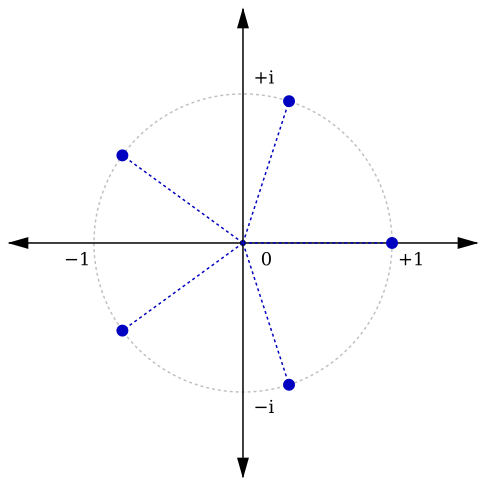
The $n$th roots of 1 are a lovely case. Solving z^n = 1 means finding n points whose $n$th power lands back at 1, and by De Moivre they are evenly spaced around the unit circle at angles \frac{2\pi k}{n}. They form a perfect regular polygon.
7. Where complex numbers do real work
Alternating current. A voltage that oscillates has a size and a timing offset — an amplitude and a phase. That is exactly a modulus and an argument, so engineers represent it as one complex number called a phasor. Adding two out-of-phase voltages, which would need trigonometric identities, becomes adding two complex numbers. Resistance, capacitance and inductance combine into a single complex impedance, and Ohm's law works unchanged. Volume III, Part 1 does this in full. (Electrical engineers write j instead of i, because i already means current.)
Signal processing. The Fourier transform of Chapter 9.3 decomposes a signal into pure frequencies, and each frequency component carries an amplitude and a phase — one complex number. Everything from your headphone's noise cancelling to MP3 compression to 5G runs on complex arithmetic.
Quantum mechanics. The wavefunction is complex-valued, not as a calculational convenience but essentially. Interference — the thing that makes quantum mechanics strange — is complex numbers adding and partially cancelling by phase. Volume IV, Chapter 7 covers it.
Control systems. Whether a feedback system is stable depends on where certain complex numbers sit relative to the imaginary axis. Volume III, Part 6 and Chapter 9.5 of this volume.
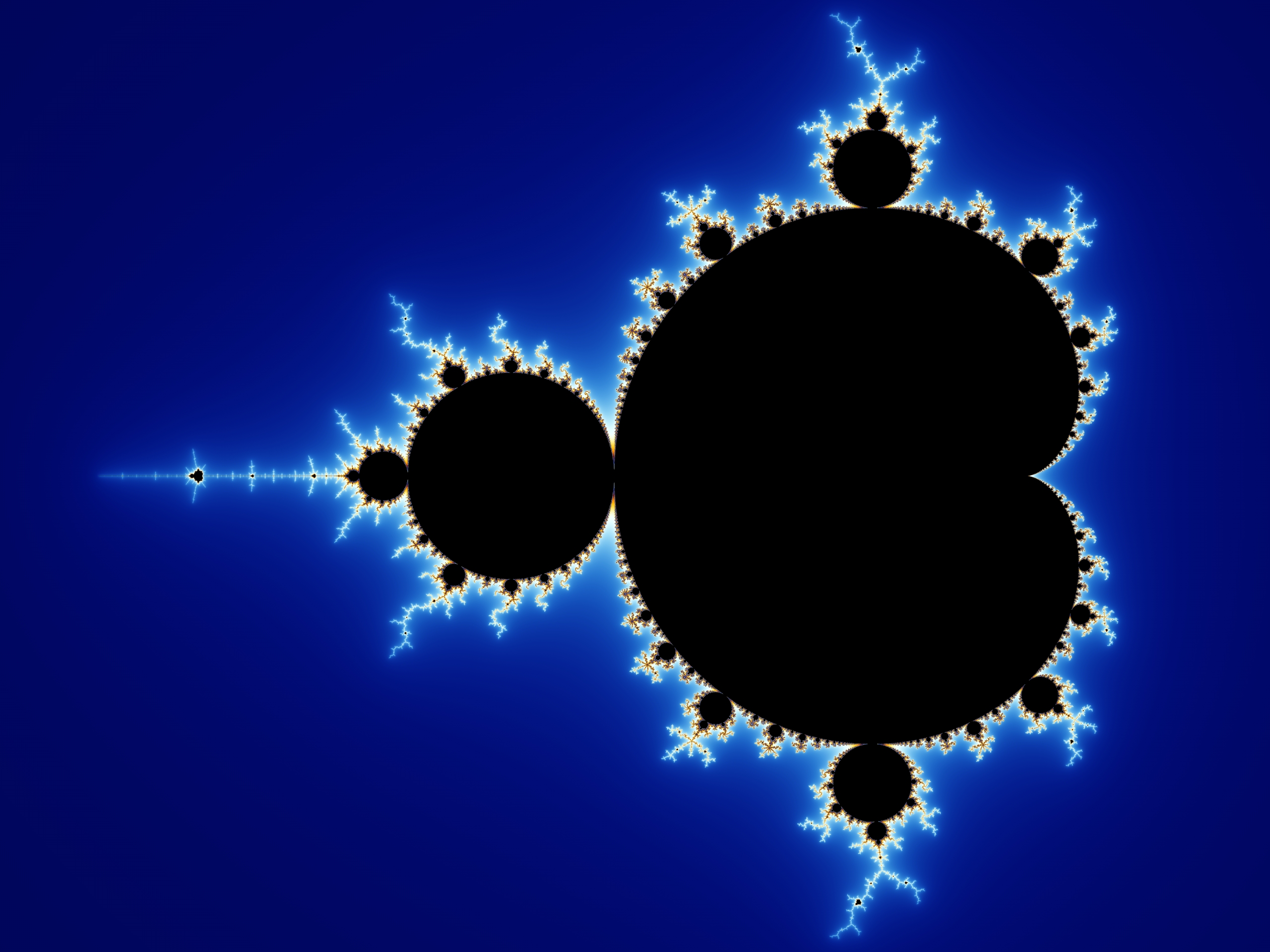
Fractals. The Mandelbrot set is defined by iterating z \mapsto z^2 + c in the complex plane and asking which starting points stay bounded. Complex multiplication's "rotate and scale" behaviour is what generates the endless self-similar detail.
Rotations in 3D graphics. Complex numbers rotate a plane; their four-dimensional cousins, quaternions, rotate space, and every game engine and spacecraft attitude system uses them because they avoid a failure mode of angle-based rotation called gimbal lock.
Every formula above, built from scratch
None of the results in this chapter are worth memorising, because each one can be rebuilt in under a minute from something simpler. What follows is that rebuilding, one result at a time, so the formula and the reason for it sit on the same page as the explanation that needed them.
Complex numbers
i^2 = -1
Every other formula here comes from that single definition plus ordinary algebra.
(a+bi) + (c+di) = (a+c) + (b+d)i
(a+bi)(c+di) = ac + adi + bci + bd\,i^2 = (ac - bd) + (ad+bc)i
The real part of the product picks up a minus sign from i^2 = -1, and that minus is the only thing that makes complex multiplication different from ordinary bracket expansion.
Division, by the conjugate trick. The conjugate of z = a+bi is \bar z = a - bi. Their product is real, by the difference of two squares from §2:
z\bar z = (a+bi)(a-bi) = a^2 - (bi)^2 = a^2 + b^2 = |z|^2
So to divide, multiply top and bottom by the bottom's conjugate — the same move that rationalised a surd in §2:
\frac{a+bi}{c+di} = \frac{(a+bi)(c-di)}{c^2+d^2}
Modulus and argument.
|z| = \sqrt{a^2+b^2}, \qquad \arg z = \operatorname{atan2}(b, a)
|z| is the distance from the origin, straight from Pythagoras; \arg z is the angle from the positive real axis.
Euler's formula.
e^{i\theta} = \cos\theta + i\sin\theta
Proved from the series in 5.8; its consequence at \theta = \pi is the most quoted equation in mathematics:
e^{i\pi} + 1 = 0
De Moivre's theorem.
(\cos\theta + i\sin\theta)^n = \cos n\theta + i\sin n\theta
Where it comes from. Write the left side as \left(e^{i\theta}\right)^n using Euler's formula, apply the power-of-a-power law to get e^{in\theta}, then translate back with Euler's formula again. Multiplying complex numbers adds their angles, so raising to the n-th power multiplies the angle by n.
What it is for. It generates trigonometric identities on demand. Take n = 2:
\cos 2\theta + i\sin2\theta = (\cos\theta+i\sin\theta)^2 = \cos^2\theta - \sin^2\theta + 2i\sin\theta\cos\theta
Two complex numbers are equal only if their real parts match and their imaginary parts match separately. So in one line you have both double-angle formulas:
\cos2\theta = \cos^2\theta - \sin^2\theta, \qquad \sin2\theta = 2\sin\theta\cos\theta
They are derived again geometrically in 3.4 — coordinate geometry; this route is faster and needs no picture.
8. Where this shows up in your life
Every AC socket in your house, and every calculation an electrical engineer does about it.
Every audio equaliser, every noise-cancelling headphone, every JPEG and MP3. Fourier, therefore complex.
Every mobile signal. The modulation schemes of Volume III, 7.3 encode data as points in the complex plane, and the diagram of those points is literally called a constellation.
Every video game's camera rotation. Quaternions.
Every piece of software that computes a fast convolution or a spectrum — from a guitar tuner app to a radar.
Part 2 is finished, and with it the number system is complete. What is missing is space: lines, angles, shapes and the measurements of the physical world. That is the oldest branch of mathematics, and it starts with a Greek who insisted that everything be proved.
More places these turn up
Completing the square is what a spreadsheet's solver does under the hood on any quadratic cost model, and it is how the trajectory of anything thrown — a ball, a firework, a water jet — gets its highest point computed. The difference of two squares is the fastest mental-arithmetic tool you own. Partial fractions are how any control system's response, from a car's cruise control to the thermostat on your boiler, gets turned into something solvable. The binomial coefficients are the number of ways a thing can happen, so they are the machinery behind every probability quoted on a weather forecast. And e^{i\theta} is how every piece of audio and radio hardware you own represents a wave, a story taken up properly in Part 9.
Next: 2.P — Worked Problems uses every identity above on real questions, step by step.