Appearance
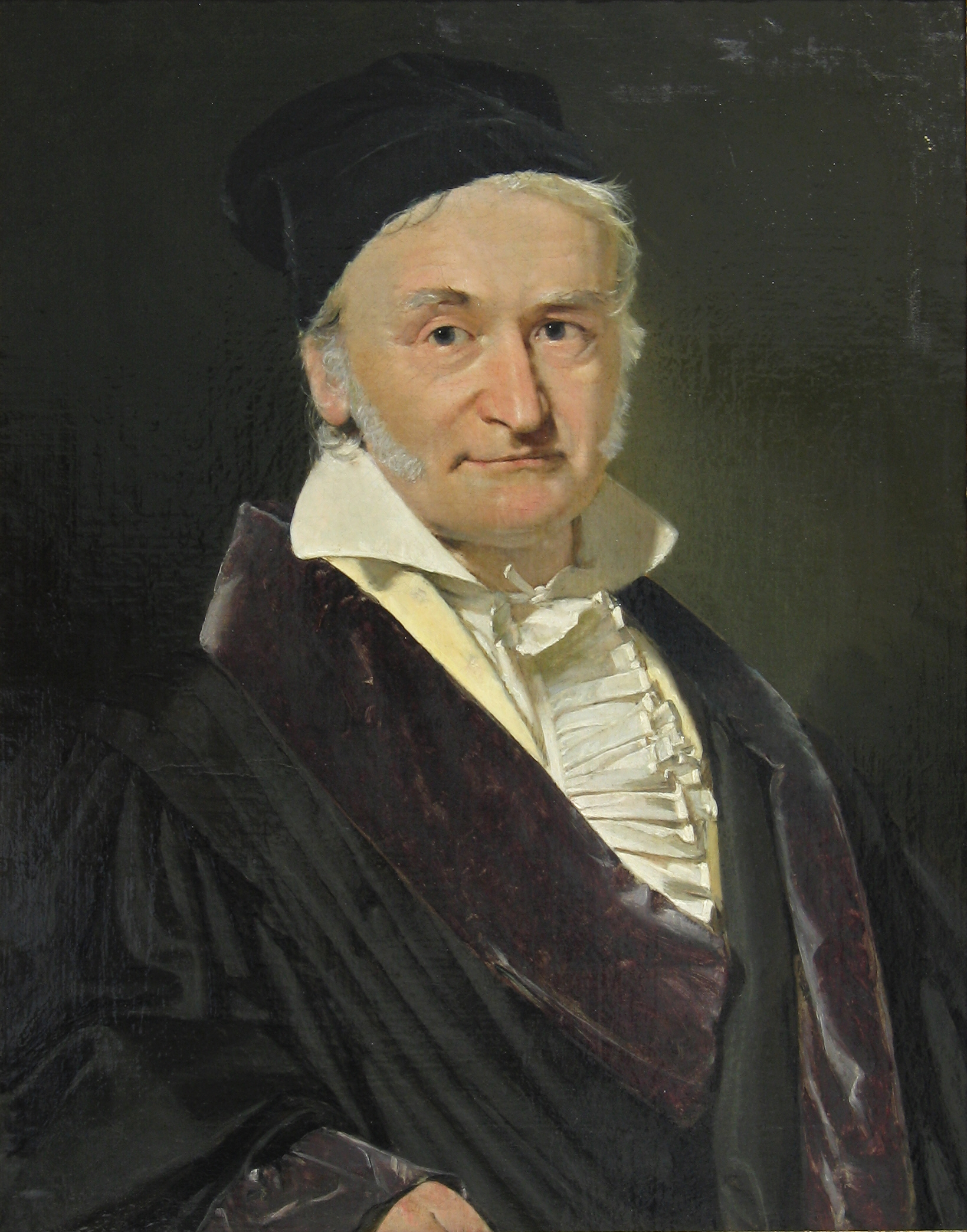
11.2 — Gauss
In 1796, a nineteen-year-old Carl Friedrich Gauss was deciding between a career in mathematics and one in classical languages. On 30 March he proved that a regular 17-sided polygon can be constructed with straightedge and compass.
This mattered because nobody had added a constructible polygon to Euclid's list in two thousand years. The Greeks knew how to construct 3, 4, 5, 15 sides and any doubling of those. Gauss showed the 17-gon works, and then went further and characterised exactly which regular polygons are constructible — those whose odd prime factors are distinct Fermat primes, of the form 2^{2^k}+1.
He chose mathematics. He asked for a 17-gon on his gravestone; the stonemason refused, on the grounds that it would be indistinguishable from a circle.
1. The child
Born in Brunswick in 1777 to a bricklayer father who could barely write and a mother who was illiterate. The family stories are unusually well attested because Gauss told them himself in old age.
At three he watched his father totalling the payroll for a group of labourers, and pointed out an arithmetic error. He was right.
At about seven or eight came the famous incident with the sum 1+2+\cdots+100, which Chapter 8.3 discussed. The teacher, Büttner, set it as busywork; Gauss wrote 5,050 on his slate almost immediately, having noticed that the numbers pair up as fifty pairs summing to 101. The details of the story have been embroidered over two centuries, and the core of it is contemporaneous.
Büttner, to his enormous credit, bought the boy an advanced arithmetic book out of his own pocket and arranged for his assistant to tutor him. The Duke of Brunswick funded his education from age 14 until the Duke's death in 1806.
2. Disquisitiones Arithmeticae
Published in 1801 when Gauss was 24, this book created number theory as a systematic subject. Before it, results about integers were a scattered collection of curiosities; after it, there was a field.
It introduced congruence notation — the \equiv and \pmod n of Chapter 1.6 — and that notation is why modular arithmetic became usable rather than awkward.
It gave the first complete proof of the Fundamental Theorem of Arithmetic (Chapter 1.5). Euclid had the ingredients; Gauss assembled and stated it properly.
It proved quadratic reciprocity, which he called the "golden theorem" and proved eight different ways across his life. The statement is technical — it relates whether p is a square modulo q to whether q is a square modulo p — and its importance is that it revealed deep hidden structure in the primes, structure nobody had suspected. It remains one of the most-proved theorems in mathematics, with over 240 published proofs.
3. Finding Ceres
In January 1801 the astronomer Piazzi spotted a new object between Mars and Jupiter, tracked it for 41 days across just 3 degrees of sky, and then lost it in the Sun's glare. Astronomers across Europe searched for it when it should have re-emerged and found nothing. The orbit could not be determined from so little data by any method then known.
Gauss, aged 24, computed the orbit from the 41 observations and predicted where it would reappear. On 31 December 1801, Franz von Zach found Ceres almost exactly where Gauss said it would be.
It made him famous outside mathematics overnight.
The method he used was least squares — Chapter 4.3 and Chapter 7.8's technique of finding the fit that minimises total squared error. He had developed it around 1795 and not published. Legendre published it independently in 1805, and the resulting priority dispute was bitter, though Gauss had genuine unpublished evidence.
He also developed the normal distribution in this work, as the error distribution that makes the arithmetic mean the most likely estimate — which is why the bell curve of Chapter 7.6 is called the Gaussian. The mathematics of measurement error was invented to find a lost asteroid.
4. The Fundamental Theorem of Algebra
His 1799 doctoral thesis proved that every polynomial of degree n has exactly n complex roots — Chapter 2.2's theorem. He returned to it three more times over his life, dissatisfied with the rigour of his earlier attempts, and gave the last proof in 1849, fifty years after the first.
That pattern is characteristic. Gauss published only what he considered complete. His motto was pauca sed matura — few, but ripe.
5. What he did not publish
After his death, his diary and notebooks were examined. They contained, undeveloped or unpublished:
Non-Euclidean geometry. He had worked it out decades before Bolyai and Lobachevsky published (Chapter 3.1). When János Bolyai's father sent him his son's work in 1832, Gauss replied that praising it would be praising himself, since he had reached the same results long before. The young Bolyai was devastated and effectively stopped doing mathematics. Gauss had kept quiet because he feared "the outcry of the Boeotians" — ridicule from conventional thinkers.
The Fast Fourier Transform, in 1805, for interpolating asteroid orbits. Chapter 9.3 tells the story. Cooley and Tukey rediscovered it in 1965, and it turned out Gauss's Latin notebook had it 160 years earlier.
Elliptic functions, which Abel and Jacobi later developed and were startled to find Gauss had anticipated.
Quaternions, before Hamilton.
Complex analysis, including Cauchy's integral theorem.
The historian Eric Temple Bell estimated that mathematics would have been advanced by fifty years if Gauss had published everything he knew.
Whether that is a tragedy or a reasonable personal standard is a real question. Gauss's published work is uniformly excellent and gives no help in seeing how he found anything — he removed the scaffolding, and Abel complained that "he is like the fox, who effaces his tracks in the sand". The modern norm of publishing partial results and letting the community build on them produces messier literature and faster progress.
6. Geodesy, magnetism and physics
From 1818 Gauss spent years surveying the Kingdom of Hanover, doing the field work himself. He invented the heliotrope, a device using mirrors to reflect sunlight over long distances for sighting.
The survey led to differential geometry. Measuring a curved surface with instruments confined to that surface, he proved the Theorema Egregium — "remarkable theorem" — that a surface's curvature can be determined entirely from measurements within the surface, without reference to any surrounding space.
A flat sheet of paper can be rolled into a cylinder without stretching, and cannot be wrapped around a sphere without distortion. That is why every flat map of the Earth distorts something, and why a pizza slice held flat flops while one curled along its length stays rigid — curving it in one direction forces stiffness in the other, because the total curvature cannot change.
And this is the mathematics Einstein needed. General relativity describes gravity as the curvature of spacetime, measured intrinsically because there is no outside to measure from. Gauss's student Riemann generalised the theorem to any number of dimensions in 1854, and Einstein used Riemann's machinery in 1915. Volume IV, Chapter 6.
Magnetism. With Wilhelm Weber he built one of the first working telegraphs in 1833, running 1,200 metres across Göttingen. He mapped the Earth's magnetic field and established the absolute system of units in which magnetic flux density is measured in gauss.
7. The man
Difficult, by most accounts. He was a demanding and unenthusiastic teacher who disliked lecturing. He was harsh to his sons, two of whom emigrated to the United States to escape his expectations. He was slow to encourage younger mathematicians, with a notable exception: he supported Sophie Germain, who had written to him under a male pseudonym, and when he learned she was a woman he wrote that her achievement was greater still given the obstacles, and recommended her for an honorary degree. She died before it was awarded.
He was multilingual, learned Russian in his sixties for pleasure, and read widely in literature. He refused most invitations and rarely travelled.
He died in 1855 in Göttingen, aged 77. His brain was preserved and studied for decades, in a long and ultimately fruitless search for a physical explanation of genius.
8. What is named after him
More than for almost anyone: the Gaussian distribution, Gaussian elimination, Gauss's law in electromagnetism, the gauss unit, Gaussian curvature, Gaussian integers, the Gauss–Bonnet theorem, Gaussian quadrature, the Gauss–Markov theorem, the Gauss–Seidel method, and the crater Gauss on the Moon.
Four of those appear in this volume as working tools — the distribution in Chapter 7.6, elimination in Chapter 4.3, quadrature in Chapter 10.3, and the FFT he did not publish in Chapter 9.3.
Euler was prolific, Gauss was exacting. The next figure had neither a university education nor access to a research library, and arrived at results that took the rest of mathematics a century to catch up with.
Every formula above, built from scratch
None of the results in this chapter are worth memorising, because each one can be rebuilt in under a minute from something simpler. What follows is that rebuilding, one result at a time, so the formula and the reason for it sit on the same page as the explanation that needed them.
Gauss's schoolboy sum
1+2+\cdots+n = \frac{n(n+1)}{2}
The story, probably embellished but not fabricated: a schoolmaster set the class to add the numbers from 1 to 100, expecting quiet for an hour, and the young Gauss produced 5,050 almost at once.
What he saw. Pair the first with the last, the second with the second-last:
1+100 = 101, \quad 2+99 = 101, \quad 3+98 = 101, \ldots
Fifty pairs, each totalling 101:
50\times101 = 5050
The general proof, writing the sum forwards and backwards and adding columns, is in 2.2 — polynomials.
The Gaussian integral
\int_{-\infty}^{\infty}e^{-x^2}dx = \sqrt\pi
The function e^{-x^2} has no elementary antiderivative — there is no formula in ordinary functions for \int e^{-x^2}dx. Yet the integral over the whole line is exactly \sqrt\pi.
The trick, which is one of the most admired in mathematics. Call the answer I and consider I^2, writing the second copy with a different letter:
I^2 = \left(\int_{-\infty}^\infty e^{-x^2}dx\right)\left(\int_{-\infty}^\infty e^{-y^2}dy\right) = \int_{-\infty}^\infty\int_{-\infty}^\infty e^{-(x^2+y^2)}dx\,dy
That is now an integral over the whole plane. Switch to polar coordinates, where x^2+y^2 = r^2 and the area element is r\,dr\,d\theta — the extra r derived in 5.5 — the integral:
I^2 = \int_0^{2\pi}\int_0^\infty e^{-r^2}r\,dr\,d\theta
The r that polar coordinates supply is exactly what makes this integrable, because now the substitution u = r^2, du = 2r\,dr works:
\int_0^\infty e^{-r^2}r\,dr = \frac12\int_0^\infty e^{-u}du = \frac12
So
I^2 = \int_0^{2\pi}\frac12\,d\theta = \frac{2\pi}{2} = \pi \quad \Rightarrow \quad I = \sqrt\pi
Why this matters. It is where the \sqrt{2\pi} in the normal distribution comes from. That constant is not chosen for convenience; it is forced, and this integral is the reason.
Stirling's approximation
n!\approx\sqrt{2\pi n}\left(\frac ne\right)^n
Where the shape comes from. Take logarithms to turn the product into a sum:
\ln n! = \sum_{k=1}^n\ln k
Approximate the sum by an integral, which is accurate because \ln changes slowly:
\sum_{k=1}^n\ln k \approx \int_1^n\ln x\,dx = \left[x\ln x - x\right]_1^n = n\ln n - n+1
Exponentiating gives n!\approx e\left(\frac ne\right)^n. The \sqrt{2\pi n} factor is the correction from doing the approximation properly, and the 2\pi inside it traces back to the Gaussian integral of §7.
How good is it? At n=10: the true 10! = 3{,}628{,}800, and Stirling gives 3{,}598{,}696 — an error of 0.83%. At n=100 the relative error is 0.083%, and it keeps improving. The relative error falls like \frac{1}{12n}, so the approximation gets better exactly where computing the factorial gets harder.
Where it is used. Anywhere factorials appear inside limits: the derivation of the Poisson distribution, the entropy of a physical system in statistical mechanics, and the analysis of sorting algorithms, where \log_2(n!) \approx n\log_2 n - 1.44n gives the exact information-theoretic lower bound on comparison sorting.