Appearance
1.10 — Deep Time and the Five Great Dyings
In a limestone quarry at Gubbio in central Italy there is a boundary you can put your finger on. Below it, the rock is full of the shells of a particular group of plankton. Above it, they are gone, and the rock is nearly empty of fossils for a while. Between the two is a layer of clay about a centimetre thick.
In 1980 a father-and-son team, the physicist Luis Alvarez and the geologist Walter Alvarez, measured the chemistry of that clay layer. It contained iridium at about thirty times the normal crustal concentration. Iridium is rare in the Earth's crust because it went down with the core during differentiation (Chapter 1.2), but it is comparatively abundant in asteroids. They proposed that the layer was the fallout of a large asteroid impact, and that the impact killed the dinosaurs.
They were mostly laughed at. Then the same iridium spike was found at the same level in Denmark, New Zealand, Spain and dozens of other sites. Then shocked quartz, whose crystal structure is deformed in a way only produced by impacts or nuclear explosions, was found in the same layer. Then tiny glass droplets of melted rock. Then, in 1991, geologists working for the Mexican state oil company realised that a buried circular structure about 180 kilometres across, centred on the town of Chicxulub on the Yucatán coast, was an impact crater — and it dated to exactly the right moment.
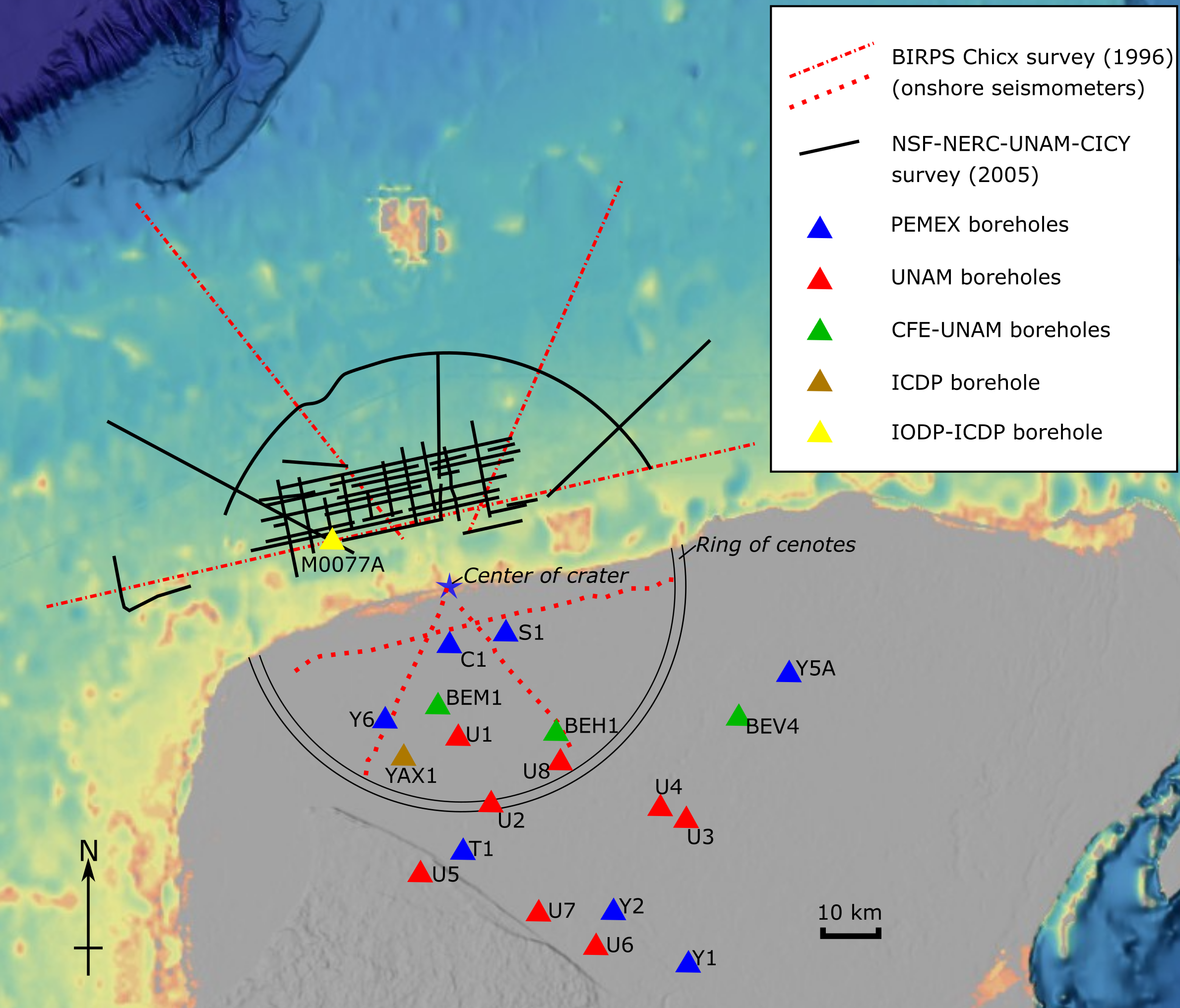
That is what a strong scientific case looks like: a prediction made from one line of evidence, then confirmed by several independent lines that had no reason to agree. This page places that event in the full sequence of Earth's history, and covers the four other times life nearly ended.
The calendar, and why it is divided where it is
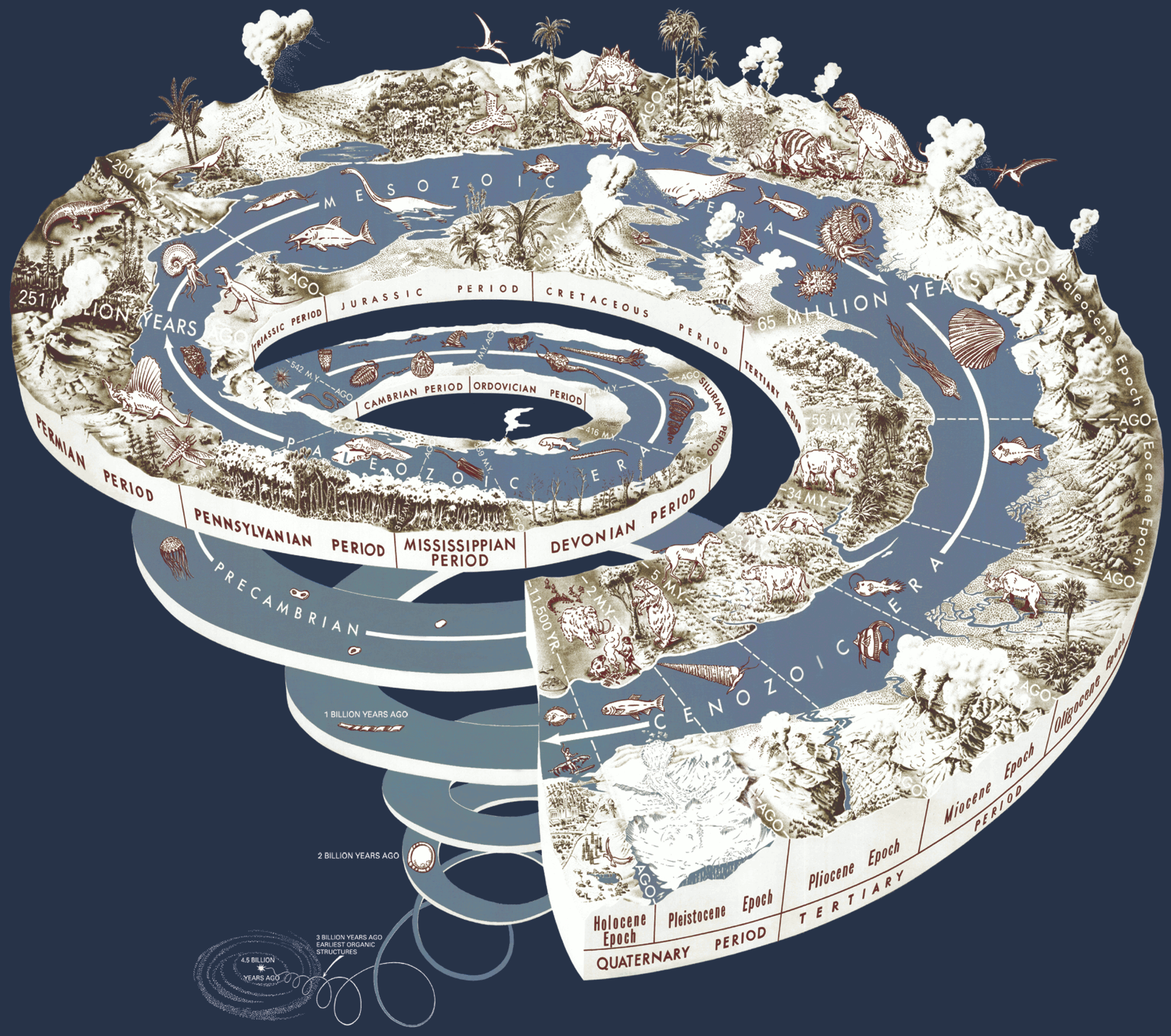
The divisions were not chosen for tidiness. Each boundary was originally drawn where the fossils in the rock change sharply — which, as Chapter 1.1 explained, is how nineteenth-century geologists could build the whole sequence with no dates at all. Only later did radiometric dating attach numbers, and the numbers confirmed that the fossil breaks were real events rather than gaps in the record. The biggest breaks turned out to be mass extinctions, so the calendar is, quite literally, a list of catastrophes with the quiet periods in between.
| Eon | Era | Period | Began (Ma) | What happened |
|---|---|---|---|---|
| Hadean | — | — | 4,540 | Formation, Moon impact, first ocean |
| Archean | — | — | 4,000 | First life, first continents |
| Proterozoic | — | — | 2,500 | Oxygen appears, first complex cells |
| Phanerozoic | Palaeozoic | Cambrian | 539 | Animals with hard parts explode |
| Ordovician | 485 | First land plants; extinction at end | ||
| Silurian | 444 | Reefs, jawed fish | ||
| Devonian | 419 | Forests, first land vertebrates; extinctions | ||
| Carboniferous | 359 | Vast coal swamps, giant insects | ||
| Permian | 299 | Pangaea assembled; the worst extinction at end | ||
| Mesozoic | Triassic | 252 | Dinosaurs and mammals appear; extinction at end | |
| Jurassic | 201 | Dinosaurs dominant, first birds | ||
| Cretaceous | 145 | Flowering plants; Chicxulub at end | ||
| Cenozoic | Palaeogene | 66 | Mammals radiate | |
| Neogene | 23 | Grasslands, apes, Himalaya rising | ||
| Quaternary | 2.6 | Ice ages, humans |
"Ma" means millions of years ago. Phanerozoic means "visible life" — the eon in which fossils are common enough to see without a microscope, which is why the detailed subdivisions all sit inside it and the first four billion years are three big blocks.
Two things about that table are worth sitting with. The Precambrian — everything before 539 million years ago — is 88 percent of Earth's history, and almost nothing in the popular picture of the past happens in it. And every era boundary in the Phanerozoic is a mass extinction. The eras are defined by the disasters.
What counts as a mass extinction
A mass extinction is a short interval in which the rate of species loss vastly exceeds the ordinary background rate, across many unrelated groups and many environments at once. Species go extinct all the time; that is the background. What marks these five events is that the losses are simultaneous, global, and indiscriminate — the successful and the marginal both go.
They are best identified by what does not explain them. Ordinary competition, ordinary climate drift and ordinary predation are all slow, selective and local. A mass extinction is fast, global and largely random with respect to how well-adapted a species was, which is why they reset the direction of evolution rather than continuing it.
1. End-Ordovician, about 444 million years ago
Roughly 85 percent of species lost, second only to the Permian in severity. All life was still in the sea.
The cause is a glaciation, in two pulses. The supercontinent Gondwana drifted over the South Pole, ice sheets grew, and locking that much water into ice dropped global sea level by perhaps a hundred metres. Since almost all marine life lived on shallow continental shelves, draining the shelves destroyed the habitat itself. Then the ice melted, sea level came back fast, and the returning water was low in oxygen, which killed much of what had survived the first pulse.
Why the ice grew is debated, and one of the more interesting candidates is that the first land plants — simple mosses and liverworts spreading over bare rock — accelerated chemical weathering enough to pull down atmospheric carbon dioxide. If that is right, the first mass extinction was caused by plants colonising land, which is a good early warning that life changes the planet as much as the planet changes life.
2. Late Devonian, about 372 to 359 million years ago
Around 75 percent of species, and unusual in that it was not a single event but a long series of pulses over millions of years, hitting shallow-water and reef life hardest. Reef ecosystems essentially collapsed and took over 100 million years to rebuild.
The leading explanation is again plants, and this time on a larger scale. The Devonian is when trees and deep root systems evolved and forests spread across the continents. Roots break up rock and accelerate weathering enormously, and the nutrients washed off the land fertilised the seas. The result was ocean anoxia: algal blooms, decay consuming the dissolved oxygen, and vast areas of sea floor becoming lifeless. The black shales laid down at these times are the physical evidence, and they are also, incidentally, major oil source rocks.
3. End-Permian, 252 million years ago — "the Great Dying"
The worst event in the history of life. About 81 percent of marine species and about 70 percent of land vertebrate species gone. Insects, which have survived everything else, suffered their only mass extinction. It came close to ending complex life entirely, and recovery took about 10 million years — several times longer than after any other event.
The cause is now well established, and it is volcanic. The Siberian Traps erupted at exactly this time: a flood basalt province (Chapter 1.7) covering an area of the order of millions of square kilometres, erupting for perhaps a million years.
But the eruption alone is not the killer — what it erupted through is. The magma intruded into thick Siberian deposits of coal, oil shale and evaporites, and cooked them. That released not only volcanic carbon dioxide but a vast additional charge of carbon and methane from the burned sediments, plus sulphur and halogens.
The chain, step by step, and each step is recorded in the rocks:
- Carbon dioxide floods the atmosphere. Carbon isotope ratios (Chapter 1.1) show a huge, fast shift.
- Global temperature rises steeply — oxygen isotopes in fossil teeth indicate tropical sea surface temperatures around 40 °C, hot enough to be lethal for most marine animals.
- Carbon dioxide dissolving into the ocean makes it more acidic, which attacks anything building a carbonate shell. Boron isotope work confirms the acidification.
- Warm water holds less dissolved oxygen, and warm surface water stops sinking, so the ocean stops overturning and goes anoxic from the depths upward. Sulphur-metabolising bacteria then thrive and produce hydrogen sulphide, which is directly poisonous.
- On land, heat, acid rain, and the collapse of plant communities. Fungal spore spikes in the rock record mark a world of rotting vegetation.
The end-Permian is the single most important case study in Earth history for a plain reason: it is the closest analogue to injecting a very large quantity of carbon into the atmosphere quickly. The scale was far larger than anything human, and the injection was slower — thousands of years rather than a few hundred. Part 14 refers back here.
4. End-Triassic, 201 million years ago
About 76 percent of species. The mechanism looks like a repeat of the Permian on a smaller scale: the Central Atlantic Magmatic Province erupted as Pangaea began to rift apart and the Atlantic began to open, delivering carbon dioxide, warming and ocean acidification.
Its significance is what it cleared the way for. The large crocodile-like archosaurs that had dominated Triassic land ecosystems were wiped out; dinosaurs, which had been present but secondary for tens of millions of years, survived and inherited an empty world. The age of dinosaurs began because of an extinction, not because dinosaurs outcompeted anything.
5. End-Cretaceous, 66 million years ago
About 76 percent of species, including every non-avian dinosaur, the flying pterosaurs, the great marine reptiles, the ammonites, and much of the plankton.
The impact. An asteroid roughly 10 to 15 kilometres across, arriving at something like 20 kilometres per second, striking a shallow sea at Chicxulub. The energy released is estimated at over a billion times that of the Hiroshima bomb.
What that actually does, in order:
- The first hours. Everything within about 1,500 kilometres is destroyed outright. Massive tsunamis cross the Gulf. Rock vaporised at the impact is thrown clear of the atmosphere on ballistic trajectories, and re-enters worldwide over the following hour, heating the sky to broiling temperatures and igniting fires across much of the planet. The soot layer in the boundary clay is the evidence.
- The next months to years. Dust and, more importantly, sulphate aerosols from the vaporised rock — Chicxulub struck a bed of sulphur-rich evaporite rock, which was extraordinarily bad luck — block sunlight. Photosynthesis stops or nearly stops. This is the actual killer: with no primary production, marine and land food chains collapse from the bottom.
- Then, once the aerosols clear, the carbon dioxide released from the shattered carbonate rock produces a warming that lasts far longer.
Who survived tells you the mechanism was a food-chain collapse. Nothing much larger than a few kilograms on land came through. Survivors were mostly small, and mostly able to eat detritus, seeds, insects or carrion rather than living plants: small mammals, birds, crocodiles, turtles, insects. Freshwater ecosystems, which run on decaying material washed in rather than on live photosynthesis, did comparatively well. This is exactly what you expect if the sun went out for a couple of years, and not what you expect from a slow climate change.
The Deccan question, handled honestly. The Deccan Traps in India (Chapter 1.7) were erupting across this same interval, and some researchers have argued they were the primary cause with the impact merely finishing the job. The current weight of evidence favours the impact as the trigger of the extinction itself — the ecological collapse in the record is abrupt and lines up with the boundary layer to within a few thousand years, and there were earlier flood basalt provinces of comparable size that produced no comparable extinction. The reasonable position is that the Deccan eruptions had already stressed the biosphere with climate swings, and the impact then delivered a shock that a stressed system could not absorb. This is still an active argument among serious people, and this book will not pretend it is closed.
The sixth one
Current extinction rates are estimated at somewhere between tens and hundreds of times the background rate visible in the fossil record, and by some measures higher for particular groups such as amphibians. Roughly a million species are assessed as threatened with extinction on current trends. Whether the present episode reaches the scale of the five is not yet determined — the five each removed the large majority of species over intervals of tens of thousands to millions of years, and we are a few centuries into this one.
What is not in doubt is the cause. The drivers, in rough order of impact, are habitat destruction, direct exploitation, invasive species, pollution and climate change. That ordering matters, because the popular assumption that climate change is the main current driver of extinction is not what the data show — land-use change is, at least so far.
And there is one genuine asymmetry with the previous five. In every earlier event the cause was blind. This is the first one where the agent can read the geological record, understand the mechanism, and choose. Part 14 takes that up.
Where this shows up in your life
Your fuel and your plastics are dead organisms from specific chapters of this table. Almost all coal was formed in the Carboniferous, when trees had evolved lignin — the tough polymer that makes wood woody — and the fungi and bacteria that decompose lignin had not yet caught up, so dead trees piled up in swamps instead of rotting. That mismatch lasted about 60 million years and produced most of the coal on Earth. The Industrial Revolution ran on a temporary failure of decomposition 320 million years ago, and Chapter 9.5 makes that connection do real work. Most oil, in turn, comes from marine plankton buried in anoxic sea-floor mud — the black shales laid down during Devonian and Cretaceous ocean anoxia events.
Your existence. If Chicxulub had arrived a few minutes earlier or later, the Earth's rotation would have put deep ocean under it rather than a shallow sulphur-rich shelf, and the sunlight-blocking aerosol load would have been far smaller. Mammals stayed small for 100 million years while dinosaurs occupied every large-animal role. The primate lineage, and therefore you, exists because of an asteroid's arrival time. That is not mysticism; it is what the sulphur chemistry of the target rock implies.
What the next page covers
Two-thirds of the planet is under water, and until the middle of the twentieth century it was almost entirely unmapped. Chapter 1.11 covers the ocean floor and the world ocean — the real shape of the sea bed, why the deepest trench is where it is, what lives at the ridges without any sunlight at all, how the ocean stores heat and carbon on a scale that governs climate, and why the sea is salty when the rivers feeding it are not.