Appearance
5.2 — Alexander and the Hellenistic World
In 326 BCE, on the bank of the Beas river in the Punjab, Alexander's army stopped and refused to go further.
They had been marching for eight years. They had beaten the Persian empire, crossed the Hindu Kush, and just fought the hardest battle of the campaign against an Indian king with war elephants in a monsoon downpour. They had been told the world ended somewhere ahead and were now hearing about the Nanda empire on the Ganges, with a reported army far larger than anything they had faced. It had rained for seventy days. Their equipment was rotting.
Alexander sulked in his tent for three days and then turned back. He died three years later in Babylon, aged 32.
This chapter is about what those thirteen years did, and — more importantly — about the world they left behind, which mattered far more than the conquest itself.
Macedon, and the army Philip built
Alexander's achievement rests on his father's. Philip II took a weak northern kingdom and rebuilt its army around several innovations.
The sarissa, a pike between four and six metres long, held two-handed. A phalanx of these presents five ranks of pike points to anyone approaching, which no hoplite with a two-metre spear can get through. It also required both hands, so the shield became small and strapped to the arm.
Combined arms. The pike phalanx is nearly unbreakable from the front and slow and vulnerable on the flanks. So Philip paired it with heavy cavalry, the Companions, who did the actual killing. The phalanx pinned the enemy line; the cavalry hit the flank or a gap. This is the pattern of nearly every Alexandrian battle.
A professional standing army, drilled year-round, with a supply system, siege train and engineers.
Philip beat the combined Greek cities at Chaeronea in 338 BCE and was assassinated two years later, leaving his twenty-year-old son an army and a plan to invade Persia.
The campaign
Granicus, 334 BCE, opened Anatolia. Issus, 333 BCE, defeated Darius III's main field army in a coastal plain where Persian numbers could not be deployed. Alexander then took the Levantine coast rather than pursuing — a decision usually read as denying the Persian fleet its harbours — including a seven-month siege of Tyre, which he took by building a causeway from the mainland to the island. Egypt surrendered without a fight, and he founded Alexandria.
Gaugamela, 331 BCE, was the decisive battle, fought on ground Darius had chosen and levelled for his chariots. Alexander drew the Persian cavalry outward, creating a gap in their centre, and drove his Companions straight into it toward Darius, who fled. Persia was finished.
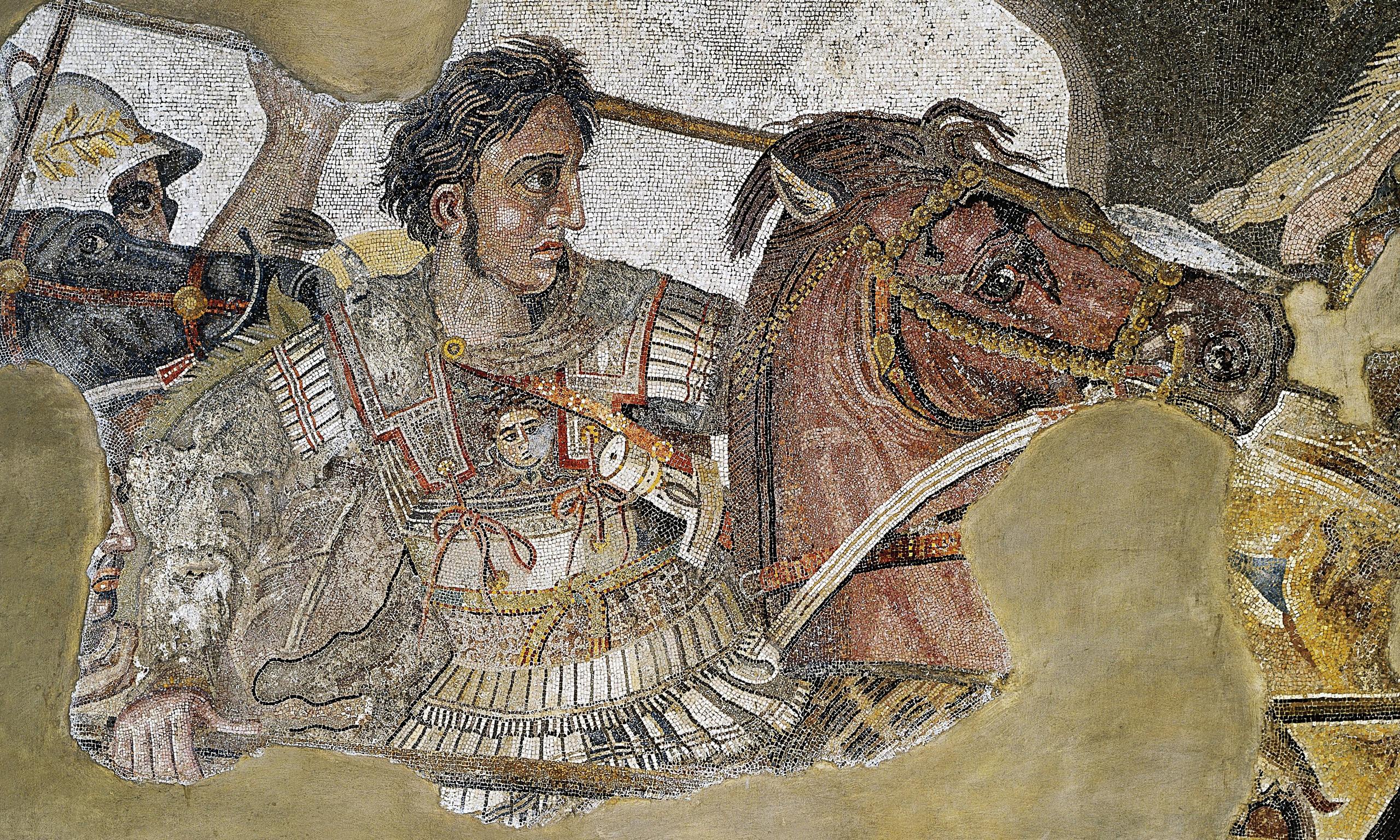
Then he kept going — through Persia proper, where the palace at Persepolis was burned, whether by policy or drunken accident is disputed — into Central Asia, where a brutal two-year guerrilla war in Bactria and Sogdiana cost him more than the whole Persian campaign, and over the Hindu Kush into India in 327 BCE.
The Hydaspes, 326 BCE, against King Porus, was fought across a monsoon-swollen river against an army with around two hundred war elephants. Alexander crossed upstream at night in a storm and won a costly victory. Porus, asked how he wished to be treated, replied "as a king" and was reinstated as a subordinate ruler.
Then the Beas, and the mutiny.
The return march through the Gedrosian desert in Balochistan killed a large part of the army — accounts describe men dying of thirst and flash floods sweeping away camps. Whether it was a miscalculation or, as some ancient writers claimed, a deliberate attempt to outdo a legendary crossing, it was the most costly episode of the whole expedition.
He died in Babylon in June 323 BCE. Cause unknown: typhoid, malaria, alcohol-related liver failure and poisoning have all been argued, and the sources describe a fever of roughly two weeks. Asked who should succeed him, he is reported to have said "the strongest".
What was actually left behind
The empire lasted less than two years. His generals — the Diadochi, the successors — fought over it for forty, and it settled into three main kingdoms: the Ptolemies in Egypt, the Seleucids across Persia and Mesopotamia, and the Antigonids in Macedon, with smaller states around them.
But the cultural result outlived all of them and it is the reason this chapter exists.
Around seventy cities were founded on Greek lines across Asia, and Greek became the shared language of administration, trade and learning from the Mediterranean to Afghanistan. This period is called Hellenistic, meaning Greek-influenced rather than Greek.
Alexandria in Egypt became the intellectual capital of the world. Its Library aimed to collect every book in existence, and the associated Museum — literally a place of the Muses — was a state-funded research institution where scholars were paid to work.
What came out of it is a serious list. Euclid systematised geometry there. Eratosthenes measured the circumference of the Earth by comparing the noon shadow at Alexandria with the known fact that the Sun was directly overhead at Syene on the same day, and got a figure within a few percent of the true value. Aristarchus proposed that the Earth orbits the Sun, seventeen centuries before Copernicus. Herophilus and Erasistratus performed human dissection — briefly permitted, and not repeated in the West for well over a thousand years — and distinguished nerves from tendons and sensory from motor nerves. Archimedes, working in Syracuse but in this intellectual world, did mathematics that comes close to integral calculus.
And the Antikythera mechanism, recovered from a shipwreck and dated to the second or first century BCE, is a bronze geared device that models the movements of the Sun, Moon and planets, predicts eclipses, and tracks calendar cycles including the four-year Olympiad. It has at least thirty gears including a pin-and-slot arrangement that reproduces the Moon's varying speed. Nothing of comparable complexity is known again for over a thousand years.
The India connection, which matters more than the conquest
Alexander's Indian campaign is a footnote in Indian history and the contact that followed is not.
Chandragupta Maurya took the northwest within about twenty years of Alexander's death (Chapter 6.4), and in 305 BCE fought Seleucus, the successor ruling the east. The settlement transferred substantial territory to Chandragupta in exchange for 500 war elephants, and included a marriage alliance. Seleucus sent an ambassador, Megasthenes, to Chandragupta's capital Pataliputra, and Megasthenes's account — surviving only in quotations by later writers — is one of the earliest outside descriptions of India.
Ashoka's edicts name Hellenistic kings. The thirteenth major rock edict lists five contemporary Greek rulers by name — Antiochus, Ptolemy, Antigonus, Magas and Alexander — as places to which he sent envoys promoting his dhamma. Two of his edicts at Kandahar are written in Greek and Aramaic. This is a Mauryan emperor communicating with the Hellenistic world in its own languages, and Chapter 6.4 uses it.
The Indo-Greek kingdoms in Bactria and northwestern India lasted for around two centuries. Menander, known in Indian sources as Milinda, is the subject of the Milindapanha — a Buddhist text in the form of a dialogue between the king and the monk Nagasena, in which the king asks sharp philosophical questions about the self and is answered. It is a genuinely good philosophical text and it records a real cultural meeting.
Gandharan art is the visible result: Buddhist sculpture in a recognisably Greco-Roman style, with drapery, musculature and facial modelling from the Mediterranean tradition. The first images of the Buddha in human form appear in this milieu — earlier Buddhist art represented him by symbols such as a footprint, an empty throne or a wheel. The standard image of the Buddha, reproduced across Asia for two thousand years, has a Hellenistic ancestry, and Chapter 6.5 develops that.
Astronomy and mathematics travelled both ways. Greek astronomical texts reached India and are named in Sanskrit works — the Romaka Siddhanta and Paulisa Siddhanta are explicitly Roman and Greek in origin. Indian mathematics later travelled west along the same channels (Chapter 3.11).
Alexander, assessed
This book will not treat him as a hero or as a monster, because the evidence supports neither simple reading and the sources are all late — the earliest surviving accounts were written three centuries after his death, from lost contemporary works of varying reliability.
What he unquestionably was: an extraordinary battlefield commander who never lost, and a logistician who moved an army across 30,000 kilometres of unfamiliar terrain for a decade.
What is also documented: the massacre and enslavement of Thebes and of Tyre's population, the razing of Persepolis, the killing of his own general Cleitus in a drunken quarrel, and the execution of Callisthenes and Parmenion on charges that ancient writers themselves doubted.
And the honest assessment of his political achievement is that he had none. He conquered and did not build; the state fell apart immediately. The Hellenistic world was the work of his successors over the following century, and the intellectual flowering at Alexandria happened under Ptolemaic administration decades after his death. He created the conditions and he did not create the result.
Where this shows up in your life
Greek is in your medicine and your science because Hellenistic Alexandria set the vocabulary — anatomy, cardiac, hepatic, thermodynamics, and thousands more.
The Buddha's face, in every temple from Japan to Sri Lanka, carries a Greek ancestry through Gandhara.
The idea of a state-funded research institution — scholars paid to do research, with a library attached — begins with the Museum at Alexandria, and every university and national laboratory since is a descendant of it.
And the Library's fate is worth carrying. It did not burn in one dramatic fire, whatever the story says. It declined over centuries — funding withdrawn, scholars expelled during political purges, portions damaged in Caesar's civil war, the institution gradually starved. That is how knowledge is usually lost: not in a catastrophe, but by nobody paying for it.
What the next page covers
While Alexander's successors fought over the east, a small city in central Italy was slowly absorbing its neighbours by a method nobody had used before: offering the defeated a share in the winning side. Chapter 5.3 covers Rome from village to Mediterranean power — how the republic was actually structured, why the legion beat the phalanx, what the wars with Carthage cost, and how the very success of the conquests destroyed the political system that produced them.