Appearance
3.3 — The Cave People, Honestly
Nobody lived in caves.
That is an overstatement, but it is much closer to the truth than the picture in your head. People used caves — for shelter in bad weather, for burial, for painting, for storage — and archaeologists find their remains there because caves preserve things and open-air campsites do not. A hearth in a rock shelter survives for forty thousand years. The same hearth on a riverbank is washed away in one flood season.
So the archaeological record is biased toward caves in exactly the way a hospital's records are biased toward sick people. Where open-air sites are preserved by unusual luck — waterlogged ground, volcanic ash, permafrost — they show tents, huts and structures. At Mezhyrich in Ukraine, around 15,000 years ago, people built dwellings framed from mammoth bones: dozens of skulls, tusks and jaws arranged into round houses, insulated with hides.
This chapter is about correcting that picture and several others, because the way we imagine our ancestors decides how we think about progress, and most of what people believe about them is wrong in specific, checkable ways.
How they actually got their food
Hunter-gatherers is the standard term, and it is misleading in its emphasis. In most environments the majority of calories came from gathering — plants, roots, nuts, seeds, fruit, honey — plus small animals, fish and shellfish, which are far more reliable than large game. Big-game hunting is dramatic, occasional, and a minority of the diet everywhere except in the Arctic, where there is no plant food to gather.
The work was skilled, and it required knowing an enormous amount. Ethnographic studies of surviving foraging peoples record individuals who can name and use several hundred plant species, who know which are toxic raw and edible after processing, which are medicinal, when each fruits, and where each grows. The San of the Kalahari, the Hadza of Tanzania, Australian Aboriginal peoples and Amazonian groups all carry botanical and zoological knowledge that professional biologists have repeatedly found accurate.
Some of that processing knowledge is remarkable. Australian Aboriginal peoples ate cycad seeds, which contain a potent toxin, after a multi-day sequence of soaking, leaching and fermenting. Acorns need leaching to remove tannins. Cassava, later, needs elaborate processing to remove cyanide. Nobody worked these out by reasoning. They are the output of an enormous, slow, costly accumulation of trial and transmitted knowledge, and losing the transmission chain has repeatedly killed people — which is a point Chapter 3.5 develops.
The work-hours question, handled carefully
In 1966 an anthropologist named Richard Lee published time-budget data on the Ju/'hoansi San of the Kalahari, and reported that adults spent roughly 20 hours a week acquiring food. The finding was popularised by Marshall Sahlins as "the original affluent society", and it became one of the most widely repeated claims about prehistory.
It is roughly right and it has been overstated. Later work, including Lee's own revisions, noted that food acquisition is not all the work — tool making and repair, food processing, firewood, water carrying and childcare add substantially, taking the total to something more like 40 to 50 hours a week. And the Kalahari San are one group in one difficult environment, studied in the twentieth century while already in contact with farming and herding neighbours, so generalising from them to all of prehistory is not sound.
What survives the scrutiny is the comparison. Foragers in reasonably productive environments generally worked less than subsistence farmers in the same regions, with more varied diets, more leisure and more mobility. That comparison is what makes the agricultural revolution a genuine puzzle, and Chapter 3.7 has to answer it.
Health: better and worse than farming
Skeletons give a fairly direct measure, and the pattern across many regions is consistent.
Foragers were taller than the farmers who followed them. Average heights in the Eastern Mediterranean fell by around ten centimetres or more between the late Palaeolithic and the early farming period, and did not recover for thousands of years.
Foragers had far fewer cavities and better teeth, because grain and other starchy staples feed the bacteria that cause decay.
Foragers show fewer signs of nutritional deficiency, because a varied diet of dozens of plant and animal foods covers the requirements that a diet dominated by one cereal does not. Anaemia markers on the skull, called porotic hyperostosis, become far more common with farming.
And foragers had far less infectious disease, for reasons Chapter 3.8 develops: small mobile groups, no domestic animals, no accumulation of waste, no dense settlement.
But mortality was still brutal. Violence, accidents, childbirth and infection killed people at rates no modern society tolerates. Life expectancy at birth was low — often quoted around 30 to 35 — and that number is dominated by infant and child deaths. A person who reached 20 had a fair chance of reaching 60 or beyond. There were old people; there just were not many, and there were many dead children.
Violence, and refusing both myths
Two opposite stories are popular, and neither survives the evidence.
The noble-savage story says pre-agricultural people lived in peace and that war came with property and states. The Hobbesian story says prehistoric life was a war of all against all.
What the evidence shows is high variability and, on average, high violent death rates.
At Jebel Sahaba in Sudan, around 13,400 years ago, a cemetery of about sixty individuals contains many with projectile points embedded in bone and healed and unhealed injuries — evidence of repeated, organised violence. At Nataruk in Kenya, around 10,000 years ago, a group of at least 27 people including pregnant women and children were killed together, several with bound hands, some with stone projectile points in the skull. Both predate farming and states.
Across surveyed forager societies and prehistoric skeletal samples, the proportion of deaths from violence commonly runs in the range of 10 to 25 percent — far above rates in modern states, even including the twentieth century's wars. The comparison has been contested, especially over whether small-scale societies studied in the twentieth century were already distorted by contact, and this book records that dispute rather than settling it.
The reasonable summary: there was no golden age of peace, warfare of some kind is very old, but its scale was limited by group size and the absence of surplus. Organised war between armies requires storable food, hierarchy and something worth taking, and those are agricultural inventions. Chapter 3.9 covers what changed.
How the societies were organised
Small groups, typically 25 to 50 people, embedded in wider networks of a few hundred to a thousand who spoke the same language, intermarried and met periodically.
No formal leaders in most cases, and this was actively maintained. Ethnographers repeatedly describe deliberate mechanisms for cutting down anyone who becomes self-important — mockery, disparagement of a hunter's kill, refusal to cooperate. Christopher Boehm called it "reverse dominance hierarchy": the group ganging up on any would-be dominant individual. Equality was not the absence of politics. It was a political achievement, continuously defended.
Sharing was obligatory, not optional, and there is a hard logic to it. A large animal is more meat than one family can eat before it rots and there is no way to store it. Hunting success is highly variable — a good hunter fails most days. So sharing meat is an insurance system, and refusing to share breaks the insurance for everyone. Societies enforced it, sometimes fiercely.
Mobility was the answer to most problems. Disputes were solved by one party leaving. Resource depletion was solved by moving. You cannot accumulate wealth if you have to carry everything, which is one reason material inequality stayed low.
And the picture was not uniform. Where resources were rich, concentrated and predictable — salmon rivers on the Pacific Northwest coast of North America, some Mediterranean and Japanese coasts — foragers became settled, dense, hierarchical, and had chiefs, slaves and hereditary rank. So it was never foraging that prevented hierarchy. It was mobility and unpredictability. That distinction matters enormously for Chapter 3.9.
What they knew
Astronomy. Notched bones interpreted as lunar tallies go back tens of thousands of years, and the interpretations are argued but the notching is real. Many cultures independently tracked solstices, and Chapter 3.11 covers the counting side.
Navigation. The settlement of Australia by 65,000 years ago and of the remote Pacific much later required deliberate open-water voyaging, which requires reading swells, stars, bird behaviour and cloud patterns over water.
Materials. Selecting stone types for specific fracture behaviour; heat-treating silcrete to improve flaking, documented in South Africa from around 70,000 years ago; making compound adhesives from birch bark tar, which requires heating bark in a low-oxygen environment — a genuinely non-obvious chemical process that Neanderthals were doing.
Medicine. Ötzi, the man frozen in the Alps around 3300 BCE, carried birch polypore fungus, which has antiparasitic properties, and he had intestinal parasites.
Ötzi: one person, in detail
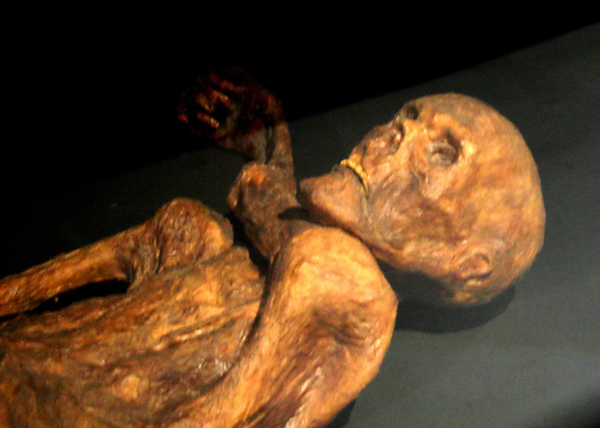
Because generalisations are abstract, here is one man. Ötzi was found in 1991 in the Ötztal Alps on the Italian-Austrian border, freeze-dried by glacier ice for over five thousand years. He belongs to the early farming period rather than the deep Palaeolithic, but he shows the level of technology and knowledge that people carried.
He was about 45, roughly 1.6 metres tall, and 50 kilograms. He wore a coat, leggings and loincloth of goat and sheep hide, a bear-skin cap, a grass cloak, and shoes made of bear-skin soles and deer-hide uppers stuffed with grass for insulation. He carried a copper axe — nearly pure copper, of a type showing that metalworking had reached the Alps. He had a longbow, unfinished, and a quiver of arrows, most also unfinished. He carried a birch-bark container with charcoal wrapped in maple leaves, which is a way of transporting fire.
He had 61 tattoos, mostly lines and crosses, positioned largely over joints and along the lower back — locations that correspond to where he had arthritic degeneration, which has led to a widely discussed suggestion that they were therapeutic rather than decorative.
He was murdered. A flint arrowhead is lodged in his left shoulder, having severed an artery, and he has a deep cut on his hand from a few days earlier and blunt trauma to the head. His last meals, recovered from his stomach and intestines, included ibex and red deer meat, einkorn wheat, and bracken.
One man, and we know his clothes, his tools, his diseases, his last meal, his tattoos and how he died. That is what preservation buys, and it is why the rest of prehistory is so much vaguer.
Where this shows up in your life
Your body is calibrated for that life, not this one. A diet of varied plants and lean meat, several hours of low-intensity movement daily, strong social bonds, and long sleep in darkness. Volume V's chapters on obesity, diabetes, myopia and back pain all describe mismatches between that calibration and the world you actually live in. The genes did not change; the environment did.
The instinct to share, and to resent free-riders, is the machinery of that insurance system still running. So is the discomfort most people feel around highly visible status displays, and the pleasure most people take in seeing arrogance punctured.
And the way you think about "primitive" people affects how you think about everything else. If our ancestors were stupid brutes, then history is a steady climb and the present is obviously the best moment ever. If they were people exactly as intelligent as us, living well within a hard set of constraints, then history is a series of trade-offs, and every gain has a bill attached. This volume takes the second view, and Chapter 3.7 is where the argument is made most sharply.
What the next page covers
Fire is the technology that made all the others possible, and it is far older than our species. Chapter 3.4 covers the first technologies — how fire was controlled and what it actually did to human bodies and societies, how stone tools were made and why the technique took years to learn, how clothing and shelter allowed the settlement of the Arctic, and how projectile weapons changed the relationship between a small primate and everything larger than it.