Appearance
6.6 — The Guptas, and Testing the Golden Age
Around 499 CE a mathematician in his early twenties, at Kusumapura near Pataliputra, completed a work of 121 verses. In it he states that the Earth rotates on its own axis and that the apparent daily motion of the stars is caused by this rotation; gives a value for pi of 3.1416 and notes that it is approximate, which is the first known statement anywhere that pi is irrational in effect; sets out a table of sine values; provides a method for solving certain equations in whole numbers; and gives a system of astronomy in which eclipses are caused by shadows rather than by a demon swallowing the Sun.
His name was Aryabhata, and he was 23 when he wrote it.
That is the case for the Gupta period as a golden age, and it is a strong case. This chapter makes it fully and then tests it, because the phrase conceals as much as it reveals.
The empire
The Gupta dynasty rose in Magadha from around 320 CE, when Chandragupta I took the title of great king of kings and made a marriage alliance with the Licchavis, an old clan of the region.
Samudragupta, his son, is described in a long Sanskrit inscription engraved — with a nice historical irony — on one of Ashoka's own pillars at Allahabad. It lists his conquests: kings of the north uprooted and their territories annexed; kings of the south defeated, captured and then reinstated as tributaries; frontier states and republics paying tribute; and foreign rulers, including the Kushans and the king of Sri Lanka, sending embassies.
That two-tier policy is the key to the Gupta system. The Ganges heartland was ruled directly. Everything else was left with its own rulers under tribute and acknowledgement. This made the empire cheaper to run and much less centralised than the Mauryan one — and much easier to lose, since a tributary who stops paying is simply independent again.
Chandragupta II, ruling around 375–415 CE, extended into western India by defeating the Shakas, giving access to the Gujarat ports and the western trade. The empire at its height covered most of northern India.

What was actually achieved
Mathematics is the strongest claim and it is genuinely world-historical.
Aryabhata, as above. His statement that the Earth rotates is explicit — he compares it to a person in a moving boat seeing the riverbank move backwards. His sine table is the beginning of trigonometry in its modern form; the Sanskrit word for the half-chord, jya, was transliterated into Arabic and then mistranslated into Latin as sinus, which is why the function is called sine.
The decimal place-value system with zero was in use in this period, and Brahmagupta in 628 CE — slightly after the Guptas, in the same tradition — gave explicit rules for arithmetic with zero and with negative numbers, treating debts and fortunes as negative and positive quantities. Chapter 3.11 traced its journey west. Volume II Part 11 covers the mathematics itself.
Astronomy. Aryabhata gave the length of the sidereal year as 365 days, 6 hours, 12 minutes and 30 seconds — accurate to within a few minutes. Varahamihira's Panchasiddhantika summarises five astronomical systems including explicitly Greek and Roman ones (Chapter 5.2), which is a striking piece of scholarly honesty about foreign sources.
Medicine. The Sushruta Samhita and Charaka Samhita, compiled and expanded across this general period from older material, describe surgery in detail — including cataract couching, the removal of bladder stones, and rhinoplasty using a flap of skin from the cheek or forehead, a technique that reached Europe in the eighteenth century after a British surgeon read a description of it being done in India, and which is the ancestor of modern plastic surgery.
Literature. Kalidasa, generally placed in this period, is the pre-eminent Sanskrit poet and dramatist. Abhijnanashakuntalam was translated into German in 1791 and read by Goethe, who wrote a famous quatrain in its praise; Meghaduta, in which an exiled spirit asks a cloud to carry a message to his wife, is one of the great lyric poems in any language.
Art. The Ajanta caves' finest paintings belong to this period.
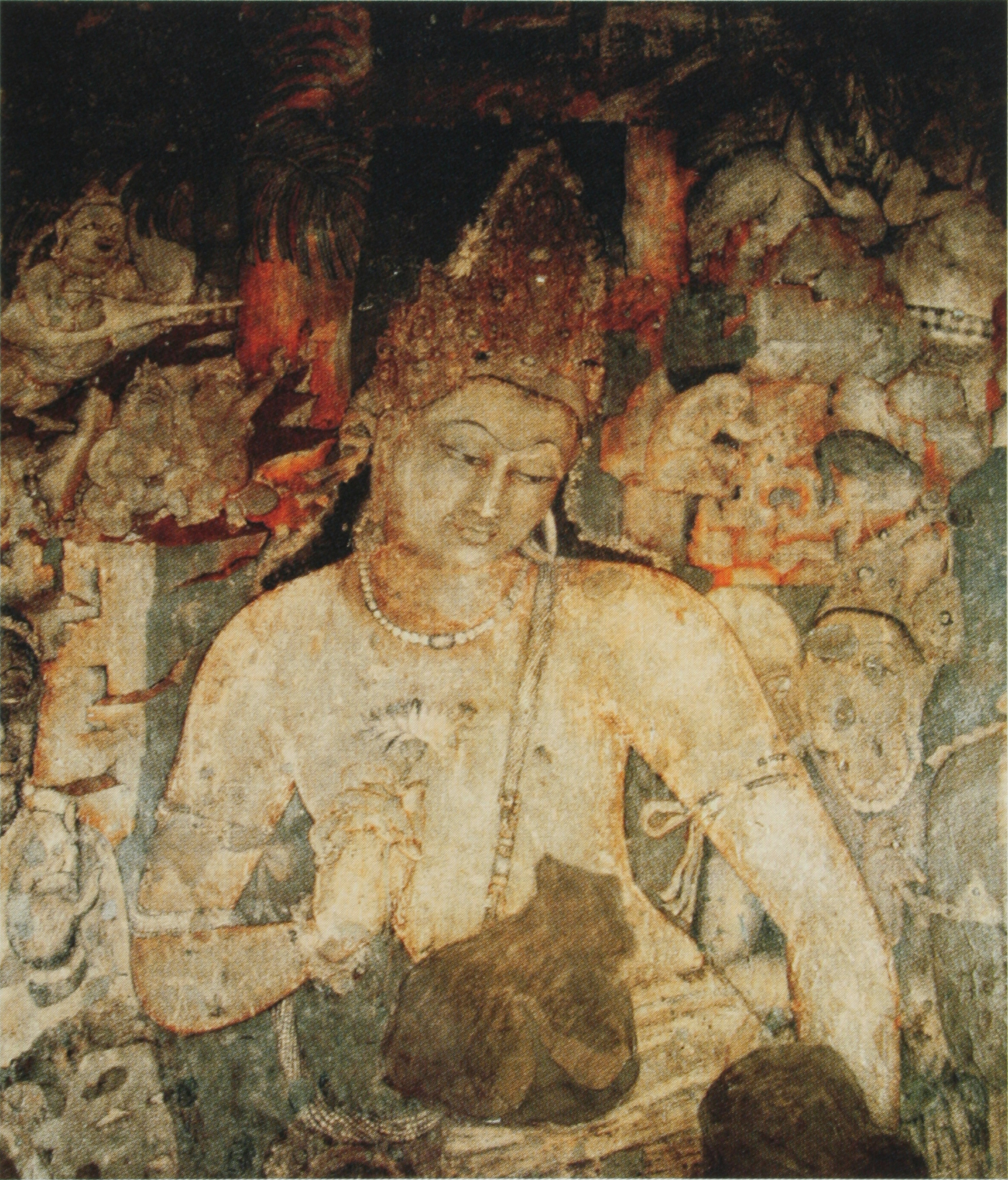
Metallurgy. The Iron Pillar of Delhi (Chapter 3.12), erected around this period, has resisted rusting for over 1,600 years — because of its phosphorus content and the protective layer that forms on it, which is a genuine and understood achievement.
Nalanda. The great monastic university was founded in this period and grew over the following centuries into an institution with thousands of students and teachers, drawing scholars from China, Korea, Tibet, Central Asia and Southeast Asia. Xuanzang studied there in the seventh century and described its libraries, its debate culture and its entrance examinations, which he says most applicants failed.
Now the test
"Golden age" was a nineteenth and twentieth-century framing, used by Indian nationalist historians for a good reason — colonial historiography insisted India had no history of its own worth respecting, and pointing at Aryabhata was an answer to that. The framing is understandable and it has costs.
Cost 1: it flattens the rest of Indian history. The five centuries before the Guptas produced Gandharan art, Mahayana Buddhism and Sangam poetry (Chapter 6.5). The Cholas after them built temples and a navy (Chapter 6.7). Designating one period golden implies the others were not.
Cost 2: it is a north Indian frame. The Guptas ruled the north. Tamil, Kannada and Telugu literary cultures had their own trajectories.
Cost 3, and the serious one: it was not golden for everyone, and the same period shows changes that are hard to read as anything but a hardening of hierarchy.
What the same period did to women and to the lowest castes
This has to be stated because it is in the same sources.
Women's position declined measurably in the legal texts. The Manusmriti, compiled in the early centuries CE and enormously influential afterwards, prescribes that a woman should be under the guardianship of her father in youth, her husband in maturity and her son in age. Property rights narrowed. Remarriage of widows was discouraged and then condemned in the texts. The age of marriage for girls fell in the prescriptions.
Compare this with the earlier evidence. Vedic texts name women composers of hymns. Buddhist and Jain donative inscriptions of the Satavahana period record large numbers of women donating in their own names (Chapter 6.5). Something changed between then and the medieval texts, and it changed in one direction.
The first datable evidence of sati — a widow's self-immolation on her husband's pyre — as a commemorated act is a Gupta-period memorial stone from Eran in Madhya Pradesh, dated 510 CE. It was never widespread across India or across castes, and it was concentrated in particular regions and communities, and Chapter 6.19 covers its abolition. But its earliest clear record is here.
Untouchability hardens. Faxian, the Chinese Buddhist pilgrim who walked across India around 400 CE, describes people called Chandalas who must live outside towns and strike a piece of wood when entering a settlement so that others can avoid them. This is an eyewitness, with no stake in Indian social arguments, describing systematic exclusion.
Endogamy tightened. Genetic studies indicate that strict marriage within groups became widespread in the first millennium CE (Chapter 6.2). The caste system in its rigid form is substantially a product of this period rather than of the Vedic age.
And land grants to brahmins became the standard instrument of royal patronage. Kings granted villages, with their revenue and often with administrative rights, to brahmins and to temples in perpetuity, recorded on copper plates. This did three things: it created a landed religious elite; it removed land permanently from the state's revenue base; and it began the fragmentation of authority that later historians describe as Indian feudalism. Chapter 6.8 argues that this practice is part of why the north fragmented politically.
Faxian's report, and what it says about ordinary life
Faxian is the most valuable witness for this period precisely because he was not interested in Indian politics. He came to obtain Buddhist texts and monastic rules, and he described what he saw in passing.
He reports a well-governed, prosperous country where travel was safe, where people did not need to register with authorities, where punishments were mostly fines rather than mutilation, and where charitable rest houses and free hospitals existed in Pataliputra, funded by wealthy citizens.
He also notes that most people did not eat meat, onions or garlic, that liquor was avoided, and that the Chandalas were excluded as described above.
And he says nothing about a golden age, because he had nothing to compare it with and was not looking for one. A traveller's incidental observations are usually better evidence than a court poet's praise inscription, and both kinds of source are used here.
Why it ended
The Hunas — a Central Asian people related to the groups called Huns in European sources — began raiding from the late fifth century, and their invasions were severe. Skandagupta repelled them at great cost, and the declining gold content of Gupta coinage from this period is a measurable trace of the fiscal strain. By the mid-sixth century the empire had broken up.
But the deeper causes are structural. The tributary model meant that provinces were always semi-independent and needed only an excuse. The land grants had permanently alienated revenue. And succession disputes recurred.
North India then fragmented into regional kingdoms for centuries, briefly reunified under Harsha in the seventh century, and Chapter 6.8 takes up what that fragmentation cost when the invasions from the northwest resumed.
Where this shows up in your life
Your digits. The numerals on every page of this book, and the zero in them, are this tradition's export (Chapter 3.11).
Your trigonometry. The word sine is a chain of translations from Sanskrit jya.
Chess. The game began in India as chaturanga — four limbs, the four divisions of an army: infantry, cavalry, elephants and chariots. It travelled to Persia as shatranj, then to the Arab world, then to Europe. The word "checkmate" is from Persian shah mat, the king is helpless.
And a way of reading claims about the past. When you hear that some period was a golden age, ask three questions: golden for whom, compared with what, and who is telling you. The Gupta period produced work of the first rank in mathematics, literature and art, and in the same centuries the position of women in the legal texts worsened, untouchability was systematised and endogamy hardened. Both belong in the same paragraph, and a history that gives you only one of them is selling something. Chapter 16.4 is built on that principle.
What the next page covers
While the north fragmented, the south did the opposite. Chapter 6.7 covers the great southern kingdoms — the Pallavas who invented the southern temple in stone, the Chalukyas and Rashtrakutas whose rivalry produced Ellora, and above all the Cholas, who built the largest temple in India, ran a system of village self-government documented on stone, sent a navy across the Bay of Bengal to conquer part of Southeast Asia, and cast bronzes that are among the finest sculptures ever made anywhere. Most Indian syllabi give them a paragraph. They deserve a chapter.