Appearance
3.5 — Language, Art and the Symbolic Mind
In the Chauvet cave in southern France there are lions painted about 36,000 years ago. They are drawn in overlapping profile so that a pride appears to be moving as one body. The artist used the natural bulges of the rock so that a bison's shoulder swells out of the wall. In places the outline is scraped clean around the animal so it stands against a lighter background, and charcoal is smudged to shade a flank.
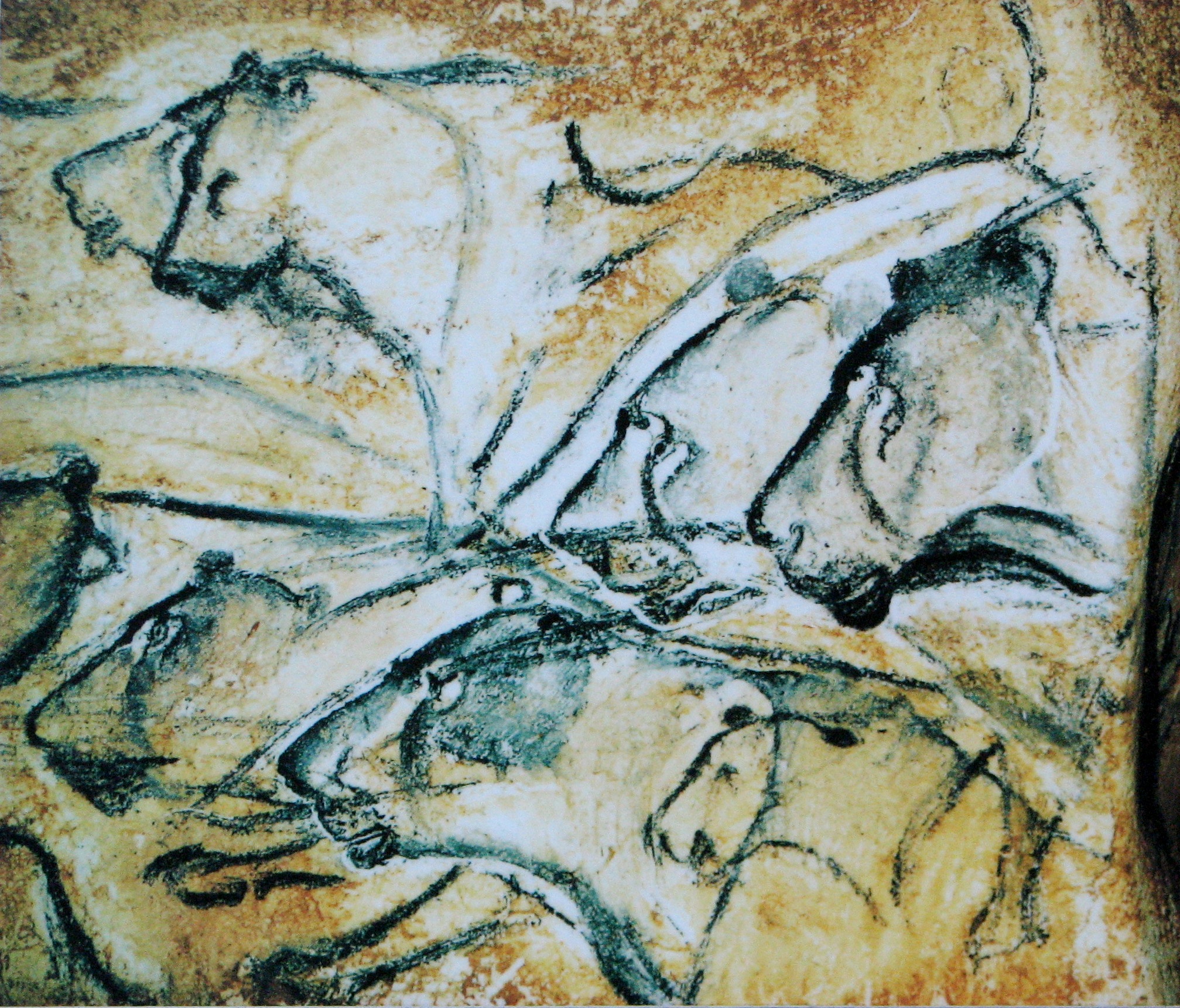
There is no crude phase before this. The oldest cave art we have is already fully accomplished. Whatever developmental period produced it happened somewhere that did not preserve — on skin, on wood, on bodies, in sand.
This chapter is about the capacity behind that: the ability to make one thing stand for another. It is the least visible and most important thing about our species.
Language: the evidence is indirect, and here is all of it
Speech does not fossilise. So every claim about when language appeared is inference, and it is worth being honest about how weak each strand is on its own and how they combine.
Anatomy. Speech needs fine control of breathing, a tongue that can be moved precisely, and a larynx positioned to shape sound. The hyoid bone, which anchors the tongue muscles, is modern in form in Neanderthals. The nerve canal supplying the tongue is wide in Homo heidelbergensis. The nerve canals in the thoracic spine, which control the fine breathing needed for long utterances, are enlarged in later hominins. None of this proves language. All of it is consistent with it and hard to explain otherwise.
Genetics. The gene FOXP2 came to public attention through a British family, half of whose members across three generations had severe difficulty with speech and grammar, traced to a mutation in this gene. The popular label "the language gene" is wrong — it is a regulatory gene affecting many tissues and it exists in mice and birds, where it is involved in vocal learning. The human version differs from the chimpanzee version by two amino acids, and Neanderthals carried the human version. So it is one component among many, and it does not date anything by itself.
Behaviour, which is the strongest strand. The technologies of Chapter 3.4 — Levallois preparation, compound adhesives, tailored clothing, boats crossing open water — all require multi-step procedures with delayed payoff, taught across generations. It is very hard to see how such things are taught without language. And the transport of materials over hundreds of kilometres, and the coordination of hunts, imply planning shared between people.
The reasonable position: some form of language is old, probably present in some form in Homo heidelbergensis and Neanderthals, and full modern syntax may be more recent. Anyone who tells you the date confidently is going beyond the evidence.
What makes human language different
Other animals communicate, sometimes richly. Vervet monkeys have distinct alarm calls for leopard, eagle and snake, and hearing the call produces the appropriate escape behaviour. Honeybees encode direction and distance in a dance. Neither is language, and the differences are specific.
Displacement. Human language can refer to what is not here and not now — yesterday, next year, the far side of the hill, a person who died, something that never happened. Almost no animal communication does this; the bee dance is a rare partial exception.
Recursion, and this is the technically crucial one. A structure can be embedded inside a structure of the same kind, without limit. The man who owns the field that borders the river said… From a finite vocabulary and a finite set of rules you can generate an unbounded number of sentences, including ones nobody has ever produced before. No animal system does this.
Arbitrariness. The sound "dog" has no doggy quality. The link between sound and meaning is pure convention, which is exactly why it can be extended to anything at all, including things with no physical form — justice, next Tuesday, seven, a nation.
And the last one is the point of this chapter. A language that can refer to things that do not exist is a language that lets a group agree on a shared fiction — a god, an ancestor, a rule, a debt, a boundary, a kingdom, a company. Every institution in Parts 4 to 16 of this volume is a shared fiction agreed by enough people, and none of them is possible for an animal that can only refer to what is present.
The symbolic record
Ochre. Red iron oxide, ground and used as pigment. It appears at sites in Africa from over 200,000 years ago, in quantities and with grinding equipment suggesting deliberate processing rather than accident. At Blombos Cave in South Africa, around 100,000 years ago, there is an ochre-processing workshop with abalone shells used as containers, and pieces of ochre engraved with deliberate cross-hatched patterns dated to about 73,000 to 77,000 years ago. A pattern with no function is a symbol.
Beads. Perforated shells worn as ornaments appear from around 100,000 to 140,000 years ago in Morocco, Israel and South Africa. A bead is meaningless except as a signal to other people — of identity, group membership, status, or availability. Its existence implies a society where such signals mattered.
Burial. Deliberate burial with grave goods appears from at least 100,000 years ago, and Neanderthals buried some of their dead. At Sungir in Russia, around 34,000 years ago, two children were buried with tens of thousands of ivory beads, each of which has been estimated to take around an hour to make, plus spears made from straightened mammoth tusks. That is many thousands of hours of labour placed in the ground for children who could not benefit from it. Whatever those people believed, they believed it enough to pay that.
The cave art
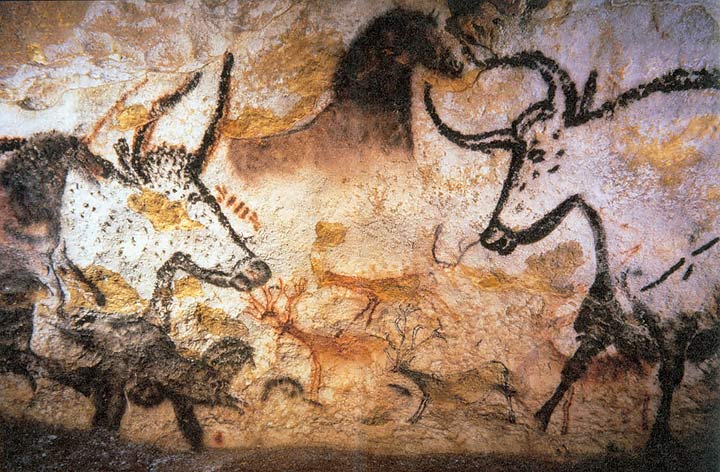
The geography is wider than most people realise. Europe has the famous sites — Chauvet, Lascaux, Altamira — but painted caves are known in Indonesia, where a hunting scene on Sulawesi has been dated to at least 43,900 years ago and a warty pig to around 45,500, currently among the oldest figurative art anywhere. Australia has rock art traditions of great antiquity. India has the Bhimbetka rock shelters in Madhya Pradesh, a UNESCO World Heritage site with paintings spanning many thousands of years and occupation layers going back far further.
What is depicted, and what is not. Overwhelmingly animals — horses, bison, aurochs, deer, lions, mammoths, rhinoceros. Very few humans, and those that appear are schematic stick figures, in complete contrast to the careful naturalism of the animals. Almost no landscape, almost no plants, almost no scenes of daily life.
Hand stencils are everywhere, made by placing a hand on the wall and blowing pigment around it, from Europe to Indonesia to Argentina. Analysis of hand proportions at several European sites has suggested a majority were made by women, which is contested methodologically but is at least a caution against assuming the artists were male hunters.

Why they painted is unknown, and the candidates are worth listing honestly. Hunting magic — influencing the hunt by representing it — was the standard twentieth-century explanation, and it fits badly with the fact that the animals painted are often not the animals eaten, as shown by bone remains at the same sites. Shamanic vision, teaching, marking territory, initiation ritual, and simply making things because making things is what people do have all been argued. The deep, awkward, dark placement of much of it — some panels require crawling for hundreds of metres — argues against decoration and for something ceremonial, but that is inference.
Portable art exists too, and it is not all animals. The so-called Venus figurines — small carved female figures with exaggerated breasts, hips and bellies — are found from France to Siberia over a span of about twenty thousand years, which is a remarkably consistent tradition across an enormous area.
And there is music. Bone flutes from Germany, made from bird wing bone and mammoth ivory, dated to around 40,000 years ago, with finger holes placed to produce a usable scale. Mammoth ivory is not naturally hollow. Making that flute required splitting the tusk lengthwise, hollowing both halves, carving the holes, and sealing the two halves back together airtight. Somebody wanted music enough to do that.
Why the ratchet matters more than the invention
Chapter 3.4 ended on Tasmania losing technologies after being cut off. That is the same point from the other side, and it is the central mechanism of everything after this chapter.
Individual humans are not very clever compared with what human societies produce. No individual can make a pencil from scratch — mining graphite, felling and seasoning wood, smelting the metal for the ferrule, refining rubber. What we have instead is cumulative culture: the ability to copy accurately enough that improvements are retained, so each generation starts from where the last finished.
Accurate copying is the hard part, and it is what other apes lack. Chimpanzees can learn a technique by watching, but they tend to reinvent the outcome rather than reproduce the method, so improvements do not accumulate. Human children over-imitate — they copy even the unnecessary steps of a demonstration — which looks foolish and is in fact the mechanism that preserves procedures whose reasons the learner does not yet understand. The cassava processing of Chapter 3.3 works precisely because people copy the whole ritual sequence without knowing which step removes the cyanide.
And the ratchet's speed depends on how many people are connected to it. Larger, better-connected populations retain more skills and generate more improvements. This idea explains Tasmania, and it explains why the pace of change accelerates through the rest of this volume every time populations grow or communication improves — writing, roads, printing, ships, telegraph, internet. Chapter 8.2 and Chapter 16.3 both come back to it.
Where this shows up in your life
Every institution you deal with is a shared fiction held up by agreement. Money is paper and numbers in databases; it works because everyone acts as if it works. A company is a legal person that has no body. A national border is a line nobody can see. None of these things exists in the way a rock exists, and all of them govern your life more directly than most rocks do. Chapter 9.1 makes this argument about money specifically, and Chapter 13.1 about states.
Your capacity to be moved by a story about people who never lived is the same capacity. So is your ability to feel loyalty to a cricket team, a nation, or a faith.
And the paintings should change how you think about time. Chauvet is 36,000 years old. The gap between those painters and the builders of the Egyptian pyramids is far larger than the gap between the pyramids and you. Those were people with the same brain, the same hands, the same capacity for skill and boredom and grief. They simply had a smaller ratchet behind them.
What the next page covers
Those painters lived in an ice age. Sea level was 120 metres lower, ice sheets covered northern Europe and North America, and the world map was a different shape. Chapter 3.6 covers the Ice Age world and how humans came to occupy every habitable landmass — the land bridges that existed and then drowned, the peopling of the Americas and the arguments about its date, the settlement of the Pacific, what the end of the Ice Age did to sea levels and coastlines, and the sudden cold snap that hit just as people were beginning to experiment with growing their own food.