Appearance
3.2 — Becoming Human
At Laetoli in Tanzania, about 3.66 million years ago, a volcano dusted the landscape with fine ash. Rain fell on it. Then, before it dried and hardened, at least three individuals walked across it, and the prints were buried by the next ash fall and preserved.
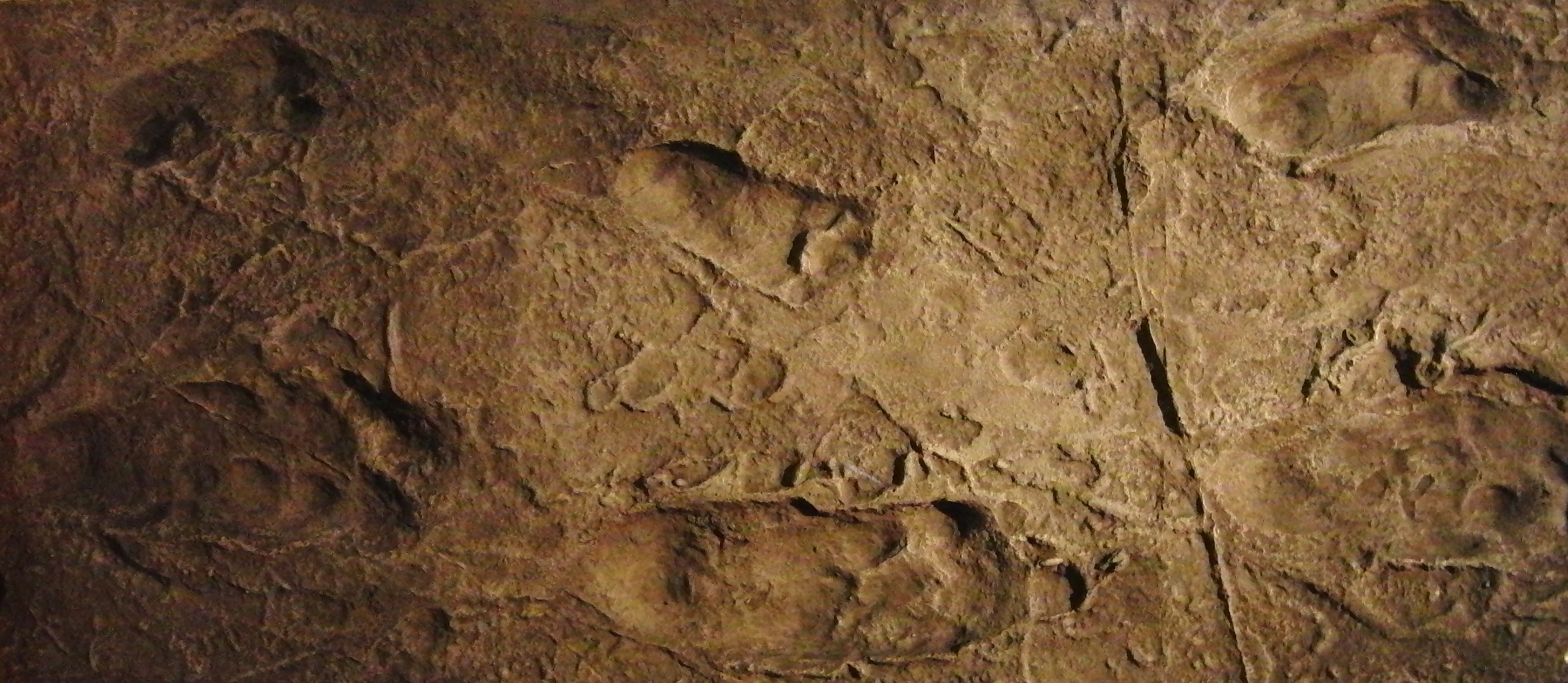
The gait recorded there is modern. And the brains of the individuals who left it were about the size of a chimpanzee's.
That single fact overturns the story most people carry — that our ancestors got clever and then stood up to free their hands. It happened the other way round, and the gap was three million years.
What actually makes us different
Compared with our closest relatives, the chimpanzee and bonobo, from whom we separated roughly 6 to 8 million years ago:
We walk on two legs, permanently and efficiently. Not occasionally, as many apes do, but as the only way we move.
Our brains are about three times larger for our body size — roughly 1,350 cubic centimetres against about 400.
We have small teeth, small jaws and weak chewing muscles, which is odd for an animal that stopped eating soft fruit.
We have almost no body hair and a great many sweat glands, which no other primate does.
We are born extremely helpless and stay dependent for over a decade.
And we accumulate culture. Other animals learn and some use tools, but no other species reliably passes improvements down so that each generation starts where the last left off. That ratchet is arguably the whole difference.
Why upright walking, and what it cost
The honest answer is that nobody is certain, and several proposed reasons are probably true together. Standing frees the hands to carry food, infants and tools. Walking on two legs is more energy-efficient over long distances than a chimpanzee's knuckle-walking, though worse for sprinting and climbing. Standing raises the eyes above tall grass. And an upright body exposes far less surface to overhead sun at midday and more to any breeze, which matters in open country.
What is certain is the sequence. Sahelanthropus in Chad, about 7 million years ago, and Ardipithecus in Ethiopia, about 4.4 million years ago, both show signs of upright posture with ape-sized brains. Australopithecus afarensis — the species of "Lucy", found in Ethiopia in 1974 — lived 3 to 4 million years ago, stood about 1.1 metres tall, had a brain of 400 to 500 cubic centimetres, and walked upright without question.
The bill for standing up is still being paid, and Volume V covers it in detail: a spine bearing loads it was shaped to bear horizontally, hence back pain; a narrowed pelvis, hence a difficult and dangerous birth; and hernias, varicose veins and knee failure from a plumbing and support system reoriented by ninety degrees.
The birth problem deserves a line here because it shapes human society. An upright pelvis is narrow. A large brain needs a wide birth canal. The compromise is that human infants are born early, relative to other primates, with skulls still soft and unfused, and they are helpless for years afterwards. That produces a species whose young cannot be raised by a mother alone, which means cooperative childcare, which means groups with strong social bonds. A great deal of human social behaviour follows from the geometry of the pelvis.
Tools, meat and the shape of the head
The oldest known stone tools are about 3.3 million years old, from Lomekwi in Kenya, predating our own genus. The better-known Oldowan toolkit — a cobble struck to produce a sharp flake — begins around 2.6 million years ago.
The flake is the point, not the core. A struck flake of flint or quartz has an edge sharper than a steel knife. With it, a small weak animal can cut through the hide of a large one, which no hominin could do with teeth or nails. It also allows the cracking of bones for marrow — a dense, fatty food source no other scavenger could reach, since only a hammerstone gets into a large limb bone.
By around 1.76 million years ago the Acheulean handaxe appears — a teardrop shape worked on both faces, symmetrical, requiring a mental plan of the finished object before starting.
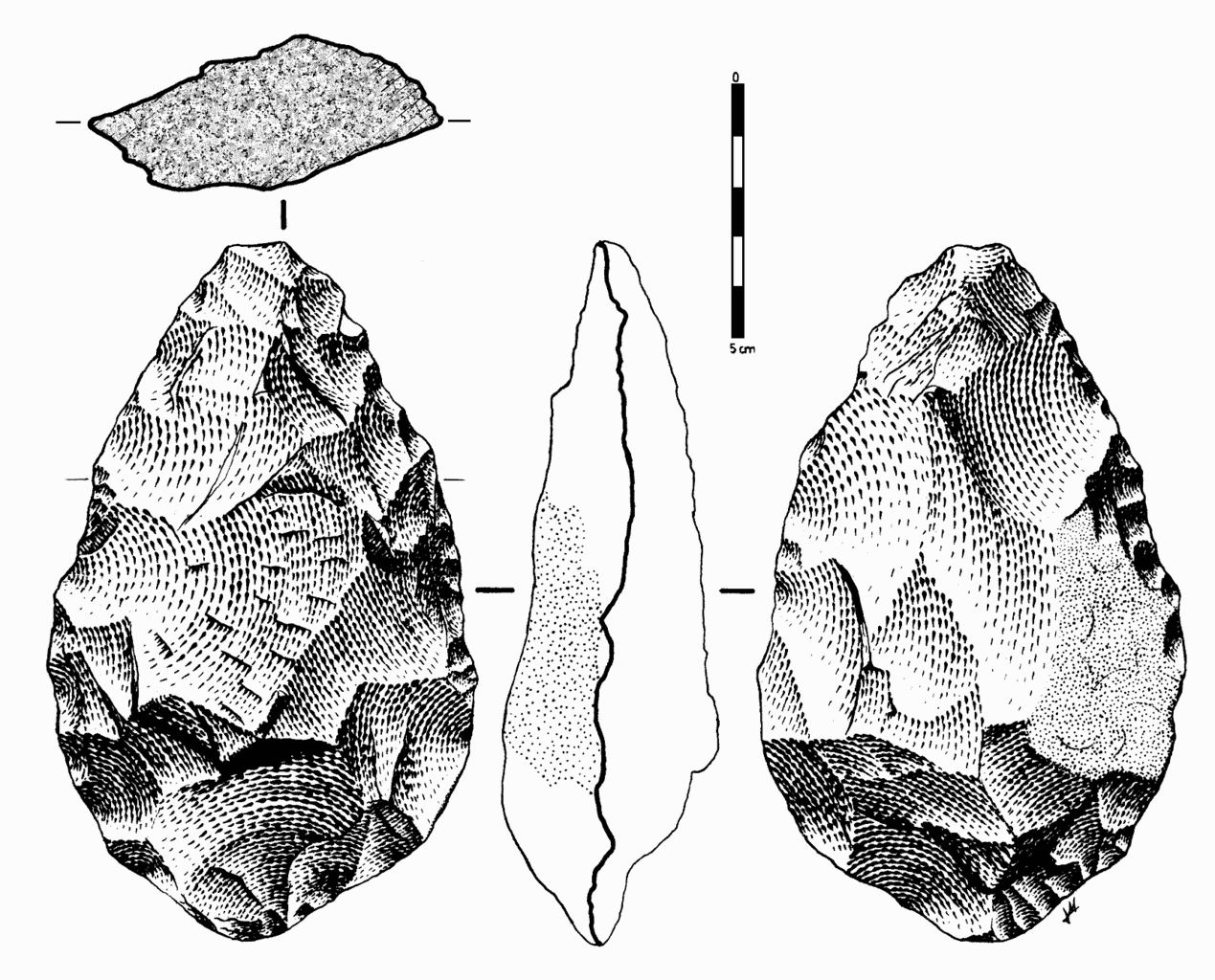
That stability is worth pausing on. The same tool, essentially unchanged, for over a million years across three continents. Whatever the makers had, it was not the restless improvement that characterises us. Something changed later, and Chapter 3.5 is about what.
Meat and marrow matter because brains are expensive. The human brain is 2 percent of body weight and uses about 20 percent of resting energy. A gut is also expensive. The human gut is unusually small for a primate our size, and the brain unusually large — and the total energy budget works out about the same. The trade is called the expensive-tissue hypothesis: get higher-quality food and you can afford a smaller gut, which pays for a bigger brain.
Fire is the other half of the payment. Cooking gelatinises starch and unfolds protein, so far more energy is extracted per mouthful and far less is spent digesting. Richard Wrangham's argument is that cooking is what made the human brain affordable. The date of controlled fire is contested — good evidence exists from around a million years ago at Wonderwerk Cave in South Africa, disputed claims run earlier, and routine hearths become common much later. The logic is well supported; the timing is not settled, and this book says so.
The genus Homo, in order
Homo habilis, about 2.4 to 1.4 million years ago. Brain 550 to 690 cubic centimetres. Associated with the earliest widespread stone tools, hence the name, "handy man".
Homo erectus, from about 1.9 million years ago. Brain 850 to 1,100. Body proportions essentially modern — long legs, short arms, a build for walking and running long distances in heat.

This is the first species to leave Africa, reaching Dmanisi in Georgia by 1.8 million years ago, and Java and China soon after. It survived for over a million years and in Indonesia possibly until around 110,000 years ago. By any measure of longevity it is more successful than we have been so far.
Homo heidelbergensis, roughly 700,000 to 200,000 years ago, brain 1,100 to 1,400, generally regarded as ancestral to both Neanderthals and us — although the naming in this period is genuinely messy and specialists disagree about which fossils belong where.
Homo sapiens. The oldest fossils assigned to our species are from Jebel Irhoud in Morocco, about 300,000 years old — a 2017 result that pushed the origin back by roughly a hundred thousand years and moved the geography out of East Africa. The current picture is not a single origin point but a pan-African process, with populations across the continent exchanging genes over hundreds of thousands of years.
We were not alone
As recently as 50,000 years ago there were at least four kinds of human on Earth — possibly five. Us; Neanderthals in Europe and western Asia; Denisovans across eastern Asia; the very small Homo floresiensis on Flores in Indonesia, adults about a metre tall; and probably Homo luzonensis in the Philippines. Late-surviving Homo erectus may still have been present too.
Being the only human species is a recent and strange situation, and it is the single most misleading gap in the popular picture.
Neanderthals were not failures. Their brains averaged slightly larger than ours. They made complex tools, controlled fire, hunted large animals cooperatively, used pigment, made string, cared for injured group members over years — several skeletons show healed injuries that would have made the individual dependent — and buried at least some of their dead. They survived European ice ages that would kill an unequipped modern human in a day.
They disappeared around 40,000 years ago, and why is not settled. Competition, climate instability, small populations and inbreeding, and absorption by interbreeding all likely contributed. "Extinction" is partly the wrong word, because of what the DNA showed.
In 2010 the Neanderthal genome was sequenced from bone, and the comparison was decisive: people of non-African ancestry carry roughly 1.5 to 2 percent Neanderthal DNA. Svante Pääbo received the 2022 Nobel Prize in Medicine for that work.
Denisovans are stranger still. They were identified in 2010 from a single finger bone in a Siberian cave — a whole human population discovered from DNA before anyone knew what they looked like. Melanesians and Aboriginal Australians carry 3 to 5 percent Denisovan ancestry, and there is a Denisovan contribution in populations across South and East Asia.
And the inherited genes do things. Tibetans carry a Denisovan version of a gene called EPAS1 that governs the response to low oxygen — it avoids the dangerous blood-thickening response most people have at altitude, it is present in about 80 percent of Tibetans and almost nobody else, and it is what makes life at 4,000 metres viable. A gene inherited from an extinct human species is why the Tibetan Plateau is inhabited.
Out of Africa

There were earlier excursions. Fossils in Israel at Misliya cave date to around 180,000 years ago, and in Greece possibly earlier. Those populations appear to have died out or left no surviving descendants.
The expansion that produced everyone alive outside Africa today happened around 60,000 to 70,000 years ago. The evidence is genetic: all non-African populations descend from a small founding group, which is why all non-African peoples together carry less genetic diversity than exists within Africa alone.
The route ran through the Middle East, then east along the coast of southern Asia. Australia was reached by around 65,000 years ago — which required crossing open water, since even at lowest sea level there was a substantial sea gap. That is the first evidence of deliberate seafaring anywhere. Europe was entered around 45,000 years ago. The Americas were reached via the Bering land bridge, with dates still under active revision and evidence for at least 15,000 years ago and arguments for considerably earlier.
What genetics says about race
Since this volume will spend a great deal of time on how people have divided each other, the biology should be stated once, plainly.
About 85 percent of all human genetic variation exists within any single local population. Only around 15 percent distinguishes continental groups. Two randomly chosen people from one village typically differ almost as much as two people from different continents.
Variation is gradual, not categorical. It changes continuously with distance, with no sharp boundaries anywhere, because humans have moved and interbred without pause. Apparent boundaries in traditional racial categories mostly reflect which populations happened to be sampled and where oceans and deserts made travel harder.
Visible traits are the least representative part of the genome. Skin colour tracks ultraviolet intensity by latitude and has evolved lighter and darker independently several times — the light skin of northern Europeans and of northern East Asians arises from different genes. Skin colour therefore tells you almost nothing about the rest of somebody's ancestry.
None of this means population differences are irrelevant to medicine. Specific variants have real and sometimes vital consequences — sickle cell, lactase persistence, drug-metabolising enzymes. The distinction is that those are testable facts about particular genes, not properties of a racial category, and medicine is steadily replacing ancestry as a proxy with direct testing.
Where this shows up in your life
Your back, your knees and your childbirth are all upright-walking compromises. Volume V has the anatomy.
Your ability to sweat and to run long distances in heat is unusual and it is an adaptation. Humans are poor sprinters and exceptional endurance movers, and persistence hunting — following an animal until it overheats — is documented among the San in the Kalahari and in Mexico. Your hairlessness and your two to four million sweat glands are what make it possible.
Your gut microbiome, your teeth and your jaw are all built for cooked food. Try living on raw food and see how much of the day it takes.
And the Denisovan sequence in a Tibetan, or the Neanderthal sequence in a European or Indian genome, is the physical proof that our species has always mixed with whoever it met. The idea of a pure ancestral population is not merely politically unattractive; it does not exist in the data.
What the next page covers
We have hands, brains, tools and fire, and populations spreading into every climate on Earth. Chapter 3.3 asks what those people were actually like — how hunter-gatherers lived, how much they worked, how healthy they were, what they knew about their environment, how their societies were organised, and how much of the popular picture of "cavemen" survives contact with the evidence. It is not the picture most people carry.