Appearance
7.2 — The Caliphates and the Islamic Golden Age
The word algebra comes from al-jabr, meaning restoration or the completion of a broken part — the operation of moving a subtracted term to the other side of an equation. It is from the title of a book written in Baghdad around 820 CE by Muhammad ibn Musa al-Khwarizmi: al-Kitab al-mukhtasar fi hisab al-jabr wal-muqabala, the compendious book on calculation by restoration and balancing.
The word algorithm is his name, Latinised as Algoritmi.
The digits you write with are called Arabic numerals in English and Indian numerals in Arabic, because he wrote the book that carried them from India to the Mediterranean (Chapter 3.11).
One man, three words in daily use in every technical language on Earth. This chapter is about the intellectual world that produced him.
Why it happened
Three conditions came together in the eighth and ninth centuries.
Political unity across an enormous area. From Spain to Central Asia, a scholar could travel, correspond and be understood in Arabic, which became the language of learning as Latin later was in Europe. A book written in Cordoba could be read in Samarkand.
Paper. Chinese papermaking reached the Islamic world in the eighth century — tradition attributes it to prisoners taken at the battle of Talas in 751 — and the first paper mill in Baghdad opened around 795. Paper is dramatically cheaper than parchment, which requires an animal skin per few pages. Cheap writing material is the precondition for a book culture, and Chapter 8.2 makes the same argument about printing.
And a religious motivation for inquiry. The Qur'an contains repeated injunctions to consider the natural world, and there were practical religious needs: determining the direction of Mecca from anywhere required spherical trigonometry; determining prayer times required astronomy; the lunar calendar required observation; and the inheritance rules required exact fractional arithmetic. Al-Khwarizmi's algebra book says explicitly that it is written for practical problems including inheritance division.
The Abbasid state then funded it deliberately. The House of Wisdom in Baghdad, developing under al-Ma'mun in the early ninth century, was a library and translation centre where Greek, Persian, Sanskrit and Syriac works were rendered into Arabic. Caliphs sent envoys to Constantinople specifically to acquire manuscripts, and translators were reportedly paid the weight of their completed books in gold.
What was translated: Aristotle, Euclid, Ptolemy, Galen, Hippocrates, Archimedes, Indian mathematical and astronomical works including the Brahmasphutasiddhanta, and Persian administrative and literary texts.
And this is the point that most needs making: they did not merely preserve, they corrected and extended. Ptolemy's astronomical parameters were re-measured and improved. Galen's anatomy was challenged. Euclid's parallel postulate was worked on for centuries.
Mathematics
Al-Khwarizmi's algebra treated equations as objects to be manipulated by general rules, classifying quadratics into six types and giving a method for each with geometric proof. The novelty is generality: previous traditions solved particular problems, and he set out procedures that solve any problem of a given form.
The decimal system with zero was transmitted through his book on Indian calculation, which survives only in Latin translation. Europe adopted it slowly — Fibonacci's Liber Abaci in 1202 popularised it, and it took until the sixteenth century to displace Roman numerals in European commerce.
Trigonometry was developed substantially. Indian sine tables were extended, and the tangent, cotangent, secant and cosecant functions were introduced, along with spherical trigonometry for astronomy.
Omar Khayyam, better known in the English-speaking world as a poet through Edward FitzGerald's very free translation, produced a systematic treatment of cubic equations with geometric solutions and worked on the parallel postulate. He also led the reform of the Persian calendar, producing a solar calendar of remarkable accuracy.
And the parallel postulate work matters more than it sounds. Several mathematicians — including Ibn al-Haytham, Khayyam and Nasir al-Din al-Tusi — attempted to prove Euclid's fifth postulate and in doing so explored the consequences of denying it. Al-Tusi's work was known to European mathematicians and fed into the eventual discovery of non-Euclidean geometry in the nineteenth century.
Astronomy
Observatories were built and staffed, at Baghdad, Damascus, Cairo, Maragha in Persia and later Samarkand.
Measurements were re-taken. Al-Ma'mun commissioned a measurement of the length of a degree of latitude, executed by surveying across the Syrian desert, giving an Earth circumference close to the modern value.
The Maragha school in the thirteenth century, under al-Tusi, developed geometric devices to fix a specific defect in Ptolemy's system — the equant, which violated the principle of uniform circular motion. The "Tusi couple" produces linear motion from two circular motions. These devices appear in Copernicus's work with the same geometry (Chapter 8.8), and whether he learned them through a transmission route or reinvented them is an open and much-studied question.
Ulugh Beg, a Timurid prince and grandson of Timur, built an observatory at Samarkand in the 1420s and produced a star catalogue whose positional accuracy was not surpassed until Tycho Brahe.
Astronomical instruments — the astrolabe above all — were refined into precision devices for finding time, direction and latitude from the stars. Star names in English are overwhelmingly Arabic: Aldebaran, Betelgeuse, Rigel, Vega, Altair, Deneb, Algol.
Medicine
This is where the practical achievement is largest.
Hospitals — bimaristans — were established as institutions, in Baghdad from the early ninth century and then across the Islamic world. They treated patients regardless of religion or ability to pay, were funded by charitable endowments, had separate wards for different conditions including mental illness, employed salaried physicians, kept records, and had attached medical libraries and teaching. The general model — a permanent, endowed, teaching institution treating the public — is the ancestor of the modern hospital.
Al-Razi (Rhazes), around 865–925, wrote a comprehensive medical encyclopaedia and a treatise distinguishing smallpox from measles clinically — the first clear description of either as separate diseases. He wrote a book titled Doubts about Galen, which is exactly what it sounds like: a direct challenge to the authority of the greatest name in medicine on the grounds of his own clinical observation. He also reportedly chose the site for a Baghdad hospital by hanging meat in several locations and picking where it rotted slowest, which is a crude but genuinely empirical approach to sanitation.
Ibn Sina (Avicenna), 980–1037, wrote The Canon of Medicine, which organised the whole of medical knowledge systematically. It was translated into Latin and used as a standard teaching text in European universities into the seventeenth century — a textbook with a run of over five hundred years. He also wrote extensively on philosophy and is one of the most important figures in the transmission of Aristotle.
Al-Zahrawi (Abulcasis) in Cordoba wrote a surgical treatise illustrating around two hundred instruments, many of his own design, and describing procedures including the use of catgut sutures.
Ibn al-Nafis, in thirteenth-century Damascus and Cairo, described the pulmonary circulation — that blood passes from the right side of the heart through the lungs to the left, rather than through pores in the septum as Galen held. This is three centuries before the same discovery in Europe, and it was found in his manuscripts only in the twentieth century.
Optics, chemistry and the experimental method
Ibn al-Haytham (Alhazen), around 965–1040, is the strongest single case for this period producing science in the modern sense.
His Book of Optics established that vision works by light entering the eye from objects, refuting the Greek theory that the eye emits rays. He demonstrated it experimentally — with the camera obscura, with the observation that looking at the sun hurts, and with systematic work on reflection and refraction.
And his method is explicit. He wrote that the seeker after truth should submit what he reads to scrutiny from all sides, should suspect himself, and should follow argument and demonstration rather than the statements of any authority. He set out hypotheses, designed experiments to test them, and reported results. He is reasonably described as one of the first people to practise a recognisable scientific method, and his work reached Europe in Latin translation and was studied by Roger Bacon, Kepler and Descartes.
Chemistry — the word alchemy is Arabic, al-kimiya — developed distillation, crystallisation, sublimation and filtration as laboratory procedures, and isolated substances including alcohol and several acids. Jabir ibn Hayyan is the name attached to a very large corpus of uncertain authorship. The goals included transmutation of metals, which is why the field is remembered as pre-scientific; the apparatus and the procedures are the direct ancestors of laboratory chemistry.
Words in English from Arabic chemistry and commerce: alcohol, alkali, alembic, elixir, algorithm, algebra, cipher, zero, average, tariff, magazine, admiral, arsenal, sugar, syrup, cotton, muslin, sofa, mattress.
Geography, history and philosophy
Al-Biruni — covered in Chapter 6.9 for his book on India — also measured the Earth's radius by a trigonometric method from a single mountain, wrote on mineralogy with accurate specific gravities, and discussed the possibility that the Earth rotates.
Ibn Battuta, in the fourteenth century, travelled roughly 120,000 kilometres over thirty years — North and West Africa, Arabia, Persia, India where he served as a judge under Muhammad bin Tughlaq, the Maldives, Sri Lanka, Southeast Asia and China — and dictated an account that is one of the great travel books.
Ibn Khaldun, 1332–1406, wrote the Muqaddimah, an introduction to history that is genuinely without precedent. He argued that history should be explained by underlying social and economic causes rather than by the deeds of rulers, developed a theory of asabiyyah — group solidarity — to explain how dynasties rise from cohesive tribal groups, become urban and luxurious, lose cohesion and are replaced by the next cohesive group from the margins, on a cycle of roughly three or four generations. He also wrote on the effect of taxation levels on revenue in terms that anticipate modern arguments. He is reasonably called the founder of sociology and of the philosophy of history.
Al-Ghazali and Ibn Rushd (Averroes) conducted the great argument about reason and revelation. Al-Ghazali's Incoherence of the Philosophers attacked the Aristotelian philosophers' claims, particularly on causation, arguing that what we call cause and effect is God's habit rather than necessity — a position that anticipates Hume's problem of induction by seven centuries. Ibn Rushd replied with The Incoherence of the Incoherence. Ibn Rushd's commentaries on Aristotle became the standard European guide and shaped Thomas Aquinas directly.
Al-Andalus
Muslim Spain deserves separate mention. Cordoba in the tenth century was among the largest cities in Europe, with street lighting, paved roads, public baths, and a library reported at hundreds of thousands of volumes when the largest European monastic libraries held a few hundred.
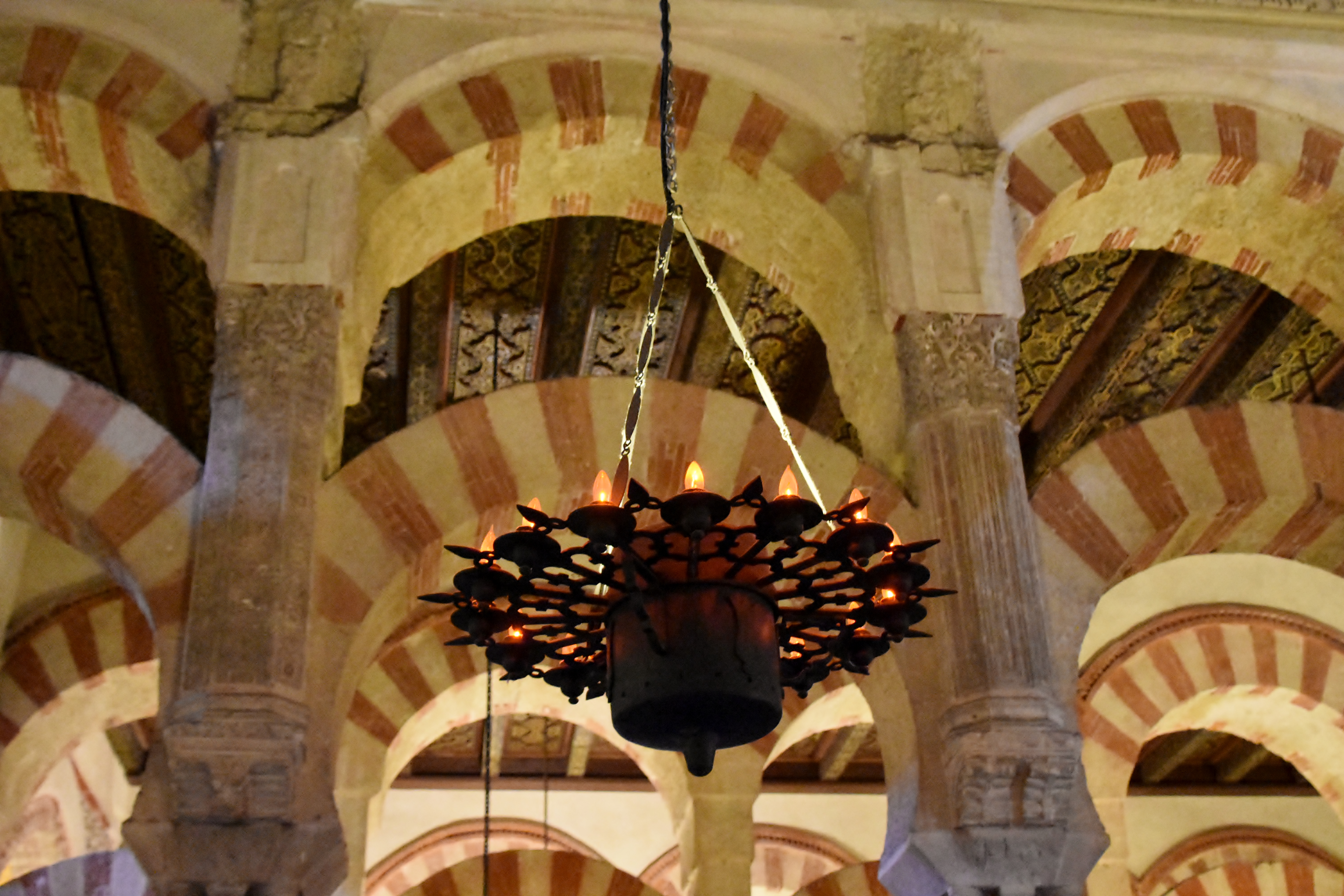
The convivencia — the coexistence of Muslims, Christians and Jews — should be described accurately rather than romanticised. Jews and Christians held high office, and Jewish intellectual life in Spain flourished as nowhere else in the medieval world, producing Maimonides, whose Guide for the Perplexed was written in Arabic. And they were legally subordinate, paid the jizya, and faced periodic persecution, particularly under the Almohads in the twelfth century, which drove Maimonides himself into exile in Egypt.
Toledo, after its capture by Christian Castile in 1085, became the great translation centre where Arabic works — including the Greek texts they preserved and the Islamic commentaries and original works — were rendered into Latin. This is the main channel by which Aristotle, Euclid, Ptolemy, Galen, algebra and the numerals reached medieval Europe, and Chapter 7.4 shows what European universities did with them.
Why it stopped leading
This is a genuine question and the popular answers are mostly wrong.
The claim that al-Ghazali single-handedly killed Islamic science by attacking philosophy is too simple. Major scientific work continued for centuries after him — the Maragha observatory, Ibn al-Nafis, Ibn Khaldun and Ulugh Beg all postdate him. The decline is later and slower than the story requires.
The factors historians actually weigh:
Political catastrophe. The Mongol destruction of Baghdad in 1258 (Chapter 7.6) killed the Abbasid caliph, destroyed the libraries, and ended the central patronage system. Timur's campaigns did comparable damage in the east.
The shift of trade routes. Once European ships reached India round Africa (Chapter 8.4), the overland and Red Sea routes that had made the Islamic world's cities rich were bypassed. The revenue that funded the patronage went elsewhere.
Institutional form. Islamic learning was organised around the madrasa and around individual scholars with personal certification, funded by charitable endowments whose terms were fixed by their founders. European universities became self-governing corporations that could change their own curriculum, hold property, and outlive their founders (Chapter 7.4). That corporate form turned out to matter enormously.
And printing. Movable type printing in Arabic was restricted in the Ottoman empire for centuries, partly on religious grounds concerning the reproduction of sacred text and partly under pressure from the scribal guilds. Chapter 8.2 shows what printing did in Europe, and a civilisation that did not adopt it for three hundred years lost the compounding.
The honest summary: a long, multi-causal decline in which political destruction, the loss of the trade routes that paid for it, and institutional forms that did not compound played larger roles than any single theological turn.
Where this shows up in your life
Your numbers, your algebra, your algorithm, your hospital, your star names, and a long list of ordinary English words.
And a correction worth carrying. The standard story of Western civilisation runs Greece to Rome to the Renaissance, with a thousand-year gap. The gap is where the work was happening, in Baghdad, Cordoba, Cairo, Isfahan and Samarkand, and the Renaissance began with Latin translations of Arabic books. Chapter 8.1 says so plainly, because a Europe-centred account of how knowledge reached the modern world is not merely unfair, it is factually wrong about the chain of transmission.
What the next page covers
While the west of the Roman empire dissolved, the east continued for another thousand years, and it has been more consistently misrepresented than any other major state in history. Chapter 7.3 covers Byzantium — what it actually was, how it survived when the west did not, the walls that held for a thousand years, Justinian's law and his plague, the split with the Latin church, what the Fourth Crusade did to it, and the fall of Constantinople in 1453 and what that did to Europe.