Appearance
9.1 — Where Money Came From
Every economics textbook opens with the same story. Once upon a time people bartered. A man with shoes who wanted bread had to find a baker who wanted shoes. This was inconvenient, so people agreed on a commodity everyone would accept, and that became money.
Anthropologists have been looking for such a society for over a century and have not found one.
The economist Caroline Humphrey's summary is blunt: no example of a barter economy, pure and simple, has ever been described, let alone the emergence from it of money. All available ethnography suggests that there never has been such a thing.
What actually exists in societies without money is credit — obligation, gift, debt and reciprocity, tracked in memory. You give your neighbour a chicken and he owes you. Barter, where it occurs, happens between strangers who will not meet again, or between people who normally use money and temporarily cannot.
So the textbook story is not a description of history. It is a thought experiment that got mistaken for one, and correcting it changes what money looks like.
What money actually is
Three functions, and they can be separated.
A unit of account — a common measure of value, so debts and prices can be stated in comparable terms.
A medium of exchange — a thing handed over to settle a transaction.
A store of value — something that holds worth across time.
The historical order is the surprising part. Unit of account came first, by a long way.
Mesopotamian temples and palaces from around 3000 BCE kept accounts in a standard measure — a weight of silver, the shekel, defined as equivalent to a fixed quantity of barley (Chapter 4.1). Debts, wages, rents and fines were all recorded in shekels.
And the silver mostly did not move. It sat in the temple. What circulated was obligation, recorded on tablets, settled at harvest, and frequently netted off against other obligations. Money existed as a measure and as debt for about two and a half thousand years before anyone made a coin.
Coins
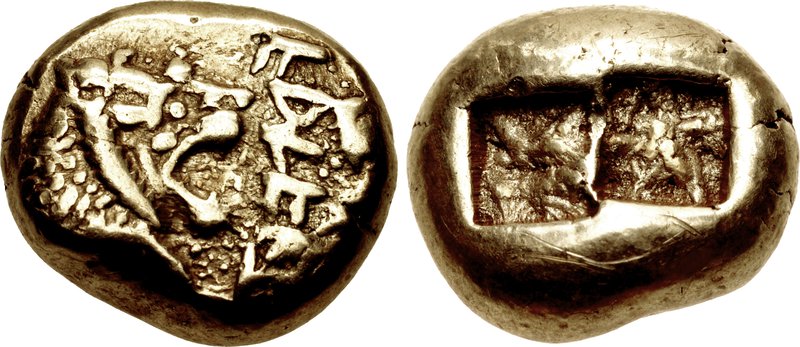
Coinage was invented independently in three places at almost the same time, in the seventh and sixth centuries BCE, which is the same pattern as agriculture (Chapter 3.7) and it needs the same kind of explanation.
Lydia, in western Anatolia, around 600 BCE, in electrum — a naturally occurring gold-silver alloy from local river sands.
India, punch-marked silver, from around the sixth century BCE (Chapter 6.3).
China, cast bronze in the shapes of spades and knives, developing into the round coin with a square hole.
What a coin adds to a lump of metal is a guarantee. Weighing and assaying metal at every transaction is slow and requires expertise; a stamped coin means the issuer certifies the weight and purity, so you can count instead of weigh.
And the issuer takes a profit on it. Seigniorage is the difference between a coin's face value and the cost of the metal and minting. A state that can make a coin worth more than its metal has found a revenue source, which is why states have always monopolised minting and why debasement is such a persistent temptation (Chapter 9.8).
And here is the connection that explains why coinage appeared when it did. The three regions that invented it were all, at that moment, developing large standing armies.
A soldier is a stranger, moving through territory where nobody knows him, who must be paid. Credit does not work — he will not be there next season and nobody trusts him. A state that mints coins, pays its soldiers in them, and then demands taxes back in those same coins has created a machine: the soldiers spend the coins locally, the locals need coins to pay tax, so the locals supply the army with food and goods to obtain them.
The coin, the army and the tax are one system, and this is the strongest available explanation for why the three inventions cluster in time and place.
Money as debt, and what states actually do
The observation that follows is the important one and it is not obvious.
A state does not need to hold anything to make its money valuable. It needs only to demand that taxes be paid in it. Once the tax is due in a particular token, everyone in the economy needs to obtain that token, and it therefore has value.
This is why the note in your pocket works. It is not backed by gold; it has not been since 1971 (Chapter 9.10). It is a claim on nothing. What makes it valuable is that the Indian state will accept it in settlement of your tax liability and will not accept anything else, and that everyone knows this and therefore accepts it from you.
The tally stick makes this vivid. The English exchequer, from the twelfth century to 1826, recorded debts on notched wooden sticks split lengthwise — the creditor kept the longer piece, the stock, and the exchequer the shorter, the foil, and the matching grain of the wood proved authenticity. These sticks circulated as money. A tally recording a future tax payment could be sold at a discount to someone who wanted to settle their own tax bill.
When the accumulated tallies were finally burned in 1834, the stoves overheated and burned down the Houses of Parliament.
The debt story, told properly
David Graeber's Debt: The First 5,000 Years (2011) made this history widely known, and its central claims should be separated by how well they hold up.
Well supported: the barter myth is wrong; credit precedes coinage; the earliest records are of debt; and periodic debt cancellation was a normal instrument of ancient statecraft.
The debt jubilee is real and it is worth knowing. Mesopotamian kings periodically issued misharum decrees cancelling agricultural debts, freeing debt-slaves and returning pledged land (Chapter 4.1). The reason was not charity. Compound interest on agricultural loans, in an economy where a bad harvest is common, mathematically drives the population into debt-bondage over a generation or two, which destroys the tax base and the army. A new king cancelling debts was resetting the system to keep it functioning. The Hebrew jubilee in Leviticus is a version of the same institution.
More contested: Graeber's larger claims about alternating cycles of credit and bullion money across world history, and some of his specific historical readings, have been criticised by specialists. The core anthropological point about barter has not been.
Interest, and why it was condemned
Charging for the use of money was prohibited or restricted in nearly every major tradition, and the reasons are worth understanding rather than dismissing.
Aristotle's argument was that money is barren — a coin does not breed — so a return on it is unnatural, and that the money-lender's gain comes from the borrower rather than from production.
The prohibitions. Christian canon law banned usury for clergy and then for everyone, from the fourth century, hardening in the twelfth. Islam prohibits riba — interpreted as any guaranteed return on a loan — which remains in force and is the basis of modern Islamic finance. Jewish law prohibited interest between Jews while permitting it to outsiders, which is the origin of the medieval European arrangement in which Jews were pushed into money-lending and then resented for it, having been excluded from land ownership and most guilds.
Why the prohibitions made sense in context. In a subsistence agrarian economy most loans are distress loans — a farmer borrowing to eat after a failed harvest — and interest on a distress loan reliably ends in the loss of land and then of freedom. The prohibition is a protection against exactly the dynamic the Mesopotamian jubilees were resetting.
And why they were abandoned. A loan to finance a trading voyage or a workshop is a different object — the borrower expects a profit from the loan's use, and a share in it is not obviously unjust. Medieval canon lawyers developed elaborate distinctions to permit it — compensation for risk, for delay, for foregone opportunity — and Chapter 9.2 shows what merchants built on top of those distinctions.
The distinction between productive and distress lending is not obsolete. It is the whole argument about payday lending, about Indian farm indebtedness and rural suicide, and about microfinance, and Chapter 9.15 returns to it.
Other kinds of money
Cowrie shells circulated across Africa, South Asia and China for centuries — durable, portable, hard to counterfeit, and supplied from a limited source in the Maldives, which kept them scarce. They were used in the Atlantic slave trade as a purchase currency (Chapter 8.6), and their value collapsed in the nineteenth century when European ships began importing them by the shipload.
Cattle as a unit of account in many pastoral societies, and the Latin pecunia, money, is from pecus, cattle.
Salt — Roman soldiers' pay is the origin claimed for "salary", though the connection is looser than usually stated.
Rai stones on Yap in Micronesia are the case that most clarifies what money is. Enormous limestone discs, some several metres across, quarried on another island and transported by canoe. They are too heavy to move in ordinary use, so ownership changes without the stone moving, and everyone in the community knows who owns which stone. One stone is known to have been lost at sea during transport and is still owned and still traded, on the general agreement that it exists on the sea floor.
That is a ledger. Money is a record of who owes what, and the physical token is a way of maintaining the record. Chapter 9.15 notes that a blockchain is the same idea with a different storage medium.
Where this shows up in your life
The note in your wallet says, in India, that the Reserve Bank promises to pay the bearer the sum — a formula left over from convertibility that now means nothing in itself. Its value rests on the tax argument above and on general confidence.
Most of the money in the economy is not notes at all. It is bank deposits: numbers in ledgers, created when banks lend (Chapter 9.2). Physical currency is a small fraction of the money supply in any modern economy.
Demonetisation in India in November 2016 is a live illustration of the whole chapter: 86 percent of currency by value was withdrawn overnight, and the economy demonstrated exactly how much of daily transaction still ran on physical cash and on trust networks. The stated objectives and the measured outcomes are covered in Chapter 6.28's ledger.
And the deepest point: money is not a thing, it is an agreement. Chapter 3.5 argued that human beings can coordinate on shared fictions and that every institution in this volume is one. Money is the purest example. It works exactly as long as everyone behaves as though it works, which is why confidence is the whole game and why Chapter 9.8's hyperinflations are so terrifying.
What the next page covers
Once money exists and interest is permitted, somebody will accept deposits, lend them out, and discover that they can lend more than they hold. Chapter 9.2 covers banking — how fractional reserve banking actually works and why it means banks create money; the medieval instruments that let merchants move value across borders without moving metal; the invention of public debt, which is the single most consequential financial instrument in this volume; and why bank runs happen and what stops them.