Appearance
9.5 — The Industrial Revolution: Why Britain, Why Then
For roughly ten thousand years, output per person did not grow. A peasant in 1700 lived at about the same material standard as a peasant in 1000 BCE — better in some places, worse in others, and not on a trend. Every gain in productivity was absorbed by population growth, which is the trap Thomas Malthus described in 1798, just as it was ceasing to be true.
Then, sometime around 1760 to 1830 in Britain, output per person began rising continuously, and it has not stopped for two and a half centuries.
This is the most important discontinuity in this volume, and this chapter is about what caused it.
What actually happened technically
Four clusters, and they reinforce each other.
Textiles. The flying shuttle (1733) let one weaver do the work of two, which created a yarn shortage. The spinning jenny (around 1764) let one spinner work many spindles. The water frame (1769) produced stronger yarn using water power. The mule (1779) combined both and produced fine strong yarn in quantity. Then the power loom caught weaving up.
Notice the sequence. Each innovation created a bottleneck at the next stage, which then attracted invention. That is a characteristic of a self-reinforcing system rather than a series of unrelated ideas.
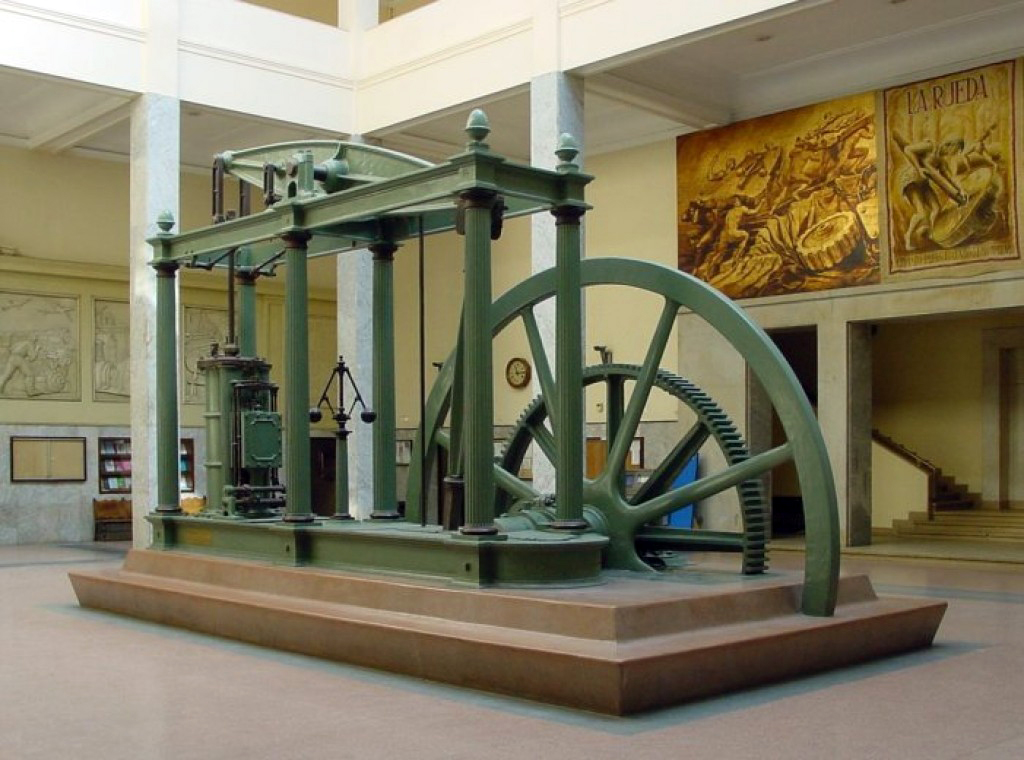
Steam. Newcomen's engine (1712) was built to pump water out of coal mines and was extremely inefficient — and it did not matter, because it sat on top of a coal mine where fuel was nearly free. Watt's separate condenser (1769) made it efficient enough to be worth running anywhere, which took it out of the mine and into the factory, and then — with Trevithick's high-pressure engines — onto rails and into ships.
Iron. Coke smelting (Darby, around 1709) replaced charcoal, removing the constraint that iron production depended on woodland. Puddling and rolling (Cort, 1783–84) allowed wrought iron in quantity. Then the Bessemer process (1856) made cheap steel, and everything from railways to skyscrapers followed.
Transport. Canals from the 1760s, then railways from the 1820s, then steamships. Transport cost is what determines the size of a market, and collapsing it turns local production into national and then global production.
And the general-purpose part is the significant one. Steam is not a textile machine or a mining machine. It is power, applicable to anything. Chapter 14.4 uses the same category for electricity and Volume I for computing: a general-purpose technology transforms every sector rather than one.
Why Britain
This is the question, and there is no single answer that survives scrutiny. Here are the candidates, weighed.
Coal, and where it was
Britain had abundant coal near the surface, near water transport, and near the towns.
Why that matters more than "having coal". China had more coal, and its major deposits were in the north while its economic centre had shifted south (Chapter 7.9), so moving it was expensive. Coal is heavy and low-value per tonne; transport cost dominates.
And the coal came with a problem that produced the solution. Mines flood. Pumping water out of deep mines was the binding constraint on coal production, and it is exactly what Newcomen's engine was built for. The first steam engines were paid for by the industry they made possible, and they ran on a fuel that was free at the pithead. This is a feedback loop, and it is located in Britain by geology.
High wages and cheap energy
Robert Allen's argument, and it is the most economically precise one.
British wages were unusually high by international standards in the eighteenth century, and British energy was unusually cheap.
So the arithmetic of mechanisation worked in Britain and nowhere else. A machine replaces labour and consumes energy and capital. Where labour is expensive and energy cheap, the machine pays for itself. Where labour is cheap — as in India or China — the same machine does not.
Allen's calculations suggest the early spinning machines were profitable in Britain and unprofitable in France and India at prevailing wage and fuel prices. The machines were not adopted elsewhere because it did not pay, not because nobody understood them.
Why British wages were high traces back to the Black Death's labour shortage (Chapter 7.7), to agricultural productivity, and to the commercial economy of the Atlantic ports.
Agriculture first
Chapter 3.7's rule: industry needs people not farming.
British agricultural productivity rose substantially before industrialisation — new rotations including turnips and clover, selective livestock breeding, drainage, and enclosure. By 1800 a much smaller share of the British workforce was in agriculture than in France or China.
Enclosure deserves an honest note. The conversion of common land to private ownership raised productivity and dispossessed a large number of small cultivators, who became wage labourers and, in many cases, the industrial workforce. It was efficient and it was a transfer, and both are true.
Institutions, and the specific ones
Chapter 9.4's general finding, applied.
After 1688, Parliament controlled taxation and the crown could not confiscate arbitrarily (Chapter 10.1). Public debt at low rates (Chapter 9.2). Patents — the English patent system from 1624 gave inventors a temporary monopoly, and while its actual effect is debated, Watt's patent and its aggressive enforcement is a documented case of a monopoly both rewarding and delaying innovation. Contract enforcement and a functioning commercial legal system. And no internal tariffs, so Britain was a single market while France had internal customs barriers until the Revolution.
A culture of tinkering
Britain had an unusually dense population of practical mechanics who were not academics.
The people who mattered were mostly craftsmen. Newcomen was an ironmonger. Arkwright a barber and wigmaker. Crompton a weaver. Watt was an instrument maker at Glasgow University, which is where the relevant contact between craft and science actually happened.
The Lunar Society of Birmingham — Watt, Boulton, Wedgwood, Priestley, Erasmus Darwin — met monthly and combined manufacturers with natural philosophers. Joel Mokyr calls this the "industrial enlightenment": the systematic application of scientific method and shared knowledge to practical production.
Note that the science of the period was mostly not the source of the inventions. Thermodynamics was worked out after the steam engine and largely to explain it — Carnot's work is from 1824, more than a century after Newcomen. The causation ran from machines to theory as much as the other way.
The Atlantic
Chapter 9.4 weighed this and here is the specific channel.
Cotton is the industry that industrialised first, and cotton was not grown in Britain. Raw cotton came from the American South, produced by enslaved labour (Chapter 8.6), and after Whitney's gin in 1793 it came in enormous and rising quantities.
And the market for the cloth was substantially colonial — India, West Africa and the Americas — with the Indian market opened by the asymmetric tariff arrangements of Chapter 6.17.
So the strongest statement is: the Atlantic economy did not fund British industrialisation in aggregate, and it supplied the specific input and the specific market for the specific industry that led it.
Why not China or India
China had, in 1700, comparable living standards in its richest regions, a large commercial economy, and technical capability. What it lacked, on the current balance of evidence: cheap coal where the people were; high wages, so mechanisation did not pay; competitive pressure between states (Chapter 8.3); and a state whose priorities were internal stability and agriculture rather than manufacture. The Qing state was competent and its objectives were different.
India had the world's largest textile industry and lost it (Chapter 6.17). The reasons it did not mechanise: very low wages, so machines did not pay; no coal industry at the relevant places and times; the political disintegration of the eighteenth century; and, once the Company was in control, a policy environment that had no interest in Indian industrialisation and actively taxed it.
The honest position on both is that this is a live scholarly argument — the "Great Divergence" literature, from Kenneth Pomeranz's 2000 book onward, is one of the most active in economic history, and the question of how much was contingent and how much structural is not settled.
What it did to people
The optimism-pessimism debate among economic historians ran for decades and the current position is reasonably clear.
Real wages did not rise for the first two generations. Estimates suggest little improvement in average working-class living standards between roughly 1780 and 1830, followed by substantial and sustained improvement afterwards.
And several things got worse before they got better.
Urban life expectancy fell. Manchester's population grew from tens of thousands to hundreds of thousands within decades, with no sewerage, no clean water and no building regulation. Cholera epidemics from 1832 onward. Life expectancy in Manchester and Liverpool in the 1840s was around 25 to 30 years, well below the rural average.
Work discipline changed fundamentally. Agricultural and craft work follows the task and the season. Factory work follows the clock, with fines for lateness, fixed hours, and supervision. E. P. Thompson's essay on time and work-discipline documents the enormous cultural violence of that transition.
Child labour was extensive — children in mines and mills from six or seven, twelve to sixteen hour days.
And then it improved, and the reason it improved matters. Factory Acts from 1833 limiting children's hours, the Ten Hours Act of 1847, public health legislation after the sanitary reports of the 1840s, the legalisation of trade unions, and the extension of the franchise. The gains were legislated, after political organisation and considerable conflict, not delivered automatically by growth. Chapter 9.6 covers the politics.
By 1900 British real wages were several times their 1800 level and life expectancy was rising. The bill was paid by the generations in the middle.
Where this shows up in your life
Everything. Your clothes are machine-made; your food is transported; your house has piped water; you expect to live past seventy; and you work fixed hours by a clock. All of it dates from this.
And two costs are still being paid. Chapter 14.1 shows that the carbon dioxide released since 1750 is the direct cause of the climate problem, and it starts here. And the inequality between countries that Chapter 9.4 measured opened here — the ratio between richest and poorest went from about five to one to about a hundred to one during and after this transformation.
The most useful thing to carry from this chapter is the mechanism, because Chapter 9.13 is about countries deliberately repeating it. Cheap energy, expensive labour, a large accessible market, an educated workforce, secure property, and something to copy. Every successful late industrialiser has assembled some version of that list on purpose.
What the next page covers
Industrial society produced enormous wealth and enormous misery simultaneously, and two bodies of thought grew up arguing about what to do. Chapter 9.6 covers capitalism and socialism — what Smith actually said as against what he is quoted as saying, what Marx actually argued and which of his predictions held and which failed, what the socialist and communist experiments produced when tried, and what the real argument between the positions is once the slogans are removed.