Appearance
4.4 — Ancient China
A Shang king wanted to know whether the harvest would be good, whether a military campaign would succeed, whether his toothache had a supernatural cause, or whether his wife's childbirth would go well. So he had a question carved into an ox shoulder blade or a turtle shell, applied a heated bronze rod to a prepared hollow on the reverse, and read the cracks.
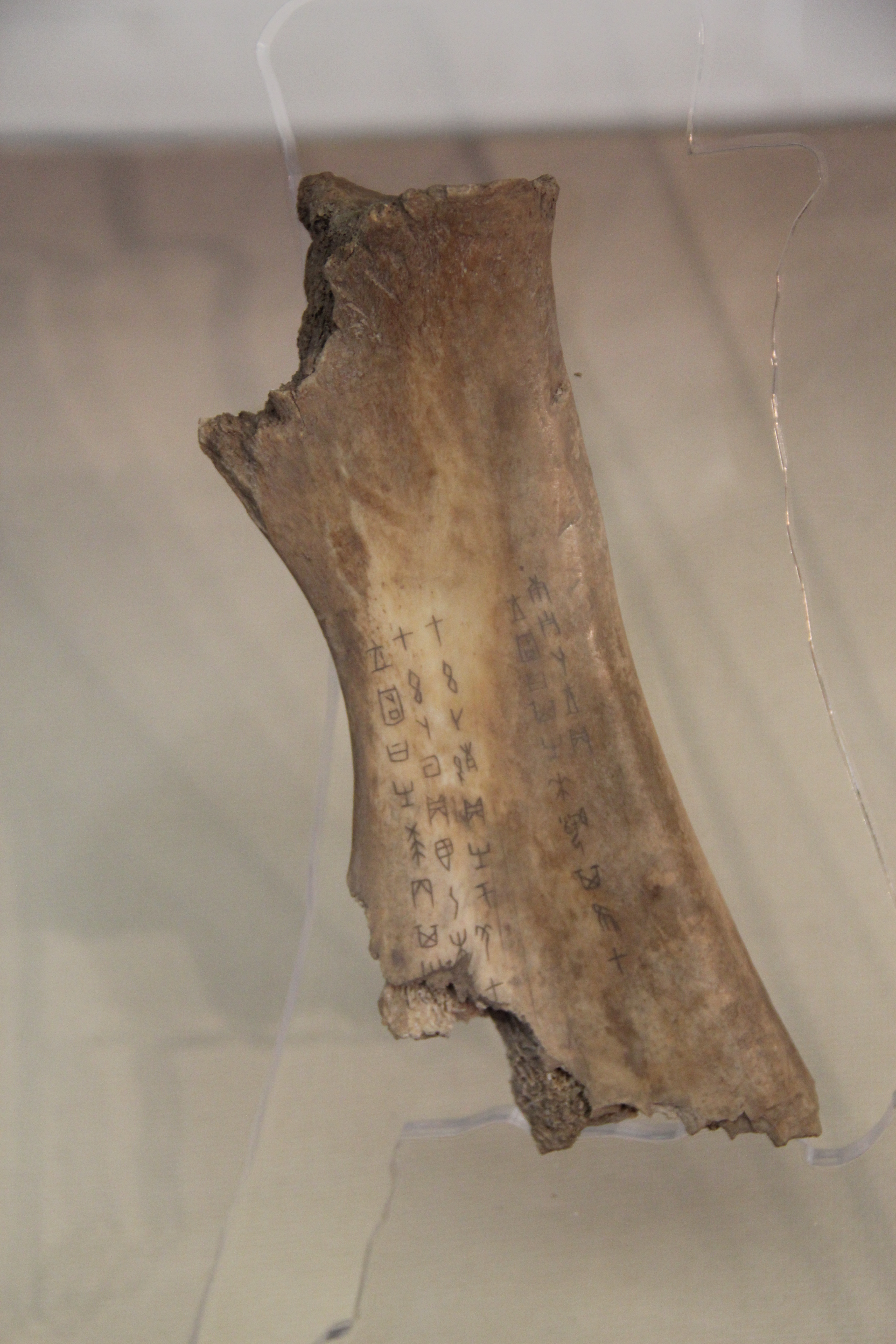
The bones were then archived. Tens of thousands of them have been excavated at Anyang, and they carry the earliest Chinese writing, the names of Shang kings in an order that matches a king list written down a thousand years later, and a running record of what a Bronze Age court was anxious about.
They were discovered by accident. In the 1890s, so-called dragon bones were being sold as medicine, ground into powder. A scholar named Wang Yirong noticed the markings on one and recognised archaic writing. An unknown dynasty was recovered from a pharmacy.
The land, and why it produced a different kind of civilisation
Chinese civilisation began on the loess. Chapter 1.9 explained loess: wind-blown glacial silt, deposited in blankets tens of metres thick, exceptionally fertile and soft enough to work with wooden tools. The Loess Plateau of the middle Yellow River is the cradle, and the millet-based farming of Chapter 3.7 grew there.
The Yellow River is the reason the state took the form it did, and it is a genuinely dangerous river. It picks up so much loess that it carries the highest sediment load of any large river in the world — hence the colour and the name. That silt settles in the channel, so the river bed rises, and to stop it flooding, people build dykes, so the bed rises higher still, until the river is running above the level of the surrounding plain behind walls. Then a breach is a catastrophe.
The Yellow River has changed course dramatically many times in recorded history, sometimes shifting its mouth by hundreds of kilometres, and its floods have killed on a scale no other river approaches — the 1887 flood alone is estimated to have killed hundreds of thousands and possibly far more. It is called both the cradle of Chinese civilisation and China's Sorrow, and both names are earned.
The political consequence is direct. Managing that river requires coordinated labour and authority over a large area, and the founding myth of Chinese statecraft is about exactly this: Yu the Great, who controlled the floods by dredging channels rather than only building dams, and was rewarded with the rule of the realm. Whether Yu existed is unknown; that the story is about hydraulic engineering as the basis of legitimate authority is the point.
The Yangtze in the south is the other half of China, warmer and wetter, where rice was domesticated, and the two agricultural systems — northern millet and wheat, southern rice — remain a real cultural divide.
And China was comparatively isolated. Mountains and the Tibetan Plateau to the west, jungle to the south, ocean to the east, and steppe and desert to the north. The steppe was the one open side, and everything dangerous came from there — a fact that shapes Chinese history from the Great Wall to the Mongols to the Manchus.
Xia, Shang, Zhou
The Xia is the traditionally first dynasty, around 2070–1600 BCE. Whether it existed as described is genuinely open. The Erlitou site in Henan is a large Bronze Age urban centre of the right date with palace foundations and bronze workshops, and Chinese archaeologists generally identify it with Xia while many Western scholars regard the identification as unproven. This book records it as: a real and substantial early state existed there; whether it is the Xia of later texts is not established.
The Shang, around 1600–1046 BCE, is unambiguously historical because of the oracle bones. It was a Bronze Age state with a king who was both political and religious head, ancestor worship at its centre, chariot warfare, and bronze casting of a technical quality unmatched anywhere in the world at the time. Chinese bronzes were cast in complex ceramic piece-moulds rather than by the lost-wax method used elsewhere, allowing extremely sharp decoration, and the largest weighs over 800 kilograms.
Shang religion involved human sacrifice on a large scale. Royal tombs at Anyang contain hundreds of sacrificed people, many of them war captives. This is well documented and it is the part of Shang civilisation that later Chinese tradition quietly dropped.
The Zhou, from 1046 BCE, overthrew the Shang and then had to explain why that was legitimate. Their answer is one of the most consequential political ideas ever formulated.
The Mandate of Heaven
The claim: Heaven grants the right to rule to a virtuous ruler who governs for the people's welfare. If a ruler becomes cruel, corrupt or incompetent, Heaven withdraws the mandate, and it passes to whoever successfully takes it.
Consider what that does. In Egypt the pharaoh was a god, so opposing him was opposing the order of the cosmos. In Mesopotamia the king was the god's appointee. The Mandate of Heaven makes legitimacy conditional, and it therefore makes rebellion legitimate — retroactively, if it works.
It is also self-confirming in a way that is worth seeing clearly. How do you know a ruler has lost the mandate? Because he was overthrown, or because disaster struck. Floods, famines, earthquakes and defeats were read as signals of withdrawal. Which means a successful rebel automatically had the mandate, and an unsuccessful one automatically did not.
This gave Chinese political thought two things simultaneously. A doctrine that ruling is a duty owed to the ruled, which produced a genuine tradition of officials remonstrating with emperors and of political thought centred on the people's welfare. And a doctrine that whoever wins is right, which legitimated every dynasty in turn including foreign conquerors, as long as they governed in the Chinese manner.
The dynastic cycle that Chinese historians themselves described follows from it: a vigorous founding, a period of strength, then growing court corruption, heavier taxation, neglected water works, floods and famine, banditry, rebellion, collapse, and a new founding. Chapter 16.1 examines how much of this is a real pattern and how much is a template historians imposed on events.
The Zhou's collapse, and what it produced
The Zhou distributed territory to relatives and allies who held it as vassals. Over centuries the vassals became independent and the Zhou king became a figurehead, retaining ritual prestige and no power.
Spring and Autumn period (roughly 771–476 BCE): a dozen or so major states, formalised warfare with chivalric conventions, and constant diplomacy.
Warring States period (roughly 475–221 BCE): the conventions collapse. Seven large states fight for survival, armies grow from thousands to hundreds of thousands, iron weapons and crossbows replace bronze and chariots, mass conscript infantry replaces aristocratic combat, and states begin building long defensive walls.
And this catastrophe produced the greatest flowering of thought in Chinese history, which is not a coincidence. When the old order fails, everyone asks what should replace it. The Chinese tradition calls this period the Hundred Schools of Thought, and three of them matter enormously.
Confucianism. Kongzi — Confucius — lived roughly 551–479 BCE, and was a minor official whose career was a failure by his own standards; he spent years travelling between courts looking for a ruler who would apply his ideas, and found none. His answer to disorder was moral cultivation and correct relationships. Society consists of five relationships — ruler and subject, father and son, husband and wife, elder and younger brother, friend and friend — and if each party performs their obligations properly, order follows. Ritual propriety, li, is not empty ceremony but the practice of correct behaviour until it becomes character. Government by moral example beats government by punishment, because punishment makes people avoid getting caught while example makes them ashamed to do wrong.
Daoism. Attributed to Laozi, whose existence is uncertain, in the Daodejing, and developed by Zhuangzi. The answer to disorder is to stop interfering. The dao is the way things naturally are, and wu wei — usually translated as non-action, better understood as action without forcing — means aligning with it rather than imposing on it. Politically it argues for a small, light-handed state. It is a direct rejoinder to Confucian earnestness, and the two have coexisted in Chinese culture for 2,500 years, with the observation that officials were Confucians at work and Daoists at home being an old joke with truth in it.
Legalism. The answer to disorder is that human beings respond to reward and punishment, and nothing else. Write clear laws, apply them without exception to everyone including nobles, reward agriculture and military service, punish everything else harshly. Legalism has no interest in virtue and no illusions. It is brutal, it is coherent, and it worked: the state of Qin adopted it and conquered all the others.
Qin: unification and the shortest dynasty
In 221 BCE the king of Qin completed the conquest of the other six states and declared himself Qin Shi Huang, First Emperor. He then did in about a decade what most states take centuries over.
Standardisation. One script across the empire, replacing divergent regional forms — this is arguably the single most important act in Chinese history, because a shared writing system holds a linguistically diverse territory together even when the spoken languages are mutually unintelligible, which they are. Standard weights, measures, currency, and even axle widths, so carts would fit the same ruts on the roads.
Administration. The feudal aristocracy was abolished and replaced with thirty-six commanderies run by centrally appointed officials who could be transferred and dismissed. This is the invention of the bureaucratic province, and its descendants govern China today.
Infrastructure. Roads, canals, and the connection of existing northern walls into a continuous defensive line — the ancestor of the Great Wall, though almost everything a visitor sees today is Ming, some 1,700 years later.

And repression. Legalism applied to a whole empire meant enormous forced labour levies, harsh punishments, and — according to the later historian Sima Qian — the burning of books and the burial alive of scholars. The book-burning story is now thought to be exaggerated by hostile Han-era historians, and some destruction of records certainly occurred.
The First Emperor spent his last years searching for an elixir of immortality and is thought to have died, ironically, from mercury preparations taken for that purpose. His tomb is described by Sima Qian as containing a model of the empire with rivers of flowing mercury; soil surveys around the mound do show anomalously high mercury concentrations, which is a striking partial confirmation of a text written a century later.
The dynasty fell four years after his death, in rebellion. It lasted fifteen years and it set the shape of China for two thousand. The Han dynasty that replaced it kept every Qin institution while loudly condemning Qin cruelty and adopting Confucianism as the official ideology — an arrangement later summarised as Confucian on the outside and Legalist on the inside, which is a fair description of most Chinese governments since. Chapter 5.6 takes up the Han.
Where this shows up in your life
The examination system, developed later but rooted here, was the world's first attempt at selecting officials by tested merit rather than birth. Every competitive public examination on Earth, including India's civil services examination, descends from that idea, which reached Europe through eighteenth and nineteenth century admiration for the Chinese model.
Paper, printing, gunpowder and the compass — the four inventions traditionally listed — all come from China, and Chapters 8.2 and 8.3 show what happened when they reached Europe.
And the deepest one: the idea that a state should be run by an examined, salaried, transferable bureaucracy rather than by hereditary lords. It is so normal now that it is invisible. It was invented in China, it took Europe another 1,800 years to arrive at the same place, and Chapter 9.13 argues that the institutional habits it created are part of why East Asia industrialised as fast as it did.
What the next page covers
Everything so far has happened in one connected Old World zone, where ideas and materials could travel. Chapter 4.5 crosses to the one place where civilisation developed with no possibility of contact — the Americas — and asks what happened when people built cities, states, mathematics, astronomy and writing entirely from scratch, without wheels for transport, without draught animals, and without iron. The answer tells you which features of civilisation are necessary and which are just what happened in Eurasia.