Appearance
5.1 — Greece
Greece is not fertile. Only about a fifth of it is arable, the soil is thin, and it is broken by mountains into hundreds of small pockets, each separated from its neighbours by ridges and by sea.
That geography produced everything else. Mountains meant no single kingdom could easily control the peninsula, so Greece developed as hundreds of independent city-states rather than one state. Poor soil meant that a growing population had to go somewhere, so Greeks planted colonies from Spain to the Black Sea, and Plato's remark that they lived around the Mediterranean like frogs around a pond is exact. And the sea was easier than the land, so they traded, which meant contact with Egypt, Phoenicia and Mesopotamia, and which meant a merchant class whose wealth did not come from land.
The polis
The polis is not a city. It is a self-governing community of citizens — a town with its farmland, its own laws, its own gods, its own calendar and its own army, typically of a few thousand adult male citizens. There were around a thousand of them.
Citizenship, not territory, was the basis. A Greek was a member of a body of people, not a resident of an area, and this is why colonies were founded as new independent poleis rather than as provinces of the mother city.
And the fighting formation shaped the politics. The hoplite was a heavy infantryman with a helmet, breastplate, greaves, a large round shield and a spear, fighting shoulder to shoulder in a dense block called a phalanx. The shield covers the left side of its bearer and the right side of the man next to him, so the formation only works if every man holds his place. One man running exposes his neighbour.
The political consequence is direct. The equipment was expensive enough that hoplites were the middling farmers who could afford it, and there were thousands of them. A state whose defence depends on several thousand ordinary property-owning men cannot easily be ruled against their wishes. The link between military participation and political rights recurs constantly in this volume — it appears again with the Roman legions, with the English Civil War, and with the extension of the franchise after the First World War.
Athens: how democracy actually worked
Athenian democracy was not representative and it is nothing like a modern system. It was direct, and understanding the machinery is more instructive than the label.
The Assembly, the ekklesia. Any adult male citizen could attend, speak and vote. It met about forty times a year on a hillside, with a quorum of six thousand for certain business. It decided war, peace, taxation, public works and treaties directly. No representatives.
The Council of Five Hundred, the boule. It prepared the Assembly's agenda. Its members were chosen by lot, fifty from each of the ten tribes, for one year, with a limit of twice in a lifetime.
Selection by lot is the feature most worth understanding, because it embodies a theory Athenians held explicitly: election favours the well-known, the eloquent and the rich, and is therefore aristocratic in effect. The lottery treats every citizen as equally capable of judgement. Most offices were filled this way. The exceptions were the ones needing expertise — generals were elected, because the Athenians were not fools.
Juries. Courts of several hundred jurors, chosen by lot, deciding by majority with no judge directing them and no professional lawyers. Litigants spoke for themselves, timed by a water clock.
Payment for office, introduced by Pericles, so that a poor citizen could afford to serve. Without pay, only the wealthy can spare the time — a problem that has not gone away.
And ostracism. Once a year the Assembly could vote on whether to hold an ostracism; if it did, citizens scratched a name on a pottery shard, and the man with the most votes was exiled for ten years without losing his property or his citizenship. It was a mechanism for removing someone considered dangerously powerful without accusing him of a crime.
Now the limits, stated plainly. Citizens were adult free males of Athenian parentage on both sides — perhaps 10 to 20 percent of the population. Women had no political rights at all and were legally under male guardianship. Resident foreigners, the metics, could not vote however long their families had lived there, and they were a large part of the commercial class. And Athens ran on slavery — estimates vary widely, but a substantial fraction of the population was enslaved, and conditions in the silver mines at Laurion, which funded the fleet, were lethal.
This is not a footnote and it is not a reason to dismiss the achievement. Both things are true: the machinery of citizen self-government was invented here, and it rested on the exclusion of most of the people living there. Chapter 13.6 traces how the franchise widened over the following 2,400 years, and it is a very long story.
Sparta
Sparta is the counter-example, and it is usually described badly.
Its foundation was the helots — the conquered population of Messenia, held in permanent servitude and vastly outnumbering the Spartans. The entire Spartan system was a response to the problem of sitting on a subject population that wanted to kill them. Sparta formally declared war on the helots each year so that killing one was not murder.
So Spartan citizens were full-time soldiers, forbidden trade and craft, fed by helot labour, trained from the age of seven in a communal upbringing called the agoge, and living in common messes. Spartan women had unusual freedoms by Greek standards — they exercised publicly, could own property, and were expected to be physically strong, because the state's interest was in producing soldiers.
The system was rigid and it was demographically doomed. The number of full citizens fell steadily — from perhaps 8,000 in the fifth century BCE to under a thousand by the fourth — because land became concentrated in fewer hands and a man who could not contribute to the common mess lost his citizenship. Sparta was defeated at Leuctra in 371 BCE by Thebes, and never recovered, because it had no reserves of manpower.
The Persian Wars
In 499 BCE the Greek cities of the Anatolian coast revolted against Persia, and Athens sent help. Persia won, and then came for Athens.
Marathon, 490 BCE. A Persian force landed and an Athenian army, heavily outnumbered, attacked at a run and broke it. The story of the runner carrying the news to Athens and dying is a later embellishment, and the modern race distance was fixed at the 1908 London Olympics for reasons involving the route to Windsor Castle.
Thermopylae and Salamis, 480 BCE. Xerxes invaded with a very large army — Herodotus's figures are impossible and modern estimates run in the low hundreds of thousands at most. At Thermopylae a small Greek force under the Spartan king Leonidas held a narrow pass for three days before being outflanked by a mountain path. The three hundred Spartans died with several hundred Thespians and others who stayed with them, a detail usually omitted.
Salamis is where the war was decided. Themistocles had persuaded Athens to spend a windfall from the silver mines on a fleet, and had the population evacuated while Athens itself was burned. He then lured the Persian fleet into the narrow straits at Salamis, where numbers were a disadvantage, and the Greek fleet destroyed it. The following year the Persian land army was beaten at Plataea.

The consequence inside Athens is the part usually missed. The fleet was crewed by the poorest citizens, who could not afford hoplite armour. Once the city's survival visibly depended on them, their political claims could not be resisted, and Athenian democracy became fully radical in the decades after Salamis. Military participation drove political inclusion again.
The Golden Age and the war that ended it
The fifty years after 479 BCE produced an extraordinary concentration of work. The Parthenon. The tragedies of Aeschylus, Sophocles and Euripides, and the comedies of Aristophanes. History as a discipline — Herodotus asking why the Greeks and Persians fought and collecting evidence from both sides, and Thucydides writing a rigorously political, deliberately unmiraculous account of his own war. Hippocratic medicine, arguing that diseases have natural causes. Socrates. The sophists teaching argument for money and being detested for it.
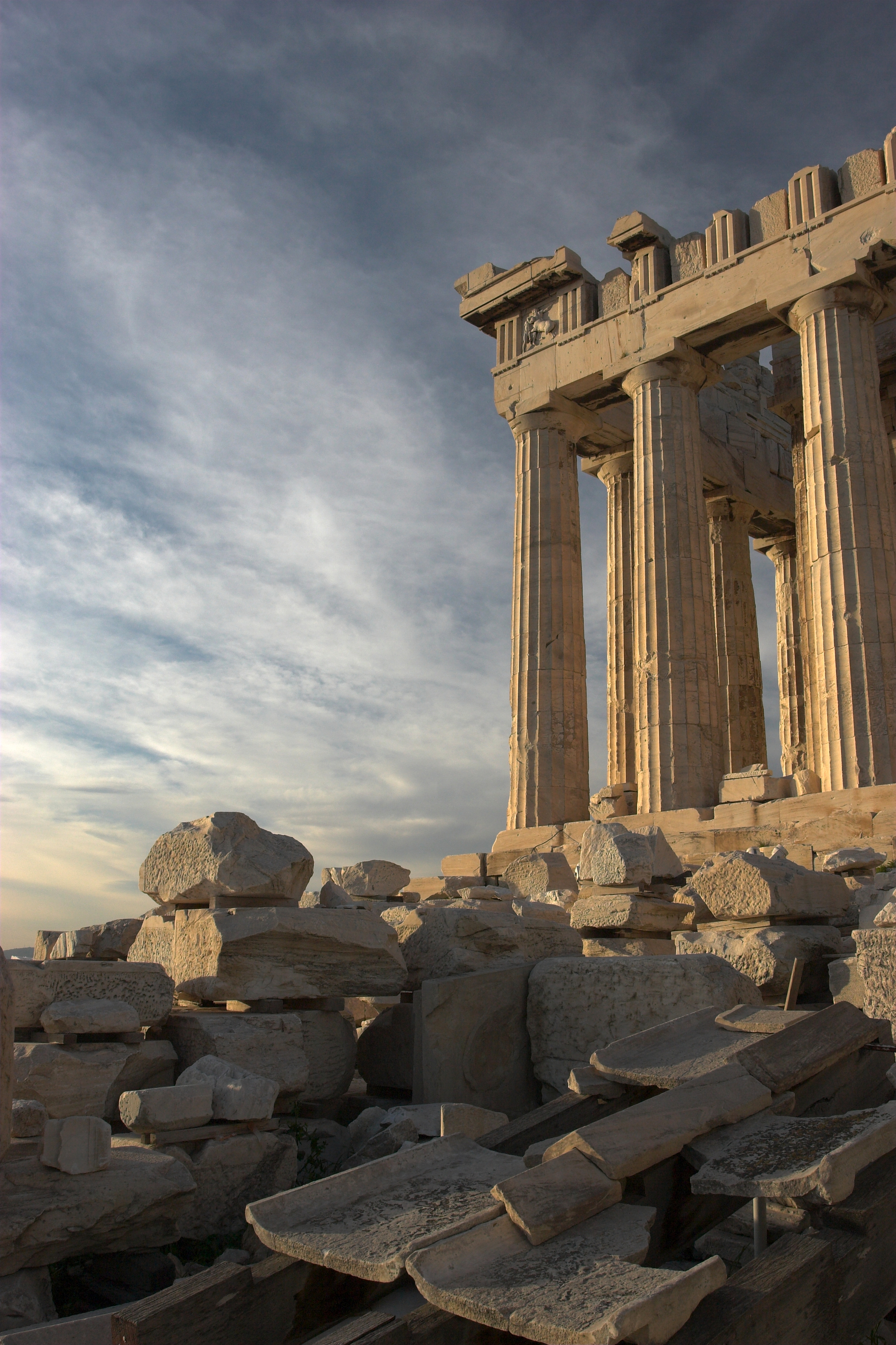
And it was paid for with other people's money. The Delian League was formed as a defensive alliance against Persia, with members contributing ships or cash. Athens moved the treasury to Athens, forbade members to leave, put down those who tried, and spent the funds on the Acropolis. An alliance became an empire, and Thucydides has the Athenians say so bluntly.
The Peloponnesian War, 431–404 BCE, was Sparta and its allies against the Athenian empire, and it ran for twenty-seven years. Athens' strategy was to abandon the countryside, shelter behind its walls, and use the fleet. The plan was sound and then a plague struck the crowded city in 430 BCE and killed perhaps a quarter to a third of the population, including Pericles.
Athens lost, after a disastrous expedition to Sicily and eventual defeat at sea. Thucydides's account is the founding text of political realism, and its most quoted passage is the Melian dialogue, in which Athenian envoys tell a small neutral island that questions of justice arise only between equals, and that the strong do what they can while the weak suffer what they must. The Melians refused, and Athens killed the men and enslaved the women and children.
What the Greeks actually invented
Deductive proof. This is the deep one. Egyptian and Babylonian mathematics solved problems; Greek mathematics proved general statements. Euclid's Elements, around 300 BCE, starts from definitions and five postulates and derives everything else — and it remained the standard mathematics textbook for over two thousand years. Volume II covers the mathematics.
Natural explanation. Chapter 4.8 made the point: explaining the world by things inside the world.
Systematic observation. Aristotle's biology, Hippocratic case records, Herodotus's ethnography.
Formal logic. Aristotle's syllogistic was the only formal logic in existence until the nineteenth century.
Politics as a subject. The vocabulary is Greek — politics, democracy, aristocracy, oligarchy, tyranny, monarchy — and so is the practice of comparing constitutions and arguing about which is best.
Drama. Tragedy and comedy as forms, with the stage conventions, the chorus and the competition structure.
And a few things that are usually attributed too generously. Greek science was frequently wrong and rarely experimental — Aristotle's physics is mistaken almost throughout, and the tendency to prefer reasoning to measurement is a real limitation. Greek achievement rested heavily on Egyptian and Mesopotamian foundations that Greek writers themselves acknowledged, particularly in astronomy and mathematics, and nineteenth-century European scholarship systematically understated that debt.
Where this shows up in your life
The words. Democracy, politics, economy, history, philosophy, physics, mathematics, logic, drama, music, theatre, athletics, school, academy, and several thousand more.
The Olympics, held at Olympia from 776 BCE, revived in 1896.
The jury, the public assembly, the idea that laws should be written and displayed, and the idea that a citizen has a claim on the state's decisions.
And a warning that Thucydides supplies better than anyone. Athens invented citizen self-government and used it to vote for an unprovoked invasion of Sicily that destroyed it, and to massacre a neutral island. Democracy is a decision procedure, not a guarantee of good decisions, and the people who invented it knew that and wrote about it. Chapter 13.6 and Chapter 16.3 both take it up.
What the next page covers
In 338 BCE a kingdom on Greece's northern edge, which the Greeks regarded as half-barbarian, defeated the combined Greek cities. Twenty years later its king had destroyed the Persian empire and reached the Indus. Chapter 5.2 covers Philip and Alexander — how Macedon built an army the Greek cities could not beat, what Alexander actually did in ten years of campaigning, why he stopped at the Beas river in the Punjab, and how the Greek-speaking world he left behind became the medium in which Buddhism, astronomy, mathematics and eventually Christianity travelled between India and the Mediterranean.