Appearance
6.24 — Nehru: The Complete Record
On 15 August 1947 India had a life expectancy of about 32 years, a literacy rate of about 12 percent, no meaningful industrial base, a partitioned economy, eight million refugees in motion, 560 princely states that had not yet acceded, a war beginning in Kashmir, and no experience of governing itself.
Almost every comparable state that became independent in the following two decades ended up under military or one-party rule within a generation. Pakistan had its first coup in 1958. Burma in 1962. Indonesia's parliamentary system collapsed in 1957. Most of newly independent Africa followed.
India did not, and it held elections on a universal adult franchise from 1951 — when most of the population could not read the ballot, which is why party symbols exist on Indian ballots to this day.
That is the case for Nehru at its strongest. This chapter makes it fully, and then makes the case against with the same seriousness, because he governed for seventeen years and the consequences of what he chose are still visible.

What he built that lasted
Parliamentary democracy, kept
This is the largest item and it is easy to undervalue because it did not fail.
He held elections and accepted the results. He faced a genuine opposition in Parliament, answered questions in it, and treated it seriously — he attended and spoke frequently, and the record of parliamentary debate in the 1950s is of a Prime Minister who could be and was challenged.
He wrote an anonymous article in 1937, under a pseudonym, warning against himself — that Jawaharlal had "all the makings of a dictator", was intolerant of others, had a "certain contempt for the weak and the inefficient", and that his conceit was "already formidable". He arranged for it to be published to warn his own party. Whatever else that shows, it shows an awareness of the danger.
And he subordinated the military to civilian control absolutely. No Indian coup has ever been attempted. Given the neighbourhood, this is not a small achievement, and it was a deliberate structural choice: no single chief of the defence staff, the service chiefs reporting to a civilian minister, and the intelligence services kept out of politics.
The constitutional settlement
The Constitution came into force on 26 January 1950, drafted by a committee chaired by B. R. Ambedkar, whom Nehru appointed as Law Minister despite Ambedkar having spent his career attacking Congress.
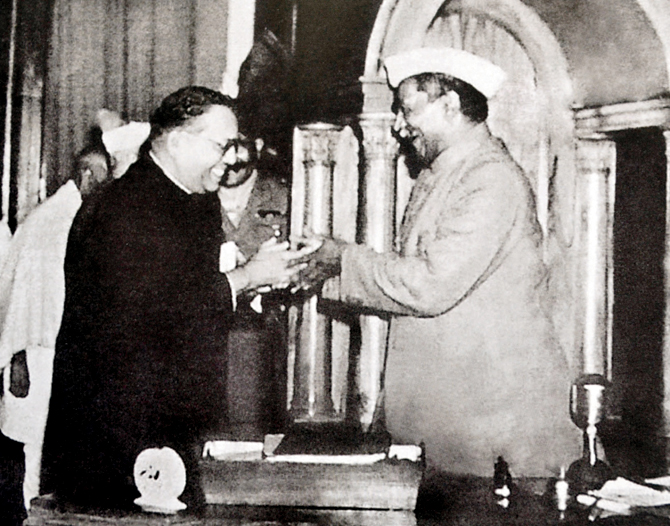
What it did: universal adult franchise immediately, without the property or literacy qualifications every Western democracy had used for decades; abolition of untouchability as a criminal offence; fundamental rights enforceable in court; an independent judiciary; a federal structure; and reservations in legislatures, education and public employment for Scheduled Castes and Scheduled Tribes.
Universal franchise from the start deserves emphasis. Britain took a century to get there. The United States was still enforcing literacy tests to disenfranchise black voters in 1950. India gave the vote to everyone, including women, immediately, in a country that was 88 percent illiterate.
Institutions
The Election Commission, the Comptroller and Auditor General, the Planning Commission, the Union Public Service Commission, the Atomic Energy Commission, the Indian Institutes of Technology, the Indian Institutes of Management, AIIMS, the national laboratories under the Council of Scientific and Industrial Research, the Sahitya Akademi and the other cultural academies, and the Bhakra and Hirakud dams.
The IITs specifically were founded from 1951 and are the single most successful institutional export India has produced.
And the scientific establishment. Homi Bhabha's atomic programme and Vikram Sarabhai's space programme both began under him, and ISRO's later record traces to that founding decision. He personally protected both from budget pressure.
Secularism, and what it meant
The Indian constitutional settlement did not adopt the American separation of church and state. It adopted something else: the state treats all religions equally, may regulate and reform religious practice where it conflicts with rights, and does not privilege the majority.
In a country that had just been partitioned on religious lines, with the third-largest Muslim population in the world remaining inside it, this was a substantive choice with an alternative. Pakistan chose the alternative.
The Hindu Code Bills of 1955–56 reformed Hindu personal law — legalising divorce, banning bigamy, giving daughters inheritance rights. They were fiercely opposed within Congress and by the President, Rajendra Prasad. Nehru pushed them through in pieces over several years.
And they applied only to Hindus, because Muslim personal law was left untouched. Ambedkar resigned as Law Minister in 1951, partly over the delay to the Hindu Code Bill. The asymmetry — reforming the majority's personal law while leaving the minority's alone — is a criticism from the right that has real force, and Nehru's reasoning was that reform of a minority community's law should come from within that community and could not be imposed on a population that had just been through 1947. Chapter 13.3 covers the Uniform Civil Code argument that follows from this.
Foreign policy
Non-alignment — refusing to join either Cold War bloc — is sometimes derided as a pose and it was a defensible strategy for a poor new state that needed aid and technology from both sides and had no capacity to defend commitments. India got Soviet steel plants and American food aid.
And he was a serious international figure, prominent at Bandung in 1955, in the mediation of the Korean armistice, and in the anti-colonial movement generally.
The case against
1. The economic model
This is the criticism with the largest measurable cost.
The model was state-led industrialisation with public-sector heavy industry, import substitution behind high tariffs, and licensing of private investment — the industrial licensing system that came to be called the Licence Raj.
The reasoning at the time was not stupid. Private Indian capital was small; the Soviet Union appeared to be industrialising rapidly; development economics of the 1950s broadly supported state-led heavy industry; and colonial free trade had been the instrument of deindustrialisation (Chapter 6.17), so the suspicion of open markets had a documented basis. The Bombay Plan of 1944, drawn up by Indian industrialists including Tata and Birla, itself proposed a large state role.
And the results were poor. Growth averaged around 3.5 percent a year from the 1950s to the 1970s — with population growth of over 2 percent, that is barely 1 percent per capita, and it was mocked as the "Hindu rate of growth". South Korea and Taiwan, starting poorer or comparable in 1950, grew at multiples of that (Chapter 9.13).
The specific failures were four.
Licensing throttled entry and competition. A firm needed government permission to start, to expand, to change product, or to import equipment. The permission was discretionary, which made it a source of rent and corruption, and it protected incumbents from competition by design.
Agriculture was underfunded relative to heavy industry for the first two plans, in a country where most people farmed. India was importing food under American aid by the early 1960s, which was a strategic humiliation.
Primary education and public health were badly neglected. The plans prioritised higher education — the IITs — over universal primary schooling. Literacy was about 12 percent in 1947 and about 28 percent in 1961. This is the single clearest contrast with East Asia, where universal primary education came first and is the foundation of everything in Chapter 9.13.
And exports were treated as unimportant, in a period when the world economy was growing faster than at any time in history and export-led growth was available.
The honest verdict: a defensible choice in 1950 given the information available, held far too long against accumulating evidence, and the cost is measurable in decades of foregone growth and in the literacy and health indicators India still carries. Chapter 9.14 does the full comparison.
2. China, and 1962
The severest failure of judgement, and it is documented in detail.
Nehru's China policy was built on the belief that two large Asian civilisations emerging from imperialism were natural partners. Hindi-Chini bhai-bhai — Indians and Chinese are brothers — was the slogan. He supported China's UN seat, recognised Chinese sovereignty over Tibet in the 1954 Panchsheel agreement, and gave up India's inherited British extraterritorial rights in Tibet without obtaining anything on the boundary.
Warnings were given and ignored. Sardar Patel's letter to Nehru of 7 November 1950, weeks before Patel's death, is the most striking document in this story: it warns that China had shown itself untrustworthy over Tibet, that India now faced a threat on a previously secure frontier, that the northern border needed strengthening, and that Indian policy had been based on wishful thinking. Nehru did not act on it.
China built a road through Aksai Chin in the mid-1950s, connecting Xinjiang and Tibet, across territory India claimed. India learned about it from a Chinese magazine.
The Forward Policy from 1959 placed small Indian posts in disputed areas without the strength to hold them or the logistics to supply them — a policy of asserting a claim without the capacity to enforce it, which is the worst of both options.
Defence was underfunded and the army was overruled. Nehru's Defence Minister Krishna Menon promoted officers on political reliability, and the professional advice that the army was not in a position to fight in the Himalaya was disregarded.
The war of October–November 1962 was a rout. Chinese forces advanced in Ladakh and in the northeast, reached the plains of Assam, declared a unilateral ceasefire and withdrew to their claimed line, retaining Aksai Chin. Indian casualties were heavy, equipment and clothing were inadequate for the altitude, and the political shock was total.
Nehru never recovered. He died nineteen months later.
The lesson India learned was to rebuild the military seriously, which it did — and the improved army won in 1965 and decisively in 1971 (Chapter 6.26).
3. Kashmir
Covered in Chapter 6.25. The criticisms specific to Nehru are three: taking the matter to the United Nations in January 1948 while Indian forces held the advantage, which internationalised a dispute India might have settled militarily; agreeing to a plebiscite that was never held and that became a permanent legal and diplomatic liability; and the special constitutional status under Article 370, whose politics are still being fought over. His personal connection to Kashmir — his family origin — is frequently cited as having distorted his judgement, and it is an inference rather than a documented cause.
4. Dynasty
The charge: that he founded a political dynasty that has damaged Indian democracy.
What the record supports. He did not appoint his daughter to office; Indira Gandhi became Congress president in 1959, in a party election, and became Prime Minister in 1966, two years after his death, chosen by the party's senior leaders — the "Syndicate" — precisely because they believed she would be pliable.
And he did nothing to prevent it, and he built a party in which he was so dominant that no successor of independent standing emerged. By 1964 Congress had no obvious alternative leadership, which is a failure of institutional design regardless of intent. Lal Bahadur Shastri, who did succeed him, died after eighteen months.
The dynasty's subsequent record is Indira's responsibility and not his (Chapter 6.27), and the conditions that made it possible were created on his watch.
5. Ambedkar's critique
Ambedkar's resignation speech in 1951 listed his reasons: the treatment of Scheduled Castes, the failure to move on the Hindu Code Bill, foreign policy, and his exclusion from serious economic policy discussion.
His deeper criticism, stated in his final address to the Constituent Assembly, is worth quoting in substance: that India was entering a life of contradictions — political equality of one person one vote, alongside social and economic inequality — and that if the contradiction was not resolved, those denied equality would blow up the structure of political democracy. Chapter 6.28 asks whether that has happened.
6. Style and its costs
He centralised. Chief Ministers were increasingly appointed rather than emerging; the Congress party's internal democracy weakened during his tenure. He was intellectually contemptuous of people he considered unserious, and it showed.
And he was, by many accounts including his own, poor at execution. He was a superb writer and a poor administrator, and the gap between the plans and the delivery is a recurring theme in the memoirs of people who worked for him.
What is not supported by the evidence
A book committed to checking claims has to say what fails the check.
"He gave away Kashmir." He committed India militarily in 1947, secured two-thirds of the territory, and made a diplomatic error at the UN. That is a serious criticism and it is not a gift.
"He was not religious and therefore anti-Hindu." He was an agnostic and said so, and he pushed through the reform of Hindu personal law over conservative opposition. The charge conflates reform with hostility, and the Hindu Code Bills gave Hindu women rights they had never had.
"He was corrupt." There is no evidence of personal enrichment. He died with modest personal assets, and the criticism of his economic model is that it created rent-seeking opportunities for others, not that he took them.
"He deliberately suppressed Patel or Bose." Nehru and Patel disagreed substantially and worked together until Patel's death in December 1950, and Patel's own letters show both the disagreements and the collaboration. The Bose files, declassified in 2015–16, showed surveillance of Bose's family continuing into the 1960s, which is a real and disturbing finding, and they did not establish the larger claims made about them.
The balance
On the plus side, and it is substantial: a functioning democracy in the poorest large country in the world, kept for seventeen years and handed on; a constitution that has survived; universal franchise from the start; the institutions of a modern state; a scientific and higher-education base that later paid enormous dividends; and a secular settlement that held, imperfectly, in the most difficult possible circumstances.
On the minus side, and it is also substantial: an economic model that cost India decades of growth and that he did not change as the evidence came in; the neglect of primary education and public health, which is the most consequential single failure in this chapter; a China policy that was naive to the point of negligence and that produced a military disaster; and a party and a personal dominance that left no successor and opened the way to dynasty.
The plainest summary: he built the political framework well and the economic framework badly, and India has spent the decades since living off the first and undoing the second.
Where this shows up in your life
Every Indian election, every IIT admission, every ISRO launch, every argument about secularism, and every argument about the state's role in the economy runs through decisions he made.
And the argument about him is now itself a political instrument. He has been made to carry blame for everything wrong with India by one side and credit for everything right by the other. The record above is checkable, item by item, from published documents and from the standard economic series, and that is the only useful way to hold the argument.
What the next page covers
Before any of this could work, India had to become a single country. On 15 August 1947 there were 560 princely states with the legal right to remain independent. Chapter 6.25 covers how they were integrated — the instrument of accession, Patel and V. P. Menon's method, the three that refused, the police action in Hyderabad, and Kashmir: what actually happened in October 1947, what the accession said, why the UN reference was made, and how a line drawn as a ceasefire became one of the most militarised borders in the world.