Appearance
1.7 — Volcanoes
In Hawaii, people photograph lava flows from a few metres away. Tourists walk up to the edge, feel the heat on their faces, and step back when it gets uncomfortable. The flow advances at a walking pace or slower, and the main hazard is that it will eventually cover a road.
In 1902, Mount Pelée on the Caribbean island of Martinique produced something else entirely. A cloud of gas and rock at several hundred degrees came down the mountain at over 100 kilometres per hour and reached the town of Saint-Pierre in about a minute. Roughly 28,000 people died, essentially all of the town. There were two or three survivors, one of them a prisoner in a thick-walled underground cell.
Both are volcanoes. The difference is chemistry, and it comes down to one variable: how much silica is in the magma.
The single variable that decides everything
Chapter 1.4 introduced silicate tetrahedra and how they link. That is the whole story here.
Magma with little silica — basalt, around 50 percent silica — has few linked tetrahedra, so the liquid is runny, roughly the consistency of honey at eruption temperature. Gas dissolved in it can escape easily, bubbling out as the magma rises. It erupts at 1,000 to 1,200 °C.
Magma with a lot of silica — rhyolite, around 70 percent — has extensively linked tetrahedra even while molten, so it is stiff and pasty, more like cold tar. Gas cannot escape. It erupts cooler, around 650 to 800 °C, which makes it stiffer still.
The gas is the explosive. All magma carries dissolved gas — mostly water vapour, then carbon dioxide, then sulphur dioxide — held in solution by the pressure of the rock above. As magma rises the pressure drops and the gas wants out, exactly like the carbon dioxide in a bottle of soda when you open the cap.
In runny basalt the gas gets out gently. In stiff rhyolite it cannot. Bubbles form, grow, and are trapped, and the pressure builds until the magma physically shatters. An explosive eruption is magma being blown apart into fragments by its own expanding gas. Shake the soda bottle, hold your thumb over the neck, and then let go: that is a volcano.
Now the three questions "why is it here", "what shape is it", and "how dangerous is it" all have the same answer.
| Setting | Magma | Behaviour | Example |
|---|---|---|---|
| Mid-ocean ridge | Basalt | Quiet, underwater | Iceland's rifts |
| Hotspot under ocean | Basalt | Quiet, effusive | Hawaii |
| Subduction zone | Andesite to rhyolite | Explosive | Fuji, Pinatubo, Vesuvius |
| Continental rift | Mixed | Variable | East African Rift |
Subduction zones make explosive volcanoes for two reasons that compound. The magma starts wetter, because the descending slab carries water down and that water is what triggers the melting in the first place — so there is more gas to drive an explosion. And the magma rises through thick continental crust, melting and absorbing silica-rich rock on the way, which makes it stiffer. Wetter and stiffer is the worst combination, and it is why the Ring of Fire around the Pacific and the arc through Indonesia produce the eruptions that make history.
The shapes, and how to read them
Shield volcanoes are broad, gently sloping domes built entirely from runny basalt flows that spread far before freezing. Mauna Loa in Hawaii is the largest mountain on Earth measured from its base on the sea floor — over 9 kilometres of relief, more than Everest — and its slopes are so gentle you can drive up much of it.
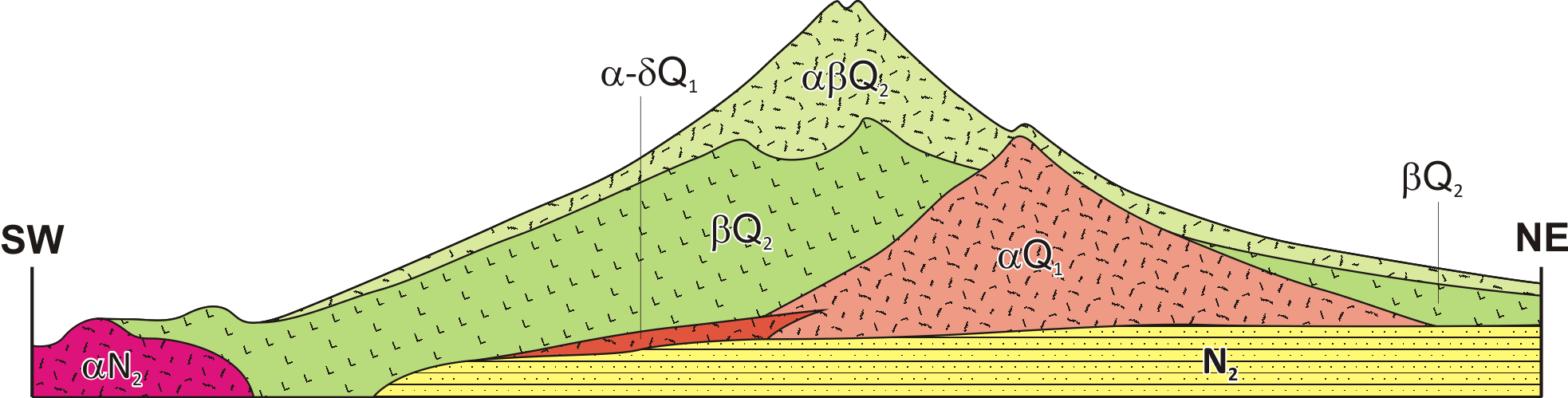
Stratovolcanoes are the postcard cones: steep, symmetrical, beautiful and dangerous. They are built of alternating layers of viscous lava that could not flow far and fragmented ash from explosions. Fuji, Vesuvius, Mayon, Rainier, Kilimanjaro. The steepness itself is a warning sign — it means the lava was too stiff to run away, which means the gas could not escape either.
Calderas are what is left when the magma chamber empties faster than it can be refilled and the roof collapses into the void. These are the giants. The Yellowstone caldera is roughly 55 by 72 kilometres, and Toba in Sumatra is about 100 by 30 kilometres — you do not recognise them as volcanoes on the ground because you are standing inside them.
Flood basalts are not mountains at all. They are eruptions so vast that lava simply floods across a region in sheet after sheet, over hundreds of thousands of years, from long fissures rather than a central vent. The Deccan Traps in western India are one of the largest on Earth — originally perhaps 1.5 million cubic kilometres of basalt covering much of what is now Maharashtra, Madhya Pradesh and Gujarat, erupted around 66 million years ago. Chapter 1.10 returns to that date, which is not a coincidence.
What actually kills people
Lava is the least of it. It is slow, visible, and avoidable. Lava destroys property and almost never takes lives.
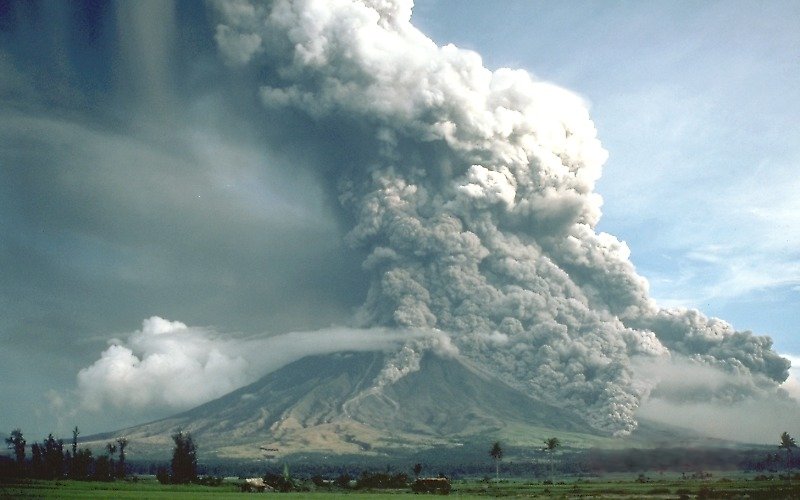
Pyroclastic flows are the main killer. A pyroclastic flow is an avalanche of hot gas, ash and rock fragments, at 200 to 700 °C, moving at 100 to 700 kilometres per hour. It hugs the ground, it is denser than air, and it flows downhill filling valleys. There is no outrunning it and there is no sheltering from it in an ordinary building. This is what killed Saint-Pierre in 1902 and what killed Pompeii and Herculaneum in 79 CE.
The bodies at Herculaneum tell you exactly how fast it is. They were found in poses of ordinary activity, not flight, and analysis of the bones shows exposure to around 500 °C — hot enough to cause instant death and to vaporise soft tissue. The Pompeii casts, made by pouring plaster into the voids that decayed bodies left in the ash, come from a later, cooler phase of the same eruption.
Lahars are the second killer, and the most preventable. A lahar is a mudflow of volcanic ash mixed with water — from melted snow and ice on the summit, from a crater lake, or from heavy rain on fresh ash. It has the consistency of wet concrete and it moves down river valleys, sometimes tens of kilometres from the volcano, hours after the eruption. Nevado del Ruiz in Colombia in 1985 killed about 23,000 people in the town of Armero, 50 kilometres from the volcano, and the eruption itself was small. Hazard maps existed. Warnings were issued. They were not acted on decisively.
Ash is the third. Volcanic ash is not soft — it is pulverised glass and rock, sharp and abrasive. Wet ash is extraordinarily heavy, and most deaths in ashfall are from roof collapse. It also destroys crops, contaminates water, ruins machinery, and melts inside jet engines: in 1982 a British Airways 747 flew into ash from Galunggung in Indonesia at night, all four engines flamed out, and the aircraft glided for sixteen minutes before the crew restarted three of them.
Gas is the quiet one. Carbon dioxide is heavier than air and pools in hollows. In 1986, Lake Nyos in Cameroon released a huge bubble of carbon dioxide that had accumulated in its depths from volcanic activity below. The gas flowed down the valleys and suffocated about 1,700 people and their livestock in their sleep. The lake is now fitted with pipes that vent it continuously.
Eruptions that changed history
Thera (Santorini), around 1600 BCE. One of the largest eruptions of the last ten thousand years, in the Aegean. It destroyed the Minoan settlement at Akrotiri, which was evacuated in time — no bodies have been found — and buried it under ash that preserved multi-storey buildings and wall paintings. Its role in the decline of Minoan Crete is argued but the destruction of Aegean shipping and farmland is not seriously doubted. It is also the leading candidate for whatever real event sits behind the Atlantis story.
Vesuvius, 79 CE. Pompeii and Herculaneum. What makes it exceptional is Pliny the Younger's eyewitness account, written to the historian Tacitus twenty-five years later — the first detailed scientific description of an eruption in existence. Explosive eruptions of that type are called Plinian in his honour. His uncle, Pliny the Elder, sailed toward the eruption to rescue people and died on the shore.
Laki, Iceland, 1783–84. An eight-month fissure eruption that released enormous quantities of sulphur dioxide and fluorine. In Iceland it killed around half the livestock and about a fifth of the human population through famine. The haze spread across Europe, the following winter was brutal, and crop failures in France in the mid-1780s are part of the background to the food crisis of 1789 — a thread Chapter 10.3 picks up.
Tambora, Indonesia, 1815. The largest eruption in recorded history, magnitude 7 on the Volcanic Explosivity Index, ejecting on the order of 150 cubic kilometres of material. Around 10,000 died directly and perhaps 70,000 to 90,000 in the famine and disease that followed in the region. The sulphur it injected into the stratosphere caused 1816 to be called "the year without a summer" — snow in June in New England, harvest failure across Europe, food riots, a typhus epidemic, and the wet Swiss holiday that produced Frankenstein. It is also probably implicated in the cholera outbreak that began in Bengal in 1817 and became the first global cholera pandemic, since the abnormal weather disturbed the Bay of Bengal ecosystem where the bacterium lives.
Krakatoa, 1883. Smaller than Tambora but far better documented, because by then there were telegraph cables. The explosion was heard 4,800 kilometres away in Rodrigues near Mauritius — the loudest sound in recorded history — and the pressure wave circled the globe several times, registering on barometers everywhere. Most of the roughly 36,000 deaths were from the tsunamis, not the eruption.
Pinatubo, Philippines, 1991. Important because it is the success story. Volcanologists read the warning signs, issued escalating alerts, and the evacuation of tens of thousands of people plus the US airbase almost certainly saved tens of thousands of lives. It also cooled global average temperature by roughly 0.5 °C for about two years, which gave climate scientists a full-scale natural experiment against which to test their models — and the models predicted it correctly, which is a piece of evidence Part 14 uses.
How sulphur cools the planet
This is the mechanism behind the year without a summer, and it is worth understanding precisely.
An eruption large enough to punch into the stratosphere — the stable layer above about 12 kilometres where there is no weather — injects sulphur dioxide there. In the stratosphere the sulphur dioxide reacts to form tiny droplets of sulphuric acid, and because that layer has no rain and very little vertical mixing, the droplets stay up for one to three years. They reflect incoming sunlight back to space while letting the Earth's outgoing heat pass, so the surface cools.
Ash, by contrast, falls out within weeks and does almost nothing to climate. It is the sulphur that matters, not the ash, which is why the size of an eruption's climate effect depends on its sulphur content and how high it threw it, not on how much rock it moved.
Monitoring, and what can be forecast
Volcanoes are far more predictable than earthquakes, and the reason is that magma has to physically move before it erupts, which announces itself.
Earthquake swarms. Magma cracking rock as it rises makes many small earthquakes. A characteristic continuous tremor often means fluid is moving.
Ground deformation. The volcano visibly swells as the chamber fills. Tiltmeters, GPS and satellite radar interferometry — which compares radar images taken at different times to detect ground movement of a few millimetres — measure it.
Gas emissions. Sulphur dioxide output rising sharply means fresh magma is close to the surface.
Heat. Thermal satellite imagery sees new hot ground and lava lakes.
These worked at Pinatubo, and the record of successful evacuations since is good. What cannot be done is name the day, the size or the style in advance. So volcanology deals in alert levels and exclusion zones rather than predictions, and the recurring failure is not scientific but political — evacuations are expensive and unpopular, and Armero is the standing example of what it costs to hesitate.
Supervolcanoes — Yellowstone, Toba, Campi Flegrei near Naples — attract a great deal of alarmed nonsense. The honest position: eruptions of that scale happen on average every 50,000 to 100,000 years somewhere on Earth, there is no evidence any of them is close to erupting, and none of them is "overdue", because volcanoes do not run on a schedule. If one did erupt the global consequences would be severe, and monitoring is good enough to give years of warning.
Where this shows up in your life
Volcanic soil is the best farmland on Earth. Volcanic ash weathers into soils extremely rich in potassium, phosphorus and trace minerals, which is why Java supports over 150 million people at some of the highest rural population densities anywhere, directly on top of a chain of active volcanoes. People do not live there despite the volcano. They live there because of it. The same is true of the Deccan's black cotton soil in India, of the slopes of Vesuvius and Etna, and of the coffee highlands of Central America and Ethiopia.
Geothermal energy. Iceland heats roughly nine out of ten of its buildings with volcanic heat and generates a large share of its electricity from it. Kenya draws around 40 percent of its electricity from the East African Rift. India has identified geothermal potential in Ladakh's Puga valley and along the Himalayan front, though little of it is developed.
And the atmosphere you are breathing. All of the Earth's original air and water came out of volcanoes as the interior degassed. Volcanoes built the ocean and the sky, and they are still adding to both, one eruption at a time.
What the next page covers
Subduction makes volcanoes when ocean floor goes down. When two continents meet, nothing goes down, and the crust has only one place left to go. Chapter 1.8 covers mountains — how a range is actually built, why the Himalaya is where it is, why it is still growing, why the Tibetan Plateau exists at all, and how a mountain range 2,400 kilometres long ended up controlling the rainfall, agriculture and history of a fifth of humanity.