Appearance
1.4 — Minerals, Rocks and the Rock Cycle
Pick up a handful of sand from any beach in the world and most of the grains will be the same mineral: quartz. Not because quartz was especially abundant in the rock that the sand came from, but because quartz is the survivor. Every other common mineral in a granite cliff either dissolves in rainwater, rots chemically into clay, or splits along its own internal weaknesses and grinds itself to dust. Quartz does none of those things. It has no easy cleavage planes, it is hard enough to scratch steel, and it is chemically almost inert.
So a beach is not a sample of the rock it came from. It is what was left after everything weaker was destroyed. Understanding why requires knowing what a mineral is, and that is where this page starts.
Mineral, rock, and the difference
A mineral is a naturally occurring solid with a definite chemical composition and an orderly internal arrangement of atoms — a crystal structure. Quartz is silicon dioxide with its atoms in a specific repeating lattice, everywhere, always. Table salt is a mineral. So is ice, technically.
A rock is an aggregate of mineral grains stuck together. Granite is a rock made of quartz plus feldspar plus mica, visibly speckled because you are looking at the individual crystals. Rock has no fixed formula. One granite differs from another.
Eight elements make up about 98 percent of the Earth's crust by weight, and the top two dominate everything:
| Element | Percent by weight |
|---|---|
| Oxygen | 46.6 |
| Silicon | 27.7 |
| Aluminium | 8.1 |
| Iron | 5.0 |
| Calcium | 3.6 |
| Sodium | 2.8 |
| Potassium | 2.6 |
| Magnesium | 2.1 |
Oxygen and silicon together are nearly three-quarters, and oxygen is even more dominant by volume because the oxygen ion is large and the silicon ion is small. Crush the crust down to its geometry and it is mostly a packing of oxygen atoms with small cations tucked into the gaps.
Why silicate minerals rule, and what the shapes mean
Silicon bonds with four oxygen atoms arranged at the corners of a tetrahedron — a four-faced pyramid, with silicon at the centre. This unit, written \mathrm{SiO_4}, is the building block of nearly every rock-forming mineral, and the entire variety of the crust comes from how many corners neighbouring tetrahedra share.
- Share none (isolated tetrahedra, held together by metal ions in between): olivine, the green mineral that makes up most of the upper mantle.
- Share two corners in a chain: the pyroxenes.
- Share corners in double chains: the amphiboles, including hornblende.
- Share three corners in sheets: the micas and the clays. Sheets slide over each other, which is why mica peels into flakes and why wet clay is slippery.
- Share all four corners in a rigid three-dimensional framework: quartz and the feldspars.
Read that list again and the beach makes sense. The more corners are shared, the more of the structure is strong silicon-oxygen bonding and the less of it is weaker metal-oxygen bonding that water can attack. Olivine, at the bottom of the list, weathers fastest. Quartz, at the top, is a continuous three-dimensional net of the strongest bond available, with no plane of weakness anywhere. It survives.
And the same list explains hardness. Diamond tops the Mohs hardness scale not because carbon is special but because every carbon atom is bonded to four others in a rigid framework, and scratching means breaking those bonds. Talc sits at the bottom because it is sheets held to each other by almost nothing.
Igneous rock: frozen melt
Three great families of rock, defined by how they formed. The first is igneous, from the Latin for fire: rock that crystallised out of molten material.
The composition depends on where the melt came from, and the texture depends on how fast it cooled. Those two facts, held separately, let you read almost any igneous rock.
Texture first, because it is the easier one. Magma cooling slowly deep underground gives the atoms time to migrate and build large crystals, so you get visibly grainy rock — granite, gabbro. Magma erupted at the surface as lava loses its heat in days and the crystals have no time to grow, so you get fine-grained rock where individual grains are invisible — basalt, rhyolite. Lava quenched instantly, for example into seawater, does not crystallise at all and becomes natural glass: obsidian. Same chemistry, different cooling speed, completely different-looking rock. Sometimes you see both in one specimen — large crystals that grew slowly at depth, sitting in a fine matrix that froze fast after eruption, which tells you the magma sat in a chamber and then erupted.
Composition second. Melts rich in silica are stiff, sticky and light-coloured, because all those linked tetrahedra make the liquid viscous even when molten. Melts poor in silica and rich in iron and magnesium are runny and dark.
| Type | Silica | Colour | Underground version | Erupted version |
|---|---|---|---|---|
| Felsic | High (~70%) | Pale | Granite | Rhyolite |
| Intermediate | Medium | Grey | Diorite | Andesite |
| Mafic | Low (~50%) | Dark | Gabbro | Basalt |
Continents are made of the felsic end; ocean floor is made of basalt. That is the density difference from Chapter 1.3, and it is why continents float higher. It is also, as Chapter 1.7 shows, the difference between a volcano that oozes and a volcano that explodes — sticky silica-rich magma traps gas until it lets go all at once.

Bowen's series explains something the Earth would otherwise not have: how you get granite out of a mantle that is not granite. A cooling magma does not solidify all at once. High-temperature minerals crystallise first, and if those crystals sink out or the remaining liquid is squeezed away, the leftover melt is now different from what you started with — poorer in iron and magnesium, richer in silica. Repeat that over and over across billions of years and you progressively concentrate the light, silica-rich material at the top of the planet. This is where continents came from. They are the distilled scum of a planet that has been partially melting and re-melting itself since it formed, and once at the top they are too buoyant ever to be pushed back down. That is why continental crust is billions of years old and ocean crust is never older than 200 million.
Sedimentary rock: the archive
The surface of the Earth destroys rock, and the debris settles somewhere. That is the second family.
Weathering has two halves. Physical weathering breaks rock into pieces without changing its chemistry: water freezing in cracks and expanding by 9 percent, roots prying joints apart, day-night heating and cooling, salt crystals growing in pores. Chemical weathering attacks the minerals themselves. Rain is slightly acidic because carbon dioxide dissolves in it to form carbonic acid, and that acid reacts with feldspar to make clay while dissolving away the potassium and sodium. This second process is the one that matters for the beach: it destroys feldspar and leaves quartz behind.
Chemical weathering also runs the planet's thermostat, and it is worth stating here because Part 14 needs it. The reaction of carbonic acid with silicate rock consumes carbon dioxide and locks it into dissolved ions, which rivers carry to the sea, where sea creatures build them into carbonate shells that end up as limestone. Warmer and wetter means faster weathering means faster removal of carbon dioxide from the air, which cools the planet. It is a genuine negative feedback loop, it operates over hundreds of thousands of years, and it is why the Earth's climate has stayed within liveable bounds for billions of years. It is also far too slow to help with anything happening this century.
Then the debris is transported and sorted. Moving water carries what it has energy to carry; as it slows, it drops the biggest particles first. This is why a mountain stream bed is boulders, a lowland river is sand, and a lake bottom is mud. The sorting is information: a sandstone made of well-rounded, well-sorted grains has been transported a long way; an angular, badly sorted deposit was dumped near its source, which is what a glacier does.
Sedimentary rocks come in three kinds. Clastic rocks are made of broken fragments — conglomerate, sandstone, siltstone, shale, in order of decreasing grain size. Chemical rocks precipitate out of water — rock salt and gypsum from evaporating seas, some limestones. Organic rocks are made from the remains of living things — most limestone is shell and coral debris, chalk is microscopic algal plates, and coal is compressed plant matter.
Only sedimentary rock contains fossils, because it is the only kind that forms at low enough temperature to leave a body intact. Everything in Chapter 1.1 about reading the past out of layers applies specifically here.
Metamorphic rock: cooked and squeezed
The third family. Take an existing rock, subject it to heat or pressure or both, but not enough to melt it, and its minerals rearrange themselves into new minerals that are stable under the new conditions. The rock stays solid throughout. That is metamorphism.
Pressure that is equal from all sides just compacts. Pressure that is stronger in one direction does something visually striking: platy minerals like mica grow with their flat faces perpendicular to the squeeze, so the rock develops a layered fabric called foliation and splits along it. Slate splits into roofing tiles for exactly this reason, and the splitting planes have nothing to do with the original sedimentary layers.
The classic sequence, as conditions intensify:
| Original rock | Becomes | Then | Then |
|---|---|---|---|
| Shale | Slate | Schist | Gneiss |
| Limestone | Marble | — | — |
| Sandstone | Quartzite | — | — |
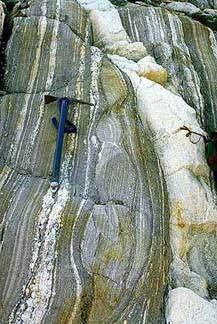
Marble and quartzite do not develop bands, because calcite and quartz crystals are blocky rather than platy and have no preferred direction to line up in. That is why marble is carved rather than split, and why sculptors have used it for three thousand years.
Metamorphic minerals are a pressure-temperature gauge. Certain minerals only form in narrow windows of depth and heat — kyanite, sillimanite and andalusite all have the identical chemical formula but different crystal structures, each stable in a different window. Find one in a rock and you know how deep it was buried and how hot it got. This is how geologists reconstruct a mountain range that has been entirely eroded away: the rocks left at the surface record the depth they were once at, so you can calculate how many kilometres of overlying material have since been removed. It is the technique that shows the Appalachians in North America were once Himalayan in scale.
The cycle

Read the arrows and the whole system falls out. Magma cools into igneous rock. Igneous rock weathers into sediment, which compacts into sedimentary rock. Bury sedimentary rock deep enough and it becomes metamorphic. Push metamorphic rock deeper still and it melts back into magma. But the shortcuts are as important as the main loop — metamorphic rock exposed at the surface weathers straight into sediment, sedimentary rock can be melted directly, igneous rock can be metamorphosed without ever becoming sediment.
The engine driving the whole thing is the mantle flow of Chapter 1.3. Plate movement is what buries rock deep enough to metamorphose, what drags ocean floor down to melt, and what raises mountains for the weather to attack. That is the next page.
Where this shows up in your life
The building you are in. Concrete is limestone burned to make cement, plus sand and gravel. Bricks are fired clay, which is weathered feldspar. Window glass is melted quartz sand. Steel reinforcement is iron from banded iron formations — sedimentary rocks laid down over two billion years ago when the first oxygen produced by early life reacted with iron dissolved in the oceans and precipitated it onto the sea floor. Almost every hard object around you was assembled from the rock cycle.
Soil, and therefore food. Soil is weathered rock plus organic matter, and its fertility depends heavily on the parent rock. The black soil of the Deccan plateau in India is weathered basalt from the vast lava eruptions of 66 million years ago, and it holds moisture exceptionally well, which is why it grows cotton. The alluvial plains of the Ganges are ground-up Himalaya, delivered by rivers, and they are among the most fertile land on Earth. The geology of a region decides what can be grown there, which decides how many people can live there, which decides where the cities and the empires ended up. Chapter 6.1 uses precisely this to explain the shape of Indian history.
Groundwater. Whether a well works depends on whether the rock beneath holds and transmits water. Sandstone and limestone can be excellent aquifers; solid granite is nearly useless. This is why some villages have year-round wells and villages fifty kilometres away go dry every summer.
What the next page covers
We have the ingredients and the recycling machinery, but not the engine. Chapter 1.5 covers plate tectonics — a theory that was proposed in 1912, ridiculed for fifty years, and then confirmed so overwhelmingly in the 1960s that the whole of Earth science was rewritten in a decade. It is the single idea that ties earthquakes, volcanoes, mountains, ocean basins and the distribution of fossils into one mechanism.