Appearance
6.7 — The Southern Kingdoms: Pallava, Chalukya, Rashtrakuta, Chola
At Ellora in Maharashtra there is a Shiva temple called Kailasanatha. It has a courtyard, a gateway, a main shrine with a tower nearly 30 metres high, subsidiary shrines, elephants and columns, and it looks like a normal large temple.
It is not built. It is carved. The whole structure was cut downward and inward out of a single basalt hillside — the workers began at the top and removed rock until the temple was left standing inside the hole. Around 200,000 tonnes of rock were excavated, and there is no possibility of correcting a mistake, because you cannot put stone back.
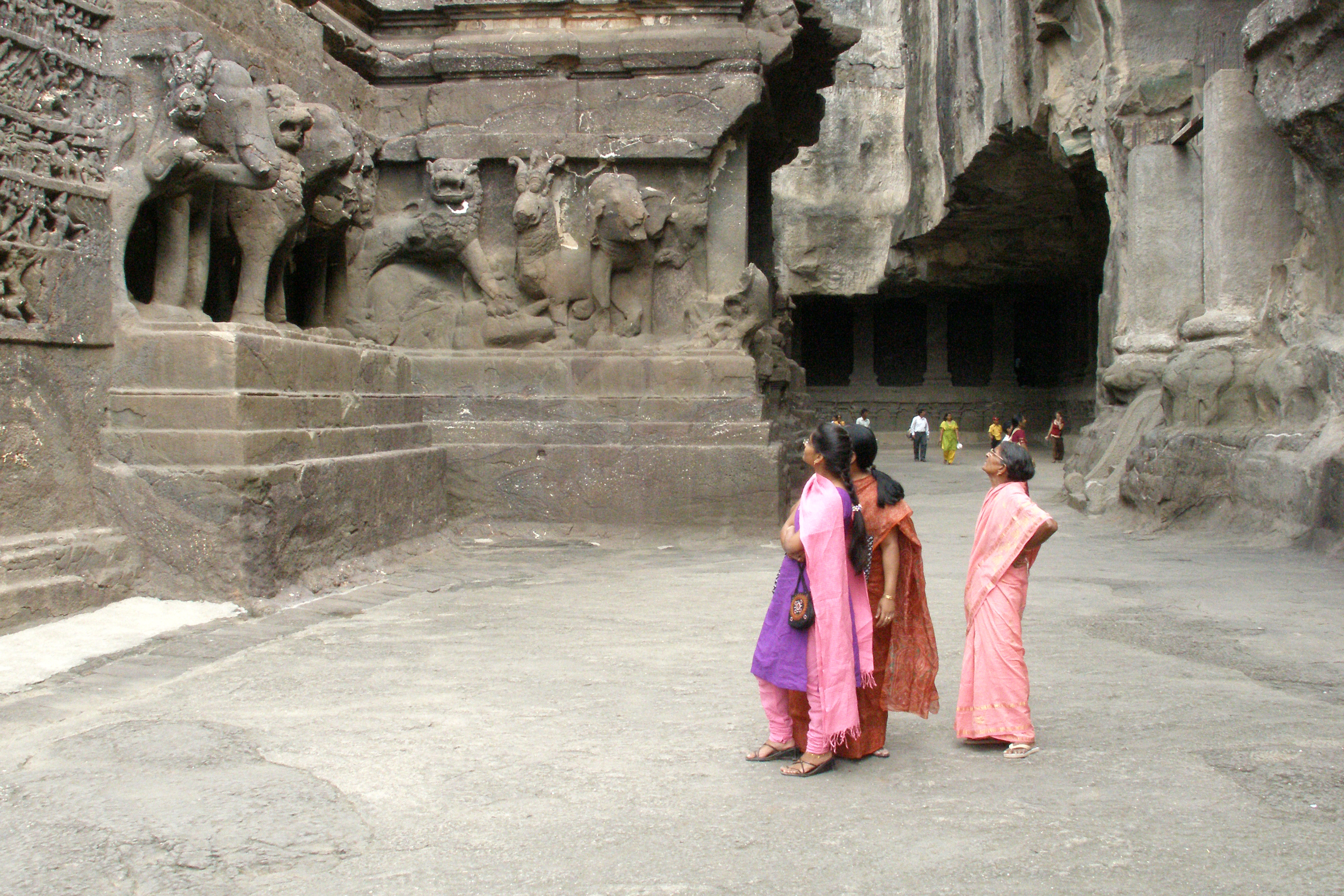
This chapter is about the powers that built things like that, and about the one that built a maritime empire while it was at it.
Why the south was different
Chapter 6.1 gave the geography. The peninsula is hills, plateau and river valleys, so power fragments into several durable regional kingdoms rather than one large plain empire. It is drier than the Ganges basin except in the deltas, so the surplus is smaller. And it faces two seas, so its outward orientation is maritime rather than continental.
The consequence is a different rhythm of history. Where the north had large empires punctuated by fragmentation and invasion through the northwest passes, the south had several substantial kingdoms coexisting and fighting each other over the same contested zones for centuries, with no successful invasion from outside until the fourteenth century.
The Pallavas and the invention of the southern temple
The Pallavas ruled from Kanchipuram in northern Tamil Nadu from around the third to the ninth century, and their contribution is architectural and it is foundational.
Southern temples had been built in wood and brick. The Pallavas moved to stone, and they did it in stages that are still visible at Mahabalipuram on the coast: first caves cut into rock, then free-standing temples carved out of single boulders — the so-called rathas, each a different architectural form — then structural temples assembled from cut stone.
The Shore Temple at Mahabalipuram, around 700 CE, is one of the earliest free-standing stone temples in southern India, and the rock relief there called Arjuna's Penance or the Descent of the Ganges is among the largest bas-reliefs in the world, with a natural cleft in the rock used as the river down which the scene organises itself.
The Pallavas also mattered for the transmission to Southeast Asia. Their script, Pallava Grantha, is the direct ancestor of the writing systems of Thailand, Cambodia, Java, Bali and Burma (Chapter 3.11), carried by traders and Brahmins, and their temple forms influenced the architecture that led eventually to Angkor.
The Deccan rivalry: Chalukyas and Rashtrakutas
The Chalukyas of Badami ruled much of the Deccan from the sixth to the eighth century, and their sites at Badami, Aihole and Pattadakal are essentially an architectural laboratory — northern and southern temple styles built side by side, in a period when the conventions were still being worked out. Aihole has been called a textbook of temple architecture for exactly that reason.
The Rashtrakutas replaced them from the eighth to the tenth century and were, for a period, the most powerful state in India — intervening in the north repeatedly, taking Kannauj, and receiving an Arab traveller's description as one of the four great kings of the world alongside the Caliph, the Byzantine emperor and the emperor of China.
They built Ellora, including the Kailasa temple above and the extraordinary Buddhist, Hindu and Jain cave complexes alongside each other on the same hillside — which is itself worth noticing, since it means three traditions were being patronised in the same place at the same time.
And the three-way struggle for Kannauj — between the Rashtrakutas from the Deccan, the Pratiharas from western India and the Palas from Bengal, through the eighth and ninth centuries — is a good illustration of Chapter 6.8's point: the political energy of India in this period went into fighting over the north Indian centre, and the northwest frontier was nobody's priority.
The Palas, incidentally, were Buddhist, and they sustained Nalanda and founded Vikramashila. Buddhism's last major royal patronage in India is theirs, and when it ended, Buddhism in India had lost its institutional base.
The Cholas
The Cholas are one of the most impressive states in Indian history and are systematically underweighted in Indian education. They ruled the Kaveri delta and far beyond from around 850 to 1279 CE.
The Kaveri delta is the material basis. It is a rich, well-watered rice region — the south's answer to the Ganges — and the Cholas invested heavily in irrigation, including the Grand Anicut, a dam across the Kaveri originally built by an earlier Chola king around the second century CE and still functioning after nearly two thousand years of use and modification. It is among the oldest water-diversion structures anywhere still in service.
The temple

The Brihadisvara temple is not merely large. Its inscriptions, carved around the base, are one of the best economic records of any medieval society anywhere: they list every endowment, every grant of land and cattle, every donor, and the names, roles and salaries of the several hundred people employed by the temple — priests, accountants, musicians, dancers, garland-makers, watchmen, lamp-lighters.
The temple was an economic institution. It owned land, employed people, lent money, stored grain, ran schools and hospitals, and was the largest concentration of capital in the region. Understanding medieval South Indian economy means reading temple inscriptions, and there are tens of thousands of them.
Village self-government
This is the Chola achievement that deserves the most attention and gets the least.
Inscriptions at Uttaramerur, from the tenth century, describe in detail the procedure for electing a village assembly, and it is startlingly specific.
The village was divided into wards. Candidates had to meet qualifications: owning a stated minimum of taxable land, living in a house on their own site, being between certain ages, having knowledge of the Vedas or of administration. Disqualifications are listed too — anyone who had served on a committee and not submitted accounts, and their relatives, were barred; so were those guilty of certain offences.
Selection was by lot from among the qualified. Names were written on palm-leaf tickets, placed in a pot, and drawn by a young boy in full public assembly. This is the same reasoning as Athenian sortition (Chapter 5.1), arrived at independently.
Elected members served on committees — for the tank and irrigation, for gardens, for gold, for justice, for the annual accounts — with one-year terms and accountability requirements.
Two honest qualifications. The property and learning requirements meant this was self-government by the landholding upper strata, not by everyone. And how consistently the written procedure was followed is unknown. What is documented is that a detailed, audited, lot-based local electoral system was written into stone in tenth-century Tamil Nadu, and that similar assemblies operated widely.
The navy, and the invasion of Southeast Asia
Almost no Indian dynasty built a serious navy (Chapter 6.1). The Cholas did, and they used it.
Rajendra Chola I sent an expedition around 1025 CE against Srivijaya, the Malay-Sumatran maritime power that controlled the Strait of Malacca and taxed the China trade. Chola inscriptions list the ports captured across the Malay peninsula and Sumatra.
The motive was commercial. Srivijaya sat on the chokepoint between the Indian Ocean and the South China Sea and extracted from everyone passing. The Cholas broke that control, and trade with Song China expanded substantially afterwards — Chola embassies to China are recorded in Chinese sources.
They also took northern Sri Lanka and held it for decades, and campaigned north to the Ganges, from which Rajendra took the title Gangaikonda — he who took the Ganges — and built a new capital named after it.
This is the only sustained naval power projection by an Indian state before the modern era, and it is worth asking why it was not repeated. The answer is partly that the Cholas declined and no successor had both the delta's wealth and the maritime orientation, and partly the structural point in Chapter 6.1: Indian states treated the sea as commerce rather than as strategy.
The bronzes

Chola bronzes are made by the lost-wax process: a wax model is made in full detail, coated in clay, heated so the wax runs out, and molten metal poured into the void. The mould is broken to release the casting, so every piece is unique and there is no second attempt.
They are among the finest metal sculptures produced anywhere, and they were made as functional objects — processional images carried out of the temple on festival days, which is why they have lugs for poles.
Why this matters for how Indian history is taught
The southern kingdoms are usually compressed into a few paragraphs between the Guptas and the Sultanate, and the reasons are worth naming.
The sources are in Tamil, Kannada and Telugu, and colonial-era and early nationalist historiography was built by scholars working in Sanskrit and Persian.
The narrative frame is Delhi-centred. Indian history is often taught as a sequence of powers that held the north Indian centre, which makes the south a permanent side-story.
And the south does not fit the standard periodisation. The categories "ancient", "medieval" and "modern", borrowed from European history and applied via the arrival of Islam, do not describe the south's trajectory at all.
The result is that a student can complete a full Indian history syllabus knowing about Ashoka and Akbar and not knowing that an Indian navy conquered part of Sumatra, or that tenth-century villages elected committees by lot with published audit rules.
Where this shows up in your life
Every large South Indian temple is in a tradition the Pallavas started and the Cholas perfected, and the temple towns — Madurai, Thanjavur, Srirangam, Chidambaram — are still organised around them.
Bharatanatyam and Carnatic music have their institutional roots in temple patronage of this period.
Southeast Asia's Indian layer — the scripts, the epics, Angkor, Borobudur, the Ramayana in Thai and Javanese versions — comes substantially through this southern maritime connection.
And the Grand Anicut still irrigates the Kaveri delta, which means an engineering work commissioned before the fall of Rome is still feeding people.
What the next page covers
While the south built temples and navies, the north spent the seventh to twelfth centuries in a long three-way and then many-way struggle that left it politically fragmented — and it was in exactly that condition when armies began coming through the northwestern passes again. Chapter 6.8 covers Harsha, the Rajput kingdoms, the Pratihara-Pala-Rashtrakuta struggle, the decline of Buddhism in India, and the specific political condition of the north on the eve of the invasions. It is the setup for the chapter that follows it.