Appearance
6.21 — Gandhi: The Complete Record
On 6 April 1930, at Dandi on the Gujarat coast, after walking 385 kilometres over 24 days, Mohandas Gandhi picked up a lump of natural salt from the beach and held it up.
It was a crime. The salt laws made it illegal for an Indian to produce salt, so that everyone had to buy government salt and pay the tax on it. The tax was small. That was the point. He had chosen the one law that touched every single person in India, that was indefensible on any moral ground, and that could be broken by anyone with a hand and a beach.
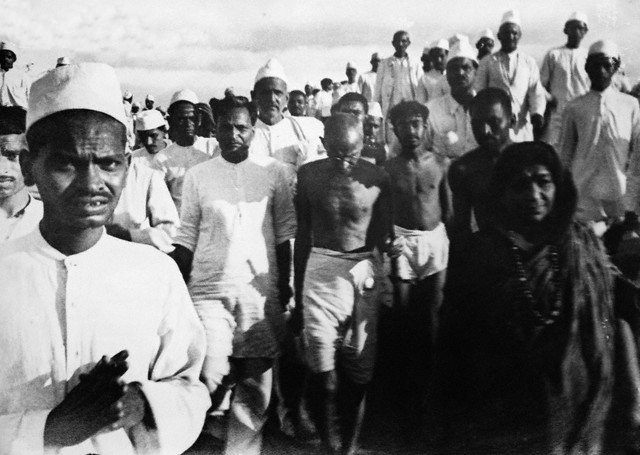
This chapter covers what he did, how the method worked, and the full set of serious criticisms — including the ones that are strongest and least often stated plainly. It is written on the documented record, which includes his own published writings, running to about a hundred volumes, in which he recorded his failures and his experiments in unusual detail.
South Africa: where the method was built
He arrived in Durban in 1893, aged 23, as a lawyer on a one-year contract, and stayed 21 years.
The famous incident — being thrown off a train at Pietermaritzburg for refusing to leave a first-class carriage — is real and is in his autobiography, and it is the standard origin story.
What he actually built there was a technique. Between 1906 and 1914 he organised Indian resistance to registration laws, a poll tax and the invalidation of non-Christian marriages, using mass refusal to comply, deliberate courting of arrest, and public suffering rather than retaliation. He coined satyagraha — from satya, truth, and agraha, holding firmly — because he disliked "passive resistance", which suggested weakness.
The race question, stated fully
This is the criticism that has grown most in the last two decades and it needs to be given its full weight rather than a footnote.
In his early South African years Gandhi campaigned for Indian rights specifically, and he did so partly by distinguishing Indians from black Africans. The documented record includes: use of the word "kaffir", a slur, in his writings of that period; a complaint in 1904 that Indians were being made to live in locations alongside Africans; and arguments to the authorities that Indians, as British subjects and as a civilised people, deserved better treatment than they were receiving.
These are his own published words in his own collected works. They are not fabrications by opponents and they are not quoted out of context in a way that changes their meaning.
Two things can be said in explanation, and neither is a defence. His campaigns were legally framed around the rights of British Indian subjects, which was the only legal claim available. And his views changed substantially over his life — his later writings on race, his correspondence with African-American leaders, and his influence on the American civil rights movement and on the South African liberation struggle are equally documented.
The honest statement: a man who arrived with the prejudices of his class and his era, who expressed them in print, who later changed, and whose early statements are being reassessed publicly — which is what happened when students at the University of Ghana campaigned successfully in 2018 to have his statue removed. Both the early record and the later change are facts, and a portrait containing only one of them is incomplete.
The Indian campaigns, and what each achieved
He returned to India in 1915 and, on Gokhale's advice, spent a year travelling the country before entering politics.
Champaran, 1917. Indigo cultivators in Bihar were forced by European planters to grow indigo on a fixed share of their land on ruinous terms. Gandhi went, was ordered to leave, refused, was arrested, and the case was dropped because the government did not want the publicity. He then organised a systematic survey of grievances, gave evidence to an official inquiry, and the tinkathia system was abolished. This is the model: local, specific, winnable, documented.
Kheda, 1918. A crop failure, and the government refused to suspend revenue collection. A no-tax campaign forced a partial suspension.
Ahmedabad, 1918. A millworkers' dispute in which he undertook his first fast in India, and the workers got an arbitrated settlement.
Rowlatt satyagraha, 1919. His first all-India campaign, against the detention-without-trial law (Chapter 6.20). It included a general hartal — a shutdown — across the country. It also produced violence in places, and he called it off, saying he had made a "Himalayan miscalculation" in launching mass civil disobedience among people not trained in non-violence.
And then Jallianwala Bagh.
Amritsar, 13 April 1919
A crowd of several thousand — including families, since it was Baisakhi — gathered in an enclosed garden with narrow entrances, in defiance of a ban on assembly that many present had not heard.
Brigadier General Reginald Dyer arrived with 50 riflemen, blocked the main exit, gave no warning, and ordered fire. The firing continued for about ten minutes, around 1,650 rounds, until ammunition ran low. Dyer's own testimony to the subsequent inquiry stated that he fired to produce a moral effect throughout the Punjab, and that he would have used machine guns had the armoured cars been able to enter through the narrow entrance.
The official inquiry put the dead at 379. The Indian National Congress inquiry put it above 1,000. Hundreds more were wounded, and the exits were blocked; many died in the well in the garden trying to escape.
Dyer was relieved of command and censured. And a fund raised for him by public subscription in Britain, promoted by a national newspaper, collected around £26,000 — a very large sum — and the House of Lords passed a motion in his support. That combination is what convinced a great many Indians that the British public, not merely its officials, was the problem.

Tagore renounced his knighthood in protest. Gandhi, who had actively recruited Indians for the British army during the war, moved to full non-cooperation.
Non-Cooperation, 1920–22
The programme: boycott of legislatures, courts, schools and foreign cloth; surrender of titles and honours; promotion of hand-spinning; and the building of parallel Indian institutions.
It was the first genuinely national mass movement, and Congress was reorganised under Gandhi into a body with linguistic provincial committees, a mass membership at four annas a year, and a working committee — transforming a debating society into a political machine.
He also allied with the Khilafat movement — Indian Muslim agitation over the Ottoman Caliphate's fate after the First World War — which produced unprecedented Hindu-Muslim political unity.
Assessing that alliance honestly: it achieved real unity for two years and it tied Indian nationalism to a pan-Islamic religious cause that collapsed when Ataturk abolished the Caliphate himself in 1924. Critics, including Ambedkar and later historians, argued it legitimised religious identity as a basis for national politics, and that the unity did not survive its collapse. The Moplah rebellion in Malabar in 1921, which began as an anti-landlord and anti-British rising and included killings and forced conversions of Hindus, damaged the alliance badly.
Chauri Chaura, February 1922. A police party fired on demonstrators, the crowd chased them into the police station and burned it, killing 22 policemen. Gandhi called off the entire national movement.
This is one of the most criticised decisions of his career. The movement was at its peak; leaders including Nehru and Bose were in prison and furious; Congress opinion was largely against him. His position was that a movement that could not maintain non-violence would produce a free India that was violent, and that the discipline mattered more than the momentum. Whether that was principled leadership or a catastrophic loss of tempo is still argued, and this book does not resolve it.
He was then arrested, tried for sedition, and made a statement to the court accepting the maximum penalty, telling the judge that he must either resign his post or inflict the severest penalty if he believed the system he served was good. The judge sentenced him to six years and said he could not ignore that he was in a different category from anyone he had tried or was likely to try.
Salt, 1930, and Civil Disobedience
The Salt March, described above. Its genius was in the choice of target — universal, trivial in cost, indefensible in principle, and breakable by anyone.
The results. Around 60,000 to 90,000 arrests. Salt made illegally on every coast. Global press coverage that made the British position internationally embarrassing — the Time magazine cover, the newsreels, the American reporting.
And at Dharasana, in May 1930, the correspondent Webb Miller watched columns of volunteers walk forward to be beaten by police with steel-tipped lathes, without raising a hand, and carried away, followed by the next column. His dispatch was carried in over a thousand newspapers. That single report did more to delegitimise British rule internationally than any speech.
Gandhi-Irwin Pact, 1931. Civil disobedience suspended in exchange for release of prisoners, the right to make salt for domestic use, and Congress participation in the Round Table Conference in London. Critics including Bose and the revolutionaries regarded it as a poor bargain, and the Round Table Conference achieved nothing.
The criticisms, in full
This is the section the chapter exists for, and each item is stated at its strongest.
1. Bhagat Singh
Bhagat Singh, Sukhdev and Rajguru were hanged on 23 March 1931, days before the Karachi Congress session, and the Gandhi-Irwin Pact had been signed on 5 March without securing commutation.
The charge against Gandhi is that he did not try hard enough, or at all, to save them.
What the record shows. Gandhi did raise the question with Irwin, both in the negotiations and in a letter on the morning of the execution, and he asked for commutation. He did not make commutation a condition of the pact. He publicly and repeatedly condemned their method — Bhagat Singh and Batukeshwar Dutt had thrown bombs in the Central Legislative Assembly (deliberately in an empty area, and they had stayed to be arrested), and Bhagat Singh had shot a police officer in a case of mistaken identity while attempting to avenge Lala Lajpat Rai's death after a police lathi charge.
He also said, after the executions, that Bhagat Singh's bravery was beyond praise and that his method was wrong.
The honest assessment. He asked and did not insist. He had genuine leverage and chose not to spend it on this, because he judged the pact more important and because he did not want to appear to endorse political violence. Whether insistence would have worked is unknowable; that he did not insist is documented. It cost him enormously with a generation of young Indians, and it is one of the main reasons Bhagat Singh's popularity has grown rather than faded.
2. Caste, and the confrontation with Ambedkar
This is the most substantial criticism and it deserves the most space.
Gandhi opposed untouchability from early on, called untouchables Harijans, "children of God", campaigned for temple entry, and made the removal of untouchability part of the Congress programme.
Ambedkar rejected all of it, and his reasons were specific.
He rejected the name. Harijan was condescending — it made the community objects of upper-caste benevolence rather than agents with rights. His people called themselves Dalit, broken, which is a description of what was done to them.
He rejected the diagnosis. Gandhi held that untouchability was an excrescence on an essentially sound varna system, and that varna — the fourfold division by hereditary occupation — was a valid social principle if practised without hierarchy. Ambedkar held that varna was the disease and that untouchability was its symptom, and that a hereditary division of labour is inseparable from a hierarchy. He wrote Annihilation of Caste to say so, and Gandhi replied publicly defending the varna ideal.
He rejected the method. Gandhi wanted a change of heart among caste Hindus. Ambedkar wanted legal and political power in Dalit hands, on the grounds that no oppressed group in history has been freed by the goodwill of its oppressors.
The Poona Pact, 1932
The confrontation came to a head over representation.
The British Communal Award of 1932 granted separate electorates to the Depressed Classes — Dalits would vote in their own constituencies for their own representatives, as Muslims already did.
Ambedkar had argued for this and regarded it as essential: only representatives elected by Dalit voters alone would be answerable to Dalits, rather than to the caste Hindu majority in a general constituency.
Gandhi began a fast unto death in Yerwada jail against it. His stated reason was that separate electorates would divide Hindu society permanently, as they had divided Hindus from Muslims.
Ambedkar's position at the time, in his own account: he was being asked to give up the political security of his people to save the life of a man whose death would be blamed on him, and would trigger violent reprisals against Dalits across India.
He conceded. The Poona Pact replaced separate electorates with a larger number of seats reserved for Depressed Classes within general constituencies.
How to assess this. The reserved-seat mechanism in a joint electorate did avoid the divisive dynamic that separate electorates created between Hindus and Muslims (Chapter 6.20), and it is the system independent India adopted and still uses. And it means that Dalit representatives are elected primarily by non-Dalit voters in most constituencies, which is precisely the dependence Ambedkar warned about, and it is a live criticism of Indian reservation politics today.
Ambedkar's own summary, written later, was that the fast was a political manoeuvre using a life as leverage against people who had no comparable weapon. He never forgave it. In 1956 he converted to Buddhism with several hundred thousand followers (Chapter 6.8).
The plainest statement available: Gandhi worked against untouchability more than any other mainstream nationalist leader and did not accept the analysis of the people who suffered it, and when their political representative sought structural power, Gandhi used his own life to stop him.
3. The sexual experiments
In his last years, into his seventies, Gandhi slept naked beside young women — including his grand-niece Manu, then in her late teens — as a test of his own celibacy. He called these his brahmacharya experiments and believed that maintaining perfect self-control in that situation would perfect his spiritual power, which he connected to his ability to stop communal violence.
He wrote and spoke about them openly, which is why we know. Several of his closest associates objected strongly and some resigned over it, including his stenographer and a long-standing Bengali colleague.
This is not a smear and it is not disputed. The assessments differ: some regard it as an old man's eccentric spiritual practice, some as an abuse of authority over young women who could not meaningfully refuse a man of his stature in his own household. The second reading is a serious one and the power imbalance is real. His own writings record that at least some of the women found it distressing.
And there is a broader pattern in his family relations. His treatment of his eldest son Harilal, who was denied the education he wanted while his father sponsored others, who became an alcoholic and converted to Islam and back, and who died a few months after his father, is a genuine indictment. His wife Kasturba was frequently subordinated to his experiments and his causes, by his own account.
4. The economics
Gandhi's economic programme was the spinning wheel, village self-sufficiency, hand production and a rejection of industrial civilisation. Hind Swaraj, written in 1909, rejects railways, machinery, modern medicine and lawyers as instruments of enslavement.
The criticism is straightforward: it was not a programme for feeding, housing and employing hundreds of millions of people, and no country has ever raised living standards on hand production. Nehru disagreed with him on this explicitly and comprehensively, and independent India followed Nehru rather than Gandhi.
What can be said for it. The spinning wheel was extraordinarily effective as a political instrument — it gave every Indian a daily act of participation, it was a direct attack on the Lancashire textile interest, and it made self-reliance visible. As symbol and mobilisation it worked. As economics it did not, and Chapter 6.28 shows what India actually needed.
5. Did non-violence actually win independence?
The strongest structural criticism, and it must be taken seriously.
The case that it did not: Britain left in 1947 because it was bankrupt after the Second World War, because a Labour government had no appetite for holding India by force, because the United States pressed for decolonisation, and — critically — because the loyalty of the Indian armed forces and police could no longer be relied on.
The evidence for that last point is real. The Indian National Army trials in 1945–46 (Chapter 6.22) produced mass public sympathy including among serving soldiers, and the Royal Indian Navy mutiny of February 1946, in which around 20,000 ratings across 78 ships mutinied, was the moment several British officials identified as decisive. Clement Attlee, in a later conversation recorded by a Bengali chief justice, is reported to have said Gandhi's contribution was "minimal" and cited Bose and the erosion of army loyalty. The source is a single second-hand account and should be weighted accordingly, and it is consistent with the strategic assessments in the British archives, which repeatedly discuss the reliability of Indian forces.
The case that it did: the mass movements of 1920–22, 1930–34 and 1942 made India ungovernable by consent, which is the only affordable way to govern. They made British rule internationally indefensible at exactly the moment Britain needed American money and moral standing. And they created a nationwide political organisation capable of taking over a state, which is why the transfer of power went to Congress rather than to chaos.
The reasonable synthesis: the war bankrupted Britain and destroyed the reliability of its Indian forces, and the mass movement is why there was a legitimate national organisation to hand power to, why the demand could not be ignored, and why the cost of staying was politically unpayable. Neither factor alone gets you to 1947.
What he actually did that nobody else did
Turned nationalism into a mass movement. Before him it was lawyers and newspapers; after him it was villages, women, students and peasants. The scale change is his.
Made the movement's method its message. A campaign that refuses violence takes away the state's strongest instrument, because shooting unarmed people who do not fight back is politically catastrophic for the shooter. He understood this as a technique, wrote about it as a technique, and taught it as one.
Brought women into Indian public life at scale. The 1930 campaign involved women in enormous numbers, and it changed what was socially possible permanently.
And he was killed for his consistency. On 30 January 1948 he was shot by Nathuram Godse, a Hindu nationalist, because Gandhi had fasted to force the Indian government to pay Pakistan the 550 million rupees it was withholding after Partition, and because he was seen as too accommodating to Muslims. He had spent the months after Partition walking through riot-affected Bengal and Delhi, and Mountbatten's staff described his effect in Calcutta as achieving what a division of troops could not.
Where this shows up in your life
The method was exported and it worked. Martin Luther King Jr. studied it explicitly and applied it in the American civil rights movement; the anti-apartheid movement, the Solidarity movement in Poland, and numerous later campaigns drew on it. Political scientists Erica Chenoweth and Maria Stephan's dataset of resistance campaigns from 1900 to 2006 found that non-violent campaigns succeeded about twice as often as violent ones — which is empirical support for the technique, independent of any view of the man.
And the honest summary this chapter argues for: a political tactician of genuine originality who built the largest mass movement in history to that point; who held social views on caste that the people concerned rejected and were right to reject; who used his own life as a weapon in ways that were effective and coercive; whose private conduct toward women in his household would not survive modern scrutiny; whose economics were unworkable; and who was neither the sole author of Indian independence nor a bystander to it.
Calling him a saint is wrong. Calling him a fraud is also wrong, and it is wrong in a way that is easy to check — a fraud does not spend fifty years in prison and public poverty, refuse office when his party takes power, and die walking unarmed into a riot.
What the next page covers
There was another stream, and it did not agree with any of this. Chapter 6.22 covers the armed struggle — Bhagat Singh, who was a serious political thinker as well as a revolutionary and whose prison writings deserve reading; the Chittagong armoury raid; and Subhas Chandra Bose, who broke with Gandhi, escaped India under surveillance, sought help from Germany and Japan, raised an army of 40,000 from Indian prisoners of war, and whose trial in Delhi in 1945 did more to end British rule than any battle he fought.