Appearance
1.3 — Inside the Earth, and How We Know
The deepest hole human beings have ever drilled is the Kola Superdeep Borehole in Arctic Russia. It was started in 1970, it took nineteen years, and it reached 12.26 kilometres before the project gave up. At that depth the rock was around 180 °C — far hotter than the 100 °C the engineers had predicted — and hot rock behaves less like stone and more like putty, so the hole kept closing itself and the drill bit kept getting stuck.
The distance from the surface to the centre of the Earth is 6,371 kilometres. Kola got 0.2 percent of the way. Every deep-sea trench, every mine, every volcano's plumbing is a scratch on the paint.
So how do we know what is down there, in the detail this page is about to lay out? We listen to earthquakes.
The trick: earthquakes are free X-rays
When rock breaks somewhere in the crust, the shock spreads outward through the whole planet as waves. Those waves travel through the interior, bend, reflect, slow down, speed up and sometimes disappear entirely depending on what they pass through. Thousands of seismometers around the world record the exact arrival time of each wave. From the arrival times alone, you can reconstruct what the wave went through — exactly as a medical scan reconstructs the inside of a body from how signals pass through it.
Two kinds of wave travel through the deep Earth, and the difference between them is what cracked the problem open.
P-waves — "primary", because they arrive first — are compression waves. The rock is squeezed and stretched along the direction the wave is travelling, the same way sound moves through air. Sound passes through solids, liquids and gases, and so do P-waves.
S-waves — "secondary" — are shear waves. The rock is shaken sideways, across the direction of travel, like a rope flicked at one end. A shear wave needs the material to resist being twisted — it needs rigidity. Liquids have no rigidity at all. A liquid cannot carry an S-wave, full stop.
That single fact is the key to the Earth's interior.
The three discoveries
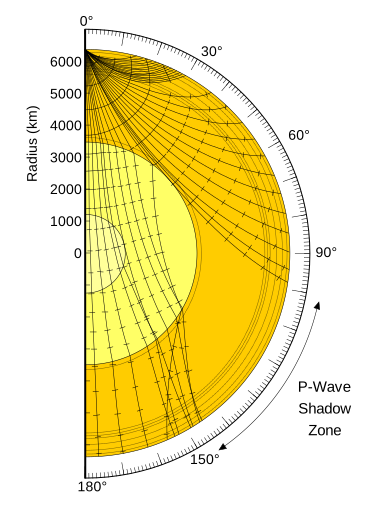
1906 — the core. The British geologist Richard Dixon Oldham noticed that P-waves arriving on the far side of the planet from an earthquake were late, and that in a band of the far side S-waves never arrived at all. Something in the middle was slowing P-waves and blocking S-waves entirely. In 1914 Beno Gutenberg pinned the boundary at 2,900 kilometres depth, which is still the accepted figure. The Earth has a core, and the core is liquid.
1909 — the crust. A Croatian seismologist, Andrija Mohorovičić, studying a local earthquake, found that stations beyond a certain distance received two separate P-wave arrivals. The explanation is that one wave travelled directly through the surface rock while a second dived into a deeper layer, travelled faster there, and came back up — overtaking the first, exactly as a car taking a motorway detour can beat a car going straight through town. A sudden jump in wave speed means a sudden change in rock. That boundary is now called the Mohorovičić discontinuity, or the Moho, and it is the base of the crust.
1936 — the inner core. A Danish seismologist named Inge Lehmann, working almost alone with data she filed in oatmeal boxes, noticed faint P-wave arrivals inside the region that was supposed to be a shadow. The only way to get waves there is for something deeper inside the liquid core to reflect them back out. She proposed a solid inner core inside the liquid outer core. She was right, it was confirmed decades later when better instrument networks could see the reflections clearly, and she published significant papers into her nineties.
Everything below is built on top of those three results, refined by a century of denser networks, and cross-checked against three completely independent lines of evidence: the total mass of the Earth (known from gravity), its moment of inertia (known from how it wobbles, which tells you how the mass is distributed rather than just how much there is), and laboratory experiments squeezing minerals to core pressures between diamond anvils to see what they turn into.
The layers, top to bottom

The crust — 0 to about 35 km, and it is not one thing
There are two kinds of crust and the difference between them governs the whole surface of the planet.
Continental crust is thick, old and light. It averages about 35 kilometres, thickening to 70 under the Himalaya. It is made mostly of granite-type rock with a density around 2.7 grams per cubic centimetre. Parts of it are extremely old — the Acasta Gneiss in Canada's Northwest Territories dates to about 4.03 billion years, and rocks in the Nuvvuagittuq belt in Quebec have been argued to be older still, though that date is contested.
Oceanic crust is thin, young and heavy. Typically 6 to 10 kilometres thick, made of basalt, density around 3.0. And nowhere on Earth is it older than about 200 million years, which is a startling fact when the planet is 4.5 billion years old, and Chapter 1.5 explains why: ocean floor is continuously made and continuously destroyed, while continents float permanently on top and cannot be pushed under.
Why light continents ride high is the same reason an iceberg does. The crust floats on the denser mantle beneath and sinks into it until it displaces its own weight. This is called isostasy. A thick block of light granite floats high and has a deep root; thin dense basalt floats low. That is the whole reason the Earth has continents standing above sea level and ocean basins below it, rather than one uniform surface — it is buoyancy, not any kind of upward push.
The mantle — 35 to 2,890 km, and it flows
The mantle is 84 percent of the Earth's volume. It is silicate rock rich in magnesium and iron, and its temperature runs from a few hundred degrees at the top to about 3,700 °C at the bottom.
It is solid, and it flows. Both are true and the apparent contradiction is the single most important idea in this Part. Mantle rock is crystalline solid — S-waves pass right through it, which they could not do through a liquid. But over millions of years, under enormous pressure and heat, the atoms in the crystals migrate slowly through defects, and the whole mass creeps. The everyday comparison is glass in a very old window, or the ice in a glacier: a glacier is unambiguously solid, you can walk on it, and it flows downhill at metres per year. Mantle rock flows at centimetres per year. That flow is what moves continents.
The mantle has internal structure, detected as sudden jumps in seismic wave speed at 410 km and 660 km depth. These are not changes of chemistry but changes of crystal packing: the mineral olivine collapses into denser arrangements when the pressure passes certain thresholds. The 660 km boundary is stiff enough to slow sinking slabs of old ocean floor, and in some places they pile up against it before eventually breaking through — which seismic tomography, the technique that builds three-dimensional images of the mantle from thousands of wave paths, can now actually picture.
At the very bottom sit two enormous blobs, one under Africa and one under the Pacific, thousands of kilometres across, where seismic waves slow abnormally. They are called large low-shear-velocity provinces. What they are is unsettled — chemically distinct ancient material, graveyards of subducted ocean floor, and remnants of Theia have all been argued seriously. What is clear is that the hot plumes feeding volcanic hotspots tend to rise from their edges.
The outer core — 2,890 to 5,150 km, liquid iron, and your compass
Molten iron with about 10 percent nickel and a few percent of lighter elements, at 4,000 to 5,000 °C. It blocks S-waves, which is how we know it is liquid.
This layer is why life on the surface is possible. The liquid iron is a superb electrical conductor, it is heated from below by the inner core and cooled from above by the mantle, so it convects — hot metal rises, cools, sinks, rises again — and the Earth's rotation twists those convection rolls into helices. Moving conductor plus existing magnetic field generates electric current; electric current generates magnetic field; and under the right conditions the loop sustains itself. This is the geodynamo, and it produces the Earth's magnetic field.
That field deflects most of the charged particles streaming out of the Sun. Without it, the solar wind would strip the upper atmosphere away over hundreds of millions of years, which is the leading explanation for what happened to Mars: a small planet, cooling faster, its dynamo shut down early, and its air and water largely went to space. The visible payoff of the field is the aurora, which is solar particles funnelled down the field lines into the atmosphere near the poles.
The field is not steady. It drifts, weakens, strengthens, and every few hundred thousand years on average it reverses — north and south swap. We know this because lava, as it cools past a certain temperature, locks in the direction of the field around it, so cooled lava flows are a stack of magnetic snapshots. The last full reversal was about 780,000 years ago. There is no known mass extinction that lines up with a reversal, so the record itself argues against the disaster stories.
The inner core — 5,150 km to the centre, solid iron
A ball of iron roughly 1,220 km in radius, about 70 percent the size of the Moon, at approximately 5,400 °C — comparable to the surface of the Sun.
And it is solid, despite being the hottest place on the planet, because pressure beats temperature. Heat makes atoms vibrate and break out of the crystal lattice, which is melting. Pressure forces them together and holds the lattice intact. At the centre the pressure is about 360 gigapascals, roughly 3.6 million times the atmospheric pressure at sea level, and at that pressure iron's melting point is pushed above the local temperature. So it freezes.
It is still freezing. The inner core grows by perhaps a millimetre a year as the planet slowly loses heat and liquid iron crystallises onto its surface. Two things come out of that growth, and both are load-carrying for the surface. Freezing releases latent heat, which drives convection above. And as iron crystallises it rejects the lighter elements dissolved in it, which then float upward through the outer core — a buoyancy source that stirs the fluid powerfully. The geodynamo, and therefore the magnetic field, is powered substantially by the inner core slowly freezing.
Why it is hot down there at all
Two sources, in roughly equal measure.
Leftover heat from formation. The energy of every impact and of the iron sinking during differentiation went into heat, and rock is a poor conductor, so the planet is still cooling off from its assembly 4.5 billion years ago.
Radioactive decay, happening now. Uranium-238, uranium-235, thorium-232 and potassium-40 are scattered through the mantle and crust, and each decay deposits energy as heat. The total heat flowing out of the Earth's surface is about 47 terawatts. For scale, all of human civilisation runs on roughly 18 terawatts, so the planet quietly leaks about two and a half times humanity's entire energy use, all the time, everywhere, at a rate too diffuse to notice.
There is a spectacular confirmation of the radioactive half. Detectors in Japan and Italy — built to catch neutrinos, the almost-massless particles Volume IV covers — have measured geoneutrinos, antineutrinos produced specifically by uranium and thorium decay inside the Earth. Neutrinos pass through a planet as though it were not there, so these particles come straight out from wherever they were made. We have directly detected the radioactivity heating the Earth's interior, from the outside.
What honest uncertainty looks like here
The layer depths and the liquid/solid states are established beyond serious dispute — multiple independent methods, decades of data, no competing model. The composition is confident but not certain. Nobody has ever held a piece of the core. What we have is: the density required by the planet's mass and inertia, the seismic wave speeds, laboratory measurements of iron alloys squeezed to those pressures, and the composition of iron meteorites, which are believed to be the cores of shattered planetesimals. All of it points to iron-nickel with a few percent of something lighter — sulphur, oxygen, silicon and hydrogen are all candidates and the mixture is not settled.
Deeper still into the honest uncertainties: the exact nature of the two great blobs at the base of the mantle, the precise energy budget that keeps the dynamo running, and what triggers a reversal.
Where this shows up in your life
Your phone's compass works because iron is convecting 3,000 kilometres beneath you. The aurora is that same field catching solar particles. Geothermal power in Iceland, Kenya and parts of India taps the outward heat leak directly. Diamonds exist because carbon was squeezed at mantle depths of 150 kilometres and above, and were brought up in rare, violent, gas-driven eruptions called kimberlites that punched from mantle depth to the surface at high speed — which is why diamonds are mined in old, thick, stable continental cores like southern Africa and central India, and never in young volcanic islands.
And the one that decides where people can safely live: the mantle flows. Chapter 1.5 turns that flow into moving continents, and Chapters 1.6 and 1.7 turn it into earthquakes and volcanoes.
What the next page covers
Before the plates can move, we should know what they are made of. Chapter 1.4 covers minerals and rocks — why silicon and oxygen dominate the crust, what actually distinguishes granite from basalt from limestone from marble, and the cycle that turns any rock into any other rock given enough time and pressure. It is also the page that explains why a beach is made of quartz rather than of everything else.