Appearance
3.9 — From Village to City, and the First Inequality
At Sungir in Russia, 34,000 years ago, two children were buried with tens of thousands of ivory beads. At most Palaeolithic sites, graves contain a body and very little else. The Sungir burial is exceptional, and its exceptionality is the point — it stands out because most burials of that period do not look like it.
Walk forward eight thousand years into the early farming world and the picture inverts. In cemeteries at Varna in Bulgaria, around 4600 BCE, one grave holds more gold than had been found in the entire rest of the world for that period — over a kilogram of it, along with copper axes and stone maces — while other graves in the same cemetery hold nothing at all.
Between those two moments, permanent inequality was invented. This chapter is about how, and about the sequence — village, town, city, state — that followed it in unconnected parts of the world.
Settlement came before farming, not after
The intuitive order is: farming, then permanent villages. The archaeology says otherwise in several regions.
The Natufians of the Levant, from around 12,500 BCE, lived in permanent stone-founded villages, harvested wild cereals with flint sickles, ground grain with heavy stone mortars that nobody would carry, and buried their dead in their settlements. They were not farmers. They were foragers who happened to live where wild wheat and barley grew densely enough to support year-round settlement.
And Göbekli Tepe in southeastern Turkey is the strongest case.
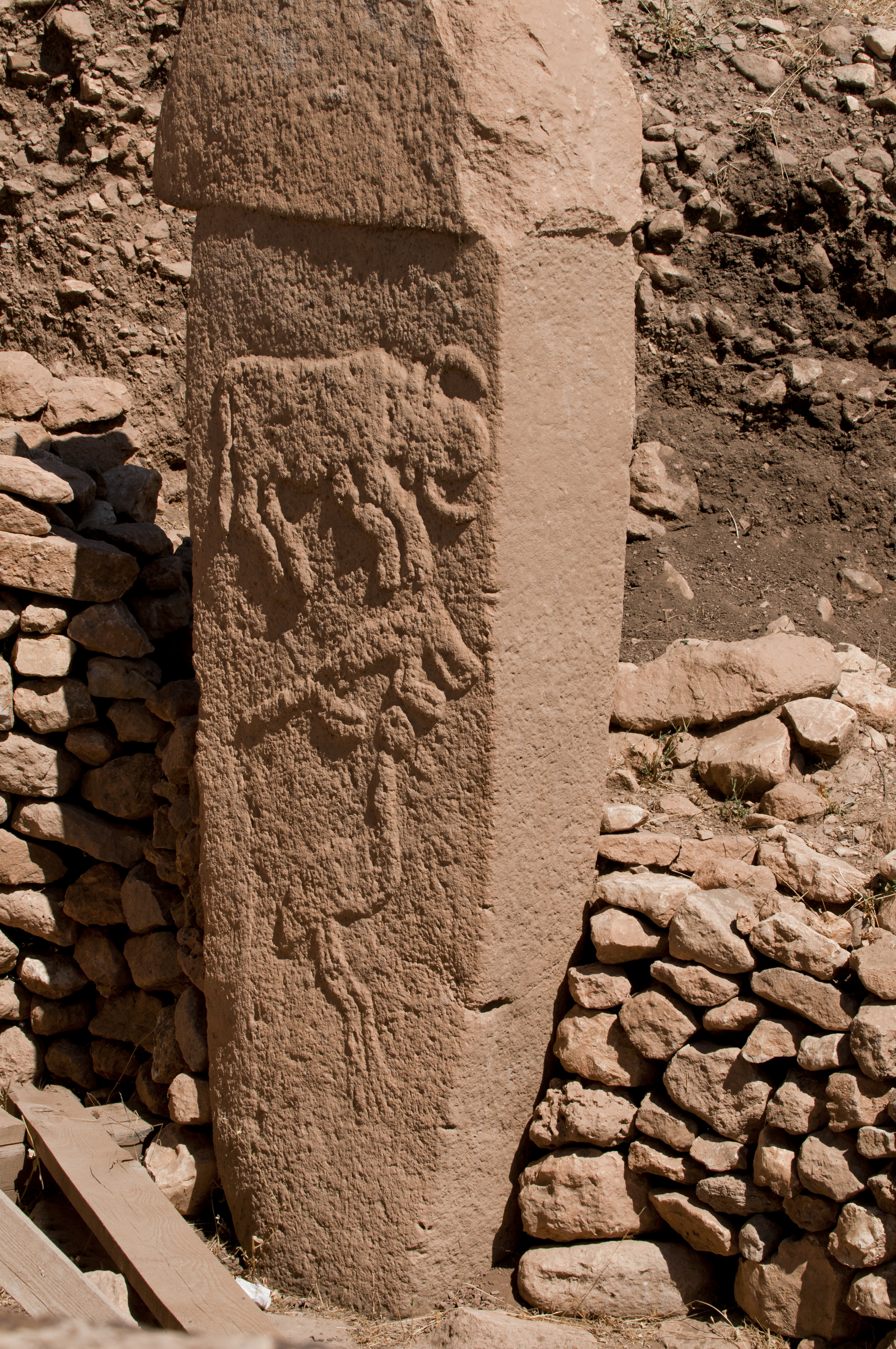
Building it required quarrying, shaping, moving and raising ten-tonne limestone pillars, which requires hundreds of people working together, which requires feeding them. The animal bones found there are entirely wild species — gazelle, aurochs, wild boar — and the plant remains are wild cereals.
This inverts the standard story. Rather than farming producing surplus which allowed monumental building, it looks as though the effort of building and feeding gatherings on this scale may have been one of the pressures that pushed people toward cultivating the local wild wheat — which happens to have been domesticated in this very region. Ritual before agriculture, not after. The excavator Klaus Schmidt put it as: first the temple, then the city.
Recent excavation has complicated the "no settlement" claim — there are indications of domestic structures and water cisterns on the site, so it may not have been purely a gathering place. This book states it as: a monumental construction by pre-agricultural people, whose interpretation is still developing.
Çatalhöyük: a town before towns had streets

It is what it lacks that is startling. No palace. No temple as a separate building. No obvious administrative buildings. No large-scale storage under central control. Houses are of broadly similar size and contents, and the burials — placed under the floors of the houses — show broadly similar treatment.
A settlement of several thousand people with no visible ruling class, sustained for over a thousand years. Whatever coordination it required was managed without the apparatus that later cities all have.
This matters because it shows that cities do not automatically produce kings. Something more specific has to happen, and that something is what the rest of this chapter is about.
Where inequality comes from
Storable, concentrated, defensible wealth. That is the answer, and every part of the phrase is doing work.
Storable. A forager's meat rots. Grain keeps for years. Wealth that persists can be accumulated, compared, inherited and taken.
Concentrated. Wealth spread thinly across a landscape cannot be controlled. Wealth that arrives at a predictable place and time can. This is why the productivity of land matters less than its legibility — the anthropologist James Scott's argument is that grain is the foundation of states specifically because it ripens at a known time, above ground, in a known place, in countable units. A tax collector can stand in a field on harvest day. He cannot do the equivalent with root crops, which stay in the ground and are dug as needed, or with foraged food.
Defensible. A granary can be guarded, walled and controlled by whoever holds the walls.
Land itself becomes property here, and this is the deepest change. To a forager, a territory is used, not owned. To a farmer who has cleared, ploughed, terraced and irrigated a plot, that plot represents years of embedded labour, and it can be inherited. Once land is heritable, families diverge over generations — good land compounds, bad land does not, one bad year forces a sale or a debt — and inequality becomes structural rather than personal.
The graves record the transition. Varna, around 4600 BCE, has some graves with a kilogram of gold and others with nothing, in the same cemetery. When burial wealth varies enormously and children are among the richly buried, rank is being inherited rather than earned, and that is the archaeological signature of a class society.
The sequence to the state
The same broad sequence occurs in Mesopotamia, Egypt, the Indus, China, Mesoamerica and the Andes, with no contact between most of them. That independence is what makes it worth taking seriously as a pattern rather than a story.
Village. A few hundred people, all farming, kin-based decision making, no permanent authority.
Town with specialists. Enough surplus that some people do not farm — potters, weavers, smiths, builders. Specialists are more productive at their craft and dependent on others for food, which creates the first genuine economic interdependence.
Chiefdom. A hereditary leader emerges, typically combining three roles: redistributor of surplus, war leader, and intermediary with the gods. These are usually the same person, and that is not an accident — the third role is what makes the first two unchallengeable.
State. Permanent institutions that outlive the individual: a bureaucracy, a standing armed force, a legal code, taxation, and record-keeping. The state is the point at which authority stops depending on who holds it.
Cities. Tens of thousands of people, monumental architecture, full occupational specialisation, and long-distance trade in bulk.
Why anyone accepted being ruled
This is the question that matters, and there are four honest answers that all operate together.
Irrigation and coordination. Large canal systems need construction, maintenance, allocation and dispute settlement, none of which a village can do alone. The historian Karl Wittfogel argued that this created "hydraulic" despotisms directly. The evidence does not support the strong version — in several regions state formation clearly precedes large-scale irrigation, and many irrigation systems were locally managed. But the coordination pressure is real and it is one input.
Defence, which is circular and self-reinforcing. Stored grain attracts raiders. Defending against raiders requires warriors. Warriors must be fed from the store, and they are armed, and they end up controlling the store. Protection and extortion are the same activity seen from two sides, a point the sociologist Charles Tilly made about states in general, and it is not a cynical exaggeration.
Debt and dependency. A bad harvest forces a farmer to borrow. Interest compounds. Land is pledged and lost, and eventually the debtor's own labour or family is pledged. Debt bondage is one of the oldest recorded institutions, and the earliest Mesopotamian legal texts include royal proclamations cancelling debts — which tells you both that it was endemic and that it periodically threatened to destroy the society.
Religion, which is the cheapest instrument of all. An army must be paid. A belief that the ruler is descended from, chosen by, or necessary to the gods costs almost nothing and is far more durable. Every early state fused political and religious authority, and Chapter 3.10 examines how that came about without assuming anyone cynically invented it.
What people lost
The evidence is fairly clear that early states were not pleasant places for most of their inhabitants.
Skeletal health declined further with urbanisation beyond the decline already caused by farming. Disease increased with density (Chapter 3.8). Working hours increased, because now a farmer had to produce a surplus for someone else as well as feed a family. Slavery appears with states, everywhere, and is nearly universal in the ancient world. Women's status appears to decline in most transitions to agricultural states, though the evidence is patchier and the picture varies.
And people voted with their feet. There is a long, well-documented record of people escaping states — fleeing to hills, forests, marshes and deserts. James Scott's work on Southeast Asia argues that many "primitive" hill peoples are not populations that never developed states, but populations that deliberately left them, adopting mobility and root crops precisely because those are hard to tax. Early states put considerable effort into stopping people leaving, which tells you which way the pressure ran.
Why did states win anyway? For the same reason farming did (Chapter 3.7): not because they were better for the individuals in them, but because they could field more people. A state can mobilise soldiers, build walls and absorb losses in a way a village cannot. Over centuries, the states expanded and absorbed the non-states. It is a selection process operating on societies, and it has no concern for whether the people inside them are better off.
Where this shows up in your life
Everything about the modern world is on the far side of this transition. Property, inheritance, taxation, police, courts, standing armies, bureaucracy, written records, and the assumption that some people give instructions and others carry them out — all of it appears here, in the same sequence, in half a dozen unconnected places.
The bargain is real and it goes both ways. In exchange for taxes and obedience you get defence, dispute resolution, insurance against local famine through redistribution, infrastructure, and the accumulated knowledge that specialists produce. Whether the bargain is fair has been the central political argument of every society since, and Part 13 is about the machinery different societies built to try to make it fairer.
And the legibility idea is worth carrying. Governments still prefer what they can count. Formal employment is taxed easily; informal work is not. Land with a registered title can be taxed and mortgaged; land held by custom cannot. A great deal of Indian policy — from the colonial land settlements in Chapter 6.19 to Aadhaar and the goods and services tax — is a continuation of the same problem: making a population legible to those who govern it.
What the next page covers
The rulers of every early state claimed divine backing, and every early city had a temple at its centre. That did not appear from nowhere. Chapter 3.10 traces the long road from fear of the unexplained to organised religion — why every human society has supernatural beliefs, what the psychological machinery behind them appears to be, how ancestors became gods and shamans became priests, why the great flood stories keep recurring, and how religion became the institution that made large-scale cooperation between strangers possible. It is handled as history and psychology, with respect for what people believed and without pretending to settle what is true.