Appearance
1.1 — What Physics Actually Does
A physicist and a poet can both say that a stone falls. Only one of them will tell you that after two seconds it is moving at 19.6 metres every second, that it has dropped 19.6 metres, and that if you drop a second stone twice as heavy beside it the two will land together. Physics is the business of turning "it falls" into a number you can check.
That is the whole trade. Every chapter in this volume is some version of the same move: take something that happens, find the quantity that is really doing the work, and write a relationship between quantities that survives being tested. When the relationship survives for three hundred years and across fourteen orders of magnitude, we call it a law. When it fails at the fifteenth, someone gets a Nobel Prize for the replacement.
Before any of that can happen, though, you need something to count. So this chapter is about measurement: what a physical quantity is, where units come from, and a technique called dimensional analysis that will let you catch your own mistakes and sometimes guess a correct formula without doing any physics at all.
A physical quantity is a number and a unit, and neither one alone means anything
Say a rod is "3 long" and you have said nothing. Three what? Three metres is a walking stick, three centimetres is a matchstick, three kilometres is a bridge. The number by itself is meaningless. So is the unit by itself — "metres" is not a length, it is the size of the step you are counting in.
A physical quantity is therefore always two things stuck together:
\text{quantity} = \{\text{number}\} \times [\text{unit}]
Read that as: a quantity equals a pure number multiplied by a unit. The braces are conventional shorthand for "the numerical part" and the square brackets for "the unit part". Length L = 3\,\text{m} means: whatever step size the metre is, this rod is three of them laid end to end.
This has a consequence people find surprising the first time. The number and the unit are inversely linked. The same rod is 3\,\text{m} or 300\,\text{cm}. The unit got a hundred times smaller, so the number got a hundred times bigger, and the product — the actual rod, which does not care what you call it — stayed the same. Written out:
3\,\text{m} = 3 \times (100\,\text{cm}) = 300\,\text{cm}
That is not a rule to memorise. It is the definition doing its job. Unit conversion, which is the single most common place people lose marks, is nothing more than multiplying by a cleverly disguised 1. Since 1\,\text{m} = 100\,\text{cm}, the fraction
\frac{100\,\text{cm}}{1\,\text{m}} = 1
is genuinely equal to one, because the top and the bottom are the same length written two ways. Multiplying by it changes nothing physical, only the bookkeeping. So
3\,\text{m} \times \frac{100\,\text{cm}}{1\,\text{m}} = 300\,\text{cm}
and the \text{m} on top cancels the \text{m} on the bottom exactly the way an algebraic x would. Units are algebra. Treat them as symbols you can cancel and you will never get a conversion wrong again.
Seven quantities are chosen, everything else is built
You could, in principle, invent a separate unit for every quantity in physics — one for speed, one for force, one for energy, one for pressure. It would be a catastrophe, because then every equation would need a conversion factor bolted onto it.
The alternative is to pick a small set of base quantities, define a unit for each of those, and then derive every other unit from them by the equations that connect them. The international agreement, the SI (from the French Système International d'unités), picks seven.

The seven, with the symbol used for the dimension of each:
| Quantity | Unit | Symbol | Dimension |
|---|---|---|---|
| Length | metre | m | L |
| Mass | kilogram | kg | M |
| Time | second | s | T |
| Electric current | ampere | A | I |
| Temperature | kelvin | K | Θ |
| Amount of substance | mole | mol | N |
| Luminous intensity | candela | cd | J |
The last column is the one that matters for this chapter. A dimension is not a unit. A dimension is the kind of thing a quantity is. Length is a dimension; the metre, the foot, the light-year and the cubit are all units of it. When we write [\,x\,] = \mathrm{L} we mean "the quantity x is of the kind length", and we have said nothing about which ruler you plan to use.
Everything else in mechanics is built from just the first three: L, M and T. Speed is a length divided by a time, so its dimension is \mathrm{L\,T^{-1}} and its SI unit is \text{m/s}. Acceleration is a speed divided by a time again, so \mathrm{L\,T^{-2}} and \text{m/s}^2. Force, by Newton's second law, is mass times acceleration, so \mathrm{M\,L\,T^{-2}}, and because that combination turns up constantly it gets a name of its own: one newton is one \text{kg}\cdot\text{m}/\text{s}^2. Nothing new was introduced. The newton is a nickname for a combination of the base three.
Here is the same construction for the quantities you will meet in the next ten chapters. It is worth reading the middle column as a sentence — "energy is a force acting through a distance" — because that is exactly what the dimension records.
| Quantity | Built from | Dimension | SI unit |
|---|---|---|---|
| Area | length × length | \mathrm{L^2} | m² |
| Volume | length³ | \mathrm{L^3} | m³ |
| Density | mass ÷ volume | \mathrm{M\,L^{-3}} | kg/m³ |
| Velocity | length ÷ time | \mathrm{L\,T^{-1}} | m/s |
| Acceleration | velocity ÷ time | \mathrm{L\,T^{-2}} | m/s² |
| Force | mass × acceleration | \mathrm{M\,L\,T^{-2}} | N |
| Momentum | mass × velocity | \mathrm{M\,L\,T^{-1}} | kg·m/s |
| Energy, work | force × distance | \mathrm{M\,L^2\,T^{-2}} | J |
| Power | energy ÷ time | \mathrm{M\,L^2\,T^{-3}} | W |
| Pressure | force ÷ area | \mathrm{M\,L^{-1}\,T^{-2}} | Pa |
Notice that momentum and energy have different dimensions, \mathrm{M\,L\,T^{-1}} against \mathrm{M\,L^2\,T^{-2}}. They are genuinely different kinds of thing, which is why you can never add them and why conserving one does not conserve the other. Chapter 1.7 will make a great deal of that difference.
Where a unit comes from, and why the kilogram was the embarrassing one
For most of history a unit was a physical object. The metre was a platinum-iridium bar in a vault in Paris. The kilogram was a platinum-iridium cylinder in the same vault, made in 1889.

The problem with defining a unit as an object is that objects change. Over the twentieth century the Paris cylinder and its official copies slowly drifted apart in mass by around 50 micrograms. Which one was right? None of them — the cylinder in Paris was right by definition, so if it lost atoms, then by definition the kilogram itself got lighter and every mass in the universe got heavier to compensate. That is an absurd position for a measurement system to be in.
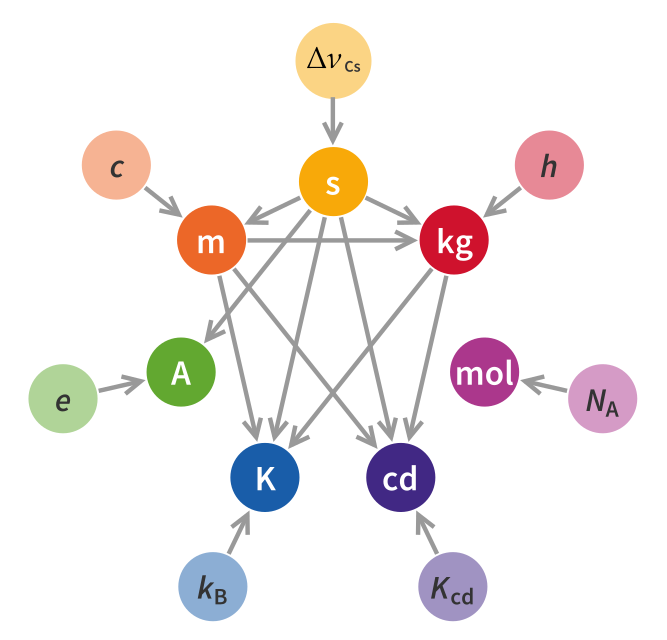
So the SI was rebuilt. Since May 2019 not a single base unit depends on an object. Instead, seven constants of nature have been assigned exact values by decree, and the units are whatever they have to be for those numbers to come out right.
The second went first, back in 1967. A caesium-133 atom has two very slightly different ground states, and when an electron flips between them the atom emits radiation at an extremely stable frequency. The definition says: that frequency is 9 192 631 770 cycles per second, exactly. So one second is however long it takes to count 9 192 631 770 of those cycles. Any laboratory with a caesium clock has the second, with no vault and no bar.
The metre came next, in 1983, and its definition is the one that changes how you should think about light. The speed of light in a vacuum is 299 792 458 metres per second, exactly, by decree. It is no longer measured; it is fixed. So the metre is defined as the distance light travels in 1/299\,792\,458 of a second. The reason this is allowed is Part 6 of this volume: the speed of light is the same for every observer, so it is the one length-per-time in the universe that everybody agrees on, which makes it the perfect ruler.
The kilogram fell last, in 2019, when the Planck constant h was fixed at exactly 6.626\,070\,15 \times 10^{-34}\ \text{J·s}. Since the joule-second is \mathrm{M\,L^2\,T^{-1}}, and length and time were already nailed down, fixing h nails down the mass. The instrument that turns that definition into an actual weighing is called a Kibble balance, and it balances a mass against an electromagnetic force whose size can be traced back to h. The vault in Paris is now a museum piece.
Dimensional analysis, the technique that checks your work for free
Now for the payoff. There is a rule so simple it looks like it cannot be useful:
You may only add or equate quantities of the same dimension.
You cannot add three metres to four seconds. Not because it is forbidden, but because there is no such thing as the answer. The sum would have to be seven of something, and there is no something.
That rule is called the principle of dimensional homogeneity, and it means that every term on both sides of any correct physical equation must have identical dimensions. Which gives you a free check on every formula you will ever write.
Take the kinematic equation you will derive properly in Chapter 1.2:
s = ut + \tfrac{1}{2}at^2
Read aloud: displacement equals initial speed times time, plus one half times acceleration times time squared. Check it dimensionally, term by term.
The left side, s, is a displacement, so [s] = \mathrm{L}.
The first term on the right is ut: a velocity times a time, so
[ut] = \mathrm{L\,T^{-1}} \times \mathrm{T} = \mathrm{L}
The \mathrm{T^{-1}} and the \mathrm{T} cancel, exactly as algebra says they should, leaving length. Good — it matches the left side.
The second term is \tfrac12 a t^2. The \tfrac12 is a pure number and has no dimension at all, so it is invisible to this check. That leaves
[at^2] = \mathrm{L\,T^{-2}} \times \mathrm{T^2} = \mathrm{L}
Length again. All three terms are lengths, so the equation is dimensionally homogeneous. It has passed.
Now watch it catch an error. Suppose in an exam you half-remember the formula and write s = ut + \tfrac12 a t. Check the last term: \mathrm{L\,T^{-2}} \times \mathrm{T} = \mathrm{L\,T^{-1}}, which is a velocity, not a length. You are adding a length to a velocity. The formula is wrong and you knew it in four seconds without remembering any physics.
This check costs almost nothing and catches a large fraction of algebra slips. Get in the habit of running it on the last line of every derivation.
What dimensional analysis cannot do
Be clear about the limits, because they matter.
It is blind to pure numbers. The \tfrac12 in \tfrac12at^2 has no dimensions, so dimensional analysis would have been equally happy with s = ut + 7at^2 or s = ut + \pi a t^2. It tells you the shape of a formula, never the numerical coefficient in front.
It cannot see the difference between quantities that share a dimension. Work and torque both come out as \mathrm{M\,L^2\,T^{-2}}, yet one is a scalar amount of energy and the other is a vector-ish twisting effect, and adding them would be nonsense. Passing the dimensional check is necessary for an equation to be right. It is not sufficient.
It cannot handle functions of dimensioned quantities. You will never see \sin(t) where t is a time in seconds, or \ln(x) where x is a length. Here is why, and it is worth seeing rather than accepting. The sine function is defined by an infinite series:
\sin\theta = \theta - \frac{\theta^3}{3!} + \frac{\theta^5}{5!} - \cdots
If \theta had the dimension of time, the first term would be a time, the second a time cubed, the third a time to the fifth — and you would be adding a time to a time cubed. Impossible. So the argument of any sine, cosine, exponential or logarithm must be dimensionless. That is why the pendulum formula in Chapter 2.1 reads \sin(\omega t) and not \sin(t): \omega has dimension \mathrm{T^{-1}}, so the product \omega t is a pure number, and the series is safe. Whenever you see something inside a trigonometric or exponential function, you are looking at a ratio that has been deliberately arranged to have no dimensions.
Guessing a formula with no physics at all
The technique goes further than checking. Sometimes it will hand you a formula.
Here is the classic. What does the period of a simple pendulum depend on? A pendulum is a mass on a string, swinging. Call the period T_p — the time for one full swing out and back. Without knowing any mechanics, list what could plausibly matter: the length of the string \ell, the mass of the bob m, and the strength of gravity g (which is an acceleration, \mathrm{L\,T^{-2}}).
Assume the answer is a product of powers of those three, with some unknown pure number k out front:
T_p = k\, \ell^{a} m^{b} g^{c}
Now write the dimensions of both sides. The left is a time, \mathrm{T}. The right is:
\mathrm{L}^{a}\ \mathrm{M}^{b}\ (\mathrm{L\,T^{-2}})^{c} = \mathrm{L}^{a+c}\ \mathrm{M}^{b}\ \mathrm{T}^{-2c}
For these to be the same kind of thing, the power of each base dimension must match on both sides. That gives three small equations:
- Power of M: the left side has none, so b = 0.
- Power of T: the left side has \mathrm{T}^1, so -2c = 1, giving c = -\tfrac12.
- Power of L: the left side has none, so a + c = 0, and since c = -\tfrac12 we get a = +\tfrac12.
Substitute back:
T_p = k\, \ell^{1/2} m^{0} g^{-1/2} = k\sqrt{\frac{\ell}{g}}
Two results fall out of that, and both are genuinely surprising the first time.
The mass has vanished. b = 0, so the period does not depend on the mass of the bob at all. A brass weight and a cork of the same size on the same string swing at the same rate. That is a real, checkable physical prediction, and we got it from bookkeeping.
The period grows as the square root of the length. To double the period you do not double the string, you quadruple it.
What dimensional analysis cannot give you is k. Solving the actual differential equation in Chapter 2.1 shows that k = 2\pi, so T_p = 2\pi\sqrt{\ell/g}. But notice how much of the physics we got for free: three of the four facts in that formula, from nothing but the requirement that both sides be the same kind of thing.
A second worked case: how fast do waves travel on a string?
Same method, new problem. Pluck a guitar string and a pulse runs along it. What sets its speed v?
Two things could plausibly matter: how hard the string is pulled — the tension F, which is a force, \mathrm{M\,L\,T^{-2}} — and how heavy the string is per unit of its length, called the linear mass density \mu, with dimension \mathrm{M\,L^{-1}}.
v = k\,F^{a}\mu^{b}
Dimensions:
\mathrm{L\,T^{-1}} = (\mathrm{M\,L\,T^{-2}})^{a}\,(\mathrm{M\,L^{-1}})^{b} = \mathrm{M}^{a+b}\ \mathrm{L}^{a-b}\ \mathrm{T}^{-2a}
Match the powers:
- M: a + b = 0
- T: -2a = -1, so a = \tfrac12
- L: a - b = 1. With a = \tfrac12 this gives b = -\tfrac12, which is consistent with a + b = 0. The system is consistent, which is itself a sign we picked the right ingredients.
v = k\sqrt{\frac{F}{\mu}}
Chapter 2.3 derives this properly from Newton's second law applied to a small curved piece of string, and finds k = 1 exactly. So dimensional analysis got the entire formula here, coefficient and all — we just could not have known that without doing the real derivation.
The physical content is immediate and matches your fingers: tighten a guitar string (raise F) and the pulse travels faster, so the note goes up. Use a thicker string (raise \mu) and the pulse travels slower, so the note goes down. That is why the low strings on a guitar are the fat ones.
Orders of magnitude — knowing the size of things
Physicists carry around a rough sense of scale, and it is more useful than it sounds. An order of magnitude is just the power of ten nearest to a quantity. The Earth's radius is about 6.4 \times 10^6\ \text{m}, so its order of magnitude is 10^7\ \text{m} (because 6.4 is closer to 10 than to 1).
| Thing | Size (m) |
|---|---|
| Proton | 10^{-15} |
| Atom | 10^{-10} |
| Virus | 10^{-7} |
| Human | 10^{0} |
| Earth's radius | 10^{7} |
| Earth–Sun distance | 10^{11} |
| Milky Way | 10^{21} |
| Observable universe | 10^{26} |
That table spans 41 powers of ten, and this volume covers all of it. Part 8 works at 10^{-15}; Part 12 works at 10^{26}.
The reason to keep these in your head is that they let you sanity-check an answer instantly. If a calculation of the height of a building gives 4 \times 10^7 metres, you do not need to find the error to know there is one — that is six times the radius of the Earth.
There is a related habit worth building, sometimes called a Fermi estimate after Enrico Fermi, who was famous for it. The idea is to get an answer to within a factor of ten using only numbers you already know. Fermi estimated the yield of the first atomic bomb test by dropping scraps of paper as the shock wave passed and measuring how far they blew sideways. He got about ten kilotons; the careful analysis afterwards said twenty-one. For a man standing in a desert with a handful of paper, being off by a factor of two is a remarkable result, and it is the same skill as checking whether your homework answer is absurd.
Significant figures, and being honest about what you measured
If you measure a table with a ruler marked in millimetres and get 1.842 m, you are claiming to know the length to about a millimetre. If you then divide by 3 and write 0.614 m — fine. But if your calculator says 0.6140000001 and you copy all of it down, you are now claiming to know the length to a ten-billionth of a metre, which is smaller than an atom. The extra digits are a lie the calculator told you.
Significant figures are the digits you actually have evidence for. The rules are short:
- All non-zero digits count. 1.842 has four.
- Zeros between non-zero digits count. 1.024 has four.
- Leading zeros never count; they are placeholders. 0.0042 has two significant figures, and writing it as 4.2\times10^{-3} makes that obvious.
- Trailing zeros after a decimal point count, because you chose to write them. 1.20 has three, and it means something different from 1.2 — it claims you checked the hundredths place.
When you combine measurements:
- Multiplying or dividing: the answer gets as many significant figures as the least precise input. 2.0 \times 3.14159 = 6.3, not 6.28318, because the 2.0 only claims two figures.
- Adding or subtracting: the answer gets as many decimal places as the input with the fewest. 12.11 + 0.3 = 12.4, because the 0.3 knows nothing about hundredths.
This is not exam pedantry. It is the difference between reporting a result and overstating it, and in Part 8 the difference between a 3\sigma hint and a 5\sigma discovery is exactly this question asked with more machinery.
The numbers worth carrying in your head
Physics is not done from tables, but a handful of constants come up so often that looking them up breaks your train of thought. These are the ones this Part uses. Each is introduced properly in the chapter that needs it; they are gathered here so that when a later chapter writes g or G without comment you have somewhere to glance.
| Quantity | Symbol | Value | First used in |
|---|---|---|---|
| Free-fall acceleration at the Earth's surface | g | 9.81\ \text{m/s}^2 | 1.2 |
| Gravitational constant | G | 6.674\times10^{-11}\ \text{N·m}^2\text{/kg}^2 | 1.9 |
| Earth's mass | M_\oplus | 5.97\times10^{24}\ \text{kg} | 1.9 |
| Earth's radius | R_\oplus | 6371\ \text{km} | 1.9 |
| Earth's escape velocity | v_e | 11.2\ \text{km/s} | 1.9 |
| Earth–Moon distance | — | 3.84\times10^8\ \text{m} | 1.9 |
| Earth–Sun distance (one astronomical unit) | AU | 1.496\times10^{11}\ \text{m} | 1.9 |
| Density of water | \rho_w | 1000\ \text{kg/m}^3 | 1.11 |
| Density of air at sea level | \rho_a | 1.2\ \text{kg/m}^3 | 1.11 |
| One atmosphere of pressure | atm | 101\,325\ \text{Pa} | 1.11 |
| Pressure added per metre of water depth | \rho g | 9810\ \text{Pa/m} | 1.11 |
| Surface tension of water | \gamma | 0.073\ \text{N/m} | 1.11 |
| Young's modulus of steel | E | 200\ \text{GPa} | 1.10 |
The symbol column matters as much as the value column. Physics reuses letters shamelessly — \gamma is surface tension here, a ratio of specific heats in Part 3, and the Lorentz factor in Part 6 — so every chapter in this book states what its symbols mean at the point of use, and you should never be expected to remember one across a Part boundary.
Where this shows up in your life
Every time you convert a recipe, compare fuel economy in litres per hundred kilometres against miles per gallon, or work out whether a 65-inch television will fit on a wall, you are doing the unit algebra from the first section. When a news story says a rocket produces "seven million pounds of thrust", the reason that sounds impressive and tells you nothing is that pounds of force divided by nothing is not yet a useful comparison — thrust divided by the rocket's weight is, and that ratio is dimensionless, which is why engineers quote it.
And the pendulum result has a direct consequence you can see. A grandfather clock keeps time because its pendulum's period depends only on its length and on g. Take that clock up a mountain, where g is very slightly smaller, and it runs slow. Take it to the equator, where the Earth's bulge puts you further from the centre and its spin helps a little, and it runs slow again. Clockmakers knew this centuries before anyone could explain it, and adjusted the bob's height to compensate.
What the next chapter fixes
We now have quantities, units and a way of checking that an equation is at least the right kind of statement. What we do not have is any actual physics — nothing here tells you how anything moves. Chapter 1.2 starts that, by defining velocity and acceleration properly with calculus rather than as slogans, and deriving the four kinematic equations that describe every straight-line motion with constant acceleration, including the falling stone we opened with.