Appearance
3.7 — How Heat Moves: Conduction, Convection and Radiation
Go back to the metal railing and the wooden bench from Chapter 3.1. Same temperature, and the metal feels far colder. The explanation was that metal pulls heat out of your hand faster. Now we can put a number on "faster", and the same number will tell you how thick to make a wall, why a saucepan has a copper base and a plastic handle, how the Earth settles at the temperature it does, and how a star gets rid of the energy made in its core.
There are exactly three ways heat travels, and they are physically different mechanisms rather than three names for one thing.
- Conduction passes energy along through a material without the material going anywhere.
- Convection carries hot material bodily from one place to another.
- Radiation sends energy as electromagnetic waves, needing no material at all.
Everything that gets warm or cold does it by some combination of these.
Conduction

At the hot end, atoms vibrate more violently — that is what temperature means, from Chapter 3.2. Each one is bonded to its neighbours, so a harder vibration shakes the atoms next door, which shake theirs. Energy travels; matter does not.
In metals there is a second, much faster channel. A metal's outer electrons are not bound to individual atoms but roam through the whole lattice (Volume III, Chapter 2 covers why). These free electrons carry energy the way a gas would, moving quickly and colliding, and they dominate conduction completely in metals. This is why good electrical conductors are good thermal conductors — the same free electrons do both jobs, a relationship known as the Wiedemann–Franz law.
The law, and where it comes from
Experiment gives a simple relationship, and once you have it you can see it could hardly be otherwise. The rate of heat flow through a slab is:
- proportional to the area — double the wall, double the flow;
- proportional to the temperature difference across it — a bigger push gives a bigger flow;
- inversely proportional to the thickness — twice as far to travel, half the flow.
\boxed{\frac{Q}{t} = kA\frac{T_H - T_C}{L}}
Read aloud: Q over t equals k A times T-hot minus T-cold, over L. The left side is heat per second, so it is a power in watts. The symbol k is the thermal conductivity, in W m⁻¹ K⁻¹, and it is the number that separates the railing from the bench.
Written for a thin slice it becomes Fourier's law, from Joseph Fourier's 1822 work on heat — the same work that produced the Fourier series of Volume II, Part 9, which he invented as a tool for solving this very problem:
\frac{Q}{t} = -kA\frac{dT}{dx}
The minus sign says heat flows down the temperature gradient, from hot to cold, which is the second law showing up as a sign.
Conductivities worth carrying:
| Material | k (W m⁻¹ K⁻¹) |
|---|---|
| Diamond | 2000 |
| Copper | 400 |
| Aluminium | 235 |
| Steel | 50 |
| Glass | 0.8 |
| Water | 0.6 |
| Brick | 0.7 |
| Wood | 0.15 |
| Fibreglass | 0.04 |
| Air (still) | 0.026 |
Copper is 2700 times better than wood. That is the railing and the bench, quantified. Your hand supplies heat at a limited rate; the copper carries it away as fast as your hand can supply it and your skin cools sharply, while the wood cannot take it away faster than your blood replaces it, so your skin stays warm. The nerve endings report skin temperature, and skin temperature is what "feels cold" means.
Diamond beating copper by a factor of five is worth a note, because diamond is an electrical insulator with no free electrons at all. It conducts heat through lattice vibrations alone, and it is superb at it because carbon atoms are light and their bonds are extraordinarily stiff, so vibrations travel fast and scatter little. This is used in practice: diamond heat spreaders sit under high-power semiconductor lasers.
Still air is the best insulator on the list, and that is the principle behind nearly every insulating material ever made. Fibreglass, wool, down, foam and double glazing all work the same way: they do not insulate by being made of anything special, they insulate by trapping air in pockets small enough that it cannot circulate. Break the air into small cells and you kill convection, and what remains is air's very low k.
Worked example: a wall
A brick wall is 20 cm thick and 4 m by 2.5 m. Inside is 21 °C, outside is 3 °C. Take k_{\text{brick}} = 0.7.
\frac{Q}{t} = (0.7)(10)\frac{18}{0.20} = 7\times90 = 630\ \text{W}
That one wall leaks 630 watts continuously — the output of a small electric heater, running all winter. Over a 24-hour day it is 630\times86400 = 5.4\times10^7 J, or 15 kWh.
Now add 10 cm of fibreglass. Two layers in series carry the same heat flow, and their thermal resistances add — exactly like resistors in series in Volume III, Chapter 1. Define the resistance of a layer as R = L/kA:
R_{\text{brick}} = \frac{0.20}{0.7\times10} = 0.0286\ \text{K/W}
R_{\text{glass}} = \frac{0.10}{0.04\times10} = 0.250\ \text{K/W}
R_{\text{total}} = 0.2786\ \text{K/W}
\frac{Q}{t} = \frac{\Delta T}{R_{\text{total}}} = \frac{18}{0.2786} = 64.6\ \text{W}
From 630 W to 65 W — a factor of ten — for 10 cm of glass fibre. And look where the resistance sits: the fibreglass contributes 90 % of it despite being half the thickness. In a series chain the largest resistance dominates, which is why adding insulation to an already well-insulated wall gives diminishing returns while the first layer is transformative.
Convection
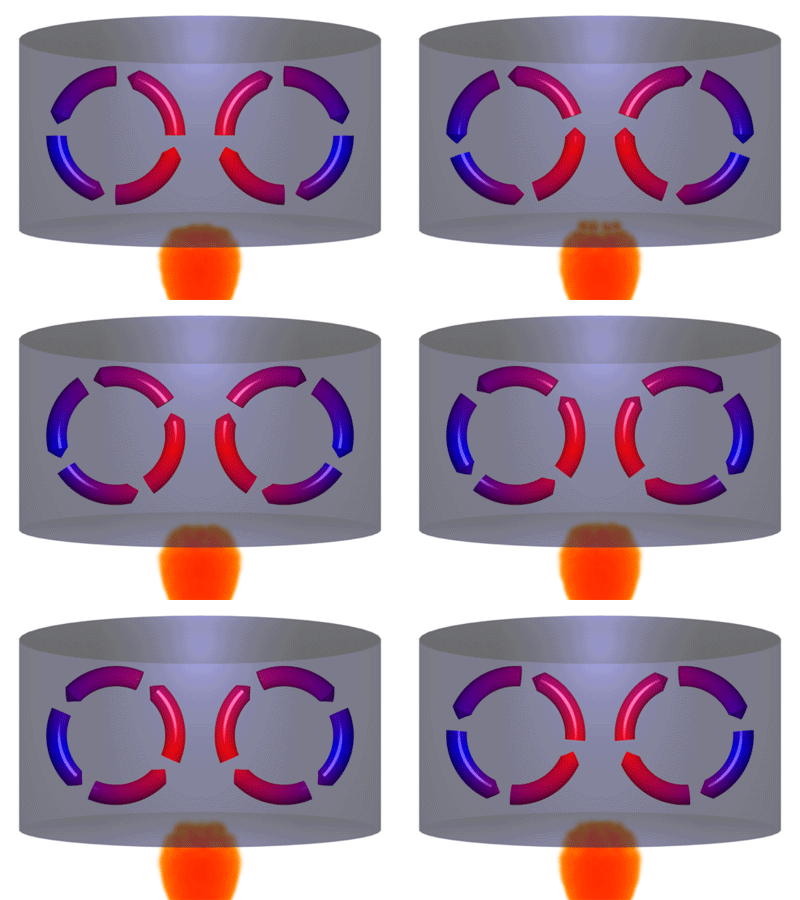
Heat a fluid from below and the bottom layer expands, per Chapter 3.1. Less dense fluid surrounded by denser fluid experiences an upward buoyant force, by Archimedes' principle from Chapter 1.11. So it rises. Cooler fluid flows in to replace it, gets heated, and rises in turn. A circulation loop establishes itself.
That is natural convection, driven by the heating itself. Forced convection is the same transport with a fan or pump doing the driving, and it is far more effective because it does not have to wait for buoyancy to build.
Convection has no clean derivation from first principles, and it is worth saying so plainly rather than pretending. The fluid flow is governed by the Navier–Stokes equations, which are nonlinear and have no general solution — this is the same difficulty that makes turbulence one of the genuinely open problems in classical physics. So engineering uses a fitted law, Newton's law of cooling:
\frac{Q}{t} = hA(T_{\text{surface}} - T_{\text{fluid}})
where h is a heat transfer coefficient measured for the situation, not derived. Typical values in W m⁻² K⁻¹: still air around 5, moving air 10 to 100, still water 100, boiling water 3000 or more. The enormous spread is why h has to be measured.
Wind chill is this equation. Your skin loses heat to a thin boundary layer of air held against it, which warms up and then insulates you. Wind strips that layer away and replaces it with fresh cold air, which raises h several-fold. The air temperature has not changed at all; the coefficient has. This also explains why wind chill is meaningless for an object already at air temperature — there is no \Delta T for the larger h to act on.
Water at 20 °C feels far colder than air at 20 °C for the same reason. Water's h is roughly twenty times air's, and its heat capacity per unit volume is about 3500 times greater, so it removes heat from you at a rate air cannot approach. Survival time in cold water is measured in tens of minutes for exactly this reason.
Newton's law of cooling also gives the shape of a cooling curve. If a body of heat capacity C cools by convection alone:
C\frac{dT}{dt} = -hA(T - T_{\text{air}})
Write \theta = T - T_{\text{air}} for the excess temperature. Then d\theta/dt = -(hA/C)\theta, which is the equation whose solution is an exponential (Volume II, Chapter 6):
\theta(t) = \theta_0 e^{-t/\tau}, \qquad \tau = \frac{C}{hA}
A cooling object approaches room temperature exponentially, halving its excess temperature in a fixed time regardless of where it started. A cup of tea at 90 °C in a 20 °C room with a time constant of 20 minutes is at 20 + 70e^{-1} = 46 °C after 20 minutes, and 20 + 70e^{-2} = 29 °C after 40. Most of the cooling happens early, because that is when \Delta T is largest.
This is the physics behind the milk-in-coffee question. If you must leave your coffee for ten minutes and want it hottest at the end, add the cold milk immediately. Cooler coffee loses heat more slowly, so the ten minutes cost you less. Adding milk at the end drops the temperature by the same amount but after ten minutes of faster cooling.
Radiation
Conduction and convection both need matter. Radiation does not. The Sun's energy crosses 150 million kilometres of vacuum to reach you, and no medium is involved at any point.
Every object above absolute zero emits electromagnetic radiation, because its charged particles are in thermal motion, and accelerating charges radiate — a result Chapter 4.7 derives from Maxwell's equations. At room temperature the emission is mostly infrared, invisible to the eye but exactly what a thermal camera sees.
The black body
To do the theory you need a standard emitter, and the standard is the black body: an object that absorbs every wavelength that falls on it, reflecting nothing.
Why does perfect absorption define an emitter? Because of Kirchhoff's law of thermal radiation: at equilibrium, a surface must emit at each wavelength exactly as well as it absorbs at that wavelength. Suppose it did not. Put it in a sealed cavity at uniform temperature. If it absorbed more than it emitted it would keep warming above its surroundings, which is heat flowing from cold to hot with nothing driving it, and the second law forbids it. So a perfect absorber is also a perfect emitter, and the two properties are the same number.
A practical black body is a cavity with a small hole. Light entering the hole bounces around inside and is almost certain to be absorbed before finding its way out again, so the hole absorbs essentially everything — and therefore radiates a spectrum depending only on the cavity's temperature and nothing else about it.

Every curve has the same shape: zero at very short wavelengths, rising to a peak, falling off with a long tail towards long wavelengths. Two facts about that family of curves have their own laws.
Stefan–Boltzmann: how much
The total power radiated per unit area is the area under the curve. Josef Stefan found the answer empirically in 1879 by re-examining other people's data, and Boltzmann derived it thermodynamically in 1884:
\boxed{\frac{P}{A} = \sigma T^4}
with \sigma = 5.670\times10^{-8} W m⁻² K⁻⁴, the Stefan–Boltzmann constant.
The fourth power is the entire content of the law, and it is a very strong dependence. Double the absolute temperature and the radiated power goes up sixteen-fold. This is why a stove element glows dully at 700 K and blindingly at 1400 K, and why a small increase in a star's surface temperature makes an enormous difference to its output.
Boltzmann's derivation is worth sketching because it is a beautiful use of Chapter 3.3's machinery. Treat the radiation in a cavity as a gas of photons with energy density u(T) and — a result from Maxwell's equations — pressure P = u/3. Apply the thermodynamic relation for internal energy, do a little calculus, and u \propto T^4 falls out with no assumptions about what light is made of. The constant \sigma itself cannot be got this way; it took Planck's quantum theory in 1900, and Chapter 7.1 shows how.
For a real surface, which is not a perfect black body, insert an emissivity \varepsilon between 0 and 1:
\frac{P}{A} = \varepsilon\sigma T^4
Polished silver has \varepsilon \approx 0.02, white paint about 0.9, black paint 0.95, human skin 0.98 in the infrared regardless of visible colour. That last fact is why thermal cameras work equally well on everybody.
Net exchange. An object at T in surroundings at T_s both emits and absorbs, so the net is:
\frac{P_{\text{net}}}{A} = \varepsilon\sigma(T^4 - T_s^4)
which is zero at equilibrium, as it must be.
Worked example: how much do you radiate?
Skin at 33 °C (306 K), surface area about 1.8 m², emissivity 0.98, in a room at 20 °C (293 K).
T^4 = 306^4 = 8.77\times10^{9}, \qquad T_s^4 = 293^4 = 7.37\times10^{9}
P = (0.98)(5.67\times10^{-8})(1.8)(8.77\times10^{9} - 7.37\times10^{9})
P = (0.98)(5.67\times10^{-8})(1.8)(1.40\times10^{9}) = 140\ \text{W}
About 140 watts net, which is more than a resting body produces — the rest is made up by clothing cutting the effective area and raising the outer surface temperature towards ambient. Radiation is not a minor channel for a human; in still air it is the largest single one.
It also explains a common experience. A room can be at a comfortable 21 °C and still feel cold if the walls are cold, because you radiate to the walls, not to the air. That is the case for a large single-glazed window at 8 °C, and it is why sitting near one feels chilly even in a warm room, and why underfloor heating with warm surfaces feels comfortable at a lower air temperature than a radiator does.
Wien: what colour
The peak of the curve shifts with temperature, and Wilhelm Wien found the rule in 1893:
\boxed{\lambda_{\text{max}}T = b, \qquad b = 2.898\times10^{-3}\ \text{m}\cdot\text{K}}
Read aloud: lambda-max times T is a constant. Hotter means shorter wavelength, which means bluer.

Work some numbers.
Human body, 310 K:
\lambda_{\text{max}} = \frac{2.898\times10^{-3}}{310} = 9.35\times10^{-6}\ \text{m} = 9.4\ \mu\text{m}
Deep infrared, far outside what the eye sees, which is why you do not glow visibly and why thermal cameras are built to be sensitive around 8–12 μm.
The Sun, 5778 K:
\lambda_{\text{max}} = \frac{2.898\times10^{-3}}{5778} = 5.02\times10^{-7}\ \text{m} = 502\ \text{nm}
Green, right in the middle of the visible band. Human vision is most sensitive at about 555 nm. That is not a coincidence — eyes evolved under this star, and it would be remarkable if they had tuned themselves anywhere else. The whole visible range, 400 to 700 nm, is the band where the Sun is brightest and where the atmosphere happens to be transparent.
An incandescent bulb filament runs at about 2800 K, giving \lambda_{\text{max}} = 1035 nm — in the infrared. So most of the output of a filament bulb is invisible heat, and that is the whole reason they were replaced. Only about 5 % of the energy lands in the visible band. You cannot fix it by improving the bulb; the fourth-power and peak-shift laws say a hot object radiating enough visible light must radiate far more invisible light, and the only way out is to abandon thermal emission entirely, which is what an LED does.
Wien's law is also the working tool of astronomy. Measure a star's colour and you have its surface temperature, without going there. A red star like Betelgeuse peaks around 830 nm and is about 3500 K. A blue-white star like Rigel peaks near 240 nm and is around 12,000 K. Part 12 uses this constantly.
The catastrophe hiding in the curve
Nineteenth-century physics could derive the shape of the black-body curve — and got it catastrophically wrong. Treating the cavity as full of standing electromagnetic waves and giving each one k_BT of energy by equipartition (Chapter 3.2) gives the Rayleigh–Jeans law:
\frac{dP}{d\lambda} \propto \frac{T}{\lambda^4}
which matches beautifully at long wavelengths and then runs off to infinity as \lambda \to 0. The dashed line in the figure above is this prediction. It says a cavity at room temperature should be pouring out infinite energy in the ultraviolet, which would make sitting near a fireplace instantly fatal.
The problem is not arithmetic. It is that the number of possible standing waves grows without limit as the wavelength shrinks, and if every one of them gets a full share of energy, the total is infinite. Something must stop short-wavelength modes from being excited.
Planck found what, in 1900, and it changed physics: energy in a mode of frequency f comes only in packets of hf. High-frequency modes need large packets, and at temperature T there is typically only k_BT available, so modes with hf \gg k_BT cannot be excited at all — exactly the freezing-out argument that explained hydrogen's heat capacity in Chapter 3.2, now applied to light. Chapter 7.1 does this properly, derives Planck's law in full, and shows both Stefan–Boltzmann and Wien falling out of it as consequences rather than separate empirical rules.
Worked example: the temperature of the Earth
This calculation uses everything in the chapter and predicts a real number about the planet you live on.
The Sun radiates P_\odot = 3.85\times10^{26} W. By the time it reaches Earth's orbit at r = 1.50\times10^{11} m, that power is spread over a sphere of that radius, so the intensity is:
S = \frac{P_\odot}{4\pi r^2} = \frac{3.85\times10^{26}}{4\pi(1.50\times10^{11})^2} = \frac{3.85\times10^{26}}{2.83\times10^{23}} = 1361\ \text{W/m}^2
This is the solar constant, and satellites measure 1361 W/m², so the arithmetic checks.
How much does Earth intercept? Not its whole surface — only the disc it presents to the Sun, of area \pi R^2. And it reflects about 30 % straight back off clouds, ice and desert, a fraction called the albedo, \alpha = 0.30:
P_{\text{in}} = S(1-\alpha)\pi R^2
How much does it emit? From its whole surface, 4\pi R^2, at temperature T, with emissivity close to 1 in the infrared:
P_{\text{out}} = \sigma T^4 \cdot 4\pi R^2
At a steady temperature these balance:
S(1-\alpha)\pi R^2 = 4\pi R^2\sigma T^4
The \pi R^2 cancels — the planet's size does not matter, only its distance and its albedo:
T = \left(\frac{S(1-\alpha)}{4\sigma}\right)^{1/4}
T = \left(\frac{1361\times0.70}{4\times5.67\times10^{-8}}\right)^{1/4} = \left(\frac{952.7}{2.268\times10^{-7}}\right)^{1/4} = \left(4.201\times10^{9}\right)^{1/4}
Take the fourth root: \sqrt{4.201\times10^9} = 6.48\times10^4, and \sqrt{6.48\times10^4} = 254.6.
T = 255\ \text{K} = -18\ ^\circ\text{C}
The measured average surface temperature is +15 °C. The calculation is off by 33 degrees, and the discrepancy is the entire greenhouse effect.
Here is the mechanism, and it follows directly from Wien's law. Sunlight arrives peaked at 500 nm, in the visible, and the atmosphere is largely transparent there — which is why you can see the Sun. The Earth radiates back at 255 K, peaked at $2.898\times10^{-3}/255 = 11\ \mu$m, deep in the infrared. Carbon dioxide, water vapour and methane are transparent in the visible and strongly absorbing at 11 μm, because that is where their molecules have vibrational transitions. So energy comes in easily and leaves with difficulty, and the surface must run hotter than 255 K to push enough infrared through.
Without it, the planet would average −18 °C and be frozen. The question in climate science was never whether the effect exists — this calculation settles that, and it dates to Fourier in 1824 and Arrhenius in 1896 — but what happens to the 33 degrees when the concentration of the absorbing gases changes.
Where this shows up in your life
A vacuum flask defeats all three mechanisms at once, which is why it works so well. The double wall with a vacuum between kills conduction and convection, since there is no material to conduct and no fluid to circulate. The silvered surfaces have emissivity near 0.02, which cuts radiation by fiftyfold. What is left is conduction up the thin glass neck, which is why the flask is joined only at the top and why the neck is narrow.
A saucepan has a copper or aluminium base and a plastic handle — high k where you want heat to pass, low k where you do not. Same object, opposite requirements, solved by choosing k.
Loft insulation beats wall insulation in most houses because convection sends the warm air upwards, so the largest temperature difference in the building is across the ceiling.
A greenhouse is not mainly the greenhouse effect. Glass does block outgoing infrared, but the dominant reason a greenhouse is warm is that it stops convection — the warm air physically cannot leave. This was measured in 1909 by R. W. Wood, who built one greenhouse with a rock-salt window transparent to infrared and found it barely cooler than a glass one.
Frost forms on clear nights and not on cloudy ones, even at the same air temperature. On a clear night the ground radiates to the sky, which is effectively at about 3 K in the infrared window, and the surface can drop several degrees below air temperature. Clouds radiate back down at close to air temperature, so the net loss nearly vanishes. This is also the trick behind radiative sky cooling panels, which can chill a surface below ambient in full daylight by emitting exactly in the band where the atmosphere is transparent.
What Part 3 established
Part 3 started with a hand on a railing and finished with the temperature of a planet. The route ran through four laws, and it is worth having them in one place.
The zeroth law made temperature a coherent idea and thermometers possible. The first law said energy is conserved once heat is counted as energy, which Joule's paddle wheel proved and which killed the caloric theory. The second law said energy has a direction as well as an amount, gave every engine a hard ceiling that depends on nothing but two temperatures, and turned out to be a statement about counting: the world moves towards macrostates that contain more microstates, because there are more of them. The third law fixed the zero of entropy and put absolute zero permanently out of reach.
Underneath all four is one picture. Matter is made of enormous numbers of particles in random motion, and the laws of thermodynamics are what emerges when you stop tracking individuals and ask only about averages. That move — from mechanics to statistics — produced laws more reliable than the ones they came from, because with 10^{23} participants the fluctuations wash out completely.
And two threads run out of this Part into the rest of the book. Entropy turned out to be the same quantity as the information entropy of Volume I, Chapter 1.8, reached from the opposite direction, with Landauer's principle putting a thermodynamic price on erasing a bit. And the black-body curve, which classical physics could not explain at all, is where quantum mechanics begins.
What the next Part fixes
Chapter 3.7 used the fact that accelerating charges radiate, and used the transparency of the atmosphere to different wavelengths, without explaining either. Both need electromagnetism. Part 4 starts with a single charge and a single force law, builds the field concept, and after seven chapters assembles four equations that describe every electrical and magnetic phenomenon there is. Then it derives from those four equations a wave that travels at a speed set by two constants measured with batteries and magnets in a laboratory — and that speed turns out to be the speed of light, which is how physics discovered what light is.