Appearance
12.9 — Science Fiction, Science-Checked
Most of what follows is not forbidden by the equations. That is the interesting part, and it is why these ideas persist in serious journals as well as in fiction.
The distinction that matters throughout this chapter is between three categories:
Forbidden — violates a law with no known exception.
Permitted but requiring something that does not exist — the equations have a solution, and building it needs matter or energy nobody has ever observed.
Permitted and merely absurd — allowed, and the engineering is beyond any conceivable scale.
Almost everything below is in the second category, and that is a far more interesting place to be than the first.
Wormholes
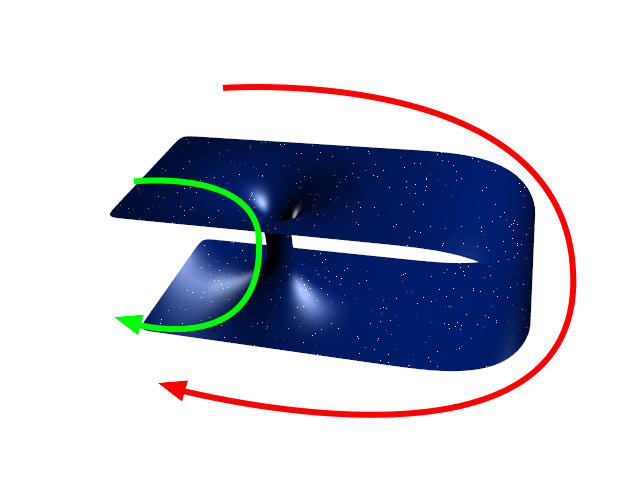
The Einstein–Rosen bridge, 1935. Einstein and Nathan Rosen found that the Schwarzschild solution (Chapter 6.9), extended through the horizon, connects two separate regions of spacetime.
It was not intended as a means of travel. They were trying to model particles as geometric features.
Two fatal problems with it:
It is not traversable. The throat pinches off faster than anything travelling at c can cross. You would be crushed at the singularity before reaching the other side.
It is not connected to the outside. In the maximally extended Schwarzschild geometry, the two regions cannot signal to each other.
Traversable wormholes
Kip Thorne and Mike Morris, 1988, working on a problem Carl Sagan had posed while writing Contact — he wanted a scientifically defensible way to move his character across the galaxy.
Their approach was to invert the usual procedure. Rather than solving the field equations for a given matter distribution, specify the geometry you want and use the equations to find what matter would produce it.
The metric:
ds^2 = -c^2dt^2+\frac{dr^2}{1-b(r)/r}+r^2d\Omega^2
with b(r) the shape function, and b(r_0) = r_0 at the throat.
Substituting into the Einstein field equations (Chapter 6.8) and reading off the required stress–energy gives the answer, and it is uncomfortable.
\boxed{\text{The throat requires matter with negative energy density.}}
Specifically, it must violate the null energy condition:
T_{\mu\nu}k^\mu k^\nu \geq 0
which every known form of classical matter satisfies.
Does negative energy exist?
Yes, in small amounts, and it has been measured.
The Casimir effect (Chapter 7.9). Between two conducting plates, the energy density is below the vacuum value:
\rho = -\frac{\pi^2\hbar c}{720d^4}
Negative, and measured to about 1 %.
Squeezed vacuum states also have regions of negative energy density, and LIGO uses them routinely (Chapter 6.10).
So negative energy is real. The question is how much.
How much would be needed
For a throat of radius r_0, the required negative energy is roughly:
E \sim -\frac{c^4r_0}{G}
For a 1 metre throat:
E \sim -\frac{(3\times10^{8})^4(1)}{6.674\times10^{-11}} = -\frac{8.1\times10^{33}}{6.674\times10^{-11}} = -1.2\times10^{44}\ \text{J}
Equivalent to -1.3\times10^{27} kg — about the mass of Jupiter, with a negative sign.
Compare with the Casimir energy available. For plates 1 μm apart over 1 m²:
E_{\text{Casimir}} \approx -1.3\times10^{-9}\ \text{J}
\frac{10^{44}}{10^{-9}} = 10^{53}
Fifty-three orders of magnitude short.
And quantum inequalities make it worse. Ford and Roman proved theorems limiting how much negative energy can be concentrated and for how long:
\int\rho(t)f(t)\,dt \gtrsim -\frac{\hbar}{t_0^4}
Negative energy must be paid back, and the larger the amount, the faster. This makes large stable concentrations extremely difficult and may make them impossible.
Verdict: permitted by general relativity, requiring a form and quantity of matter nobody has any route to.
Warp drive

Miguel Alcubierre, 1994. A general relativity paper explicitly motivated by Star Trek.
The insight: Chapter 12.5 established that space itself can expand faster than c without violating relativity. Special relativity restricts motion through space, not the expansion of space.
\boxed{\text{So do not move through space. Move space.}}
The metric:
ds^2 = -c^2dt^2+\left[dx-v_s(t)f(r_s)dt\right]^2+dy^2+dz^2
with f(r_s) a function that is 1 inside the bubble and 0 outside.
Inside the bubble, spacetime is flat. The occupants are in free fall, feel no acceleration, experience no time dilation, and could exceed c effectively without ever moving locally.
The problems
1. Negative energy again, and in staggering quantity.
Alcubierre's original estimate for a 100 m bubble at 10c:
E \approx -10^{64}\ \text{J} \approx -10^{47}\ \text{kg}
More mass-energy than the observable universe contains, with a negative sign.
Later refinements helped enormously. Van Den Broeck (1999) showed that a bubble with a small outer surface and a large interior volume cuts the requirement to a few solar masses. White (2011) suggested that thickening the bubble wall and oscillating its intensity might bring it to a few hundred kilograms.
Even at the optimistic end, it is hundreds of kilograms of negative energy, which is 10^{50} times the largest Casimir effect ever produced.
2. Causality. Chapter 6.5 proved that any faster-than-light signalling permits a closed causal loop. A warp drive is a faster-than-light signalling mechanism, so two of them on crossing trajectories permit messages to the past.
3. Horizons. Krasnikov showed in 1998 that the bubble's front wall is causally disconnected from its interior. The occupants cannot control it or turn it off from inside, which means the entire journey must be set up in advance by some other means — which requires having already travelled there.
4. The blue-shifted death ray. Particles swept up by the bubble are compressed against the front wall and released as an intensely blueshifted burst when it stops. Anything at the destination is destroyed.
5. Hawking radiation from the horizon would fill the bubble interior with radiation at temperatures that increase with speed.
Recent developments. Bobrick and Martire (2021) showed that a class of "physical warp drives" exists using only positive energy — but none exceeds the speed of light. They are relativistic-speed shells, not faster-than-light drives.
Verdict: a valid solution of general relativity, requiring exotic matter nobody can make, and permitting time travel if it worked — which is itself an argument that it cannot.
Time travel
Backwards time travel is not obviously forbidden by general relativity, which is the uncomfortable part.
Solutions with closed timelike curves
A closed timelike curve is a worldline that returns to its own past. Several exact solutions contain them.
Gödel's rotating universe, 1949. Kurt Gödel found an exact solution in which the entire universe rotates and CTCs exist everywhere. He presented it to Einstein for his 70th birthday, and it disturbed Einstein considerably.
It does not describe our universe — ours does not rotate measurably, and it is not expanding in Gödel's solution.
Tipler cylinder, 1974. An infinitely long cylinder of dense matter rotating rapidly generates CTCs. Hawking showed in 1992 that the infinite length is essential, and a finite version requires negative energy.
Kerr black holes (Chapter 6.9) contain CTCs inside the inner horizon. Whether that region is physically realised is doubtful, since the inner horizon is thought to be unstable.
Wormhole time machines. Thorne's construction: take a traversable wormhole, move one mouth at relativistic speed, bring it back. Time dilation (Chapter 6.3) means the two mouths' clocks now disagree, and the wormhole connects a later time to an earlier one.
This is the most concrete proposal, and it requires a traversable wormhole first.
The paradoxes
The grandfather paradox. Go back and prevent your own birth. A logical contradiction.
Two resolutions in the literature.
Novikov self-consistency. Only self-consistent histories occur. The universe does not forbid time travel; it forbids inconsistency. You may go back, and every attempt to change events fails through some ordinary means — the gun jams, you arrive at the wrong house.
Echeverria, Klinkhammer and Thorne (1991) tested this concretely with billiard balls sent through a wormhole to strike their earlier selves. They found that every initial condition that appeared paradoxical had a self-consistent solution — the ball is deflected in a way that makes it hit the wormhole at exactly the right angle to produce the deflection. There were often infinitely many consistent solutions, which is a different problem.
Many-worlds. Travelling back creates a branch (Chapter 7.8). You kill someone's grandfather in a different branch, and no contradiction arises because you did not come from that one.
The bootstrap paradox is harder. Information with no origin: you take a manuscript back in time and give it to the author, who publishes it, and you later buy a copy and take it back. Who wrote it?
Novikov consistency permits this, and it makes many people uncomfortable because information appears from nowhere without violating any conservation law.
Chronology protection
Hawking's conjecture, 1992: the laws of physics conspire to prevent CTCs.
The mechanism he proposed: vacuum fluctuations circulate around a nascent CTC, amplifying without limit, and the resulting energy density destroys the geometry before the time machine forms.
He wrote that this "makes the universe safe for historians".
It remains a conjecture. Proving it requires quantum gravity, which does not exist. Some calculations support it; others find the divergence is cut off before it destroys anything.
And there is empirical evidence of a sort. Hawking's remark: "The best evidence that time travel is impossible is that we have not been invaded by hordes of tourists from the future."
He held a party for time travellers in 2009 and sent the invitations afterwards. Nobody came.
Verdict: forbidden if chronology protection holds, and nobody has proved it does. Time travel to the future is trivially possible and routine — Chapter 6.3's twins, and Sergei Krikalev is 20 milliseconds younger than he would otherwise be.
Faster-than-light communication
Every proposed mechanism fails, and the reasons are instructive.
Quantum entanglement (Chapter 7.8). The no-communication theorem is a theorem, provable from the structure of quantum mechanics: Alice's marginal statistics are unaffected by anything Bob does. The correlation requires classical communication to be seen at all.
Tachyons. Hypothetical particles with imaginary mass, always faster than c. Never observed, and their existence would permit the causal loops of Chapter 6.5. In quantum field theory, an imaginary mass signals an unstable vacuum rather than a fast particle.
Quantum tunnelling. Some experiments report tunnelling times suggesting superluminal traversal. The peak of a wave packet can arrive early because the barrier preferentially transmits the leading edge — the front of the signal never exceeds c, and no information travels faster.
Wormholes and warp drives — covered above, and both require exotic matter.
Verdict: forbidden, and the prohibition is structural rather than technological.
Interstellar travel
Not forbidden. Merely absurdly difficult, and worth costing.
Proxima Centauri: 4.24 light years.
| Method | Speed | Journey time |
|---|---|---|
| Voyager 1 | 17 km/s | 75,000 y |
| Chemical, optimised | 100 km/s | 12,700 y |
| Nuclear pulse (Orion) | 0.05c | 85 y |
| Antimatter | 0.5c | 8.5 y |
| Light sail (Breakthrough Starshot) | 0.2c | 21 y |
Chapter 6.P computed the energy for a 1000 kg craft at 0.999c: 1.9\times10^{21} J, three years of world energy consumption.
And the fuel problem is worse than the energy problem. From the rocket equation (Chapter 11.7), at v_e = 0.3c for perfect antimatter annihilation with ideal collimation, reaching 0.5c needs a mass ratio of e^{1.67} = 5.3 — and decelerating at the far end needs another factor of 5.3, so 28:1 overall.
For a 1000 kg payload that is 27 tonnes of antimatter, against the few nanograms humanity has ever made (Chapter 7.10).
Three obstacles beyond energy:
The interstellar medium. At 0.2c, a hydrogen atom arrives as a 20 MeV proton. At one atom per cubic centimetre and 100 m² frontal area, that is a continuous flux delivering serious radiation dose and erosion.
Dust. A 1 mg grain at 0.2c carries \frac{1}{2}(10^{-6})(6\times10^{7})^2 = 1.8\times10^{9} J — the energy of half a tonne of TNT.
Deceleration. Doubles everything, unless you use a magnetic sail or the destination star's radiation pressure.
Breakthrough Starshot proposes gram-scale probes on light sails, pushed by a 100 GW laser array for a few minutes to reach 0.2c. The physics works. The engineering — a 100 GW phased laser array, a sail that survives it, and a communications link from 4 light years using a gram of hardware — does not exist.
Verdict: permitted, extremely difficult, and the only item in this chapter that violates no physics at all.
The multiverse
Four distinct meanings, routinely conflated, and they differ enormously in how speculative they are.
Level I: beyond the horizon
If space is infinite (Chapter 12.8) and matter is distributed with the observed statistics, then somewhere beyond the horizon there is a region identical to this one.
The argument is combinatorial. A Hubble volume has finitely many possible quantum states — roughly 10^{10^{115}} — so in an infinite space every arrangement recurs.
How far? About 10^{10^{115}} metres to an identical copy.
Status: an almost unavoidable consequence of infinite space and standard physics. It requires no new assumptions at all, only that space extends beyond what we can see. The least speculative of the four.
Level II: bubble universes
Eternal inflation (Chapter 12.6). Most inflation models predict that inflation never ends everywhere — quantum fluctuations keep some regions inflating, and bubbles of non-inflating space form within it.
Each bubble is a separate universe, and if the string landscape (Chapter 8.7) is right, each may have different low-energy physics — different particle masses, different couplings, possibly different effective dimensions.
Status: a prediction of models that are themselves well motivated but unconfirmed. Possible observational signature: a bubble collision would leave a circular imprint in the CMB. Searches have found nothing.
Level III: many-worlds
Chapter 7.8. The Everett interpretation of quantum mechanics, in which the wavefunction never collapses and all outcomes occur in branches.
Status: an interpretation, making identical predictions to the alternatives. Not currently testable.
Level IV: mathematical universe
Max Tegmark's proposal that every self-consistent mathematical structure exists physically.
Status: philosophy. Not testable even in principle, by any route anyone has proposed.
Is any of this science?
The objection: an untestable hypothesis is not science.
The response: Levels I and II are consequences of theories that are testable in other ways. You cannot test infinite space directly, and infinite space follows from flatness plus trivial topology, both of which are constrained by measurement. Rejecting an unavoidable implication of a well-tested theory because the implication is unobservable is not obviously good practice.
And the anthropic argument has produced at least one successful prediction. Weinberg argued in 1987 that if \Lambda varies across a multiverse, observers can only exist where it is small enough for galaxies to form, and predicted a small non-zero value. Dark energy was measured eleven years later at roughly the predicted scale (Chapter 12.7).
That is one prediction, and it is not nothing.
The honest position: the multiverse in senses I and II is a reasonable inference from established physics; in senses III and IV it is not currently science. And the whole framework is criticised, seriously, for being unfalsifiable.
Fine tuning
Several constants appear to sit in narrow ranges compatible with complex structure.
| Parameter | If changed |
|---|---|
| Strong force coupling | +2 %: diproton binds, stars burn out fast; -5 %: deuterium unbound, no fusion |
| \Lambda | 10^{2} larger: galaxies never form |
| n–p mass difference | Reversed: hydrogen decays, no chemistry |
| Higgs vacuum value | Larger: heavier W, weaker weak force, different stellar physics |
| Initial density | 10^{-60} deviation gives collapse or dispersal |
Four responses, and they are genuinely different kinds of answer:
Chance. The constants happen to have these values. Unsatisfying but not refuted.
Necessity. A deeper theory fixes them uniquely. This was the hope for string theory, and the landscape (Chapter 8.7) undermined it.
Selection. In a multiverse, observers only arise where the values permit it. Requires Level II.
Design. Section below.
Two important cautions.
The tuning is often overstated. Many claims vary one parameter while holding the rest fixed, which is not the right calculation. Studies varying several at once find that habitable regions of parameter space are considerably larger than single-parameter analyses suggest. Adams's work on stellar structure finds that a substantial fraction of randomly chosen parameter sets still permits stars.
And we do not know what other kinds of complexity are possible. The tuning is assessed against life resembling ours.
Fermi's paradox
In 1950, over lunch at Los Alamos, Enrico Fermi asked: "Where is everybody?"
The argument. The galaxy is 13 billion years old and 100,000 light years across. Even at 1 % of light speed, and allowing centuries between colonisations, a single expanding civilisation would cross it in a few tens of millions of years — a fraction of a percent of the galaxy's age.
So the galaxy should be full, and it appears empty.
The Drake equation
N = R_*\cdot f_p\cdot n_e\cdot f_l\cdot f_i\cdot f_c\cdot L
What has been learned since 1961:
R_* \approx 1.5 stars formed per year — known.
f_p \approx 1 — measured. Chapter 11.2: most stars have planets.
n_e \approx 0.2 — roughly measured, from Kepler statistics.
f_l, f_i, f_c, L — completely unknown. The last four span so many orders of magnitude that the equation's output is unconstrained.
\boxed{\text{The Drake equation organises the ignorance. It does not reduce it.}}
Proposed resolutions
Rare Earth. Complex life requires an improbable combination — a large moon stabilising the axis, plate tectonics, a magnetic field, Jupiter shielding from impacts, a quiet galactic neighbourhood.
The Great Filter. Some step is extremely improbable. The crucial question is whether it is behind us or ahead.
If abiogenesis is the filter, we have passed it and the galaxy is empty. If it is technological self-destruction, it is ahead of us.
This is why the discovery of independent life elsewhere would be alarming rather than reassuring. It would mean abiogenesis is easy, which pushes the filter forward.
They are there and quiet. Interstellar travel may simply not be worth it, or advanced civilisations may not radiate detectably. Our own radio leakage has declined sharply as broadcasting moved to cable, fibre and tight satellite beams.
Detection is harder than assumed. SETI has surveyed a tiny fraction of the parameter space. Analogy: examining a bathtub's worth of ocean and concluding there are no fish.
Timing. Complex life may be recent in cosmic terms, and the galaxy may be filling up now.
The zoo hypothesis and the dark forest. Unfalsifiable and therefore not scientifically useful, though the dark forest — everyone stays quiet because announcing yourself is dangerous — is at least internally consistent.
Status: genuinely unresolved. The only data point is one instance of life on one planet.
The scorecard
| Idea | Verdict |
|---|---|
| Interstellar travel | Permitted. Extremely hard. No new physics needed. |
| Wormholes | Permitted by GR. Needs exotic matter, 10^{53} times available. |
| Warp drive | Permitted by GR. Needs exotic matter. Causality problems. |
| Time travel (future) | Routine. Measured. |
| Time travel (past) | Solutions exist. Probably forbidden by chronology protection. |
| FTL communication | Forbidden. Structural, not technological. |
| Teleportation of states | Demonstrated. Not matter transport, needs a classical channel. |
| Multiverse I and II | Plausible inference from tested physics. |
| Multiverse III and IV | Interpretation and philosophy. |
| Aliens | Unknown. No evidence either way. |
The general lesson: very little is flatly forbidden. What blocks most of this is not a law but a quantity — how much negative energy, how much fuel, how much time. And a few things are genuinely forbidden, always for the same reason: they would let you send information into your own past.
What the next chapter fixes
This chapter examined what physics permits. The final chapter examines what physics can address at all — the questions about why there is anything, whether the universe had a cause, what science can and cannot say about a creator, and where the boundary of the subject honestly lies.