Appearance
10.3 — Between Molecules, and Why Water Is Strange
Methane boils at -161 °C. Water, which is lighter, boils at +100 °C.
That is a difference of 261 degrees between two small molecules of similar mass, and it is not a small anomaly. If water followed the pattern of its chemical relatives it would boil at about -80 °C, which means there would be no liquid water anywhere on Earth and no life of any kind.
This chapter is about the forces between molecules, which decide whether something is a gas, a liquid or a solid — and about the one substance whose intermolecular behaviour made the planet habitable.
The three intermolecular forces
All of them are electrostatic, and all are far weaker than the covalent bonds inside a molecule.
| Force | Strength (kJ/mol) | Between |
|---|---|---|
| Covalent bond | 150–1000 | (for comparison) |
| Hydrogen bond | 10–40 | H on N/O/F, and a lone pair |
| Dipole–dipole | 5–25 | Polar molecules |
| London dispersion | 0.05–40 | Everything |
Note the range on dispersion. It is the weakest per interaction and it adds up, and for large molecules it dominates everything else.
London dispersion
The puzzle: helium and argon are perfectly spherical, non-polar, and have no permanent dipole. They liquefy anyway — argon at -186 °C. Something attracts them.
Fritz London explained it in 1930, and the explanation is purely quantum mechanical.
Electrons are in constant motion. At any instant, the electron cloud of an atom is not perfectly symmetric — there is a fleeting, instantaneous dipole.
That momentary dipole polarises the neighbour, inducing a dipole aligned to attract it. The two fluctuate in step, and the correlation produces a net attraction.
The energy:
U \propto -\frac{\alpha^2}{r^6}
where \alpha is the polarisability — how easily the electron cloud distorts.
Two features matter.
The r^{-6} is very short range. Double the distance and the attraction falls by 64. This is why these forces only matter for touching molecules.
Polarisability grows with size. A large, diffuse electron cloud with electrons far from the nucleus distorts easily.
Worked example: the noble gases.
| Gas | Electrons | Polarisability (ų) | Boiling point |
|---|---|---|---|
| He | 2 | 0.20 | -269 °C |
| Ne | 10 | 0.40 | -246 °C |
| Ar | 18 | 1.64 | -186 °C |
| Kr | 36 | 2.48 | -153 °C |
| Xe | 54 | 4.04 | -108 °C |
Boiling point rises monotonically with polarisability, and the correlation is close.
And it explains the halogens' physical states, which look mysterious otherwise: F₂ and Cl₂ are gases, Br₂ is a liquid, I₂ is a solid. Same bonding, same shape, only the number of electrons differs.
Shape matters too. Pentane (linear, boiling at 36 °C) and neopentane (spherical, boiling at 10 °C) are isomers with identical formulas. The linear one has more surface area available for contact, so more dispersion attraction, so a higher boiling point.
This is why straight-chain hydrocarbons are waxy solids and branched ones are liquids, and it is a real consideration in fuel and lubricant design.
And it is why geckos climb glass. A gecko's foot has about half a billion microscopic hairs, each splitting into hundreds of spatula-shaped tips a few hundred nanometres across. Each tip makes van der Waals contact with the surface, and the total is enough to support the animal several times over. No adhesive, no suction — just r^{-6} multiplied by 10^{9}.
Dipole–dipole
Polar molecules align, positive end to negative end. Stronger than dispersion for small molecules and weaker than hydrogen bonding.
Worked comparison. Propane (C₃H₈, 44 g/mol, non-polar) boils at -42 °C. Acetaldehyde (CH₃CHO, 44 g/mol, dipole 2.7 D) boils at +20 °C. Same mass, 62 degrees apart, entirely from the dipole.
Hydrogen bonding
The strongest of the three, and it needs specific ingredients.
A hydrogen covalently bonded to N, O or F, plus a lone pair on another N, O or F.
Why only those three. They are the most electronegative elements, so the bond to hydrogen is highly polar and the hydrogen is left with a large partial positive charge. And hydrogen is unique in having no inner electrons — strip its electron density and you expose a bare proton (Chapter 9.6), which can approach a lone pair extremely closely.
Any other atom has core electrons that get in the way.
Strength: 10–40 kJ/mol, roughly a tenth of a covalent bond, and about ten times a dispersion interaction.
And it is directional. The strongest arrangement is linear, X–H⋯Y at 180°, unlike dispersion which has no preferred direction. That directionality is what allows hydrogen bonds to build precise structures, and it is why DNA and proteins work.
The boiling point evidence is the clearest single argument.
| Group | Hydride | Boiling point |
|---|---|---|
| 14 | CH₄ | -161 °C |
| SiH₄ | -112 °C | |
| GeH₄ | -88 °C | |
| 15 | NH₃ | -33 °C |
| PH₃ | -88 °C | |
| 16 | H₂O | +100 °C |
| H₂S | -60 °C | |
| 17 | HF | +20 °C |
| HCl | -85 °C |
Group 14 rises smoothly with molecular mass, exactly as dispersion predicts.
Groups 15, 16 and 17 all have a first member that breaks the trend spectacularly. NH₃, H₂O and HF are the three that hydrogen bond.
Extrapolating group 16's trend downward gives water a predicted boiling point of about -80 °C. It boils at +100. A 180-degree anomaly.
Water
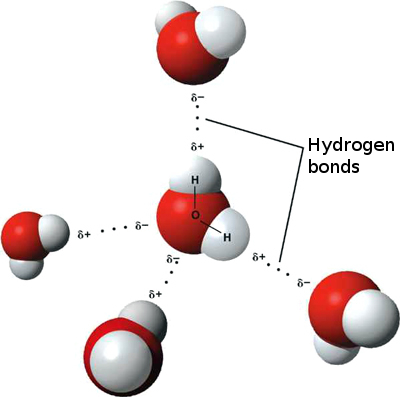
Water's key structural fact: each molecule can form four hydrogen bonds. Two hydrogens to donate, two lone pairs to accept. The four point roughly tetrahedrally, which follows directly from VSEPR (Chapter 10.2).
No other common molecule can do this. HF has one hydrogen and three lone pairs; ammonia has three hydrogens and one lone pair. Only water has the balance to build a three-dimensional network.
Every anomaly below comes from that one fact.
1. It is a liquid at all
Already covered. Without hydrogen bonding, water boils at -80 °C and Earth has no oceans.
2. Ice floats
Almost every substance is denser as a solid. Water is not: ice is 917 kg/m³ against liquid water's 1000, about 9 % less dense.
The mechanism. In liquid water the hydrogen bonds are constantly breaking and reforming — each lasts about a picosecond — so molecules pack fairly efficiently. When it freezes, every molecule locks into exactly four hydrogen bonds in a rigid tetrahedral lattice, and a tetrahedral arrangement is an inefficient way to fill space. The crystal has large hexagonal channels through it.
The consequence is that lakes freeze from the top down (Chapter 3.1), the ice insulates the water below, and aquatic life survives winter. If ice sank, lakes and eventually oceans would freeze solid from the bottom and would not fully thaw, and Earth would be a very different planet.
3. Maximum density at 4 °C
Chapter 3.1 described it; here is the cause. Just above freezing, clumps of open ice-like structure survive in the liquid. Warming from 0 to 4 °C breaks those clumps and lets the molecules pack closer, so the volume shrinks. Above 4 °C ordinary thermal expansion takes over.
This drives ocean circulation. Cold surface water sinks only to 4 °C, and the resulting density structure is part of what powers the deep ocean currents that move heat around the planet.
4. Enormous heat capacity
4186 J/kg/K, the highest of any common liquid.
Why. Heating water partly goes into breaking hydrogen bonds rather than into molecular motion. Energy absorbed without raising the temperature is exactly what high heat capacity means.
Consequences: oceans moderate climate, coastal regions have mild winters, and water is the working fluid in nearly every cooling system built (Chapter 3.1).
5. Enormous latent heat of vaporisation
2260 kJ/kg, again the highest of any common liquid, because every hydrogen bond must be broken to leave.
This is why sweating cools you so effectively and why steam burns are so much worse than boiling water burns (Chapter 3.1).
6. High surface tension
72 mN/m, higher than any common liquid except mercury.
Molecules at the surface have fewer neighbours to hydrogen bond with, so the surface costs energy, so the liquid minimises its area.
Consequences: insects walk on water, droplets are spherical, and capillary action carries water up narrow tubes against gravity.
And that is how trees work. Water evaporating from leaves pulls a continuous column up through xylem vessels a few tens of micrometres across. The column is under tension — negative pressure — of up to 2 MPa, and it holds together only because hydrogen bonds make water cohesive enough to be pulled rather than pushed. A 100 m redwood is lifting water 100 m by evaporation alone, which no pump does.
7. It dissolves almost everything ionic
Dielectric constant 80 (Chapter 4.3), the highest of any common liquid, which cuts the attraction between ions eightyfold.
And the polar molecules surround each ion — hydration — releasing energy that pays for breaking the lattice.
This is why water is the solvent of life. Every biological reaction happens in it, and its ability to dissolve ions while not dissolving fats is what allows cell membranes to exist.
8. High viscosity, high boiling point, unusual compressibility
All from the same network.
Water has at least 66 documented anomalies, and essentially all of them trace to one molecule being able to make four directional bonds.
Hydrogen bonding in biology
This is where the directionality pays off.

DNA's base pairing. Adenine pairs with thymine via two hydrogen bonds; guanine pairs with cytosine via three. The geometry only works for those pairings, which is what makes the genetic code specific.
The strength is exactly right, and this is not a coincidence. Each hydrogen bond is about 20 kJ/mol, so a base pair is 40 to 60. Too weak and the strands would separate spontaneously; too strong and no enzyme could open them. As it is, a helicase enzyme can unzip DNA using a few ATP molecules, while the double helix is stable for the lifetime of a cell.
And GC pairs, with three bonds, are stronger than AT pairs with two. DNA rich in G and C has a higher melting temperature, which is why organisms living in hot springs have GC-rich genomes and why the polymerase chain reaction's temperature cycles must be tuned to a sequence's GC content.
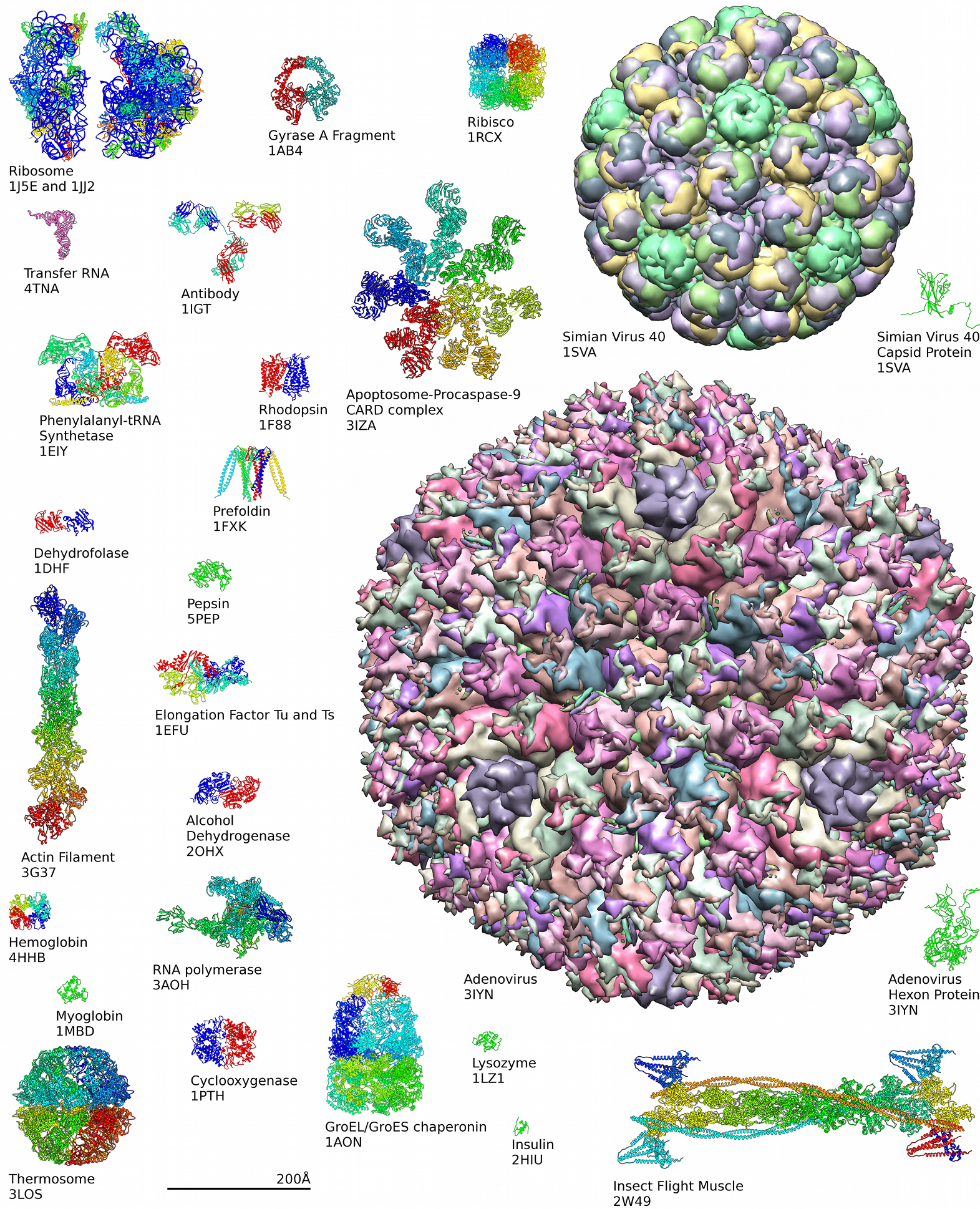
Protein folding. The alpha helix and the beta sheet — the two basic structural motifs in every protein — are held by hydrogen bonds between backbone C=O and N–H groups. Pauling predicted both in 1951 from bond geometry alone, before either had been observed.
And denaturation is breaking them. Heat an egg and the proteins unfold and tangle irreversibly; the covalent bonds are untouched and the structure is destroyed. Cooking is hydrogen bond disruption.
The hydrophobic effect is the other half of protein folding, and it is subtler than it sounds. Non-polar groups cluster together in water not because they attract each other but because water is better off without them. A non-polar molecule forces the surrounding water into an ordered cage, which costs entropy (Chapter 3.5). Clustering the non-polar groups reduces the total surface area of cage, freeing water molecules and increasing entropy. The hydrophobic effect is entropy-driven, which is why it strengthens with temperature up to a point.
This is what folds proteins, what assembles cell membranes, and what makes oil and water separate.
Solids
How atoms and molecules arrange when they stop moving.
Crystals
A repeating three-dimensional pattern. Fourteen distinct lattice types (the Bravais lattices) cover every possibility.
Common metal structures:
Face-centred cubic (FCC). Atoms at cube corners and face centres. Packing efficiency 74 %, the maximum possible for identical spheres, with 12 nearest neighbours. Copper, aluminium, gold, silver, nickel.
Hexagonal close packed (HCP). Also 74 %, also 12 neighbours, differing in stacking sequence (ABAB instead of ABCABC). Magnesium, zinc, titanium.
Body-centred cubic (BCC). Atoms at corners and cube centre. 68 % packing, 8 neighbours. Iron at room temperature, chromium, tungsten.
The packing difference has real consequences. FCC metals have more slip planes available, so they are more ductile — which is why aluminium and copper draw into wire easily and why iron is comparatively less workable. And iron changes from BCC to FCC at 912 °C, which is exactly what makes steel heat treatment possible: the FCC form dissolves far more carbon, and quenching traps it.
That 74 % maximum was conjectured by Kepler in 1611 and proved only in 1998, by Thomas Hales, with a computer-assisted proof that took years to verify.
Ionic crystals are determined by the radius ratio, since the ions are different sizes. NaCl has a 6:6 rock salt structure; CsCl, with a larger cation, has 8:8.
Covalent networks — diamond, quartz, silicon carbide — have no discrete molecules at all. The entire crystal is one molecule, which is why they are hard and have very high melting points.
Molecular crystals — ice, sugar, iodine — have strong covalent bonds inside each molecule and weak intermolecular forces between. So they are soft and melt easily, because melting only breaks the weak forces.
Defects
Perfect crystals essentially do not exist, and that is fortunate.
Point defects: vacancies, interstitials, substitutions. Semiconductor doping is a deliberate substitutional defect (Volume III, Chapter 2).
Dislocations are line defects, and they are why metals are far weaker than the strength of their bonds would suggest. A perfect metal crystal should require about 10 GPa to deform; a real one needs about 100 MPa — a hundred times less. Dislocations let atoms slip one row at a time, like moving a heavy carpet by pushing a ripple across it rather than dragging the whole thing.
And every method of hardening a metal works by blocking dislocations:
| Method | Mechanism |
|---|---|
| Alloying | Foreign atoms distort the lattice |
| Work hardening | Dislocations tangle with each other |
| Grain refinement | Grain boundaries stop dislocation motion |
| Precipitation hardening | Small particles obstruct slip |
Steel is iron with dislocations blocked by carbon (Chapter 9.6), and every heat treatment is a way of controlling where the carbon sits.
Glasses and liquid crystals
A glass has no long-range order — it is a liquid whose molecules were frozen in place before they could arrange. It has no sharp melting point, softening gradually over a range.
The persistent myth that medieval window glass is thicker at the bottom because it flowed is false. Glass at room temperature has a viscosity around 10^{18} Pa·s, and flow over 800 years would be around 10^{-20} m — unmeasurable. The thickness variation comes from the crown glass manufacturing process, and glaziers installed the thicker edge downwards.
Liquid crystals flow like liquids while retaining orientational order, and Chapter 5.5 covered how twisting that order produces every LCD screen.
Where this shows up in your life
Water everywhere. You are 60 % water, your climate is moderated by oceans, and every reaction in you happens in solution.
Cooking. Boiling, frying and baking are all about breaking or forming hydrogen bonds and hydrophobic associations. Emulsions like mayonnaise work because lecithin has a polar head and a non-polar tail.
Detergents and soap — same principle, polar head and non-polar tail, surrounding grease and carrying it into water.
Gecko-inspired adhesives are a real product area, using microstructured surfaces to exploit dispersion forces.
Non-stick pans work because fluorine holds its electrons so tightly that its polarisability is minimal, so dispersion forces to anything else are negligible.
Antifreeze works by disrupting the hydrogen bond network so it cannot form the ice lattice, lowering the freezing point.
Freeze-drying exploits water's phase diagram (Chapter 3.6).
And DNA sequencing, PCR and every molecular biology technique depend on hydrogen bonds being strong enough to hold and weak enough to break on demand.
What the next chapter fixes
Substances have been described as they sit. Chemistry is about change, and change raises two separate questions that are constantly confused: where does a reaction end up, and how fast does it get there. Chapter 10.4 answers the first — stoichiometry done properly, the mole, equilibrium and the constant that describes it, and Le Chatelier's principle applied to the industrial process that feeds half the world.